Cheapest Digital Nomad Visa Options in Europe


Europe offers several affordable digital nomad visas tailored for remote workers. These visas let you live in a new country while working for a foreign employer or running your own business. The key factors to consider when choosing a visa include income requirements, living costs, and tax rules. Here are some of the most budget-friendly options:
- Croatia: Requires $3,500/month income or $54,500 in savings. Application fees range from $110–$180. No local taxes on foreign income. Non-renewable, valid for 1 year.
- Hungary: Monthly income requirement of $3,400. Application fee is $127. Living costs in Budapest are low, around $690/month (excluding rent). Renewable for up to 2 years.
- Portugal: D8 Visa requires $3,700/month income and $11,100 in savings. Costs $82 for the visa and $99 for the residence permit. Renewable, with a path to permanent residency after 5 years.
- Greece: Requires $3,700/month income plus additional amounts for dependents. Offers a 50% tax reduction for 7 years if tax residency is established.
- Estonia: High income threshold of $4,750/month. Living costs range from $900–$1,060/month. Offers 0% tax for the first 183 days.
- Albania: Low income requirement of $865/month. Valid for 1 year, renewable up to 5 times, allowing a 6-year stay. Among the lowest living costs in Europe.
Quick Comparison
| Country | Income Requirement (Monthly) | Application Fee | Tax Benefits | Living Costs (Monthly) | Visa Duration |
|---|---|---|---|---|---|
| Croatia | $3,500 or $54,500 savings | $110–$180 | No taxes on foreign income | Moderate | 1 year, non-renewable |
| Hungary | $3,400 | $127 | No tax if staying <183 days | $690 (excluding rent) | 2 years (renewable) |
| Portugal | $3,700 + $11,100 savings | $82 + $99 | Tax benefits for new residents | Varies | 1–2 years, renewable |
| Greece | $3,700 (+$740/spouse, $555/child) | $82 + $1,090 | 50% tax reduction for 7 years | $860 (excluding rent) | Up to 2 years |
| Estonia | $4,750 | $109 | 0% tax for first 183 days | $900–$1,060 | 1 year, non-renewable |
| Albania | $865 | Low | No specific tax benefits | Very low | 6 years (renewable) |
These visas provide flexibility for remote workers, but it's important to weigh income thresholds, living costs, and tax rules to choose the best option for your needs.
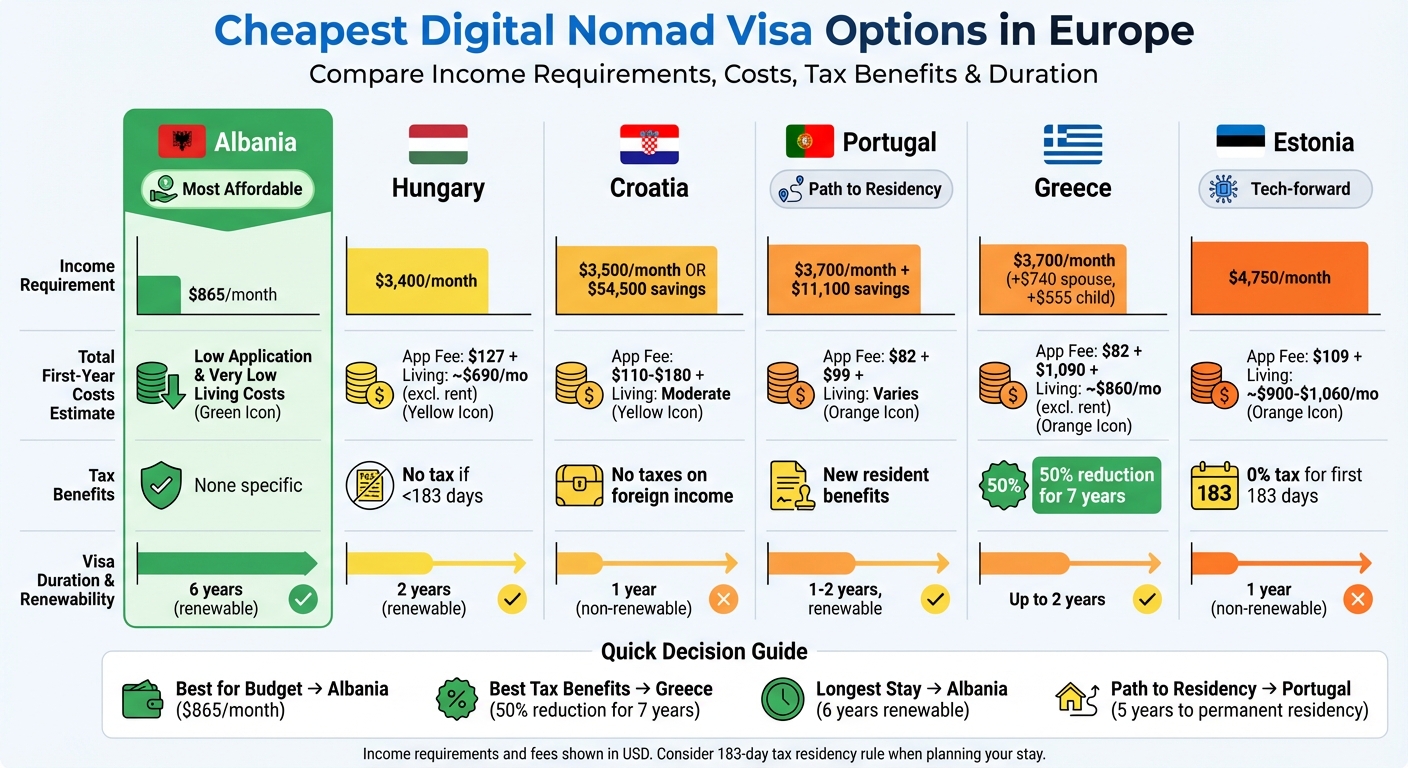
Europe Digital Nomad Visa Comparison: Income Requirements, Costs & Benefits
15 Countries with the Cheapest Digital Nomad Visas
Most Affordable Digital Nomad Visas in Europe
Here are three European visa options that balance low income requirements with affordable living expenses and tax-friendly policies.
Croatia: Digital Nomad Temporary Stay
Croatia’s digital nomad visa requires proof of either a monthly income of $3,500 (€3,295) or savings of $54,500 (€51,310). The application fee ranges from $110 to $180, depending on your payment method and country of origin. A major perk? You won’t owe Croatian taxes on your U.S. income, thanks to the full tax exemption on foreign earnings.
The application process is straightforward. U.S. citizens can apply online, at a Croatian consulate, or even at a local police station after entering Croatia on a tourist visa. Digital nomad Natalia Ivanikova shared her experience:
I applied online and received my visa without leaving Croatia.
While official processing takes about 3–4 weeks, in practice, it may extend to 3–4 months. The visa is valid for one year and is non-renewable, meaning you’ll need to leave Croatia for six months before reapplying.
Cities like Split and Zagreb offer a more affordable lifestyle compared to many Western European capitals. You can enjoy the stunning Adriatic coastline and historic charm while stretching your budget further.
Hungary: White Card
Hungary’s White Card program sets its income requirement at $3,400 (€3,000) per month. The application fee is approximately $127 (€110), and you’ll also need to budget around $200 (€180) annually for mandatory medical insurance. Tax-wise, if you stay under 183 days in a year, you won’t owe income tax on your foreign earnings. If you exceed that, a flat 15% personal income tax applies.
Living costs in Budapest are notably low - around 30% cheaper than Barcelona and 55% less than Vienna. A single person typically spends about $690 (€650) per month (excluding rent), while a one-bedroom apartment in the city center averages $640 (€600) monthly.
The White Card is limited to solo applicants, so spouses and dependents cannot join under this visa. However, it can be renewed once, allowing a total stay of up to two years.
Portugal: Digital Nomad Visa
Portugal’s D8 Visa requires a monthly income of $3,700 (€3,480), which is four times the national minimum wage for 2025. The visa itself costs roughly $82 (€75), plus an additional $99 (€90) for the residence permit. Applicants must also show savings equivalent to 12 months of the minimum wage, totaling $11,100 (€10,440).
This visa offers flexibility: you can apply for a one-year temporary visa or a two-year renewable residency permit. After five years of legal residence, you may qualify for permanent residency or citizenship - ideal for those considering a longer-term move.
While Lisbon and Porto are on the pricier side, smaller cities and coastal towns provide more budget-friendly options without sacrificing quality of life. Additionally, the D8 Visa grants access to Portugal’s tax schemes for new residents, which can offer financial benefits depending on your situation.
Other Budget-Friendly Visa Options
While the top three visa choices balance low income requirements with affordable living costs, there are other options worth considering. These alternatives provide unique advantages, such as tax breaks or simplified application processes, catering to different needs. Below are three additional visa options that expand your affordable choices.
Greece: Digital Nomad Visa
Greece's digital nomad visa is a compelling option for those earning a steady income. To qualify, you’ll need a monthly income of $3,700 (€3,500), with an additional $740 (€700) for a spouse and $555 (€525) per child. The application fee is $82 (€75), and the residence permit costs $1,090 (€1,000). Processing is quick - just 10 working days.
One standout perk is the 50% income tax reduction for seven years if you establish tax residency, making it an appealing choice for long-term stays. Monthly living costs average $860 (€810) without rent, though this can vary significantly. Smaller towns, islands, or areas away from tourist hotspots like Santorini often offer more economical living options. To apply, you’ll need proof of a Greek address, such as a rental agreement, and can submit your application either at a Greek consulate or directly at the Aliens and Immigration Department if you’re already in Greece.
Estonia: Digital Nomad Visa
Estonia is a tech-forward haven for remote workers who value efficiency. To qualify for its digital nomad visa, you’ll need a higher monthly income of $4,750 (€4,500). The country’s advanced digital infrastructure and government services streamline daily life, making it a favorite for tech-savvy professionals.
The visa costs $109 (€100) and is processed within 15 working days. Monthly living expenses range from $900 to $1,060 (€850–€1,000), and city-center apartments typically rent for $425–$850 (€400–€800). Nomads enjoy 0% income tax for the first 183 days, after which a flat 20% rate applies. While the visa is valid for one year and doesn’t lead to permanent residency, it does include Schengen access for up to 90 days within any 180-day period.
Albania: Low-Cost Visa Option
For those seeking an affordable entry point to Europe, Albania’s "Unique Permit" is a standout choice. It requires proof of an annual income of $10,400 (€9,800), which breaks down to about $865 (€816) per month. The permit is valid for one year and can be renewed up to five times, allowing a potential stay of six years.
Living costs in Albania are among the lowest in Europe, making it ideal for digital nomads looking to save. Applicants must provide an employment contract with a foreign company that supports remote work. While Albania doesn’t boast the digital infrastructure of Estonia or the tax benefits of Greece, its low income requirements and affordable living expenses make it an attractive option for budget-conscious travelers.
These visa options highlight the flexibility Europe offers to digital nomads, allowing individuals to prioritize what matters most - be it tax advantages, modern infrastructure, or a low cost of living.
sbb-itb-88a7fe6
How to Select the Right Visa
Choosing the right visa is about balancing factors like income, living costs, taxes, and employer requirements. These elements are crucial for ensuring a smooth and satisfying experience in your new location.
Income Requirements vs. Living Costs
When evaluating visa options, it's essential to compare income thresholds with the cost of living in your target country. For example, Finland's monthly income requirement is relatively low at $1,290 (€1,220), but its living expenses are notably high [5][6].
Another key consideration is whether the income requirement is based on gross or net earnings. Many countries set thresholds by multiplying the local minimum wage by two or three, ensuring digital nomads don’t depend on local resources. For instance, Greece and Cyprus require $3,700 (€3,500) net income per month [4][1][2]. If you're applying with family, expect higher thresholds. In Spain, you’ll need to add $1,095 (€1,035) for a spouse and $366 (€346) per child [1].
Some countries offer flexibility. Croatia, for example, allows applicants to show $54,250 (€51,310) in savings instead of regular monthly income [1]. Beyond income and living costs, it's important to account for tax obligations, which can significantly impact your budget.
Tax Residency and Length of Stay
Spending more than 183 days in a country often triggers tax residency, meaning you’ll owe taxes on your worldwide income at local rates [3][1][2]. These rates can vary widely depending on the country.
To attract digital nomads, some countries offer tax breaks. Spain, for instance, provides a reduced 15% tax rate for the first four years if your income is under $634,000 (€600,000) [3]. Malta offers a flat 10% rate and exempts nomads from taxes entirely during their first year [8]. Romania goes even further, exempting digital nomads from both income tax and social security contributions as long as they maintain tax residency elsewhere [2].
Visa duration and renewal policies are equally important. Croatia’s visa, for example, is non-renewable and requires a six-month exit period before reapplication [3][1]. Montenegro provides an initial visa for up to four years [6][2], while Albania allows up to five renewals, enabling a potential six-year stay [6]. Consulting an immigration expert about the 183-day rule can help you avoid unexpected tax liabilities [1].
Considerations for Employers and Teams
Visa requirements also affect employers, especially when managing remote teams. Companies must consider how visa rules align with employee compensation and living costs.
For example, a developer earning $4,000 per month meets the visa income requirements for Hungary, Portugal, and Greece. However, their purchasing power will vary greatly between cities like Budapest and Lisbon. Employers can use this information to ensure fair and competitive compensation while supporting employees' quality of life.
Remotely Talents assists businesses in navigating these complexities, helping them build remote teams across Europe, Latin America, and North America. By aligning visa requirements with living costs, companies can identify optimal locations for their workforce. This approach is particularly useful when hiring for roles in IT/Data/Engineering, Marketing & eCommerce, Finance, Operations, or Business Development & Sales [1][7].
Additionally, specific visa conditions may impose restrictions on employers. For instance, Latvia requires employers to be registered in an OECD country, Spain mandates at least one year of operational history, and the Czech Republic sets a 50-employee minimum for certain visa types [3][1]. Adhering to these rules not only prevents delays but also ensures smooth workforce management.
Conclusion
Europe offers a variety of digital nomad visa options, each with its own balance of income requirements and living costs. For example, Albania stands out as the most accessible, with a monthly income requirement of about $863 (€817). On the other hand, Finland’s threshold is slightly higher at $1,289 (€1,220), but it’s worth noting that living expenses in Finland are significantly steeper compared to countries like Albania or Montenegro [5][6].
When choosing a visa, it’s important to weigh income requirements against the cost of living. A lower income threshold might seem appealing but could come with higher day-to-day expenses. For instance, while Finland’s income requirement is moderate, its living costs are substantially higher than those in Albania. Also, keep in mind that most European countries apply tax residency rules after 183 days of stay [1][2][3].
For businesses hiring remote workers, aligning visa conditions with compensation strategies is equally critical. As mentioned earlier, income thresholds for these visas are typically set at two to three times the local minimum wage. This means employers must ensure remote salaries meet these criteria. Additionally, some visas come with specific employer requirements. For example, the Czech Republic only accepts applications from employees of companies with at least 50 workers [1][2].
To help businesses navigate these complexities, Remotely Talents provides guidance on building remote teams in Europe, Latin America, and North America. By aligning visa requirements with salary structures, companies can identify the best locations for hiring talent in fields like IT, Marketing, Finance, Operations, and Sales.
Whether you’re an individual digital nomad or a business hiring remotely, evaluating visa options based on income thresholds, living costs, tax considerations, and long-term goals is key to creating a sustainable and legally compliant remote work arrangement.
FAQs
What taxes should digital nomads consider when working in Europe?
Digital nomads planning to work in Europe need to keep a close eye on tax residency rules. Spending 183 days or more in a single country within a calendar year often classifies you as a tax resident there. This status could subject you to taxes on your worldwide income unless specific exemptions apply. Fortunately, many digital nomad visas in Europe are designed to ease these concerns by offering tax benefits. For example, Portugal’s Non-Habitual Resident (NHR) program allows for a flat 20% tax rate on local income while exempting most foreign income. Similarly, Croatia’s digital nomad visa provides a full exemption on foreign income during its 12-month validity.
If you’re a U.S. citizen, the situation is a bit more complex. The IRS requires you to report your worldwide income, no matter where you reside. However, you might be eligible for the Foreign Earned Income Exclusion or the Foreign Tax Credit, which can help prevent double taxation. Additionally, many European countries have tax treaties with the U.S., but staying compliant means filing the correct forms and keeping track of your time in each country. Consulting a cross-border tax expert is a smart move to ensure you’re adhering to both U.S. and local tax laws.
How do income requirements for digital nomad visas compare to living costs in Europe?
Income requirements for digital nomad visas in Europe usually fall between $2,800 and $3,300 per month. For instance, Hungary and Croatia set the bar lower, starting around $2,800/month, while countries like Portugal and Estonia expect higher incomes - Portugal at approximately $3,500/month and Estonia nearing $3,700/month.
These figures often reflect the cost of living in each country. Hungary and Croatia, with their more affordable daily expenses, are attractive options for those looking to stretch their budget. Meanwhile, destinations like Portugal and Spain have higher thresholds, driven by pricier housing and lifestyle expenses. Simply put, countries with lower income requirements tend to be easier on the wallet.
What is the best digital nomad visa for long-term stays in Europe?
The Malta Nomad Residence Permit, commonly referred to as the Malta Digital Nomad Visa, is a standout opportunity for remote workers aiming for long-term residency in Europe. This permit lets digital nomads live and work in Malta for up to four years, offering a stable base in an EU country while maintaining a remote lifestyle.
What makes Malta particularly appealing? Its mild weather, widespread use of English, and living costs that are generally more budget-friendly than many other European countries. These factors combine to make Malta an inviting destination for professionals planning an extended stay.
Related Blog Posts
Read also



Ready to hire without salary-based agency fees?
Book a free 30-minute consultation. We’ll review your role, timeline, and hiring goals, then show you how our fixed-fee remote search works.