Why Traditional Healthcare Hiring Is Failing Telemedicine Providers


Telemedicine is booming, with the global market expected to surpass $175.5 billion by 2026. But outdated hiring methods, designed for on-site roles, are holding providers back. Here's why:
- Slow Hiring: Filling roles like Registered Nurses takes an average of 66 days, while revenue-critical positions take over 131 days.
- Location Constraints: Local recruitment limits access to talent, even for roles that can be done remotely.
- Mismatch of Skills: Telemedicine demands tech-savvy professionals with digital communication skills and multi-state licenses - qualities traditional hiring overlooks.
- High Costs: Traditional hiring models, including agency fees, can cost $7,000–$10,000+ per month.
Modern solutions like remote-first recruitment are addressing these challenges. Platforms like RemotelyTalents reduce time-to-hire to 1–3 weeks, access global talent pools, and offer predictable costs at $1,450/month. Telemedicine providers must rethink hiring to meet growing demand and deliver care efficiently.
Should Healthcare Providers Build or Outsource Telemedicine Infrastructure? Exploring Pros & Cons
How Traditional Healthcare Hiring Works
The traditional healthcare hiring process was designed with hospitals and clinics in mind. It prioritizes candidates who can physically report to a specific location, work set shifts, and hold state-specific licenses. This system made sense when healthcare revolved around in-person visits and bedside care. But for telemedicine providers operating across states and time zones, these old practices create major obstacles. Let’s break down the key limitations of this outdated approach.
Location-Based Recruitment Limits
Traditional healthcare hiring often starts with one question: "Can you work at our facility?" Recruiters tend to focus on candidates within a specific geographic area, narrowing their search to those who already live nearby or are willing to move. State licensing requirements make things even trickier. Telehealth professionals often need licenses in multiple states to treat patients across different jurisdictions, but traditional recruiters struggle to navigate this complexity. As a result, they stick to the same local talent pools, where 53% of medical group leaders say "finding candidates" is their biggest staffing challenge in 2024 [9].
This location-first approach eats up time too. Traditional sourcing methods account for about 70% of the hiring timeline [2]. For telemedicine startups trying to grow fast, this model is a poor fit.
Slow Hiring Timelines and High Costs
In telemedicine, speed is everything. But traditional healthcare hiring moves at a snail’s pace. Filling a Registered Nurse position takes an average of 66 days, while revenue-generating roles can drag on for 131+ days [2].
"Hiring in healthcare hasn't just become harder - it's slower, costlier, and more complex." - symplr [2]
Outdated processes are a big reason for these delays. Many organizations rely on untrained interviewers, deal with frequent interview cancellations, and use clunky applicant tracking systems that aren’t built for remote hiring [6]. On top of that, internal recruitment teams and agency fees can drive up costs. It's no wonder 57% of healthcare hiring leaders say their time-to-hire has increased recently [6].
For telemedicine providers, these slow timelines are more than just a headache - they’re a competitive disadvantage. When patient demand spikes, waiting months to fill key roles can leave providers scrambling to meet needs.
Focus on In-Person Roles
Traditional recruiters are trained to evaluate candidates for in-person tasks like physical exams, bedside care, and facility-based workflows. They prioritize skills that are essential in hospitals but don’t translate to virtual care settings [3].
Telemedicine, on the other hand, requires a completely different skill set. Professionals need to excel in digital communication, be comfortable with remote monitoring technology, and develop what’s often called "web-side manner" - the ability to build trust with patients through a screen [3]. Traditional hiring models aren’t equipped to assess these capabilities.
In some cases, practices even pull remote-capable staff back into on-site roles like registration when patient demand shifts [8]. This in-person focus highlights just how out of sync traditional hiring is with the needs of telemedicine providers.
Why Traditional Healthcare Hiring Fails Telemedicine Providers in 2026
Telemedicine is reshaping healthcare by breaking down geographical barriers, but outdated hiring practices are struggling to keep up. While the global telehealth market is expected to surpass $175.5 billion by 2026, nearly four times its 2019 value [3], traditional hiring models remain tied to local markets, leaving telemedicine providers at a disadvantage.
Remote Care Meets Outdated Hiring Practices
Telemedicine thrives on its ability to deliver care from anywhere, yet many recruiters still limit their searches to specific geographic areas. By relying on local professional networks and medical schools, they shrink the talent pool for roles that could easily be performed remotely.
Multi-state licensing adds another layer of difficulty. Telehealth professionals often need credentials in multiple states to provide care across jurisdictions, but traditional hiring methods are ill-equipped to navigate this complexity [1][10]. A standout example of breaking free from these constraints is Wellstar Health System. Under the leadership of Danyale Ziglor, VP of HR, Wellstar expanded its remote workforce from 300 to 1,500 employees in just one year by recruiting talent nationwide instead of focusing solely on local markets [4].
"The ability to work remotely has vastly expanded that talent pool as you can now hire team members from anywhere across the US." - Danyale Ziglor, VP of HR for Shared Services, Wellstar Health System [4]
The U.S. Healthcare Talent Crisis
The challenges don’t stop at geography. A global shortage of healthcare workers is looming, with estimates suggesting a shortfall of at least 10 million workers by 2030 - and some projections go as high as 78 million [11]. In the U.S., the competition for healthcare talent is fierce. In 2024, 51% of talent leaders identified rising demand and a more competitive hiring landscape as their biggest challenges [6]. It now takes over 131 days to fill revenue-generating roles [2], and 42% of healthcare candidates report waiting more than three weeks to hear back from recruiters [2].
This shortage isn’t just about numbers - it’s about losing talent to other industries. Entry-level healthcare roles are increasingly being filled by workers in retail and service sectors, which often offer better pay and less stress. To stay competitive, 35% of medical groups are allocating more funds for cost-of-living and merit increases [9]. Traditional recruiters, stuck in local markets, are struggling to keep up with this demand.
The Financial and Structural Limitations of Traditional Hiring
Traditional hiring practices come with hefty costs. Recruiter salaries, benefits, and agency fees - ranging from 15-25% of a candidate's annual salary - quickly add up. When roles take months to fill, and turnover remains high, these expenses become unsustainable.
Beyond cost, the rigidity of traditional hiring models is a poor fit for telemedicine. These models are designed for full-time, permanent roles, but telemedicine providers often need flexible solutions. Whether it’s part-time care coordinators for peak hours, contract-based support during seasonal surges, or rapid scaling to meet patient demand, traditional hiring simply doesn’t offer the adaptability telemedicine requires.
Overlooking Global and Bilingual Talent
The U.S. is home to 68 million residents who speak a language other than English, including 53 million Spanish speakers [14][12]. By 2050, this group is projected to become the largest Spanish-speaking population in the world. Yet traditional hiring models rarely tap into bilingual or global talent pools, leaving a significant gap in care accessibility.
Take Galileo, a telehealth service operating across all 50 states, as an example. By ensuring 44% of its clinicians were bilingual in English and Spanish, Galileo eliminated the need for translation services. This allowed the company to manage 90% of medical conditions virtually, helping 80% of patients avoid costly ER visits and leading to 85% of patients reporting improved health outcomes [12].
"Galileo's Spanish-language offering stems from our commitment to provide equitable healthcare to all. By removing language and access barriers... we can close that gap and build toward a more equitable, reliable and affordable healthcare system." - Dr. Jason Chirichigno, Clinical Systems Leader, Galileo [12]
Traditional hiring also ignores the potential of global talent for 24/7 care. For example, bilingual teams in Latin America or Europe could provide round-the-clock support at a fraction of the cost of domestic night-shift staff [13][15]. But location-based recruitment models fail to consider these options, leaving telemedicine providers struggling to scale effectively.
What Telemedicine Companies Need from Hiring
Telemedicine companies face unique hiring challenges that demand a shift from traditional methods. They require hiring processes that are fast, adaptable, and capable of meeting the demands of virtual healthcare. The focus is on finding talent that thrives in remote settings while addressing the operational realities of telemedicine.
Remote-Ready Healthcare Professionals
Virtual care isn't just about clinical expertise - it calls for professionals who excel in digital environments. Telemedicine providers need individuals who can handle electronic health records (EHR) systems, remote monitoring tools, and telehealth platforms with ease. These roles also demand strong communication skills to build patient trust through a screen, the ability to manage workflows independently, and adherence to HIPAA regulations in a home office setting.
For example, a virtual medical assistant who struggles with troubleshooting video calls or a care coordinator unfamiliar with digital tools can create delays that impact patient care.
"Virtual care requires more than clinical acumen. Telemedicine providers need to be tech-savvy and comfortable navigating digital platforms, skilled communicators who can build rapport without physical presence, and highly organized to manage asynchronous or remote workflows." - Artemis Team [16]
Additionally, professionals must often hold multistate licensure and telehealth certifications to practice across different regions [10].
Affordable and Flexible Hiring Options
Telemedicine's fluctuating workloads make flexibility a must. Patient demand can spike during flu season, drop in the summer, and shift across time zones. To keep up, providers need hiring options that allow them to scale their workforce without the financial strain of traditional hiring models.
This might mean hiring part-time care coordinators to cover peak hours, contract-based specialists during seasonal surges, or full-time virtual assistants for long-term needs - all without incurring steep agency fees, which typically range from 15-25% of an annual salary. The rigid, full-time employment model simply doesn't align with the realities of telemedicine.
Quick Hiring Timelines
Speed is critical in telemedicine hiring. In 2024, 57% of healthcare hiring leaders reported longer hiring timelines [6], and organizations met only 56% of their hiring goals [6]. These delays can strain existing staff and compromise patient care. In contrast, telemedicine companies often need to onboard new hires within 1-3 weeks to keep up with service demands.
Achieving this speed requires recruiters who understand the nuances of remote healthcare roles, have access to pre-vetted candidate pools, and can expedite screening and credentialing. Traditional hiring models, with their slow, localized processes, simply can't keep pace.
Bilingual and Global Talent
Telemedicine companies also need talent that reflects the diversity of their patient base. With 53 million Spanish speakers in the U.S. [14][12], bilingual professionals fluent in English and Spanish are essential for delivering seamless care. Relying on translation services can slow down care delivery, making bilingual staff a competitive advantage.
Time-zone alignment is another key factor. Recruiting bilingual coordinators from Latin America or remote specialists from Europe ensures 24/7 coverage. These regions offer a wealth of tech-savvy, English-proficient professionals who can integrate effortlessly into U.S.-based telemedicine teams. Traditional hiring, which often focuses on local markets, misses out on this global talent pool.
Meeting these hiring needs requires a recruitment approach tailored to the unique demands of telemedicine.
sbb-itb-88a7fe6
Why RemotelyTalents Works for Telemedicine Hiring
Remote-First Recruitment Approach
RemotelyTalents is designed specifically for companies operating in virtual environments. The platform excels at finding remote-ready healthcare professionals who are well-versed in telemedicine, whether they’re virtual medical assistants, care coordinators, or patient support specialists.
Unlike traditional recruiters who often treat remote roles as secondary, RemotelyTalents prioritizes candidates who are already comfortable working in digital spaces. This means healthcare providers spend less time training new hires on basic remote work practices and avoid the headaches of onboarding individuals unfamiliar with virtual collaboration tools. This targeted approach directly addresses the pressing need for adaptable, remote-capable talent.
By focusing on a remote-first model, RemotelyTalents breaks past traditional recruitment limits, accessing wider talent pools without geographical constraints.
Global Talent Access
RemotelyTalents sources professionals from LATAM, Europe, the U.S., and Canada, offering a diverse selection of bilingual candidates. With 22% of U.S. residents speaking a language other than English at home [7][17], hiring Spanish-speaking care coordinators from Latin America isn’t just cost-effective - it’s essential for delivering care that resonates with patients’ cultural and linguistic needs.
This global reach enables telemedicine providers to maintain seamless operations across time zones. For example, patient support specialists in Europe can handle morning shifts, while virtual assistants in the Philippines can provide around-the-clock triage support. This flexibility ensures uninterrupted service and reduces the strain on local staff, making it easier to meet unique language and scheduling demands.
Clear and Affordable Pricing
RemotelyTalents keeps things simple with a $1,450 per month subscription model - no placement fees, hidden charges, or long-term commitments. You’re only billed while a recruiter is actively working on your open role, and you can cancel anytime. For telemedicine companies managing fluctuating patient volumes, this predictable pricing model is a game-changer. Compare this to traditional recruitment agencies, which often charge 15–25% of a candidate’s annual salary, or the $7,000–$10,000+ monthly cost of in-house recruiters, and it’s clear how much more manageable this approach can be.
Faster Hiring Process
Speed matters in telemedicine, and RemotelyTalents delivers. The platform cuts the average time-to-hire to just 1–3 weeks, thanks to a combination of pre-vetted candidate pools, senior recruiters specializing in remote healthcare roles, and streamlined screening processes tailored for virtual care. This is a stark contrast to the typical 66 days it takes to fill traditional RN roles or the 131+ days for revenue-generating positions [2].
For telemedicine providers dealing with sudden spikes in patient demand or seasonal surges, this accelerated hiring process can make all the difference. It ensures high-quality service is maintained without overloading existing staff.
Common Remote Healthcare Roles for Telemedicine
Telemedicine companies rely on a diverse team of professionals, ranging from clinical experts to administrative and technical staff, all tailored for remote work. These roles are designed to address operational needs while meeting the fast-paced demands of modern telemedicine.
Clinical positions such as mental health therapists, nurse practitioners, and physician assistants are at the forefront of this shift. Mental health therapists alone make up 39% of all physicians offering remote care, followed by health coaches at 18% and nurse practitioners or physician assistants at 11% [3]. With nurse practitioner roles expected to grow by 40% between 2023 and 2033 [9], these positions are crucial for scaling telemedicine services effectively.
Administrative and support roles are equally vital, managing critical back-office functions. Virtual medical assistants, medical coders, billing specialists, and patient schedulers streamline operations that keep telemedicine platforms running smoothly. For example, medical assistant roles are anticipated to grow by 15% by 2033, making them an ideal fit for remote work environments [9].
Operations and technical roles round out the workforce needs. IT telehealth coordinators oversee remote monitoring devices and ensure platform security, while healthcare recruiters and data entry specialists maintain efficient workflows across distributed teams. These roles are highly process-oriented and can be centralized to support multiple locations simultaneously [5].
The table below highlights key remote healthcare roles by region, along with the benefits of remote work for each position.
Remote Healthcare Roles by Region
| Role | Region | Why Remote Works |
|---|---|---|
| Virtual Medical Assistant | LATAM | Cost-effective, proficient in English, handles scheduling and administrative tasks [3][9] |
| Mental Health Therapist | U.S. / Canada | High demand (39% of remote care), enables confidential home-based sessions [3] |
| Medical Coder / Billing Specialist | Global | Process-focused, easily monitored with productivity tools, 31% remote availability [5] |
| Care Coordinator / Patient Scheduler | U.S. / LATAM | Centralizes operations across clinics, supports tech-enabled workflows [4][5] |
| Nurse Practitioner (NP) | U.S. / Canada | Addresses physician shortages, with 40% projected demand growth [9] |
| IT Telehealth Coordinator | Europe / Global | Maintains remote monitoring devices and ensures platform security [4] |
| Patient Support Specialist | LATAM | Bilingual (English/Spanish), time-zone aligned, meets diverse patient needs [18] |
| Healthcare Operations Associate | Europe | Manages cross-functional remote teams, tech-savvy and process-driven [5] |
Hiring Model Cost and Speed Comparison (2026)
Telemedicine Hiring Models: Cost, Speed, and Flexibility Comparison 2026
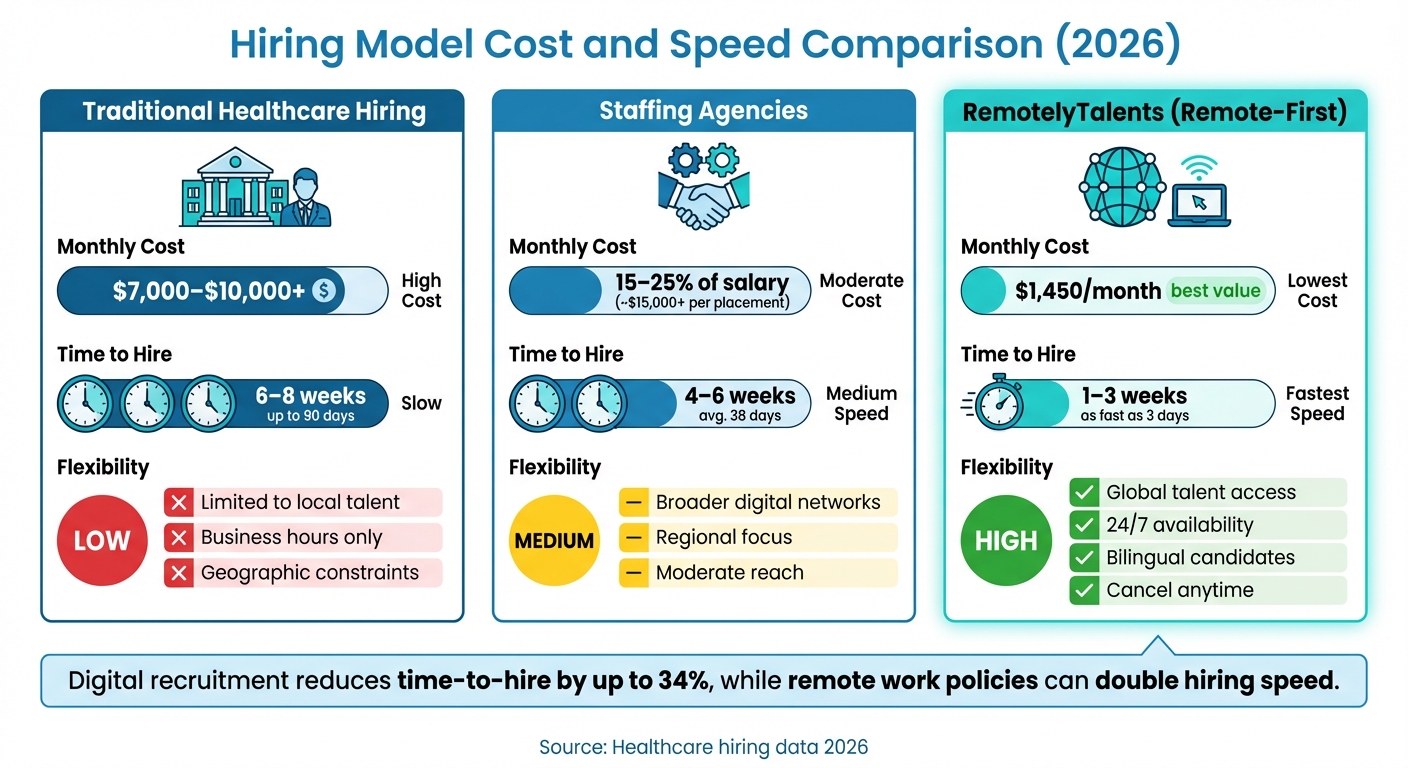
When you compare hiring models, the financial and operational gaps become pretty clear. Traditional healthcare hiring can cost anywhere from $7,000 to $10,000+ per role each month. This includes recruiter salaries, benefits, and overhead. On the other hand, staffing agencies charge contingency fees of 15–25% of the candidate's first-year salary, which often means paying $15,000 or more for a single placement[19]. In contrast, RemotelyTalents offers a flat-rate subscription of $1,450 per month, giving telemedicine providers a predictable and cost-effective solution.
But hiring isn't just about cost - speed matters just as much. Traditional healthcare hiring is notoriously slow, taking 6–8 weeks on average. For specialized roles, this timeline can stretch to 60–90 days[19]. The delays are often due to manual processes, repeated in-person interviews, and geographical constraints. Staffing agencies typically take 4–6 weeks, averaging about 38 days[20]. RemotelyTalents, however, has streamlined the process, completing most placements in just 1–3 weeks, with some roles filled in as little as 3 days. This speed is possible thanks to a pre-vetted global talent pool and AI-powered matching systems[22].
Flexibility is another critical factor, especially for telemedicine providers with global needs. Traditional hiring limits companies to local talent pools and business-hour communication, which doesn’t align well with the demands of telemedicine. Staffing agencies offer moderate flexibility by using broader digital networks, but they often remain regionally focused. RemotelyTalents, on the other hand, excels in flexibility by providing global access, 24/7 availability, bilingual candidates, and a cancel-anytime subscription model[22].
"Companies often rely too heavily on outdated or ineffective recruiting methods. Simply posting a job ad and hoping for the best is not a strategy." - Sai Blackbyrn, CEO, Coach Foundation[21]
Hiring Model Comparison
| Hiring Model | Monthly Cost | Time to Hire | Flexibility |
|---|---|---|---|
| Traditional Healthcare Hiring | $7,000–$10,000+ | 6–8 weeks (up to 90 days) | Low – Limited to local talent and business hours |
| Staffing Agencies | 15–25% of salary | 4–6 weeks (avg. 38 days) | Medium – Broader digital networks, but regional |
| RemotelyTalents | $1,450/month | 1–3 weeks (sometimes as fast as 3 days) | High – Global talent access, 24/7 availability, bilingual options |
Digital recruitment has been shown to reduce time-to-hire by up to 34%, while remote work policies can double hiring speed - a game-changer for telemedicine providers looking to scale quickly or fill urgent roles[20][19]. These differences aren’t just operational; they’re strategic. Faster, more flexible hiring directly impacts patient care capacity, making a remote-first, subscription-based model like RemotelyTalents a smart choice for the fast-evolving telemedicine industry.
Conclusion
The traditional hiring methods simply can't keep up with the demands of telemedicine in 2026. To thrive, telemedicine providers need more than just speed - they need flexibility and the ability to tap into a global talent pool, free from the constraints of geography.
With the telehealth market expected to surpass $175.5 billion by 2026, sticking to outdated recruitment practices could be a costly mistake. Consider this: filling nursing roles takes an average of 66 days, and traditional hiring can cost anywhere from $7,000 to $10,000+ per month. For virtual care organizations, these delays and expenses create roadblocks they can't afford to face[3][2].
This is where modern solutions come into play. For example, RemotelyTalents offers a streamlined, cost-efficient alternative: a $1,450/month subscription that includes access to pre-vetted talent from LATAM, Europe, the U.S., and Canada, with hiring timelines as short as 1–3 weeks. No long-term contracts. No uncertainty. Just a faster, more predictable way to build teams.
"The ability to work remotely has vastly expanded that talent pool as you can now hire team members from anywhere across the US." - Danyale Ziglor, VP of HR, Wellstar Health System[4]
To scale effectively and meet the demands of modern virtual care, telemedicine leaders must embrace remote-first recruitment. The future of healthcare is virtual, and its recruitment strategies need to be just as forward-thinking.
FAQs
Why doesn’t traditional healthcare hiring work for telemedicine roles?
Traditional hiring practices in healthcare fall short when applied to telemedicine. These models are built around local, in-person recruitment, which clashes with the remote and global setup of virtual care. The process tends to be slow, costly, and bogged down by state licensing requirements, making it tough to scale telemedicine teams quickly enough to meet patient needs.
What telemedicine providers require are hiring solutions designed with remote work in mind - methods that can efficiently source skilled talent from around the globe. The old ways just don't match the pace and flexibility that modern virtual care demands.
What are the benefits of using a remote-first recruitment model for telemedicine providers?
A remote-first recruitment model allows telemedicine providers to break free from the constraints of traditional hiring by tapping into a much broader talent pool - one that extends beyond local or state lines. Since telehealth services operate entirely online, the focus shifts to candidates with strong remote-working skills rather than those living nearby. This shift dramatically cuts down the hiring timeline, reducing it from the typical 6–8 weeks to just 1–3 weeks.
This strategy also tackles common challenges like talent shortages and high recruitment costs. By sourcing talent globally, providers can find bilingual professionals and more cost-efficient roles, such as virtual medical assistants and patient support specialists, in regions like LATAM and Eastern Europe. This global reach not only makes hiring more affordable but also ensures that a diverse range of patient needs can be addressed effectively.
On top of that, subscription-based recruitment models bring predictability and scalability to the hiring process. For instance, instead of dealing with hefty placement fees or rigid long-term contracts, providers can opt for a flat monthly fee (e.g., $1,450 per recruiter). This offers a quicker, more flexible, and budget-conscious way to meet the ever-growing staffing demands of the telehealth industry heading into 2026.
How do the costs of traditional hiring compare to modern recruitment solutions for telemedicine?
Traditional hiring practices in healthcare often come with a hefty price tag and a drawn-out process. Between agency fees, in-house recruiter salaries, and hiring timelines that can stretch beyond six weeks, the expenses pile up fast. On top of that, these older methods struggle to keep up with the rapid pace of telemedicine, causing costly delays and higher turnover rates.
Enter modern, remote-first recruitment models. These approaches simplify the process with a flat monthly subscription - say, $1,450 per recruiter - and slash hiring times to just 1–3 weeks. By cutting out steep placement fees and offering flexibility, these models help telemedicine providers grow quickly while keeping hiring costs predictable and under control.
Related Blog Posts
Read also



Ready to hire without salary-based agency fees?
Book a free 30-minute consultation. We’ll review your role, timeline, and hiring goals, then show you how our fixed-fee remote search works.