Remote Healthcare Staffing: How Telemedicine Companies Hire Globally


The U.S. healthcare industry is facing a staffing crisis. By 2036, the country could lack 86,000 physicians, and by 2030, 1 million nurses may be missing from the workforce. With rising labor costs and high turnover rates, telemedicine companies are turning to global hiring to address these challenges. Offshore staffing offers cost savings of 20%-70%, access to specialized skills, and the ability to provide 24/7 care. However, this approach requires navigating licensing, compliance, payroll, and cultural differences.
Key Takeaways:
- Global Hiring Trends: In 2024, 82% of new hires through Deel were for remote roles, with cross-border hiring in Latin America and Asia Pacific growing over 200%.
- Compliance Challenges: Credential verification, HIPAA/GDPR compliance, and ethical recruitment are critical for global teams.
- Top Talent Regions: Latin America and Europe offer skilled professionals with time zone compatibility and strong English proficiency.
- Hiring Platforms: Tools like Remotely Talents streamline recruitment, compliance, and payroll for international teams.
By addressing these factors, telemedicine companies can build effective global teams to tackle the healthcare workforce shortage.
Licensure and Compliance Requirements for Global Hiring
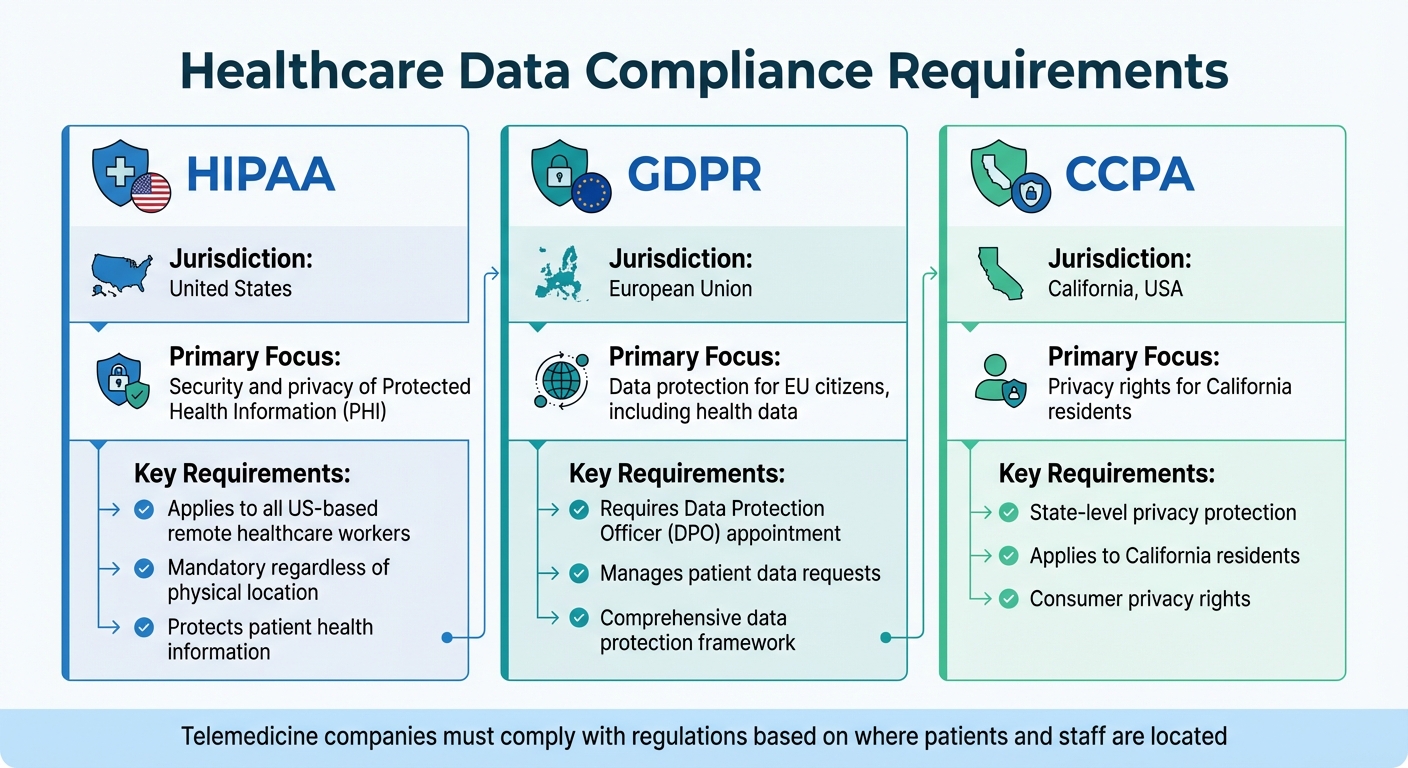
Healthcare Data Compliance Requirements: HIPAA vs GDPR vs CCPA
For telemedicine companies venturing into global markets, staying on top of licensure and compliance is essential to ensure both patient safety and the organization's credibility. When hiring internationally, verifying credentials becomes a top priority - especially when considering the financial risks of mishandled data, with breaches averaging $15 million in losses [11]. Additionally, outdated credentials can lead to sudden staffing disruptions [7]. Before offering a role to an international candidate, it's crucial to have systems in place for verifying credentials and meeting compliance standards across various regions. Below, we'll break down the steps to manage credential verification and regulatory compliance effectively.
Verifying International Medical Licenses
Credential verification should begin during the application stage to avoid delays later and focus efforts on qualified applicants [7]. For physicians, the Electronic Portfolio of International Credentials (EPIC) is a valuable tool. It provides primary-source verification by directly connecting with medical schools and regulatory bodies worldwide, ensuring the authenticity of degrees, training certificates, and exam results - all at no cost to the hiring organization [9].
In the U.S., medical licensure is regulated at the state level, with each state board establishing its own criteria for education, training, and examinations [6]. Licensure compacts can simplify this process by allowing healthcare providers to practice across multiple states under a single agreement [8]. Modern HR systems can further streamline the process by automating license checks and sending alerts when credentials near expiration [7]. Digitizing employee records during onboarding not only reduces manual errors but also enables automated renewal tracking and secure communication for credential updates, safeguarding sensitive data [7].
Meeting Healthcare Regulatory Standards
Verifying licenses is just one piece of the compliance puzzle. Telemedicine companies must also navigate stringent data and recruitment regulations. For example, U.S.-based remote healthcare workers handling patient data must comply with HIPAA requirements, regardless of their physical location. Meanwhile, in the European Union, organizations are required to appoint a Data Protection Officer (DPO) to ensure GDPR compliance and manage patient data requests [12]. Clear data contracts that outline responsibilities, expectations, and quality standards can further strengthen compliance efforts [12].
"The licensure process is intended to protect the general public and to ensure patient safety. Health professionals must meet the licensure requirements of the state where they are located and be licensed or legally permitted to practice in the state where the patient is located." - Telehealth.HHS.gov [13]
Before recruiting in any specific region, it's essential to consult the WHO Health Workforce Support and Safeguards List [3]. This "red list" identifies countries with critical healthcare worker shortages and prohibits recruitment from these areas unless an agreement exists between governments [3]. For companies operating across borders without local entities, Employer of Record (EOR) services can help navigate labor laws, manage international payroll, and protect intellectual property. For instance, Remote offers an EOR service priced at $599 per employee per month when billed annually [10].
| Regulation | Jurisdiction | Primary Focus |
|---|---|---|
| HIPAA | United States | Security and privacy of Protected Health Information (PHI) [12] |
| GDPR | European Union | Data protection for EU citizens, including health data [12] |
| CCPA | California, USA | Privacy rights for California residents [12] |
Finding Talent in Key Global Regions
After setting up your compliance framework, the next step is pinpointing where to find skilled healthcare professionals who can seamlessly integrate into your telemedicine operations. Europe and Latin America stand out as top regions for remote healthcare staffing. These areas not only offer a wealth of English-speaking professionals but also align well with U.S. time zones, making collaboration significantly easier. Let’s dive into how to effectively source candidates from these regions.
Hiring from Europe and Latin America
Latin America is particularly appealing for U.S.-based telemedicine companies due to its close time zone alignment. This makes real-time patient consultations and team communication much smoother compared to hiring from regions with larger time differences. The region boasts a strong pool of healthcare professionals with solid technical expertise. On the other hand, Europe offers access to highly educated healthcare workers with excellent English proficiency, making it another great option.
To tap into these talent pools, focus on region-specific job platforms. For Latin America, platforms like Near are ideal for finding talent in Argentina, while Workana is tailored for professionals in Brazil. For a broader international search, niche job boards like FlexJobs, We Work Remotely, and RemoteOk can help you connect with qualified candidates [1][14]. Make sure to clearly outline time zone expectations and remote work policies in your job postings to attract candidates who are a good fit.
When it comes to compensation, benchmarking salaries against local cost-of-living standards is crucial. For example, many Latin American countries require benefits like a 13th-month salary, while European nations often mandate extensive paid leave and comprehensive health insurance [1]. Salary insight tools covering over 120 countries can be invaluable for crafting competitive offers that attract top talent without exceeding your budget.
Using Recruitment-as-a-Service Platforms
If you’re looking to simplify the hiring process, consider using Recruitment-as-a-Service (RaaS) platforms. These platforms manage everything from sourcing candidates to ensuring compliance. One example is Remotely Talents, which specializes in connecting telemedicine companies with pre-screened professionals from Europe and Latin America. Their team of senior-level talent acquisition managers oversees a thorough screening process, evaluating technical skills, English proficiency (usually at a C1+ level), and alignment with company culture.
Remotely Talents also offers advanced tools to filter candidates by time zone and language, ensuring they match your operational needs. Additionally, their compliance support helps you navigate complex international labor laws and payroll requirements [14][15]. For companies without a local legal presence in target countries, they provide Employer of Record (EOR) services, allowing you to hire full-time employees without having to establish a local entity [1][15].
The platform offers flexible pricing options to fit different hiring needs. Their On-Demand Plan costs $1,450 per month per open role and doesn’t require a long-term commitment, while the Partner Plan, at $1,000 per month, is designed for businesses making multiple hires annually. Both plans include a 90-day replacement guarantee and promise to deliver 3–4 qualified candidates within two weeks, significantly cutting down the time it takes to fill positions compared to traditional recruitment methods.
Screening Candidates for Remote Healthcare Positions
In remote healthcare staffing, a thorough screening process is essential. Candidates need to demonstrate not only their clinical expertise but also their technical skills and communication abilities to succeed in a virtual healthcare environment.
Testing Clinical Skills and Technical Knowledge
When screening candidates, remote clinical proficiency should take center stage. This means assessing their ability to handle tasks like remote triage, virtual assessments, and creating treatment plans without in-person interaction. Research highlights that physicians using video conferencing for teleconsultations achieved a 96% confidence level in clinical decisions, compared to 90% for phone-only consultations [16][17][18].
Technical know-how is just as important. Candidates should be adept at using HIPAA-compliant platforms, ensuring data security through encryption and authentication, and troubleshooting tools like remote patient monitoring (RPM) devices [16]. Knowledge checks during the screening phase can confirm their understanding of telehealth policies, equipment testing (e.g., antivirus software, firewalls), and bandwidth requirements [16][17]. With healthcare recruiters reportedly spending up to 23 hours manually screening resumes for a single position [19], integrating AI-powered tools can save significant time and effort.
Additionally, assess documentation skills by testing how candidates handle digital patient consent and maintain accurate electronic health records (EHRs) [16][17]. Certifications in telehealth, such as telebehavioral health programs, can further demonstrate specialized training [17]. For roles requiring practice across multiple states, prioritize candidates involved in licensure compacts to simplify compliance with regulatory requirements [8].
| Category | Specific Skills & Knowledge to Evaluate |
|---|---|
| Clinical Skills | Virtual triage, remote assessments, digital prescriptions, follow-up care [16] |
| Technical Skills | HIPAA-compliant platforms, RPM device management, encryption protocols [16][17] |
| Administrative | Digital patient consent, EHR documentation, quality assurance reporting [16][17] |
| Compliance | State-specific telehealth registrations, reciprocity laws, data breach protocols [8][17] |
Once technical and clinical skills are confirmed, the next step is to evaluate how these proficiencies translate into effective communication and teamwork.
Assessing Communication Skills and Team Compatibility
Strong communication is critical for remote healthcare providers, as the success of virtual care hinges on the clear exchange of clinical information, patient preferences, and values [18]. Structured interviews are a great way to evaluate how candidates relay essential details [18].
"Effective communication involves exchanging clinical details alongside patient preferences." – NCBI Systematic Review [18]
Pre-arrival calls can provide insight into a candidate’s verbal communication style and readiness to work in a diverse healthcare environment [2]. These calls also test their ability to adhere to virtual clinical guidelines, such as verifying patient identification and ensuring all participants are present at the start of a session [16]. Since communication demands vary by specialty - real-time interaction is crucial in fields like cardiology and stroke care, while dermatology may rely more on asynchronous methods - tailor your evaluations to the specific role [18].
Assessing cultural alignment and adaptability is equally important. With hospital turnover rates averaging 22.7% [19], identifying candidates who align with your organization’s values and can thrive under varying leadership styles is crucial for long-term success. Standardized interview questions can help maintain consistency across evaluations [2], ensuring candidates are well-suited for teamwork in a global, remote healthcare setting.
sbb-itb-88a7fe6
Setting Up Onboarding and Payroll for International Teams
Once you've selected remote healthcare professionals, the next step is ensuring smooth onboarding and payroll processes. These elements are essential for building a successful global healthcare team. This phase involves creating contracts that comply with local labor laws and setting up payroll systems that work across borders.
Drafting Contracts That Align With Local Labor Laws
Employment contracts must adhere to the labor laws of the country where your healthcare worker resides [24]. For instance, if a telemedicine company based in California hires a nurse in Brazil, the contract must meet Brazilian regulations, including mandatory benefits like the 13th-month salary [1].
Key details to include in employment contracts:
- Employee and employer information
- Employment type and work hours
- Overtime policies and compensation
- Mandatory benefits
- Probation terms and termination clauses
- Intellectual property (IP) and confidentiality provisions
Highlighting IP protection is especially important to safeguard patient data, treatment protocols, and proprietary processes [24][5]. Additionally, accurate worker classification is crucial to avoid issues like back taxes, fines, or other legal penalties [23][5]. For example, Project44 reportedly saved around $500,000 annually by using compliant contractor management tools [1][24].
"An international contract is a legally binding agreement between an employer from one country and an employee from another, which must comply with the employee's local employment laws." – Lorelei Trisca, Content Marketing Manager, Deel [24]
In some countries, contracts must be written in the local language to be legally enforceable, such as in China and Indonesia [24]. Using localized contract templates can help address regional differences, like Turkey’s two-month probation limit or the EU’s 48-hour weekly work cap [24]. Platforms that track real-time regulatory changes can also help maintain compliance [1][24].
Managing International Payroll and Benefits
Handling payroll for international teams involves navigating currency exchange rates, local tax requirements, and social security contributions [1][5]. If you don’t have a local entity in the employee’s country, an Employer of Record (EOR) can manage payroll, benefits, and compliance, saving time and eliminating the need to establish a local entity [22][20][5].
Companies like Gecko Robotics, Inc. have seen significant gains in efficiency - boosting operations by 70% - using tools like Deel Payroll. Similarly, Cake has managed to cut compliance costs by over $3,000 per hire with automated solutions [1].
Statutory benefits vary widely across regions. For example:
- Europe: Paid vacation, health insurance, retirement contributions, and parental leave are common requirements.
- Asia: Employees often expect pension insurance, medical coverage, and work-related injury insurance.
- Latin America: Dental care, retirement plans, and a 13th-month salary are standard.
- Australia: Superannuation, long service leave, and paid time off are typical benefits.
| Region | Common Mandatory Benefits |
|---|---|
| Europe | Paid vacation, health insurance, retirement, parental leave [1] |
| Asia | Pension insurance, medical insurance, work-related injury coverage [1] |
| Latin America | Dental care, retirement plans, 13th-month salary [1] |
| Australia | Superannuation, long service leave, paid time off [1] |
If you already have a legal entity in the employee’s country, localized payroll platforms can handle payments while keeping you as the legal employer [22]. Regardless of your setup, standardizing onboarding workflows - such as providing equipment, conducting background checks, and collecting necessary documents - can reduce administrative strain and ensure consistency [1][21].
Solving Common Problems in Global Healthcare Staffing
Tackling global healthcare staffing challenges requires practical and well-thought-out solutions.
Licensing differences are a major obstacle. In the U.S., multi-state licensure compacts allow healthcare providers to work across multiple states while still under state oversight [8]. For international hires, some regions offer telehealth-specific registrations, enabling providers to practice remotely if they hold an unrestricted license and don't establish a physical office [13]. Advanced screening technologies can also streamline the recruitment process, ensuring smoother global hiring. To make global staffing more efficient, it's essential to address licensing, time zones, and integration challenges.
Time zone coordination is another key issue. For organizations requiring 24/7 coverage, adopting a follow-the-sun model by hiring staff from different time zones can ensure round-the-clock availability [26]. For roles that demand real-time collaboration, nearshoring and asynchronous communication strategies can help bridge the gap [25][26].
Cross-cultural communication thrives with structured support systems. A great example is Yeovil District Hospital in Somerset, UK, which implemented an international recruitment strategy between 2018 and 2023. They revamped their clinical examination program and created a dedicated team to support international hires. By 2023, they reduced nursing turnover among overseas staff to 11%, a significant drop from the 30% peak in 2019. Monthly agency nursing costs also plummeted from $312,500 to under $6,250 [2]. Their success stemmed from initiatives like pre-arrival engagement, pastoral care, and structured mentorship, which are practical tools to address common challenges.
Challenges and Solutions: Quick Reference Table
| Challenge | Solution |
|---|---|
| Licensing Across Borders | Use licensure compacts, reciprocity agreements, or telehealth-specific registrations [8][13] |
| Ethical Recruitment | Follow WHO Global Code of Practice and avoid recruiting from "red list" countries unless government agreements exist [4] |
| Time Zone Coordination | Use smart scheduling tools, regional support hubs, or a follow-the-sun model [25][26] |
| Cross-Cultural Integration | Provide pre-arrival pastoral care, mentorship programs, and cultural competency training [2] |
| Regulatory Monitoring | Utilize automated tools to track legal changes in over 90 countries [10] |
| International Payroll | Partner with an Employer of Record to handle salaries, taxes, and benefits in local currencies [10] |
| Meeting Coordination | Emphasize asynchronous communication for non-urgent updates and use ATS platforms for scheduling [1][26] |
Ethical recruitment is another critical consideration. The World Health Organization's Health Workforce Support and Safeguards List identifies 57 countries facing severe shortages of trained healthcare workers [4]. Recruiting from these "red list" countries is prohibited unless a government-to-government agreement is in place. Adhering to these guidelines ensures responsible and fair global hiring practices.
Conclusion
To successfully navigate global healthcare staffing, it's crucial to define the role clearly and identify the target regions. Ensuring compliance with international medical licenses and local labor laws is non-negotiable. Structured screening processes should evaluate both clinical expertise and alignment with workplace values. From there, compliant contracts, precise international payroll systems, and an efficient onboarding process help set the stage for success.
The benefits of international recruitment are evident. Data highlights a rise in remote hires, stronger workforce diversity, and better retention rates[1][27]. Moreover, global hiring supports 24/7 operations through follow-the-sun models, ensuring uninterrupted patient care across different time zones.
For telemedicine companies, platforms like Remotely Talents simplify the complexities of international hiring. They offer a senior-level talent acquisition manager, access to pre-vetted candidates from Europe and Latin America, and transparent pricing starting at $1,450 per month for each role. Their services cover everything from sourcing to compliance, including a thorough screening process, adherence to international labor laws, and a 90-day replacement guarantee. For those managing recruitment independently, the Self Service plan promotes job openings to over 10,000 pre-vetted remote candidates for a one-time fee of $299.
"Remote helps us unlock unlimited talent pools, and having the best talent gives us the greatest chance of business success. They enable us to onboard quickly and seamlessly." - Matt Moralo Langan, Head of People, TheyDo[27]
When approached thoughtfully, global healthcare staffing becomes a straightforward process, empowering telemedicine companies to build compliant, high-performing teams that deliver outstanding patient care.
FAQs
How do telemedicine companies comply with international healthcare regulations when hiring globally?
Telemedicine companies take compliance with international healthcare regulations seriously by implementing rigorous processes for credential verification, ethical hiring practices, and adherence to local legal standards. They ensure that healthcare professionals hold valid, current licenses for each region where they provide care. This is accomplished through a combination of automated tools and manual verification methods.
To handle the complexities of labor laws and tax requirements across various countries, many telemedicine companies collaborate with Employer-of-Record (EOR) services. These services handle payroll, taxes, benefits, and employment contracts, ensuring that hires are properly classified and comply with local regulations. On top of this, telemedicine platforms leverage technology to uphold strict data privacy standards, such as HIPAA compliance in the U.S. and GDPR alignment in Europe, ensuring patient information remains secure while meeting international regulatory demands.
By integrating these approaches, telemedicine companies can confidently expand their services across borders while staying compliant with healthcare and employment laws.
What are the advantages of hiring healthcare professionals from Latin America and Europe?
Hiring healthcare professionals from Latin America comes with several advantages. The region boasts a wide pool of skilled talent, including clinicians and support staff, many of whom are bilingual and graduates of respected medical programs. Additionally, salaries in Latin America tend to be 30%–70% lower than in the U.S., thanks to differences in the cost of living. This allows telemedicine companies to save on costs while still offering competitive pay locally. Another plus? The region’s time zones align closely with U.S. business hours, making real-time collaboration much more seamless.
On the other hand, professionals from Europe bring a wealth of expertise, shaped by rigorous education systems and high professional standards. European clinicians are highly experienced in working within regulated environments, a critical asset for addressing licensing and compliance issues. Moreover, the region’s emphasis on diverse perspectives and a standardized regulatory framework ensures access to adaptable, highly skilled professionals who can serve varied patient populations while meeting compliance requirements across borders.
How do telemedicine companies handle payroll and benefits for international employees?
Telemedicine companies make managing payroll and benefits for international employees more efficient by using unified systems. These systems handle essential tasks like currency conversion, local tax compliance, and statutory deductions. The result? Employees are paid accurately, on time, and in their local currency - all while meeting the tax and reporting standards of their respective countries.
To simplify this process further, many companies work with an Employer of Record (EOR) or a global payroll provider. An EOR legally employs workers on the company's behalf, manages payroll, and ensures employees receive benefits tailored to their country, such as health insurance, paid time off, and retirement plans. This approach allows telemedicine companies to concentrate on delivering top-notch care while staying aligned with international labor laws and tax obligations.
Related Blog Posts
Read also



Ready to hire without salary-based agency fees?
Book a free 30-minute consultation. We’ll review your role, timeline, and hiring goals, then show you how our fixed-fee remote search works.