Time-to-Hire Benchmarks for Remote Roles (2026)


Hiring remote roles in 2026 takes time, money, and strategy. The average time-to-hire ranges from 24–30 days, but technical roles like AI/ML engineers can stretch to 58 days. U.S. companies spend an average of $4,700 per hire, excluding productivity losses from unfilled positions. Remote roles attract 46% of applications, yet competition is fierce, and top candidates accept offers within days.
Key takeaways:
- Benchmarks by region: North America averages 24–30 days; LATAM is faster, while Europe faces regulatory delays across various countries.
- Role complexity: Marketing roles fill in 20 days, while technical roles take 35–60+ days.
- Hiring methods: Referrals are fastest (12 days), agencies reduce time by 20%, and AI tools cut hiring time by 26%.
- Bottlenecks: Manual screening, slow feedback, and excessive interviews (35+ for tech roles) delay hiring.
- Solutions: Automate screening, limit interviews to 3 stages, and prioritize referrals or pre-vetted candidates.
Actionable tips:
- Use AI tools to cut screening time by 11 days.
- Set clear feedback deadlines (24–48 hours).
- Focus on referrals for faster, cost-effective hiring.
For companies hiring 4–6+ roles annually, subscription services like RemotelyTalents.com offer a predictable, faster alternative to traditional methods, filling roles in 5–7 weeks with a 90-day replacement guarantee.
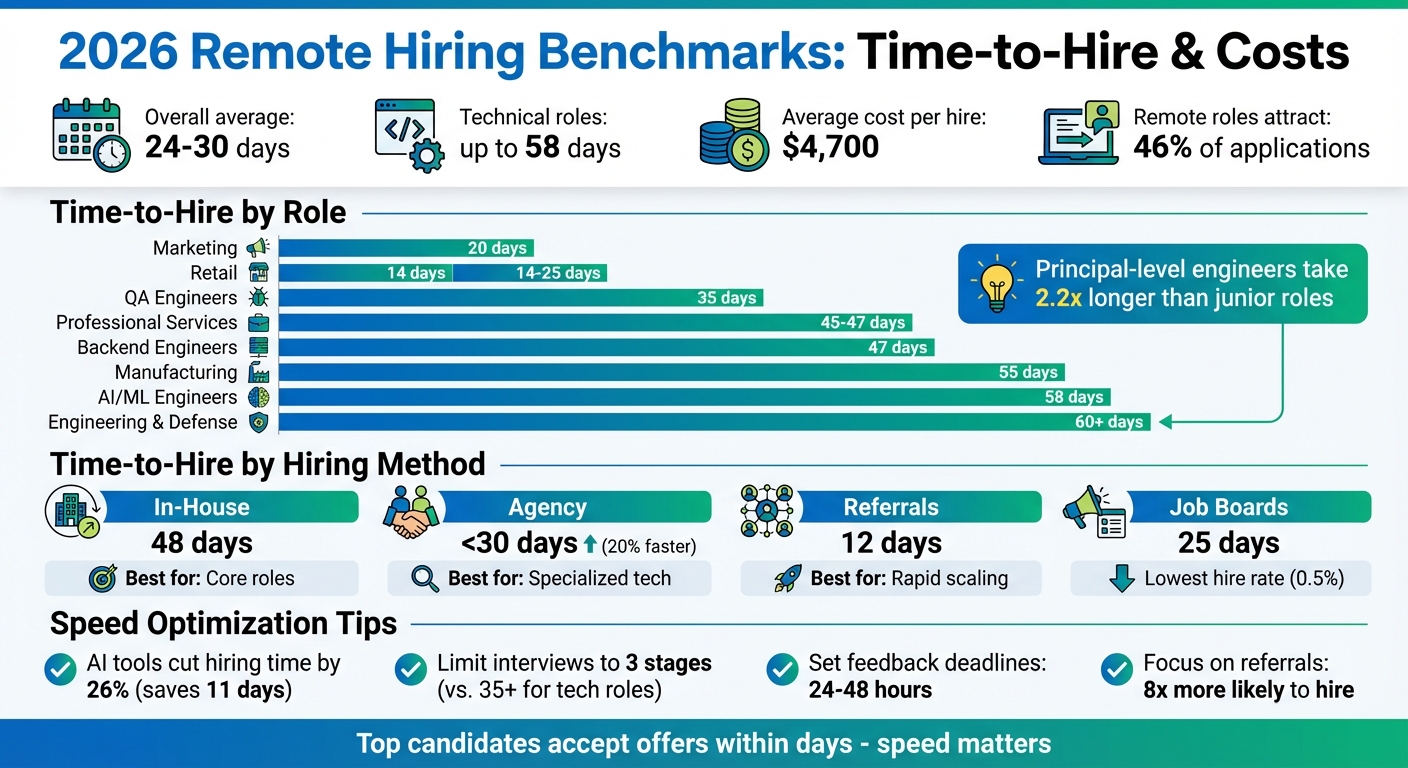
2026 Remote Hiring Benchmarks: Time-to-Hire by Role and Method
Time-to-Hire Benchmarks for Remote Roles in 2026
Benchmarks by Region
The time it takes to hire for remote roles depends heavily on the region. In North America, the average hiring timeline falls between 24 and 30 days for most roles [4]. However, technical positions often take longer - up to 48 days - due to increased competition and the need for thorough evaluation [7].
In Latin America, hiring tends to be quicker, thanks to efficient processes and time-zone compatibility with U.S. companies. Europe, on the other hand, faces unique challenges. While it boasts a strong talent pool, regulatory requirements and the complexity of specialized roles can lead to longer hiring periods, especially for highly regulated industries.
Benchmarks by Role and Industry
The complexity of a role plays a significant part in how quickly it can be filled. For instance, marketing roles are among the fastest to hire, with an average time of 20 days [4]. Retail positions are also relatively quick, taking 14 to 25 days [4][7]. On the flip side, technical and specialized roles often take much longer. Hiring an AI/ML engineer can stretch to 58 days, while professional services or operational roles typically take 45 to 47 days [2][4].
Here’s a snapshot of average hiring times for different remote roles:
| Role Type | Average Time-to-Hire (Days) |
|---|---|
| Marketing | 20 |
| QA Engineers | 35 |
| Backend Engineers | 47 |
| AI/ML Engineers | 58 |
| Professional Services | 45–47 |
| Manufacturing | 55 |
| Engineering & Defense | 60+ |
Seniority also impacts timelines. For example, hiring a principal-level engineer can take 2.2 times longer than hiring a junior engineer [2]. Additionally, tech roles often attract a high number of applicants - averaging 369.1 applications per job [1]. Without automation, this volume can significantly slow down the screening process.
"Speed and personalization aren't rivals - they're partners. The best teams are moving fast while still treating people like humans."
- Stephanie Manzelli, HR Executive, Employ Inc. [1]
Benchmarks by Hiring Method
The method you choose for hiring also plays a critical role in determining how long the process takes. In-house recruiting for technical roles averages 48 days, primarily because of resource constraints and manual processes [2]. Third-party recruiters, however, can reduce this timeline by about 20%, often completing hires in less than 30 days [7]. Employee referrals are even faster, with an average time of just 12 days, compared to 25 days when using job boards [2].
Here’s a breakdown of hiring methods and their trade-offs:
| Hiring Method | Avg. Time-to-Hire (Tech) | Primary Trade-off | Best For |
|---|---|---|---|
| In-House | 48 days | Slower for niche roles; resource-heavy | Core roles, culture-focused positions |
| Agency | <30 days | Higher upfront recruiting costs | Specialized tech, urgent needs |
| Freelance/Referral | 12–29 days | Limited to networks or project-specific | Rapid scaling, short-term projects |
Adding recruitment AI to the mix can make a noticeable difference. Companies using AI report hiring 26% faster, cutting an average of 11 days from their processes [7]. This is particularly valuable for tech roles with high applicant volumes, where automation can streamline screening and improve efficiency.
"Time kills all deals... A short recruitment process can mean the difference between hiring the right candidate and time killing the deal."
- Miguel Marques, Founder, Remote Crew [7]
sbb-itb-88a7fe6
Common Hiring Delays and How to Fix Them
Where Remote Hiring Gets Stuck
Remote hiring often hits predictable roadblocks. One of the biggest delays comes from manual screening. On average, enterprises spend 5.7 days just reviewing applications, and for software and tech roles, this stretches to 9 days [1]. This issue is magnified by the fact that companies are now handling 50 more applicants per role compared to the previous year [1].
Another common hurdle is scheduling conflicts. Coordinating interviews across multiple time zones and packed calendars slows the process significantly [1]. Even after interviews are done, slow feedback loops can derail progress. While teams wait for internal approvals or hiring manager input, top candidates often accept offers from faster-moving competitors [7].
Inefficient hiring processes also add unnecessary delays. Some technical roles, for example, now require 35–36 interviews per hire [8]. A lack of structured evaluation systems or shifting role requirements mid-process can lead to misalignment between recruiters and hiring managers. This often results in frustrated candidates dropping out [1][5].
Recognizing these bottlenecks is the first step to fixing them. By addressing these issues, you can streamline your hiring process and reduce delays - details on how to do this are outlined below.
How to Speed Up Your Hiring Process
Fixing delays in screening, scheduling, and process inefficiencies can significantly cut your time-to-hire.
Start with automating screening tasks. AI recruiting tools can slash time-to-hire by 26%, saving roughly 11 days [7]. This is especially helpful when managing high application volumes, as only 0.5% of the additional 50+ applicants per role actually get hired [1][8].
To prevent candidate burnout, limit interviews to three stages and use a structured set of questions with a shared scoring rubric (e.g., a 1–5 scale). This approach speeds up decision-making and reduces the chances of candidates dropping out [2][5].
Implement clear Service Level Agreements (SLAs) for feedback. Hiring managers should provide feedback within 24–48 hours to keep things moving [1][7]. Additionally, secure approvals for headcount and compensation before the final interview to avoid offer-stage delays [7].
Clarify outcomes early. Before posting a job, define the top three goals for the first 30, 60, and 90 days. This helps applicants self-assess their fit for the role, saving time on mismatched candidates [5]. Lastly, focus on employee referrals and direct sourcing over job boards. Referrals average just 12 days to hire, compared to 25 days for job boards [2].
"Speed and personalization aren't rivals - they're partners. The best teams are moving fast while still treating people like humans, not just requisitions to fill."
- Stephanie Manzelli, HR Executive, Employ Inc. [1]
Remote Hiring Costs in 2026
Cost Ranges by Region and Role
In 2026, the average cost-per-hire in the U.S. is $4,700 [3]. This figure accounts for recruiting expenses like job board fees, ATS software, and recruiter time - but excludes salaries.
Speaking of salaries, the average advertised salary for a remote role in the U.S. is around $61,000 annually [3]. However, costs can vary widely based on region and job complexity. For example, hiring remote talent from Latin America or Eastern Europe often results in lower costs while maintaining strong skill sets and convenient time-zone overlap [3].
Senior and specialized roles tend to increase hiring expenses. For instance, remote accounting roles experienced a 15% salary increase in 2025 [3], and the growing demand for AI/ML engineers has driven costs higher. Filling principal-level engineering positions can take 2.2 times longer than junior roles, leading to higher job board fees, additional recruiter hours, and productivity losses while the position remains vacant [2].
Beyond salaries, onboarding delays also add hidden costs. In 2026, 43% of new hires wait over a week for basic tools, and 18% wait more than two months [3]. These delays can significantly impact overall hiring costs, despite potential savings like the $11,000 annual reduction in office overhead per remote employee [3].
Cost Comparison by Hiring Method
Once you understand baseline hiring costs, it’s important to evaluate how different hiring methods affect expenses and timelines. Each approach has its own cost structure, speed, and ideal use case.
| Hiring Method | Primary Costs | Speed | Best For |
|---|---|---|---|
| In-House Recruiting | Recruiter salaries, ATS tools, job boards | Slower (45+ days avg) | Core roles critical to company culture |
| Recruitment Agency | Placement fee (% of salary) | 20–70% faster [7] | Niche, technical, or urgent positions |
| Freelance Platforms | Hourly/project rate, platform fees | Fast | Short-term projects or specific tasks |
| Subscription Recruiting | Flat monthly fee ($1,000–$1,450) | 4–7 weeks | Consistent hiring needs, predictable budgets |
In-house recruiting comes with fixed costs that grow the longer a role stays unfilled, such as job board renewals and internal labor. Recruitment agencies, while charging a percentage of the hire's first-year salary, can reduce time-to-hire by up to 70% [7], which helps offset vacancy costs.
Freelance platforms are a good fit for short-term needs but may lack the thorough vetting required for full-time positions. Subscription-based recruiting services, like RemotelyTalents.com, offer a middle ground with flat fees, a 90-day replacement guarantee, and access to a large pool of pre-vetted candidates across North America, Latin America, and Europe.
How to Calculate Your Total Cost of Hire
For accurate budgeting, it’s essential to calculate the total cost of hire by factoring in recruiter time, hiring manager time, job board fees, ATS costs, agency fees, and revenue lost during vacancies. Here’s a common formula:
(Internal Recruiter Time × Hourly Rate) + (Hiring Manager Time × Hourly Rate) + Job Board Fees + ATS Costs + Third-Party Fees + (Days Vacant × Daily Revenue Loss)
For example, 10 recruiter hours at $75/hour equates to $750. If a sales role generating $500 in daily revenue remains vacant for 45 days, that’s an additional $22,500 in lost output.
Employee referrals, which average just 12 days to hire, are among the most cost-effective hiring channels [2][7]. However, onboarding delays can still inflate costs. If a new hire waits two weeks for essential tools and access, you’re paying their salary without seeing productivity. Structured onboarding processes can reduce these inefficiencies and help mitigate the 12.1% first-year turnover rate reported in 2026 [1].
"Time kills all deals. How long it takes you to recruit, from an applicant entering the hiring process through to them accepting an offer, is your 'time to hire'."
- Miguel Marques, Founder, Remote Crew [7]
Choosing the Right Hiring Method for Your Team
In-House vs. Agency vs. Freelance Platforms
Your company's size and urgency play a huge role in deciding the right hiring method. This choice impacts how quickly you can hire, how much it costs, and how much control you maintain.
In-house recruiting is ideal for core, ongoing roles where having direct oversight is critical. While this approach requires investments in salaries, tools like Greenhouse or Workable, and AI-powered sourcing tools like Juicebox (which can save up to 80% compared to platforms like LinkedIn Recruiter), it comes with tradeoffs. Expect slower hiring times - around 40–50 days - and higher fixed costs [5][9].
Recruitment agencies are a go-to for niche technical roles, senior positions, or offshore hiring. They’re faster, often delivering candidates within 48 hours, but come with higher fees - typically 15–25% of a candidate's first-year salary [5][9][12]. For example, if you’re hiring a principal-level engineer or scaling quickly, agencies can save weeks of vacancy costs, making them a solid option.
Freelance and contractor platforms are designed for short-term, project-based work. These platforms offer the quickest onboarding - sometimes within hours - and lower costs. However, they require strong internal processes, like clear SOPs and testing, to maintain quality [5][10]. They’re perfect for projects where you pay for results rather than ongoing management.
Employee referrals are a strategic advantage, offering reliability and efficiency. Candidates sourced this way are eight times more likely to be hired compared to job board applicants. Plus, nearly half of hires in 2026 are expected to come from "rediscovered" candidates already in your ATS or CRM [8]. Ignoring referrals could mean missing out on both speed and quality.
"A bigger tech stack doesn't equal better hiring. In fact, it often creates the opposite effect. The real goal is to generate talent velocity."
- Juicebox [9]
Which Method Fits Your Company
Now that you know the strengths of each method, it’s time to match them to your specific needs. Here's how different types of companies can approach hiring.
Startups should focus on speed and cost-efficiency. Specialized recruiting partners or subscription-based services can secure candidates within 48 hours, avoiding the delays of job board applications [12]. To cut costs, startups can combine U.S.-based leadership with offshore operations for admin roles [5]. Avoid pricey Employer of Record (EOR) services ($599+/month) if a simpler contractor payment platform ($29/month) can do the job.
Small and medium businesses (SMBs) benefit from a mix of methods. Use in-house recruiting for core roles that require a strong cultural alignment, while agencies or subscription services can fill niche or urgent positions. SMBs often face high application volumes (312 per job) but may lack the resources for fast screening [1]. AI recruiting tools can ease this burden, reducing stress for nearly half of recruiters [1].
Mid-market companies with regular hiring needs should consider subscription-based recruiting models. These services offer flat monthly fees ($1,000–$1,450), 90-day replacement guarantees, and access to pre-vetted candidates globally. For teams hiring four to six or more roles annually, this approach is more cost-effective than paying per-hire fees. Mid-market companies typically have structured interview processes, averaging 35–36 interviews and 26 interviewer hours for technical roles, which helps improve hiring outcomes [8].
"The companies that see remote hiring as a strategic advantage, not a temporary fix are the ones building stronger, more resilient teams for the future."
- Claudia Real, CEO, There is Talent [11]
Hiring Method Decision Scorecard
Use this scorecard to evaluate each hiring method based on your priorities. Rate each factor from 1 (low importance) to 5 (high importance), then align your top needs with the best method.
| Factor | In-House | Agency | Referrals | Freelance Platforms | Subscription Recruiting |
|---|---|---|---|---|---|
| Speed (Need hire in <30 days) | 2 | 5 | 5 | 5 | 4 |
| Budget Constraint (Low upfront cost) | 2 | 1 | 5 | 4 | 4 |
| Quality (Technical vetting required) | 4 | 5 | 4 | 3 | 5 |
| Management Bandwidth (Low oversight) | 2 | 5 | 3 | 3 | 5 |
| Cultural Fit (Core team member) | 5 | 3 | 5 | 2 | 4 |
If speed is your main concern, referrals (with a 12-day average) or agencies (48-hour turnaround) are your best bets. Tight budget? Start with referrals and freelance platforms, then consider subscription recruiting. For roles needing technical expertise, agencies and subscription services provide the most thorough vetting. And if you’re short on internal resources, agencies and subscription services can handle the entire process with minimal effort on your part.
Before committing to a new hiring method, review your current funnel. If your interview-to-offer rate is below the 2026 mid-market benchmark of 16.6%, you may need to tighten your screening process [1]. Keep in mind that only 0.5% of job board applicants are ultimately hired, so relying solely on postings could waste time and money [8].
This scorecard can help you quickly align your hiring strategy with your most pressing needs.
Why RemotelyTalents.com Works for Remote Hiring in 2026
What RemotelyTalents.com Offers
RemotelyTalents.com tackles common hiring delays by offering access to a database of over 10,000 pre-screened candidates paired with a subscription model. Pricing starts at $1,000/month for the Partner Plan (12-month commitment) or $1,450/month for the On-Demand Plan (cancel anytime). This setup avoids the time-consuming manual screening process - where only 0.5% of job board applicants are hired [8] - by providing candidates already evaluated for technical skills, language ability, and workplace compatibility.
Here’s what both plans include:
- 90-day replacement guarantee
- A dedicated senior recruiter and account manager
- Slack communication and weekly updates on progress
Most roles are filled within 5–7 weeks, a timeframe that matches or beats the industry average of 48 days for technical positions [2]. For highly specialized roles, like AI/ML engineers that typically take up to 58 days to fill [2], this faster process can make a big difference.
For businesses hiring four to six roles or more annually, the subscription model offers a clear financial advantage over traditional agency fees, which often range from 15–25% of a new hire's first-year salary. The flat monthly cost simplifies budgeting and eliminates surprises. Plus, the 90-day replacement guarantee ensures no additional fees if a hire doesn’t work out, providing peace of mind during the hiring process.
Coverage Across Europe, LATAM, and North America
RemotelyTalents.com leverages its regional expertise across Europe, Latin America, and North America to ensure time-zone alignment and smoother collaboration for remote teams. With senior recruiters based in Europe and Latin America, the platform benefits from local market knowledge and networks, speeding up the process of finding the right candidates. In 2026, when real-time communication and synchronous teamwork are non-negotiable for remote teams, this regional focus is a major advantage.
For example, whether you’re hiring a senior marketing manager in LATAM or a data engineer in Eastern Europe, their recruiters understand local pay expectations, work habits, and hiring practices. This insight helps avoid delays during negotiations and increases offer acceptance rates. Employers also gain access to the 2026 Global Salary Guide, which supports competitive and quick offer creation, cutting down on lengthy back-and-forth discussions [6].
With 10+ years of remote hiring experience and a history of working with 250+ companies, RemotelyTalents.com has streamlined its processes to overcome the typical bottlenecks in hiring. Their expertise spans roles in Marketing & eCommerce, IT/Data/Engineering, Operations & VAs, and Finance & Accounting, ensuring recruiters are well-versed in the skills and qualifications these positions demand. This industry-specific knowledge enhances their ability to reduce hiring delays across international markets.
Performance Data and Client Results
The platform’s 5–7 week average time-to-hire is made possible by a structured process that minimizes the manual workload many recruiters face. With recruiters now handling 93% more applications than in 2021 [8], delays in traditional hiring methods are inevitable. RemotelyTalents.com bypasses these issues by starting with a pool of pre-screened candidates, saving employers significant time and effort.
Their vetting process ensures only top-tier candidates make it to the interview stage, avoiding wasted hours on poorly matched applicants. For technical roles, which often require 26 interviewer hours and 35–36 interviews per hire [8], this efficiency is critical. Within two weeks, employers receive 3–4 qualified candidates who meet both the technical and cultural requirements of the role.
This approach aligns seamlessly with mid-market companies that have structured interview procedures. The 90-day replacement guarantee adds an extra layer of security, ensuring that if a new hire doesn’t meet expectations within the first three months, a replacement is provided at no extra cost. This safeguard is especially valuable for roles where early turnover can disrupt team dynamics and delay key projects. These results highlight why RemotelyTalents.com is well-suited to meet the speed and quality demands of remote hiring in 2026.
Conclusion
Main Takeaways
In 2026, cutting down your time-to-hire means setting clear goals, removing delays, and choosing a hiring approach that aligns with your company's size and urgency. With average timelines ranging from 24–30 days (and over 48 days for technical roles [2][4]), taking more than 50 days to hire a remote developer puts your process among the slowest 25% [12].
Addressing key bottlenecks is crucial. Whether it’s faster feedback loops, fewer interview stages, or moving from job boards to proactive candidate sourcing, these adjustments can make a big difference [1]. For example, sourced candidates are eight times more likely to be hired than those from job boards, with nearly half coming from existing CRM or ATS databases [8]. Ignoring these resources or skipping structured screening tools could cost you weeks dealing with unqualified applicants.
Your Next Step: Audit Your Hiring Process
With these insights in hand, it’s time to take a closer look at your hiring funnel. Pinpoint the slowest parts - whether it’s screening candidates, scheduling interviews, collecting feedback, or finalizing offers. If it takes you over nine days to screen applicants [1] or if your process includes more than three interview stages [2], you’re probably losing top talent to competitors who move faster.
Evaluate where your process falls short and whether your hiring strategy aligns with your goals. By applying the decision-making framework outlined in this guide - balancing budget, speed, and quality - you can fine-tune your approach for better results. For companies hiring four to six roles or more annually, services like RemotelyTalents.com offer predictable costs, quicker timelines, and access to over 10,000 pre-screened candidates across Europe, Latin America, and North America. Most roles are filled within 5–7 weeks, backed by a 90-day replacement guarantee.
Schedule a hiring funnel audit to find out how you can streamline your process without sacrificing quality.
Related Blog Posts
Read also



Ready to hire without salary-based agency fees?
Book a free 30-minute consultation. We’ll review your role, timeline, and hiring goals, then show you how our fixed-fee remote search works.