Ultimate Guide to Global Talent Acquisition Metrics


Global hiring is complex, but tracking the right metrics can simplify decision-making and improve outcomes. Here's what you need to know:
- Key Metrics: Focus on five metrics - Time to Fill, Cost per Hire, Quality of Hire, Offer Acceptance Rate, and Turnover Rate. These help measure hiring speed, expenses, candidate quality, offer competitiveness, and retention.
- Global Challenges: Hiring internationally adds layers like compliance, currency conversion, and regional differences. Metrics help pinpoint inefficiencies and opportunities.
- Actionable Insights: Use data to identify cost-effective regions, improve hiring strategies, and align offers with market expectations. For instance, hiring in Latin America might lower costs and speed up placements without sacrificing quality.
This guide explains how to calculate and apply these metrics, offering practical examples and formulas to help you hire smarter and achieve better results.
The Ultimate Guide to Talent Acquisition KPIs (Cost, Quality, Speed & More)
Core Metrics for Global Talent Acquisition
Tracking the right metrics turns global hiring into a science rather than a guessing game. These five key indicators highlight where your recruitment process excels and where there’s room for improvement across different regions. Let’s break down how each metric can guide smarter hiring decisions.
Time to Fill
Time to Fill measures how many days it takes from opening a job requisition to when a candidate accepts the offer. For critical roles, this averages 42 days[1]. Globally, this timeline can stretch due to factors like time zone coordination, longer notice periods (common in places like Singapore), and additional compliance requirements. For example, hiring in competitive markets often takes longer. Using AI tools to analyze regional hiring patterns can help identify areas with shorter cycles and streamline your process.
Cost per Hire
Cost per Hire is calculated by dividing total recruitment expenses by the number of hires: (internal costs + external fees + onboarding + compliance/currency conversion) ÷ number of hires[2][7]. For global remote hiring, this includes expenses like visa fees, currency conversion (typically 1–3%), payroll localization, and agency charges. To illustrate, if you spend $20,000 recruiting five remote developers - covering sourcing ($5,000), assessments ($1,500), legal compliance ($2,000), and remote tools ($500) - your Cost per Hire is $4,000[2][5]. By tracking this metric by source, you can identify which channels, such as LinkedIn, offer the best value for your recruitment spend.
Quality of Hire
Quality of Hire evaluates how well new employees perform, particularly in remote or global roles. This can be measured through manager ratings on a 1–5 scale after 90 days, onboarding completion time, productivity metrics, and remote-specific factors like time zone compatibility[7][4]. Combining quality scores with first-year retention rates provides a clearer picture of ROI, as high-quality hires often translate to increased revenue per employee[7][4]. Tracking year-over-year improvements in performance and retention rates can help you assess whether your sourcing strategies are attracting candidates who thrive in distributed teams.
Offer Acceptance Rate
Offer Acceptance Rate shows the percentage of job offers accepted by candidates. It’s calculated as: (accepted offers ÷ total offers extended) × 100[3][6]. With 74% of companies reporting challenges due to uncompetitive packages[1], this metric helps you evaluate whether your compensation aligns with global market standards. Comparing salaries (in USD equivalents) across emerging talent hubs and more saturated markets can guide you in creating offers that are more appealing. Beyond pay, perks like flexible schedules or home office stipends can also make a difference, especially in remote settings.
Turnover Rate
Turnover Rate measures how long new hires stay with your company. The formula is: (number of separations within a period ÷ average headcount) × 100, typically assessed at 90 days or one year[8][4]. Remote teams often face unique challenges, like cultural mismatches or time zone issues, which can increase turnover. For instance, companies monitoring turnover indicators and internal mobility reduced attrition from 16% to under 12%[8]. When paired with Quality of Hire, this metric offers insights into whether your strategies are bringing in candidates who integrate well into your remote culture. At Remotely Talents, we specialize in helping businesses use data to refine their global hiring processes.
How to Calculate and Compare Your Metrics
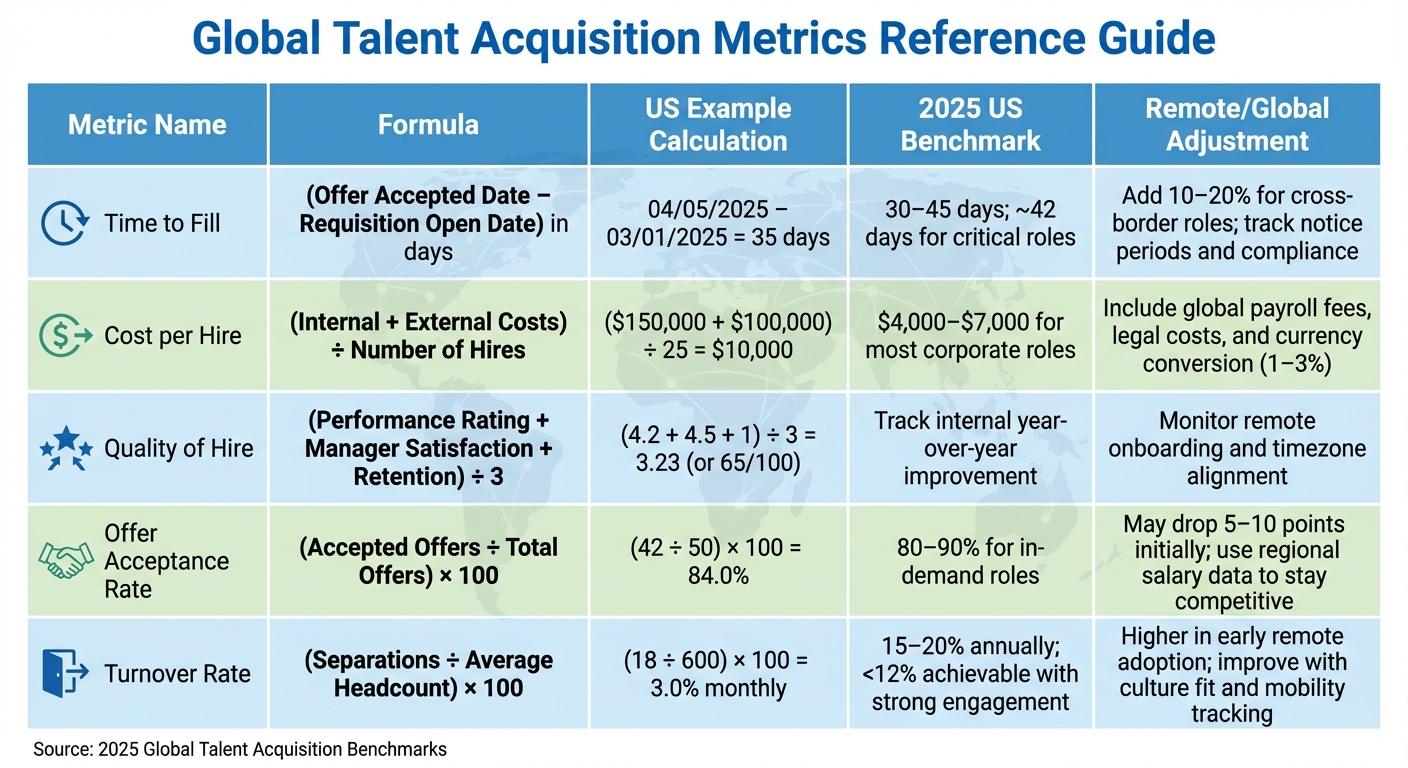
5 Essential Global Talent Acquisition Metrics: Formulas and Benchmarks
Transform your recruitment data into actionable insights by using consistent formulas and benchmarks. Start by ensuring your ATS (Applicant Tracking System) accurately records key dates and costs. For example, if you opened a requisition on 03/01/2025 and the candidate accepted the offer on 04/05/2025, your Time to Fill is 35 days. To maintain consistency, always store dates in MM/DD/YYYY format and record costs in USD.
Calculating Key Metrics
Here’s how you can calculate and interpret some of the most important recruitment metrics:
-
Cost per Hire: Add up internal expenses (like recruiter salaries and software licenses) and external fees (such as agency costs and background checks), then divide by the total number of hires. For example, if your internal costs are $150,000 and external costs are $100,000, and you’ve hired 25 people, the formula would be:
($150,000 + $100,000) ÷ 25 = $10,000 per hire.
Breaking down costs by source (e.g., LinkedIn, referrals, agencies) can help identify which channels deliver the best ROI. -
Quality of Hire: This combines first-year performance ratings (on a 1–5 scale), manager satisfaction scores, and retention data. For instance, if the ratings are 4.2, 4.5, and 1, the formula is:
(4.2 + 4.5 + 1) ÷ 3 = 3.23, which can be normalized to a 0–100 scale.
This metric gives you a clear view of how well new hires are performing and staying with the company. -
Offer Acceptance Rate: Divide the number of accepted offers by total offers made, then multiply by 100. For example, if 42 out of 50 offers were accepted, the calculation is:
(42 ÷ 50) × 100 = 84.0%.
While the typical range is 80–90%, note that remote hiring might initially bring this down by 5–10 points due to global competition. Using regional salary benchmarks can help counteract this. -
Turnover Rate: Divide the number of separations by the average headcount, then multiply by 100. For example, if 18 employees left out of an average headcount of 600, the formula is:
(18 ÷ 600) × 100 = 3.0% monthly turnover.
Evaluating this at 90 days and one year can provide insights into retention trends.
Metric Formula Reference Table
Standardized formulas make it easier to compare metrics across regions and roles:
| Metric | Formula | US Example | 2025 US Benchmark | Remote/Global Adjustment |
|---|---|---|---|---|
| Time to Fill | (Offer Accepted Date − Requisition Open Date) in days | 04/05/2025 − 03/01/2025 = 35 days | 30–45 days; ~42 days for critical roles | Add 10–20% for cross-border roles; track notice periods and compliance |
| Cost per Hire | (Internal + External Costs) ÷ Number of Hires | ($150,000 + $100,000) ÷ 25 = $10,000 | $4,000–$7,000 for most corporate roles | Include global payroll fees, legal costs, and currency conversion (1–3%) |
| Quality of Hire | (Performance Rating + Manager Satisfaction + Retention) ÷ 3 | (4.2 + 4.5 + 1) ÷ 3 = 3.23 (or 65/100) | Track internal year-over-year improvement | Monitor remote onboarding and timezone alignment |
| Offer Acceptance Rate | (Accepted Offers ÷ Total Offers) × 100 | (42 ÷ 50) × 100 = 84.0% | 80–90% for in-demand roles | May drop 5–10 points initially; use regional salary data to stay competitive |
| Turnover Rate | (Separations ÷ Average Headcount) × 100 | (18 ÷ 600) × 100 = 3.0% monthly | 15–20% annually; <12% achievable with strong engagement | Higher in early remote adoption; improve with culture fit and mobility tracking |
Benchmarking and Segmenting Data
Compare your metrics to benchmarks based on industry and role type. For example, tech roles often have higher turnover and longer time-to-fill than administrative positions. Segmenting your data by hiring type - such as US in-office, US remote, and international remote hires - can uncover important trends.
For instance, platforms like Remotely Talents can help track metrics in regions like Europe and Latin America. While notice periods and compliance steps might increase Time to Fill by 10–20%, accessing broader talent pools can significantly lower Cost per Hire. Use ATS dashboards to monitor trends monthly and adjust your strategies when metrics fall outside target ranges.
sbb-itb-88a7fe6
Applying Metrics to Improve Your Hiring Strategy
Let’s take a closer look at how you can turn recruitment metrics into actionable strategies to refine your hiring process.
Use data to align recruitment with business goals. Extended vacancies can lead to noticeable dips in productivity, making it crucial to focus on reducing Time to Fill. This ensures your operations stay on track and minimizes disruptions.
Segment data for smarter decisions. Break down metrics by region and hiring source to uncover cost-effective talent pools. For instance, if remote roles consistently show a lower Cost per Hire while maintaining a strong Quality of Hire, you’ve identified a valuable area to grow. Similarly, tracking which recruitment channels lead to the highest first-year retention rates can help you allocate your budget to sources that deliver long-term success.
Refine outreach with diversity metrics. By analyzing every stage of your hiring pipeline - sourcing, screening, interviewing, and offers - you can identify where underrepresented groups may be dropping off. Expanding your search to European markets known for strong IT talent or tapping into Latin American finance hubs can not only improve diversity but also broaden your skill coverage.
Leverage external support when needed. If your internal team is stretched thin, consider Recruitment-as-a-Service to speed up hiring by 20–30%. Providers like Remotely Talents offer tailored plans with dedicated recruiter support and a 90-day replacement guarantee, making them a reliable option when expanding into regions like Europe or Latin America.
Steps to Improve Your Recruitment Outcomes
Here are practical ways to optimize your hiring strategy:
- Tie metrics to specific goals. For example, when entering new markets, use the Hiring Difficulty Index to identify regions with abundant talent or track the Skill Gap Fulfillment Rate to address critical shortages. This is especially relevant as 63% of companies anticipate skill gaps to be a major challenge by 2025[1].
- Streamline each stage of your funnel. Monitor application completion rates and pass-through rates between interview rounds to identify bottlenecks. Evaluate your compensation packages against regional benchmarks to boost your Offer Acceptance Rate.
- Build proactive pipelines. Focus on nurturing talent in regions that consistently yield strong candidates. Track the Cost per Quality Applicant by region to determine which sourcing efforts deliver the best ROI.
- Prioritize internal mobility. Keep an eye on how often roles are filled through internal promotions versus external hires. Combine upskilling programs with external recruiting efforts to strike a balance between speed and development costs. This is particularly vital as half of the workforce is expected to need reskilling by 2025.
- Work with specialized recruiters. When internal efforts slow, partner with external recruiters. Use metrics like Time-to-Shortlist, Source-of-Hire Quality, and First-Year Retention to evaluate their effectiveness, ensuring they add value without inflating costs.
Key Takeaways
Keeping tabs on global talent acquisition metrics is a game-changer when it comes to building strong remote teams. With 74% of companies struggling to fill roles and critical positions taking an average of 42 days to fill, relying on data instead of gut instinct is the way forward[1]. Metrics like Time to Fill, Cost per Hire, Quality of Hire, Offer Acceptance Rate, and Turnover Rate provide the foundational data needed to identify inefficiencies and make smarter hiring decisions.
But traditional metrics alone won’t cut it in today’s fast-changing hiring landscape. Strategic KPIs are essential for tackling modern challenges - especially when 63% of companies cite skill gaps as a major hurdle and half of all employees will need reskilling by 2025[1]. These metrics help pinpoint where talent shortages exist, identify markets that are oversaturated, and highlight opportunities to reduce costs through internal mobility.
The good news? These insights lead directly to actionable improvements. Start by benchmarking your performance with standardized formulas to identify cost-effective talent pools. Once you’ve calculated your core metrics, break down the data by region and hiring source. For businesses expanding into regions like Europe or Latin America, working with specialized recruiters such as Remotely Talents can help maintain quality, thanks to their 90-day replacement guarantee.
Building on these benchmarks, it’s crucial to regularly review your recruitment dashboard. Keep track of which sourcing channels yield the highest first-year retention rates, compare your Offer Acceptance Rate to regional averages, and use analytics to identify potential flight risks early. For example, one company successfully reduced its attrition rate from 16% to under 12% by using KPI dashboards to spot at-risk employees early on[8].
When used effectively, these metrics can transform recruitment into a strategic advantage. By aligning them with your business goals - whether it’s closing skill gaps, reducing hiring timelines, or creating agile distributed teams - you’ll not only speed up the hiring process but also achieve sustainable growth and measurable returns on your investment.
FAQs
What are the best ways to reduce the Time to Fill for international positions?
To cut down on the Time to Fill for international roles, it’s all about making your recruitment process more efficient. Start by tapping into pre-vetted talent pools - this gives you quick access to highly qualified candidates without the usual legwork. Define job requirements clearly from the beginning to avoid unnecessary back-and-forth, and streamline interview scheduling by using tools or flexible time slots that work across various time zones.
You might also want to collaborate with recruitment agencies that specialize in sourcing remote talent. These agencies are skilled at connecting you with top candidates from regions like Europe, Latin America, and North America, and they can handle much of the vetting process on your behalf. Another option? Flexible hiring models, like on-demand recruitment, which can help you adapt to shifting priorities and tight timelines.
How can businesses increase their offer acceptance rate in global talent acquisition?
To improve offer acceptance rates in global talent acquisition, start by ensuring compensation packages are competitive and aligned with local market standards. Be upfront about job expectations and responsibilities, leaving no room for ambiguity. Candidates also value the perks of remote work - emphasize flexibility and the chance for a better work-life balance.
Maintaining clear and timely communication throughout the hiring process is essential for building trust and keeping candidates engaged. Additionally, tailor job offers to reflect individual preferences, whether that's adjusting work schedules or including benefits that resonate with different cultural or logistical needs. A thoughtful, personalized approach to the candidate experience can make all the difference in securing top talent.
How can I ensure high-quality hires for remote and distributed teams?
To build a strong remote or distributed team, start with a solid vetting process. This means conducting skill assessments, structured interviews, and ensuring the candidate aligns well with your team’s values and work environment. Don’t skip reference checks - they’re key to verifying qualifications and past achievements.
After hiring, set your new team members up for success with a clear onboarding process. Define measurable goals so they know what’s expected from day one. Keeping the momentum going with regular performance reviews, constructive feedback, and chances for professional growth can keep engagement high and standards consistent. If you want to streamline the hiring process, consider working with services that pre-vet candidates, saving you time and minimizing risks.
Related Blog Posts
Read also



Ready to hire without salary-based agency fees?
Book a free 30-minute consultation. We’ll review your role, timeline, and hiring goals, then show you how our fixed-fee remote search works.