Remote Hiring Scorecard: How to Pick the Right Recruiting Partner


In 2026, remote hiring is more competitive and complex than ever, with over 32 million Americans working remotely. Businesses must navigate global talent pools, AI-driven processes, and compliance challenges to hire the right candidates. Picking the wrong recruitment partner can lead to high turnover, legal risks, and wasted resources. This guide helps decision-makers evaluate recruitment partners using a weighted scorecard, focusing on:
- Speed-to-hire: How quickly candidates are delivered.
- Vetting quality: Screening for technical skills and remote readiness.
- Cost transparency: Clear pricing without hidden fees.
- Compliance expertise: Handling labor laws and tax regulations.
- Support level: Ongoing management and communication.
The article also compares in-house recruitment, staffing agencies, and freelance platforms, offering insights on costs, timelines, and best use cases. Specialized agencies often outperform generalists by focusing on remote-specific skills, compliance, and faster hiring. Use the provided checklist and scorecard template to make data-driven decisions and avoid costly mistakes.
Best Remote Recruitment Agencies in 2026 (Complete Guide)
sbb-itb-88a7fe6
The Remote Hiring Scorecard: 5 Evaluation Criteria
This section highlights the essential metrics used in the remote hiring scorecard - a tool designed to objectively evaluate recruitment partners.
5 Key Criteria to Evaluate Recruitment Partners
A well-structured scorecard helps you compare partners effectively. The five factors that directly influence hiring success are: speed-to-hire, vetting quality, cost transparency, compliance expertise, and support level.
Speed-to-hire tracks how quickly a partner can deliver qualified candidates. Vetting quality examines the thoroughness of their screening process, focusing on both technical skills and remote readiness. This includes evaluating a candidate's ability to work autonomously, communicate asynchronously, and take accountability. With 65% of recruiters in 2024 reporting an increase in under-qualified applicants due to AI-generated resumes, this criterion has become even more crucial[6].
Cost transparency looks at how upfront a partner is about pricing. For example, traditional staffing firms often apply markups of 40–60% on salaries without breaking down the costs[5]. In contrast, cost-plus models (a flat fee added to the salary) offer clearer pricing. Compliance expertise assesses whether the partner handles Employer of Record (EOR) services, local taxes, and labor laws. This is critical, as 77% of businesses have faced international labor law challenges in the past six months[6].
Finally, support level evaluates factors like communication frequency, dedicated account management, and replacement guarantees. Agencies that provide regular updates via tools like Slack and offer 90-day guarantees can save you significant management time. To quantify these criteria, use a standardized scoring system.
How to Score and Identify Red Flags
Evaluate each criterion on a 1–5 scale, where 1 indicates poor performance and 5 indicates excellence. Ensure your scores are based on verifiable data rather than promises. For example, request time-to-fill metrics to validate speed-to-hire and ask for a detailed breakdown of the screening process. This includes the number of interview stages, types of assessments, and how remote-specific skills are evaluated.
Be on the lookout for these red flags:
- Vague claims about "rigorous" vetting processes without clear details
- Hidden fees, such as percentage-based markups that don’t include a salary breakdown
- Over-reliance on 1099 contractor models for ongoing roles, which can lead to misclassification issues under laws like California's AB5[1]
- A lack of references or data on candidate retention
It’s also worth confirming if the agency operates as a remote-first organization. Such agencies are better equipped for asynchronous communication and effective remote management. Adjust your evaluation criteria as needed based on these warning signs.
Tailoring Evaluation Weights to Your Needs
Not all criteria carry the same importance for every company. Here’s how different businesses might weigh these factors:
- Startups hiring their first remote employees may focus more on vetting quality (40%) and support level (30%) because they lack internal hiring infrastructure.
- SMBs experiencing rapid growth might prioritize speed-to-hire (35%) and cost transparency (30%) to scale quickly.
- Mid-market companies in regulated industries should emphasize compliance expertise (40%) and vetting quality (30%) to navigate complex legal requirements.
If you're filling an urgent role, consider giving more weight to speed-to-hire. For positions in high-risk regions or industries, compliance expertise should take precedence. And when hiring for senior or specialized roles, prioritize vetting quality to ensure the right fit. Apply these weights consistently across all potential partners to make an informed choice.
In-House vs. Agencies vs. Freelance Platforms
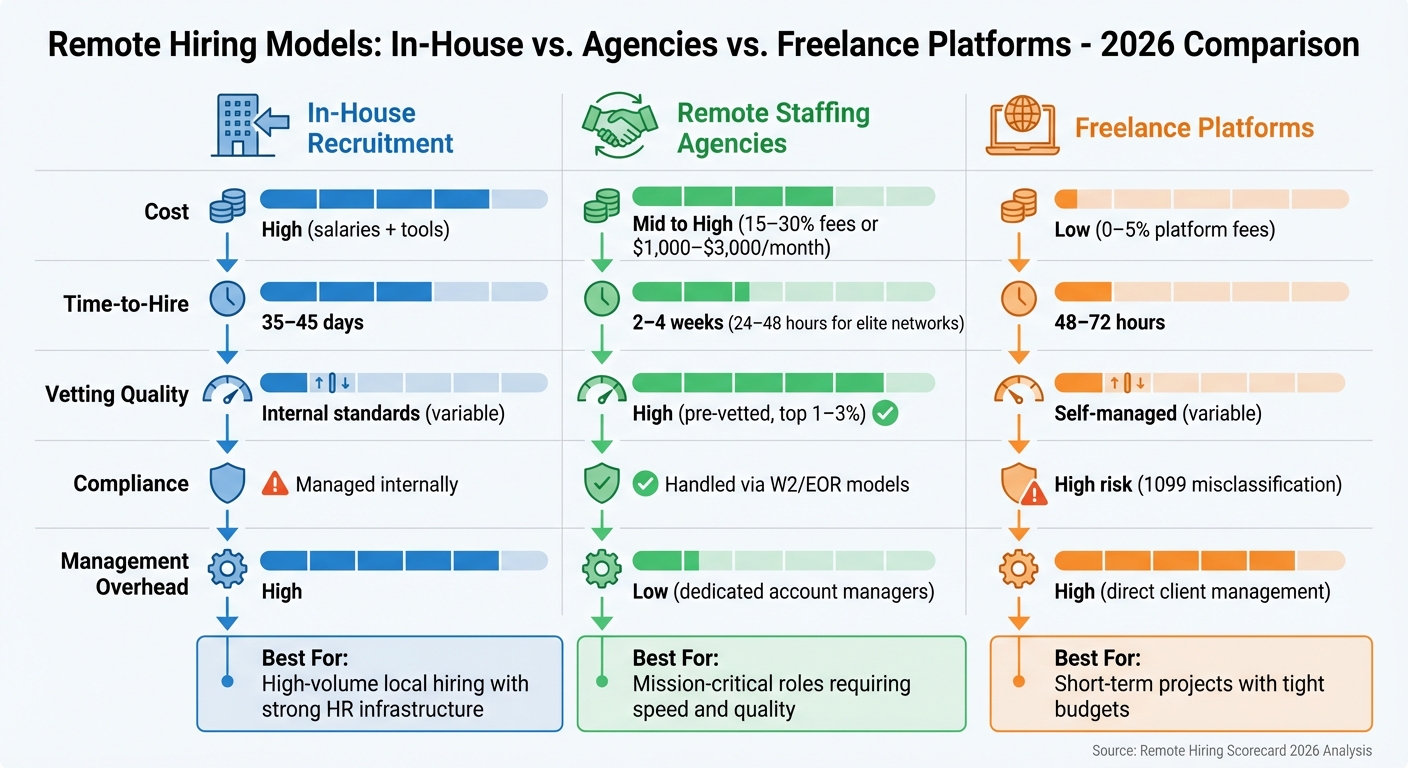
Remote Hiring Models Comparison: In-House vs Agencies vs Freelance Platforms
Deciding between in-house recruitment, agencies, and freelance platforms comes down to factors like speed, budget, and available resources. Each option serves different hiring needs, so understanding their strengths and weaknesses can help you make smarter choices and avoid unnecessary setbacks.
Model Comparison Table
| Feature | In-House Recruitment | Remote Staffing Agencies | Freelance Platforms |
|---|---|---|---|
| Cost | High (salaries + tools) | Mid to High (15–30% fees or $1,000–$3,000/month) | Low (0–5% platform fees) |
| Time-to-Hire | 35–45 days | 2–4 weeks (24–48 hours for elite networks) | 48–72 hours |
| Vetting Quality | Internal standards (variable) | High (pre-vetted, top 1–3%) | Self-managed (variable) |
| Compliance | Managed internally | Handled via W2/EOR models | High risk (1099 misclassification) |
| Management Overhead | High | Low (dedicated account managers) | High (direct client management) |
| Best For | High-volume local hiring with strong HR infrastructure | Mission-critical roles requiring speed and quality | Short-term projects with tight budgets |
The table gives a quick snapshot of key metrics, but let’s dig deeper into how each model can shape your hiring strategy.
In-house recruitment is ideal if you need to align hires with your company’s culture and long-term goals. However, it demands significant infrastructure, such as an Applicant Tracking System (ATS), AI-driven assessment tools, and a team of dedicated recruiters.
Remote staffing agencies can speed up the hiring process by leveraging pre-vetted talent pools. They’re particularly effective for finding candidates with remote-specific skills like asynchronous communication or self-management, which in-house teams might overlook. These agencies also handle cross-border compliance through W2 employment models, minimizing legal risks. Keep in mind, though, that they typically charge 15–30% markups on salaries or require monthly subscriptions starting at $1,000–$3,000[3].
Freelance platforms like Upwork or Workana are the go-to for quick, budget-friendly hiring. You can often fill roles within 48–72 hours while paying minimal platform fees (0–5%)[8]. That said, you’ll need to manage vetting, onboarding, and compliance yourself, which can increase risks, especially when dealing with contractor laws like California’s AB5[1].
Real-world examples show how these models can deliver results. In 2025, Apisero used HackerEarth Assessments to streamline internal developer hiring, cutting its dependency on external recruiters by 70% and reducing time-to-hire by 60%[7]. Similarly, CloudMetrics, a SaaS startup in San Francisco, built a distributed engineering team using Jobbers.io, saving an estimated $125,000 compared to agency rates[8].
"Building our remote team on Jobbers.io saved us $125,000 compared to Toptal - money we desperately needed for infrastructure and marketing."
- CTO, CloudMetrics[8]
These examples highlight how different hiring models can boost efficiency and cost-effectiveness, making them valuable tools for your overall recruitment strategy.
When to Combine Models
Sometimes, the best approach isn’t picking just one model but combining them to meet your needs. For instance, your in-house team can focus on core roles and long-term hires, while agencies handle specialized or high-volume requirements. Freelance platforms can step in for short-term, non-critical tasks when your team has the expertise to vet candidates effectively.
If you’re scaling quickly but lack internal capacity, you might partner with an agency for key roles while gradually building your in-house capabilities. Freelance platforms can also help fill smaller gaps without stretching your budget.
To ensure smooth collaboration, start with a pilot role before committing to larger volumes. This lets you evaluate whether an agency’s vetting process meets your standards and if their candidates are prepared for remote work. Look for agencies that were designed for remote hiring from the ground up rather than those that transitioned to remote out of necessity[1].
Lastly, clearly define who handles each stage of the hiring process when blending models. For example, if your in-house team sources candidates and the agency manages technical screenings, outline handoff points to prevent confusion, reduce duplicate work, and maintain accountability.
Remote Hiring Costs in 2026
Understanding the costs tied to remote hiring can help you budget wisely and make informed decisions. These costs vary depending on factors like location, job complexity, and the hiring model you choose. Here's a breakdown to help you assess recruiting partners effectively. These calculations also contribute to cost transparency and ROI metrics for your hiring strategy.
Cost by Region: U.S., LATAM, and Europe
Regional salary differences can make remote hiring a cost-effective option. As Isaac Kassab, a staffing expert at Pearl Talent, states, "Hiring through remote job agencies often saves businesses 30%–60% compared to hiring locally" [4]. Some agencies even report savings of up to 80% when hiring from Latin America versus the U.S. [3].
Here’s a snapshot of typical salaries across regions in 2026:
| Role | Level | LATAM Salary (Annual) | U.S. Salary (Annual) | Savings |
|---|---|---|---|---|
| Frontend Developer | Mid-level | $48,000 – $78,000 | $118,000 – $131,000 | 40–63% |
| Accountant | Senior | $42,000 – $54,000 | $106,000 – $127,000 | 58–67% |
| Sales Dev Rep (SDR) | Mid-level | $24,000 – $30,000 | $66,000 – $76,000 | 60–68% |
| Graphic Designer | Senior | $42,000 – $48,000 | $104,000 – $147,000 | 59–71% |
These figures are base salaries, but the fully loaded cost of an employee - factoring in payroll taxes, benefits, equipment, and overhead - ranges from 1.25× to 1.5× the base salary [11]. In the U.S., employers also face additional costs like FICA (7.65%), FUTA (0.6%), and state unemployment taxes, which vary by state [11].
The complexity of the role and seniority level also influence costs. Entry-level roles might cost $3,000–$6,000 to hire, while technical positions like software engineers can range from $10,000 to $20,000+ due to specialized vetting [10]. Executive searches often exceed $25,000–$50,000 when factoring in search firm retainers and extended recruitment timelines [11].
Beyond these visible costs, there are hidden expenses to consider.
Calculating Total Cost of Hire
The invoice from your recruiting partner is just the tip of the iceberg. The total cost of hire includes direct expenses, internal labor, onboarding, and productivity losses that are often overlooked.
- Direct recruitment costs: These include agency fees, job board ads, applicant tracking system (ATS) subscriptions, and video interview tools. Contingency agency fees typically range from 15–30% of the hire’s first-year salary [3], while flat fees can go from $10,000 to $50,000+ depending on the role [3]. Subscription-based services, like RemotelyTalents.com, charge $1,000/month for their Partner Plan or $1,450/month for On-Demand hiring without placement fees.
- Internal labor costs: These involve the hourly rates of employees involved in hiring. For instance, if a hiring manager earning $120,000 annually spends 10 hours on interviews, that’s about $577 in internal costs (based on a $57.70 hourly rate). Multiply this by the number of interview rounds, and costs add up quickly.
- Onboarding costs: These cover expenses like equipment, software licenses, and the time it takes for new hires to become fully productive. New employees typically operate at only 25% productivity during their first month, reaching 100% after about 12 weeks [11]. This lag in productivity represents a significant, often overlooked cost.
- Cost of a bad hire: A poor hiring decision can cost up to 30% of an employee’s first-year earnings [14].
"Voluntary turnover costs U.S. companies over $1 trillion per year - with the average cost of replacing an employee ranging from one‐half to two times their salary!" - Sandra Lewis, Founder and CEO of Boldly [1]
This underscores the importance of thorough vetting and guarantees when choosing recruiting partners.
Once you’ve captured all these costs, the next step is to evaluate how they translate into hiring outcomes.
Measuring ROI on Recruiting Partners
To assess whether a recruiting partner is worth the investment, compare your total cost of hire with metrics like quality of hire (performance ratings at 90–180 days) and retention rate [13][15]. A lower-cost partner whose hires leave within six months can ultimately cost more than a premium service with better retention.
Key metrics to track include:
- Time-to-hire: Specialized agencies often fill remote roles in 2–4 weeks [3][4], while in-house teams take 35–45 days. Faster hiring minimizes the opportunity cost of unfilled positions.
- Quality of hire: Use structured scorecards to evaluate performance at 90 days. Top remote staffing agencies report developer retention rates as high as 98% [3], which significantly reduces replacement costs.
- Cost per quality hire: Divide total recruitment spend by the number of hires meeting performance benchmarks at 90 days. This helps determine whether you’re paying for quantity or quality.
- Replacement rate: Many agencies, like RemotelyTalents.com, offer a 90-day replacement guarantee. However, frequent use of this guarantee may signal poor vetting, driving up your effective cost per hire.
Consider running a pilot project before committing to a larger volume of hires. Test a single role to measure KPIs like time-to-productivity and cost-per-hire [12]. This approach provides clear data on whether the partner’s model aligns with your hiring needs and whether their candidates are prepared for remote work.
Practical Tools: Checklists and Scorecards
Choosing the right recruiting partner requires more than gut instinct - it calls for a structured, objective approach. Tools like checklists and scorecards can help you evaluate agencies, ensuring they deliver on their promises. These resources translate abstract criteria into actionable steps you can take right away.
Partner Evaluation Checklist
Here’s a detailed checklist to guide your decision-making process and reduce risks:
Vetting and Talent Quality
- Ask how the agency evaluates remote-specific soft skills, such as asynchronous communication and self-management, alongside technical expertise.
- Request their acceptance rates. Leading agencies often present only a small fraction of candidates (e.g., Toptal’s benchmark is 3% acceptance)[3][4].
- Check if they provide video shortlists, which can simplify your team’s initial screening process.
Compliance and Legal Framework
- Verify whether they hire talent as W2 employees or 1099 contractors. W2 models help minimize misclassification risks, particularly in states like California[1].
- Confirm if they offer Employer of Record (EOR) services to handle international tax and labor law complexities.
- Ask about their internal staff retention rate. A high retention rate often reflects a strong organizational culture and reliable client support[1].
Pricing Transparency
- Look for “all-in” pricing that includes both the employee’s compensation and a fixed management fee, avoiding hidden markups.
- Clarify whether their fees are based on contingency (15–30% of the first-year salary) or flat monthly subscriptions (e.g., RemotelyTalents.com’s model ranges from $1,000–$1,450/month)[3].
Service Level Agreements (SLAs)
- Confirm metrics like time-to-shortlist (ideally 3–5 days) and time-to-hire (usually 3–4 weeks).
- Review replacement guarantees. Standard guarantees range from 90 to 180 days, with longer periods often indicating confidence in their vetting process.
Integration and Onboarding
- Ask for a documented 30-60-90 day onboarding framework. Without a structured plan, the risk of early hire failures increases[2][16].
"Strong remote hires come from: 1. defining role outcomes, 2. using a skills test, 3. running structured interviews, and 4. following a 30–60–90 day onboarding plan with clear communication norms." - Search Party Recruiting[2]
With these checklist items in mind, you can use a scorecard to quantitatively compare potential partners.
Scorecard Template with Sample Scores
A weighted scorecard can help you objectively evaluate recruiting partners. Assign scores (1–10) to each criterion, apply weights, and calculate the total score:
| Evaluation Criteria | Weight | Partner A Score | Partner A Weighted | Partner B Score | Partner B Weighted |
|---|---|---|---|---|---|
| Vetting Quality (acceptance rate, remote-specific screening) | 30% | 8 | 24 | 6 | 18 |
| Compliance & Legal (W2 vs. 1099, EOR services) | 25% | 7 | 17.5 | 9 | 22.5 |
| Pricing Transparency (all-in costs, no hidden fees) | 20% | 9 | 18 | 5 | 10 |
| Speed & SLAs (time-to-shortlist, time-to-hire) | 15% | 6 | 9 | 8 | 12 |
| Onboarding Support (30-60-90 day framework) | 10% | 5 | 5 | 7 | 7 |
| Total Score | 100% | - | 73.5 | - | 69.5 |
You can adjust the weights based on your priorities. For instance, if compliance is a top concern, you might increase its weight to 35% while reducing others. Similarly, startups operating at breakneck speed might prioritize SLAs and onboarding support.
This scorecard provides a clear, numbers-driven way to compare options and avoid costly hiring mistakes.
How to Verify Partner Claims
Once you’ve shortlisted potential partners, it’s essential to validate their claims. Here’s how to separate marketing promises from reality:
Distinguish Remote-First from Remote-by-Default
- Ask if the agency was designed as a remote-first operation. Such agencies are typically better equipped to handle remote work dynamics and deliver high-quality candidates[1].
Run a Pilot Hire
- Test the waters with a single role. This allows you to assess the partner’s workflow, communication quality, and candidate performance. Track metrics like time-to-productivity and 90-day performance to gauge their effectiveness[3].
Check References and Case Studies
- Request references from 2–3 clients in your industry. Look for data on replacement rates, cost savings, and retention outcomes.
Audit Their Vetting Funnel
- If an agency claims to offer elite talent, ask for details about their vetting process and acceptance rates. Elite agencies typically accept only a small percentage of applicants.
Review Internal Retention
- High turnover within the agency itself can signal deeper issues that might affect their ability to deliver long-term success[1].
For instance, in 2021, Luxclusif, a luxury fashion resale platform, partnered with Penbrothers to scale its operations in the Philippines. By leveraging Penbrothers’ sourcing and compliance infrastructure, Luxclusif saved an average of 78% per role. These efficiencies contributed to their acquisition by Farfetch Group later that year[16].
RemotelyTalents.com provides a 90-day replacement guarantee and assigns senior-level recruiters who offer weekly updates via Slack. This transparency makes it easier to monitor progress and validate their claims throughout the hiring process.
Why Specialized Agencies Outperform Generalists
Where Generalist Agencies Fall Short
Generalist agencies often lack the tools and expertise to properly assess remote-specific skills. Many operate as remote-by-default rather than remote-first, and that difference is key.
These agencies tend to source candidates who are either in career transitions or have limited remote work experience. In contrast, specialized agencies prioritize professionals with deep remote work backgrounds - those who have built their careers around distributed teams. Generalists also rely on standardized screening processes, which can overlook critical skills like asynchronous communication, self-management, and technical readiness.
Sandra Lewis, Founder and CEO of Boldly, highlights the hidden costs of these shortcomings:
"Outsourcing, while inexpensive on paper, can actually cost up to 60% more because of spotty communication and work that needs to be redone."[1]
Considering that voluntary turnover can cost anywhere from 0.5x to 2x an employee's annual salary[1], partnering with the wrong agency can quickly become a costly mistake. This makes the expertise of specialized recruiting agencies all the more important.
What Specialized Agencies Deliver
Specialized agencies address these challenges by adhering to remote-first hiring practices. They implement rigorous, role-specific vetting processes, often accepting only the top 3% of applicants[3]. As Sandra Lewis explains:
"Remote communication requires supreme clarity and foresight. True remote staffers thrive because they're expert communicators who see the big picture and think ahead."[1]
These agencies also ensure compliance by employing talent as W2 employees or through approved Employer of Record (EOR) structures. This is a critical capability, especially since 77% of businesses struggle with international compliance[6]. Specialized staffing models not only reduce compliance risks but also result in longer working relationships - averaging about 3 years[1]. They also significantly cut down the time-to-shortlist, delivering candidates in just 3–5 days compared to the two weeks or more it often takes generalists.
These advantages directly impact the quality of talent and compliance evaluations, making specialized agencies an invaluable resource for remote hiring.
Why RemotelyTalents.com Stands Out
RemotelyTalents.com has been recruiting remote talent for over a decade across Europe, Latin America, and North America. With a database of more than 10,000 pre-screened candidates and the trust of over 250 companies, the agency focuses on key sectors like Marketing & eCommerce, IT/Data/Engineering, Operations & VAs, and Finance & Accounting.
Their pricing model is refreshingly transparent, eliminating the hefty 15–30% contingency fees typical of traditional agencies[3]. Instead, they offer subscription-based recruiting starting at $1,000/month. The On-Demand plan costs $1,450/month per open role (cancel anytime), while the Partner plan is available at $1,000/month with a 12-month commitment - ideal for teams with ongoing hiring needs. Both plans include a 90-day replacement guarantee.
Clients benefit from a dedicated senior recruiter and account manager who provide weekly updates via Slack. Most hires are finalized within 5–7 weeks, with the first 3–4 qualified candidates delivered in just two weeks. This efficiency is driven by recruiters based in Europe and Latin America, who bring a deep understanding of regional talent markets, time-zone alignment, and business nuances that generalist agencies often overlook.
RemotelyTalents.com also ensures that candidates are fluent English speakers (C1+ level) and aligned with North American and European business hours. This approach overcomes common offshore hiring challenges. For companies looking to avoid the high fees of retained search firms - often $10,000 to $50,000+ per role[3] - RemotelyTalents.com offers a cost-effective alternative with specialized vetting, clear pricing, and a guarantee-backed commitment to quality hires.
7 Mistakes to Avoid When Choosing a Partner
When selecting a recruiting partner, making the wrong choice can lead to wasted time, money, and resources. Here are some common missteps to watch out for and how to avoid them.
Prioritizing Price Over Quality
Opting for the cheapest recruiting partner may seem like a smart financial move, but it often backfires. Sandra Lewis, Founder and CEO of Boldly, explains it clearly:
"Outsourcing, while inexpensive on paper, can actually cost up to 60% more because of spotty communication and work that needs to be redoing." [1]
Low-cost providers often rely on 1099 contractors, which can result in high turnover and short employee tenure. When these hires leave, you're left scrambling to fill the gap. Considering that replacing an employee can cost anywhere from 0.5x to 2x their annual salary [1], this approach can quickly become expensive. In fact, voluntary turnover alone costs U.S. companies over $1 trillion each year [1].
Beyond the financial toll, there's the loss of institutional knowledge - those key insights into your systems, customers, and processes that take months to develop. Additionally, relying on 1099 contractors for ongoing work can lead to legal risks, including employee misclassification penalties [1][2].
What to do instead: Choose a partner that prioritizes quality over cost. Look for those offering W2 employees or compliant Employer of Record (EOR) setups. Ask about candidate tenure and internal staff retention - these metrics often reflect the partner's commitment to long-term success [1].
While cost is important, don't let it compromise compliance or security.
Ignoring Compliance and Security
Global hiring comes with its own set of challenges, especially when it comes to compliance. Navigating international labor laws can be tricky, with 77% of businesses reporting struggles with these regulations in the past six months [6]. What's worse, 57% of these issues arose from companies attempting to manage hiring through their own entity rather than using an EOR [6].
Misclassifying workers as contractors instead of employees can lead to wage disputes, tax penalties, and even lawsuits. Additionally, hiring in foreign countries without proper compliance measures can inadvertently create a "permanent establishment", leading to unexpected tax liabilities [9][17].
What to do instead: Confirm your partner's ability to handle legal requirements. Ask whether they hire talent as W2 employees or 1099 contractors and ensure they have a robust compliance framework for the regions you're hiring in - whether that's Europe, Latin America, or North America. Seek out partners who are "remote-first", as they are more likely to have secure systems and structured communication processes tailored for distributed teams [1].
According to research, 40% of business leaders believe that using an EOR could significantly reduce compliance risks [6]. Address these concerns upfront to avoid costly mistakes later.
Once compliance is covered, focus on assessing your partner's history and reliability.
Not Checking References
Skipping reference checks can leave you vulnerable to partnering with an underqualified recruiter. The rise of AI-generated resumes has only made this issue worse - by 2026, 73% of businesses are expected to encounter resumes containing false information [6]. Without proper vetting, these candidates could slip through the cracks and make it to your final interview stages.
Failing to verify a partner's track record also means you won't know if they consistently place candidates who stay. High turnover rates can derail your hiring efforts, and with the cost of replacing an employee ranging from 0.5x to 2x their annual salary [1], this is a mistake you can't afford.
What to do instead: Reference checks are non-negotiable. Request detailed references from clients in your industry or those hiring for similar roles. A partner with low internal turnover is often a sign of a strong internal culture and better candidate matching [1]. Dig into their hiring process - ask about structured interviews, skills-based assessments, and how they handle the influx of AI-generated applications. Partners with rigorous, multi-stage screening methods are more likely to deliver high-quality talent [3][6].
Thoroughly vetting your recruiting partner will save you time, money, and frustration in the long run.
Conclusion: How to Choose with Confidence
What to Remember
Choosing the right recruiting partner isn’t just about filling roles - it’s about reducing risks, ensuring quality hires, and protecting your bottom line. The scorecard framework outlined earlier offers a clear way to measure what truly matters, focusing on talent quality, tenure, remote-specific skills, legal employment status, and a remote-first mindset. These factors directly influence retention, communication, and long-term success.
Consider this: voluntary turnover costs U.S. companies over $1 trillion annually, with replacement costs ranging from 0.5x to 2x an employee’s salary [1]. Making the right choice here is not just strategic - it’s financially critical.
Avoid cutting corners. Reference checks are non-negotiable, and prioritizing quality over price will pay off in the long run. A reliable partner delivers candidates who stick around, saving you far more than any upfront savings. The best remote employees excel in communication, anticipate challenges, and focus on the bigger picture.
Want to ensure your hiring strategy is solid? Request a partner due-diligence review today and make sure you’re on track.
Your Next Steps
Start by narrowing your options to two or three partners using the checklist and scorecard provided in this guide. Test the waters by piloting a critical role. This will help you evaluate their screening process, communication, and overall fit [3]. It’s a low-risk way to gather the insights you need before scaling up your remote hiring efforts.
For example, RemotelyTalents.com specializes in remote-first recruitment with a subscription model starting at $1,000/month. They offer a 90-day replacement guarantee and typically complete hires within 5–7 weeks. Their senior recruiters handle everything from sourcing to onboarding, keeping you updated through weekly Slack reports and giving you access to a database of over 10,000 pre-screened candidates.
Request a partner due-diligence review from RemotelyTalents.com to double-check your shortlist, evaluate your current hiring practices against the scorecard framework, and identify any weak points before committing. A great recruiting partner isn’t just a service provider - they’re a strategic ally that helps you build stronger teams, faster.
Related Blog Posts
Read also



Ready to hire without salary-based agency fees?
Book a free 30-minute consultation. We’ll review your role, timeline, and hiring goals, then show you how our fixed-fee remote search works.