Remote Healthcare Pay: US vs. LATAM


Remote healthcare jobs are growing fast, and comparing pay between the U.S. and Latin America (LATAM) reveals huge cost differences. Here's what you need to know:
- U.S. remote healthcare salaries are significantly higher. For example, a medical billing specialist costs about $55,000/year in the U.S., but only $18,000/year in LATAM - a 67% savings.
- LATAM's advantages include lower wages, minimal time zone differences (0–3 hours), and a growing pool of English-proficient professionals familiar with U.S. healthcare systems.
- Key roles in LATAM (like medical billing, research support, and patient coordination) cost 40–70% less than in the U.S., while still delivering skilled professionals.
- Employers save even more with reduced benefits costs: 5–35% of salary in LATAM vs. 29.6% in the U.S.
Quick Comparison
| Role | U.S. Annual Cost | LATAM Annual Cost | Savings |
|---|---|---|---|
| Medical Billing Specialist | $55,000 | $18,000 | ~67% |
| Patient Support Representative | $45,000 | $15,000 | ~67% |
| Clinical Research Associate | $85,000 | $37,500 | ~56% |
LATAM offers cost savings, time zone compatibility, and a skilled workforce, making it a strong option for U.S. healthcare employers. However, companies must invest in compliance, training, and secure remote setups to ensure quality.
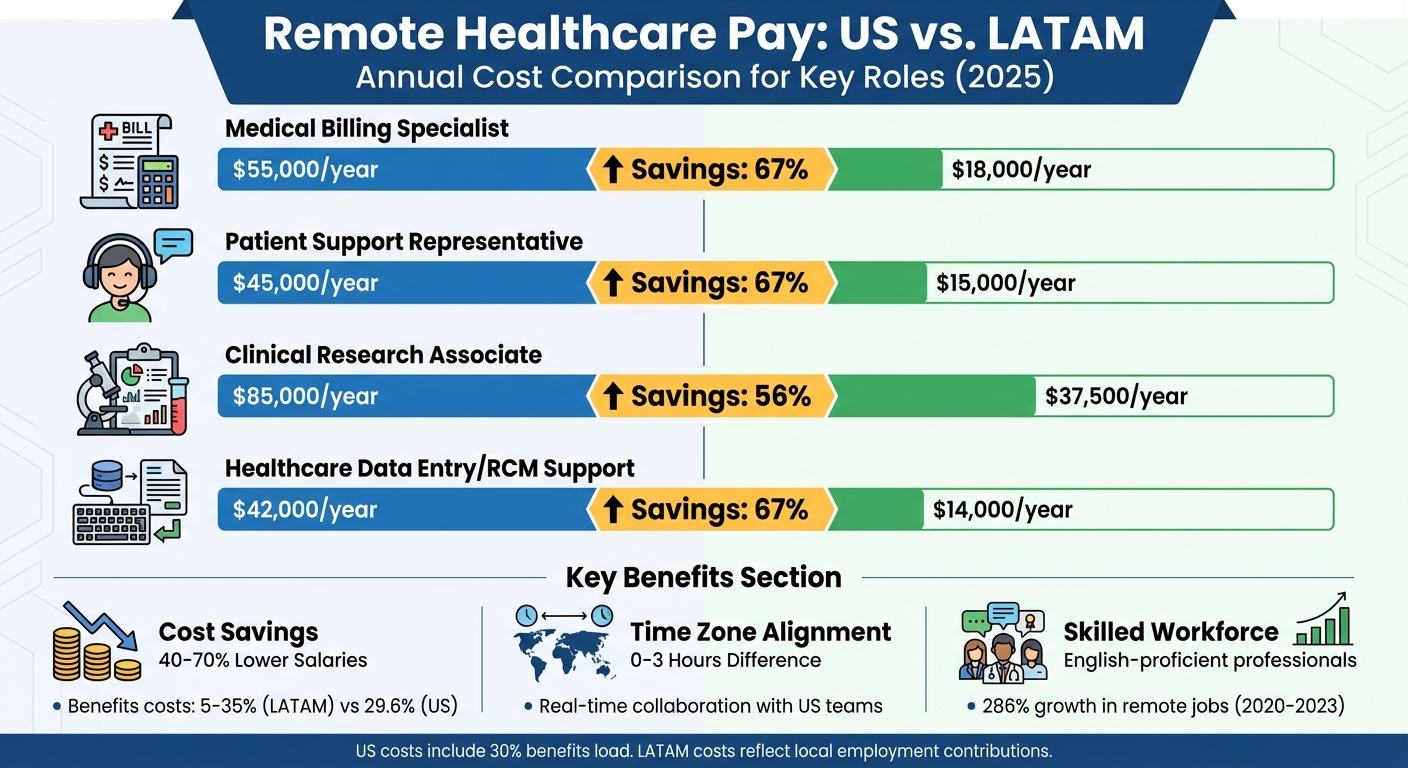
US vs LATAM Remote Healthcare Salary Comparison 2025
Remote Healthcare Pay in the United States
Healthcare employers in the U.S. face significant costs when it comes to employee compensation. Beyond base salaries, they spend an additional 29.6% on benefits, payroll taxes, and other related expenses. For example, a remote nurse earning $90,000 annually actually costs the employer around $116,000 when all expenses are factored in.[2] Let’s break down salaries for key roles in remote healthcare.
Salary Ranges for Key Roles
Salaries in remote healthcare can vary significantly depending on the role. Telehealth physicians in primary care, psychiatry, and urgent care often earn between $200,000 and $300,000 or more annually. Many also receive productivity bonuses tied to patient volume or RVUs. Meanwhile, remote registered nurses working in areas like triage, case management, or utilization review typically earn between $70,000 and $100,000, with experienced nurses in large health systems reaching the higher end of this range.
In non-clinical roles, clinical research associates - who often work remotely or in the field - earn around $80,000 to $120,000, while clinical research coordinators earn between $55,000 and $80,000.[5] Medical coders, one of the most common remote healthcare roles, have salaries ranging from $40,000 to $70,000+. Entry-level coders start at $40,000 to $55,000, while experienced professionals with certifications like CPC or CCS can earn $55,000 to $70,000 or more.[5] Similarly, medical billing specialists typically earn between $40,000 and $60,000.
Regional Pay Differences
Geography plays a big role in determining salaries, even for remote positions. Many U.S. healthcare employers use geographic pay zones to adjust compensation by 10–25%, depending on the cost of living. For example, high-cost metropolitan areas like San Francisco, New York, Boston, and Seattle often pay 15–30% above the national median.[5] A senior medical coder in one of these cities might earn $65,000 to $75,000, compared to $55,000 to $62,000 in lower-cost regions - a difference of about 10–20%.
Remote nurses experience similar regional pay differences. In coastal urban markets, care-management RNs can earn $90,000 to $105,000, while in lower-cost states, salaries typically range from $75,000 to $90,000 - a gap of around 15–25%. To address these disparities, many large U.S. employers have introduced 3–4 geographic pay bands (high, medium, and low cost-of-living zones), ensuring compensation aligns with regional market conditions while maintaining some standardization.
Remote Healthcare Pay in Latin America
LATAM as a Nearshore Talent Source
Latin America has emerged as a key region for sourcing cost-efficient remote healthcare talent for U.S. companies. The region combines several advantages: lower living expenses, a well-educated workforce with strong English proficiency, and time zone alignment with the U.S. Countries like Mexico, Colombia, and Brazil share overlapping work hours with the U.S., making real-time collaboration much easier.[2][3]
Between 2020 and 2023, remote job opportunities in Latin America surged by 286%, positioning the region as the fastest-growing remote talent hub for U.S. businesses heading into 2025.[3][4] Healthcare employers are increasingly capitalizing on this trend, hiring skilled professionals for roles such as medical billing and clinical research support at a fraction of U.S. costs.
Salary Ranges for Key Roles
Salaries in Latin America reflect the region's lower cost of living while remaining competitive within the local job market. In Colombia, healthcare administrators typically earn between $800 and $1,200 per month (equivalent to $9,600–$14,400 annually). Entry-level roles start around $500 per month, while senior positions can go up to $2,000 monthly.[1] In Mexico, salaries for similar positions range from $1,000 to $2,000 monthly ($12,000–$24,000 annually). Meanwhile, in Brazil, experienced healthcare administrators earn between $30,000 and $50,000 annually.[1][3][6]
Medical billing specialists in Colombia and Mexico earn $800–$1,500 per month ($9,600–$18,000 annually), with hourly rates falling between $5 and $12.[1][6] In Brazil, these roles are compensated at $30,000–$40,000 annually, offering U.S. employers savings of 70–80% compared to domestic rates.[3][6] For clinical research support staff, annual salaries range from $24,000 to $50,000, with entry- to mid-level positions in Colombia and Mexico paying $1,000–$2,500 per month ($12,000–$30,000 annually).[1][3][5]
These competitive salaries, combined with reduced overall employment costs, make the region an appealing option for healthcare organizations.
Employment and Benefits Costs
In addition to lower salaries, employer contributions in Latin America are significantly less than in the U.S. Total benefits and statutory costs in the region range from 5–35% of base salaries, compared to an average of 29.6% in the U.S. For example, in Mexico and Colombia, social security, health insurance, and pension contributions typically fall between 20–30% of base pay.[2] In Brazil, these costs can climb as high as 35% due to severance provisions, though access to free public healthcare through the SUS system helps offset some of these expenses.[2][3]
The combination of lower wages and reduced employment costs translates to major payroll savings, making Latin America an increasingly attractive choice for healthcare organizations aiming to expand their remote teams without breaking the bank.[4]
U.S. vs. LATAM Healthcare Salaries: Side-by-Side Comparison
Role-by-Role Cost Comparison
When you stack up healthcare salaries in the U.S. against those in Latin America, the cost differences are striking. For example, a medical billing specialist in the U.S. typically costs around $55,000 per year (this includes a 30% benefits load on top of base pay). In Latin America, the same role comes in at approximately $18,000 annually, offering a 67% reduction in costs [2][6]. Similarly, patient support representatives and medical call center agents cost about $45,000 per year in the U.S., but only $15,000 in LATAM - again, a savings of about 67% [6].
When it comes to clinical research associates, the numbers show a slightly different picture. U.S.-based professionals in this role, who handle remote monitoring and coordination, earn between $75,000 and $95,000 annually. Meanwhile, similar roles in LATAM are available for $30,000–$45,000 per year, representing 40–60% lower costs while still accessing skilled professionals [3][5].
| Role | U.S. Total Annual Cost | LATAM Total Annual Cost | Estimated Cost Savings |
|---|---|---|---|
| Medical Billing Specialist | $55,000 | $18,000 | ~67% |
| Patient Support / Medical Call Center Agent | $45,000 | $15,000 | ~67% |
| Clinical Research Associate | $85,000 | $37,500 | ~56% |
| Healthcare Data Entry / RCM Support | $42,000 | $14,000 | ~67% |
These U.S. salary figures include a 30% benefits load, whereas LATAM costs reflect local employment contributions that range from 5–35%, depending on the country and employment model [2][3][4].
While salary differences are compelling, other factors also play a key role in choosing where to source talent.
Non-Salary Factors That Matter
Beyond the clear salary savings, operational considerations like time zones, language skills, and training needs significantly influence decisions about hiring.
One of LATAM's biggest strengths is time zone alignment. Countries like Mexico, Colombia, and Peru have minimal time differences with U.S. Eastern and Central Time zones, making real-time collaboration almost as smooth as working with domestic teams [2][3][4].
English proficiency is another factor to consider. While U.S.-based staff are typically native English speakers, many professionals in LATAM - especially those from urban areas or with university-level education - possess intermediate to advanced English skills. However, stronger language capabilities often come with higher salary expectations in the region [1][3].
When it comes to certifications and training, U.S. professionals are more likely to hold credentials specific to the U.S. healthcare system, such as CPC, CCS, SOCRA, or ACRP. On the other hand, LATAM candidates usually have local certifications and may require additional onboarding to learn U.S.-specific standards like HIPAA regulations, billing rules, or FDA clinical research processes [3][5].
Infrastructure reliability is another consideration. Major LATAM cities generally have modern remote-work setups with dependable broadband. However, power and internet connectivity can occasionally be less consistent compared to most U.S. metro areas. To ensure uninterrupted operations, backup solutions like 4G/5G hotspots or uninterruptible power supplies are often recommended [3][4].
| Factor | U.S.-Based Remote Staff | LATAM-Based Remote Staff |
|---|---|---|
| Time Zone Alignment | Operate within standard U.S. time zones | 0–3 hours difference with Eastern/Central Time, enabling near-real-time collaboration |
| English Proficiency | Typically native English speakers | Intermediate to advanced in urban areas; varies by region |
| Certifications & Training | Frequently hold U.S.-specific credentials (e.g., CPC, CCS, SOCRA) | Local credentials; may need onboarding for U.S. standards (e.g., HIPAA, FDA, billing rules) |
| Infrastructure Reliability | Consistently strong broadband and power | Reliable in major cities; backup options like hotspots or UPS advised |
| Patient Interaction & Familiarity | Deep understanding of U.S. healthcare practices | Increasing familiarity; may benefit from targeted training for U.S.-specific patient communication |
These non-salary factors, combined with the salary savings, make LATAM an appealing option for healthcare roles, provided that companies plan for any additional onboarding or infrastructure needs.
sbb-itb-88a7fe6
Market Dynamics and Long-Term Outlook
Economic Factors Behind the Pay Gap
The wage gap between U.S. and LATAM healthcare workers is largely influenced by differences in cost of living and currency strength. A compensation study from 2025 revealed that hiring in Latin America allows companies to save about 41% on salaries alone, with overall employment costs - factoring in benefits, payroll taxes, and overhead - dropping by as much as 70% [3][4]. These savings stem from lower wages in the region combined with higher local purchasing power. For instance, in Colombia, remote healthcare support roles typically pay $800–$1,200 per month [6]. In Argentina, where the average local salary is approximately $474 per month, remote roles paid in U.S. dollars can offer $3,200–$4,600 monthly, significantly boosting purchasing power [1].
However, currency fluctuations and inflation add complexity. In high-inflation countries like Argentina, U.S. employers must closely monitor exchange rates and inflation trends, as these factors can diminish real wages. Incorporating regular salary reviews tied to inflation metrics can help ensure that compensation remains competitive over time [3].
These economic disparities are not temporary. By 2025, Latin America has become the fastest-growing hub for remote talent serving U.S. companies. This growth is fueled by ongoing wage differentials, time zone compatibility, and an expanding pool of college-educated, service-oriented professionals [4]. For roles like medical billing, coding support, and patient coordination, the cost advantage compared to U.S.-based hires remains strong, even as LATAM wages gradually increase [6]. These cost differences, however, require a parallel focus on maintaining quality and compliance standards.
Quality and Compliance Requirements
While cost savings are a major driver, maintaining high standards for quality and compliance is equally critical. For remote healthcare roles that involve handling protected health information (PHI), strong English skills and strict adherence to HIPAA regulations are non-negotiable. Patient-facing positions - such as care coordinators, schedulers, and telehealth support - demand advanced spoken and written English skills, often at a B2–C1 level on the CEFR scale, to handle medical terminology and sensitive communications effectively [5][6]. Back-office roles also require excellent reading comprehension and writing abilities, with candidates often undergoing structured language tests and scenario-based assessments to ensure they are ready for the demands of U.S. healthcare environments.
Compliance goes beyond language proficiency. LATAM staff managing PHI must meet the same HIPAA standards as their U.S.-based counterparts. This includes comprehensive background checks, signed confidentiality agreements, secure devices and networks (such as VPNs and encryption), role-based access controls, formal HIPAA training, and documented procedures for responding to security incidents [5]. Treating LATAM employees as integral participants in compliance programs - not as exceptions - ensures regulatory standards are upheld while scaling cross-border teams.
Investing in thorough onboarding and ongoing training is essential to balance cost savings with accuracy, patient satisfaction, and compliance. Candidates with prior experience in U.S. healthcare systems adapt more quickly, make fewer errors, and contribute to better long-term retention and return on investment [5][6].
How Remotely Talents Connects U.S. Employers with LATAM Healthcare Talent
Specialized recruitment services play a key role in overcoming these challenges. Remotely Talents simplifies the process by sourcing, vetting, and matching LATAM candidates who meet U.S. employers' expectations for English proficiency, technical expertise, and healthcare experience. Each client is assigned a senior-level talent acquisition manager who oversees the hiring process with a personalized approach, creating tailored pipelines for roles like patient support, medical billing, and clinical coordination.
The company employs a rigorous screening process to evaluate candidates' technical skills, soft skills, cultural fit, and language abilities. Using advanced recruitment technology - including a robust candidate database, an applicant tracking system, and AI-driven tools - Remotely Talents streamlines hiring and reduces time-to-fill. For healthcare organizations, this means access to pre-screened professionals already familiar with U.S. workflows and compliance requirements, eliminating the need to build recruitment infrastructure from scratch.
Beyond recruitment, Remotely Talents integrates compliance into its services. They assist with setting up secure remote work environments, design onboarding processes that include HIPAA and data privacy training, and provide ongoing performance monitoring. The agency also offers payroll and compliance support, helping clients navigate international labor laws, contracts, and payroll complexities while adhering to global employment standards. With flexible pricing options, such as subscription services or pay-per-hire models, healthcare organizations can scale their teams efficiently, leveraging LATAM talent without compromising on quality or compliance.
Conclusion
Pay Comparison Summary
Healthcare organizations in the U.S. can achieve substantial cost savings - ranging from 40% to 70% - by hiring remote professionals from LATAM. For mid-senior roles, this translates to about $30,000 in annual savings per employee. Administrative and billing positions in LATAM typically cost 70–80% less than their U.S. equivalents. Even highly specialized roles, such as healthcare data scientists (who earn around $155,000–$156,000 annually in the U.S.), can be filled for just $24,000–$36,000 per year[7]. These savings stem from lower base salaries, reduced benefits costs (5–35% of salary in LATAM versus 29.6% in the U.S.), and minimal overhead expenses[2][3][4].
Beyond cost, LATAM professionals bring operational alignment and meet quality standards comparable to U.S.-based employees. With thorough vetting, HIPAA training, and secure remote infrastructure, they deliver dependable performance. Additionally, offering pay above local market rates in LATAM can increase retention by 15–25% and boost productivity by roughly 30%[1].
These factors make LATAM talent a strategic choice for healthcare organizations aiming to balance quality and cost.
What Employers Should Consider
To fully capitalize on these savings, employers need a thoughtful approach. Start by benchmarking salaries in key LATAM regions, including Mexico, Colombia, Brazil, and Argentina, to craft competitive offers that attract top talent. Use the savings to invest in robust training programs and ensure compliance with industry standards[3][4][6].
Partnering with specialized recruitment platforms like Remotely Talents can simplify the process. With dedicated recruiters, a replacement guarantee, and flexible pricing plans, platforms like these ensure a seamless experience from sourcing to onboarding, all while maintaining high standards.
Lastly, treat LATAM hires as integral members of your team rather than short-term cost-saving solutions. Build mixed teams that utilize U.S. staff for high-risk or strategic roles while assigning billing, scheduling, and support tasks to LATAM professionals. This balanced approach not only enhances cost efficiency but also maintains care quality, positioning your organization for sustainable growth in an increasingly remote-first healthcare industry[6][5].
FAQs
How does the cost of living in Latin America impact remote healthcare salaries compared to the U.S.?
Remote healthcare salaries in Latin America tend to be lower than those in the U.S., primarily because of the region's lower cost of living. Wages in LATAM are generally tied to local economic conditions, enabling businesses to offer regionally competitive pay while still cutting labor costs compared to U.S. standards.
This setup creates a beneficial dynamic: companies gain access to skilled healthcare professionals at reduced costs, and LATAM employees maintain purchasing power that aligns well with their local living expenses. It’s a mutually advantageous arrangement for both businesses and remote workers.
What compliance challenges arise when hiring remote healthcare workers from Latin America?
When bringing remote healthcare professionals on board from Latin America, businesses often encounter a few compliance hurdles. These typically revolve around understanding and adhering to local labor laws, meeting data protection regulations like privacy standards, and ensuring that healthcare workers fulfill the necessary licensing requirements for their roles.
Another key consideration is safeguarding patient information. This means aligning with global standards, such as HIPAA in the United States, to ensure the security and confidentiality of sensitive data. Taking proactive steps to address these challenges can make the hiring process smoother and more compliant.
What are the advantages of U.S. and LATAM time zone alignment for remote healthcare operations?
Time zone alignment between the U.S. and LATAM offers clear advantages for remote healthcare operations. One of the biggest perks is the ability to have real-time communication, which ensures teams can collaborate instantly and respond to patient needs without unnecessary delays.
This shared working schedule also boosts workflow efficiency, making tasks like scheduling appointments, conducting consultations, and resolving issues much smoother. The end result? Healthcare providers can offer quicker, more responsive care while keeping team coordination running effortlessly.
Related Blog Posts
Read also



Ready to hire without salary-based agency fees?
Book a free 30-minute consultation. We’ll review your role, timeline, and hiring goals, then show you how our fixed-fee remote search works.