The Highest Paying Remote Jobs in the U.S. in 2026


Remote work in 2026 is thriving, offering high-paying roles across technology, healthcare, finance, and more. These jobs provide six-figure salaries, flexibility, and opportunities to work from anywhere in the U.S. Here's a quick breakdown of the top roles and their salary ranges:
- Cloud Architect: $118,000–$208,000
- Software Engineer: $110,000–$300,000
- Data Scientist: $110,000–$250,000
- Cybersecurity Specialist: $120,000–$200,000
- Product Manager: $105,000–$200,000
- AI and Prompt Engineer: $130,000–$250,000
- UX/UI Designer: $80,000–$170,000
- Telemedicine Physician: $95,000–$256,930
- Financial Analyst: $85,000–$170,000
- Sales/Business Development Manager: $85,000–$300,000
These roles demand specialized skills like cloud computing, AI expertise, data analysis, and cybersecurity knowledge. Industries such as SaaS, fintech, healthcare, and e-commerce are leading the hiring push. While remote work offers flexibility, challenges like job security concerns and location-based pay adjustments remain.
For success, focus on in-demand skills, certifications, and measurable achievements to stand out in this competitive market.
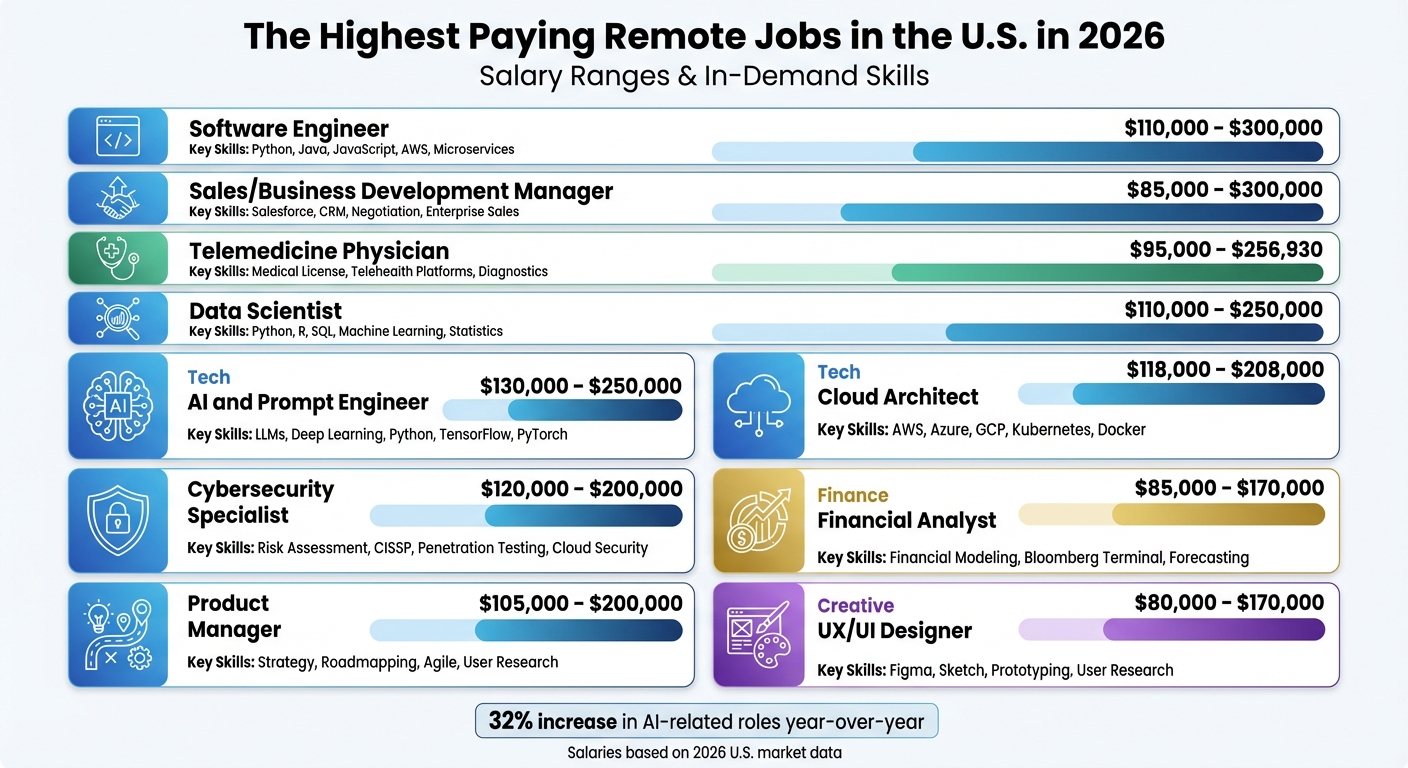
Top 10 Highest Paying Remote Jobs in the U.S. 2026 - Salary Ranges and Key Skills
1. Cloud Architect
Salary Range (USD)
By 2026, remote Solutions Architects are expected to earn between $118,000 and $184,000, with a median salary of $148,000. Meanwhile, Cloud Security Architects could see salaries ranging from $136,000 to $208,000, with a median of $168,000 [1]. Keep in mind, these figures represent base salaries only [3]. These numbers highlight how much companies value strong cloud architecture expertise.
Demand Outlook
The demand for Cloud Architects continues to grow as businesses increasingly digitize their operations. Industries like technology, finance, and professional services are actively seeking professionals who can design and maintain cloud infrastructures. In August 2025, sectors such as financial activities (26.2%), professional and business services (26.3%), and information (25.5%) reported high levels of remote work [11]. For example, Atlassian advertised a remote Principal Full Stack Software Engineer role in December 2025, requiring deep knowledge of AWS services [13].
Core Skills and Tools
To thrive as a Cloud Architect, you'll need to master platforms like AWS, Azure, or Google Cloud Platform. Familiarity with Kubernetes, Docker, and container orchestration is critical, along with hands-on experience in CI/CD pipelines and automation tools. A strong understanding of microservices, distributed systems, and high-availability architecture is also essential. Security expertise is increasingly important, with companies prioritizing skills in zero-trust architecture and other secure cloud practices [1]. Additionally, proficiency in programming languages such as Python, Java, or Go is a must [6][7].
Typical Hiring Industries
Tech and software companies are at the forefront of hiring Cloud Architects, followed closely by businesses in AI, data, and cybersecurity [1]. Other major players include financial services, healthcare, and legal industries [10]. For instance, CrowdStrike, a company with a remote-first workforce, continues to recruit talent to support its secure cloud storage solutions. This trend underscores the growing demand for cloud expertise across various sectors [12].
2. Software Engineer
Salary Range (USD)
In 2026, remote Software Engineers earn an average salary of $110,000, though pay scales can vary significantly based on experience and area of expertise [2]. Interestingly, a study from 2025 revealed that 16.9% of software engineering roles offered salaries exceeding $200,000 [9]. Positions at the higher end of the spectrum - especially those focused on AI, machine learning, or enterprise architecture - can bring in anywhere from $150,000 to $300,000 annually [8].
Demand Outlook
The demand for Software Engineers shows no signs of slowing down. Employment in this field is expected to grow by 25% by 2031, with approximately 162,900 job openings projected [14]. Companies are increasingly embracing remote work for engineering roles, realizing that top talent can be sourced globally. The rise of AI and automation is also transforming the industry, making expertise in AI as crucial as basic digital skills [15]. To thrive in this evolving landscape, staying current with key technical skills is more important than ever.
Core Skills and Tools
Landing a well-paying remote Software Engineer position requires strong command of programming languages like Python, Java, and JavaScript [6]. Familiarity with microservices, distributed systems, and AWS cloud services is becoming indispensable [13]. For example, in 2025, Atlassian sought a Principal Full Stack Software Engineer with over 10 years of experience in enterprise-grade solutions, proficiency in Java and Kotlin, knowledge of observability tools, and expertise in AWS [13]. Beyond technical skills, remote engineers need to excel in asynchronous communication, self-management, and working effectively across time zones [2]. While many employers prefer candidates with a computer science degree, alternative pathways like coding bootcamps and certifications - such as AWS Certified Developer - are increasingly gaining recognition [6].
Typical Hiring Industries
Tech companies remain the biggest employers of remote Software Engineers, but there's also strong demand in financial services, healthcare, and e-commerce. The technology and data-driven sectors continue to fuel the remote job market [2]. With predictions that 39% of the global workforce will be remote by 2026 [2], businesses across industries are building distributed engineering teams to maintain their competitive edge.
3. Data Scientist
Salary Range (USD)
Remote Data Scientists in the U.S. are expected to earn between $110,000 and $165,000 by 2026 [7]. For those advancing to Principal Data Scientist roles, salaries can climb significantly, falling between $160,000 and $250,000 [8]. These numbers highlight both the demand and the specialized expertise required in this ever-evolving field.
Demand Outlook
The need for Data Scientists is on the rise, with a projected 34% growth over the next decade [10]. This demand is driven by the sheer volume of data generated across industries, pushing companies to hire skilled professionals capable of working independently to extract meaningful insights [8]. Additionally, AI-related roles have seen a 32% year-over-year increase, further fueling this growth [2]. Companies such as Airbnb, Uber, Netflix, Spotify, and DoorDash are actively recruiting remote Data Scientists, showcasing the critical role these experts play in shaping data-driven business strategies [7].
Core Skills and Tools
To succeed as a remote Data Scientist, proficiency in programming and analytical tools is a must. Expertise in Python (including libraries like pandas, NumPy, and scikit-learn), R, SQL, advanced statistics, and machine learning algorithms is essential [8,9]. Familiarity with data visualization tools like Tableau, Looker, or Matplotlib is equally important [8,9]. Employers often seek candidates with academic backgrounds in computer science, statistics, mathematics, or business, with many professionals pursuing advanced degrees [7,11]. Beyond technical skills, strong business acumen, clear communication, and the ability to present findings asynchronously are critical for translating complex data into actionable business strategies [8].
Typical Hiring Industries
Remote Data Scientists are in high demand across industries such as technology, fintech, healthcare tech, life sciences, e-commerce, retail, and consulting. These professionals play a key role in decision-making processes through predictive modeling, A/B testing, and delivering strategic insights [3,8]. Technology companies, particularly those in software, SaaS, fintech, and cloud services, are at the forefront of hiring. Additionally, the finance and fintech sectors stand out for offering some of the most lucrative remote opportunities [3,8].
4. Cybersecurity Specialist or Analyst
Salary Range (USD)
In the U.S., remote Cybersecurity Specialists and Analysts are projected to earn a median annual salary of $135,000 by 2026 [11]. Salaries for these roles typically range from $120,000 to over $180,000 per year [9], with Cybersecurity Consultants often earning between $140,000 and $200,000 annually [6]. These figures highlight the increasing value placed on cybersecurity skills in the remote workforce.
Demand Outlook
The demand for cybersecurity professionals is surging, fueled by growing digital threats and the widespread adoption of remote work. Cybersecurity roles are expected to see significant growth by 2026 [2]. For instance, recent phishing attacks have impacted 42% of organizations, underscoring the urgent need for skilled experts [5]. Furthermore, 60% of business and tech leaders are prioritizing investments in cyber risk management as they navigate geopolitical challenges and the rise of AI technologies [5]. Despite these efforts, only 6% of organizations feel fully prepared to tackle all cybersecurity vulnerabilities, driving a continuous demand for remote specialists [5]. Notably, 36% of organizations are channeling their cybersecurity budgets into AI tools over the next year [5].
Core Skills and Tools
To excel in remote cybersecurity roles, professionals need a strong foundation in areas like risk assessment, cloud security, networking, system administration, and encryption. Skills in penetration testing, compliance frameworks, and incident response are equally important. Certifications such as CISSP (Certified Information Systems Security Professional), CEH (Certified Ethical Hacker), and CompTIA Security+ are highly regarded. For cloud-specific roles, credentials like AWS Certified Cloud Practitioner or CompTIA Cloud+ can provide an edge. Beyond technical expertise, strong problem-solving abilities and asynchronous communication skills are crucial. A portfolio showcasing measurable achievements in remote cybersecurity can further enhance job prospects [2][6][8].
Typical Hiring Industries
Remote Cybersecurity Specialists are in demand across a range of industries, including technology, finance, fintech, healthcare tech, and e-commerce [2]. The increasing adoption of AI has heightened cybersecurity risks [5], and the exponential growth in global data creation has made security analysts essential in nearly every sector [1].
5. Product Manager
Salary Range (USD)
In 2026, remote Product Managers in the U.S. are earning impressive salaries, with an average annual base pay of $120,000 [2]. Base salaries typically range from $105,000 to $168,000 [1]. Senior Product Managers often see earnings between $120,000 and $180,000 [7], while those specializing in Fintech can command between $140,000 and $200,000 or more [9]. These figures highlight the critical role Product Managers play in shaping product strategies and driving business growth.
Demand Outlook
The demand for remote Product Managers remains robust. In 2026, these roles are becoming increasingly prominent, particularly for professionals adept at navigating remote and hybrid service models. Technology and data-driven industries offer some of the most lucrative opportunities [2]. Fintech is another hotspot for hiring, with companies like Notion, Figma, Miro, Airtable, and Webflow actively seeking Senior Product Managers [7]. Industry leaders such as Stripe, Square, and Coinbase are also expanding their teams [9]. This growing demand reflects the vital need for skilled managers who can deliver impactful product strategies.
Core Skills and Tools
Being a successful remote Product Manager requires a mix of strategic thinking, technical know-how, and the ability to collaborate effectively. Key skills include product strategy, roadmapping, user research, data analysis, and managing cross-functional teams [7]. Familiarity with Agile methodologies and UX principles is essential [2]. Strong communication and stakeholder management skills are critical, especially when working across time zones. A technical understanding of APIs, databases, and system architecture can provide a competitive edge. Additionally, proficiency in tools like Slack, Asana, and Notion is indispensable for staying organized and connected in a remote work environment.
Typical Hiring Industries
The technology, SaaS, and Fintech sectors are leading the charge in hiring remote Product Managers [3, 8, 10]. Enterprise SaaS companies and providers of development tools are key players. Opportunities are also growing in fields like AI, blockchain, and clean technology. Other industries undergoing significant digital transformation - such as e-commerce, marketing tech, healthcare, banking, and manufacturing - are also seeking skilled Product Managers to guide their growth.
6. AI and Prompt Engineer
Salary Range (USD)
AI and Prompt Engineers are carving out a lucrative niche in the remote job market. By 2026, the average salary for a remote AI Prompt Engineer is expected to hover around $130,000 [2]. Those with extensive experience - particularly in machine learning - can command salaries ranging from $140,000 to $220,000 per year, with some elite positions offering as much as $250,000 annually [8]. These roles often outpace other technical positions by an additional $20,000–$50,000, reflecting the specialized knowledge required [7]. This compensation surge mirrors the growing demand for these skills, as detailed in the demand outlook below.
Demand Outlook
The rising salaries for AI and Prompt Engineers are a direct response to their increasing importance in the tech landscape. Over the past year, global demand for AI-related roles has surged by 32% [2], fueled by the widespread adoption of AI and automation. These engineers play a critical role in optimizing large language models and generative AI to enhance productivity, analytics, and security [1][2]. Companies like OpenAI, Hugging Face, Scale AI, Anthropic, and Google are at the forefront of hiring remote talent [7]. Meanwhile, tech giants such as Airbnb, Uber, and Meta are offering highly competitive salaries for roles focused on advancing AI solutions [9]. With demand outpacing supply, salaries continue to climb [7][8].
Core Skills and Tools
To thrive as an AI and Prompt Engineer, you’ll need a blend of technical know-how and hands-on experience. Key skills include expertise in deep learning, neural networks, MLOps, prompt engineering, and working with large language models. Proficiency in programming languages and tools like Python, R, SQL, TensorFlow, PyTorch, and Scikit-learn is essential [7]. Familiarity with statistical analysis, data visualization, and cloud platforms like AWS, Google Cloud, or Azure adds significant value [9]. Most positions require 3 to 8 years of experience, and showcasing your capabilities through a public GitHub portfolio or open-source contributions can set you apart [7].
Typical Hiring Industries
The demand for AI and Prompt Engineers spans a variety of industries. Leading the charge are technology and software companies, particularly those in SaaS, enterprise software, and cloud services [7]. The finance and fintech sectors are also leveraging AI for analytics and automation [2]. Other active hiring industries include cybersecurity, healthcare tech, legal tech, and data analytics firms [7]. Even education and consulting organizations are expanding their AI initiatives as digital transformation continues to reshape how businesses operate [2].
7 Boring But High Paying Remote Jobs (Always Hiring in 2026)
sbb-itb-88a7fe6
7. UX or UI Designer
Creative roles, like UX and UI design, are now stepping into the spotlight with competitive remote salaries, right alongside their technical counterparts.
Salary Range (USD)
Remote UX/UI designers can expect annual salaries ranging from $80,000 to $150,000. Senior-level designers typically earn between $95,000 and $150,000, while design directors see figures as high as $110,000 to $170,000 [7][8][9].
Demand Outlook
The demand for UX/UI designers is on a steep upward trajectory. By 2026, 70% of hiring managers plan to grow their UX teams [16]. In Q3 2025 alone, 30% of job postings in Marketing and Creative fields offered hybrid roles, while 15% were fully remote [17]. Companies like Figma, Webflow, Framer, Abstract, InVision, Airbnb, Netflix, Spotify, IDEO, and Frog Design are actively scouting for remote talent in this space [7][9]. This surge in demand highlights the importance of having a well-rounded and polished skill set.
Core Skills and Tools
To excel as a remote UX/UI designer, mastery of design tools and seamless remote collaboration are a must. Familiarity with Figma, Sketch, and Adobe Creative Suite is non-negotiable. Designers should also be skilled in prototyping, wireframing, and interaction design, as well as user research and testing methodologies - covering both qualitative and quantitative approaches, including A/B testing. Knowledge of design systems and strong asynchronous communication abilities can further set candidates apart [7][8].
Typical Hiring Industries
The biggest demand for remote UX/UI designers comes from Technology, Data, and Digital Marketing & Design sectors. Software and web development platforms are especially hungry for design expertise, fueled by the ongoing digital transformation and the rapid growth of AI and automation. Remote and hybrid work models are becoming the norm as companies tap into global talent pools to stay competitive [2][17].
8. Virtual Healthcare Consultant or Telemedicine Physician
The digital shift in healthcare is opening up exciting opportunities for remote roles, blending medical expertise with cutting-edge technology.
Salary Range (USD)
Remote healthcare jobs come with a wide range of earning potential. For instance:
- Healthcare Operations Professionals are expected to earn a median salary of $131,000 per year by 2026 [11].
- Healthcare IT Specialists can see salaries ranging from $95,000 to over $150,000 annually [9].
- Telemedicine Physicians, including psychiatrists, average $256,930 per year [18].
Demand Outlook
The demand for virtual healthcare professionals is on the rise, driven by competitive salaries and the growing integration of technology into healthcare. Michelle Perchuk, Founder of MTV Coaching, highlights this shift:
"Healthcare operations, telehealth and transformation in tech initiatives are crucial because doctors now interact with patients in an almost customer-like manner" [11].
This shift is fueling the need for experts who can design strategies to improve service delivery and broaden healthcare access through digital tools. Companies such as Epic Systems, Cerner, and Teladoc are actively recruiting for these specialized roles [9].
Core Skills and Tools
Thriving in virtual healthcare requires a mix of clinical knowledge and technical skills. For example:
- Telemedicine Physicians need strong diagnostic skills and familiarity with telehealth platforms like Doxy.me and VSee [18].
- Healthcare IT Specialists should be proficient in electronic health records (EHR) systems, telemedicine platforms, and healthcare data analytics [9].
Additionally, remote healthcare professionals must excel in communication, be self-directed, and possess cultural awareness to navigate diverse patient needs effectively [9] [18].
Typical Hiring Industries
The push for telehealth and tech-driven healthcare solutions is creating opportunities across the industry. Organizations are prioritizing professionals who can implement strategies to enhance service efficiency and extend care to underserved populations [11]. This trend underscores how digital healthcare is reshaping accessibility and service delivery in meaningful ways.
9. Financial Analyst or Senior Financial Consultant
The finance industry is embracing remote work at a rapid pace, as traditional institutions adapt to new distributed work models. This shift has opened up a wealth of opportunities for finance professionals, who are now able to thrive in remote roles while delivering impactful results.
Salary Range (USD)
Data from the U.S. Bureau of Labor Statistics shows that Financial Analysts earn an average annual salary of $112,950. For those in senior positions or with specialized expertise, such as Investment Professionals, salaries range from $85,000 to $170,000 [7][8][9].
Demand Outlook
By Q3 2025, fully remote roles made up 13% of Finance and Accounting job postings, with an additional 26% offering hybrid arrangements [17]. Major players like JPMorgan Chase, Goldman Sachs, and Fidelity have embraced remote work, alongside fintech companies such as Stripe, Square, Brex, and Ramp. These organizations are hiring for roles focused on financial modeling, strategic planning, budgeting, and forecasting [7][9].
Core Skills and Tools
To excel in remote finance roles, professionals need a strong command of financial modeling, forecasting, and strategic planning. Tools like Bloomberg Terminal and Refinitiv are essential for accessing real-time market data and conducting in-depth analysis [9]. Beyond technical expertise, success also depends on clear asynchronous communication and the ability to produce measurable results while working across time zones [8]. Highlighting achievements like revenue growth, cost savings, or operational improvements can set candidates apart in this competitive field [8].
Typical Hiring Industries
Traditional banks, such as Citizens Bank, are increasingly hiring remote workers for roles in operations, mortgage processing, and accounting [12]. At the same time, fintech companies continue to lead the way in expanding remote opportunities. Investment firms and financial services companies are also recognizing the benefits of remote work, particularly the ability to recruit top talent without geographical limitations [8][9].
10. Remote Sales or Business Development Manager
Remote sales and business development positions are some of the highest-paying opportunities in the current remote work environment. Companies across various industries have realized that exceptional sales talent can drive revenue regardless of location, breaking free from geographic limitations.
Salary Range (USD)
Remote Sales Managers bring in an average annual salary of $112,332 [6]. Business Development Managers typically see earnings between $85,000 and $135,000 [8]. For senior-level roles, Sales Directors and VPs of Sales earn between $130,000 and $220,000 [7], while Sales Engineering Managers make $130,000 to $190,000 [8]. Enterprise Sales Representatives, factoring in commissions, can reach total compensation of $100,000 to $300,000 or more per year [9].
Demand Outlook
The demand for remote sales professionals is growing rapidly as companies aim to access global talent pools. Remote work has proven that sales teams can successfully manage client relationships, deliver virtual presentations, and close deals without the need for in-person meetings. Industries like technology, SaaS, fintech, and healthtech are particularly aggressive in hiring, leveraging remote sales teams to cover multiple territories and time zones while cutting operational costs.
Core Skills and Tools
To thrive in remote sales, professionals need a blend of technical expertise and strong interpersonal abilities. Proficiency in Salesforce and other CRM platforms is vital for managing pipelines and forecasting [7]. Additionally, skills in enterprise sales, negotiation, and managing digital relationships are critical [8,9]. Remote sales professionals must excel in asynchronous communication and collaboration across time zones, using tools like Zoom and Microsoft Teams to build trust and rapport [9]. For leadership roles, data-driven decision-making, strategic planning, and remote team mentorship are essential [7]. A strong portfolio showcasing measurable results - such as revenue growth, deal closure rates, or market expansion - can make candidates stand out in this competitive field [8].
Typical Hiring Industries
Technology companies, especially SaaS providers, are at the forefront of hiring remote sales professionals. Fintech and healthtech organizations are also expanding their remote sales teams, seeking experts who can handle complex products and lengthy sales cycles. Even traditional enterprises are embracing remote sales to reduce expenses and broaden their market reach. In this environment, employers value candidates who can work effectively across global markets and demonstrate an understanding of diverse business cultures [9]. This shift highlights the growing acceptance of remote work as a key component of modern sales strategies.
Pros and Cons of High-Paying Remote Jobs
High-paying remote jobs come with a mix of perks and challenges. For many workers, flexibility is a priority - 85% of employees rank remote work as more important than salary when choosing a job [4]. The appeal is clear: working remotely often means better work-life balance, no time wasted on commuting, and access to jobs that don't require relocation. This is particularly beneficial for fields like technology, healthcare, and finance, where specialized roles can now be filled without geographical barriers.
But it's not all smooth sailing. 83% of global CEOs expect a return to full-time office work by 2027 [5], casting doubt on the long-term stability of fully remote roles. Hybrid work models are gaining traction, with companies increasingly calling employees back to the office. This shift creates uncertainty for remote workers. On top of that, remote work can blur the lines between professional and personal life - 65% of workers report significant stress during the workday, and 77% say work often intrudes on their personal time [4]. Setting boundaries is crucial but not always easy.
"Many leaders claim to support hybrid work but are calling employees back more often because of underlying pressures and old habits. They equate visibility with productivity and fear losing culture and collaboration. Executives still say 'hybrid,' but often mean structured office days rather than true flexibility." - Stacie Haller, Chief Career Advisor, Resume Builder [5]
The financial aspects of remote work also present complexities. While high salaries are a draw, 66% of professionals would choose on-site roles if they paid more, and some companies adjust remote salaries based on location, cutting them by as much as 20–40% [5][7]. Additionally, 26% of workers reported increased anxiety about job security in 2025 compared to six months earlier [4]. These factors highlight the trade-offs professionals must weigh when considering a remote career.
Quick-Reference Summary of Remote Roles
| Role | Salary Range (USD) | Demand Outlook | Key Skills Required |
|---|---|---|---|
| Cloud Architect | $140,000 – $200,000+ | Very High | AWS, Azure, GCP, system design |
| Software Engineer | $100,000 – $180,000+ | Very High | Programming languages, frameworks |
| Data Scientist | $110,000 – $170,000+ | High | Python, R, machine learning |
| Cybersecurity Specialist | $100,000 – $160,000+ | Very High | Security protocols, threat analysis |
| Product Manager | $120,000 – $180,000+ | High | Strategy, roadmap planning |
| AI and Prompt Engineer | $130,000 – $200,000+ | Very High | LLMs, prompt optimization |
| UX/UI Designer | $85,000 – $140,000+ | Moderate | Design tools, user research |
| Telemedicine Physician | $150,000 – $250,000+ | High | Medical license, telehealth platforms |
| Financial Analyst | $85,000 – $150,000+ | Moderate | Financial modeling, Excel |
| Sales/BD Manager | $85,000 – $220,000+ | High | CRM platforms, negotiation |
Conclusion
By 2026, the remote job market is thriving, fueled by the demand for specialized technical skills and the growing preference for flexible work arrangements. Roles in technology - especially in areas like AI, cloud architecture, and cybersecurity - are leading the charge, with salaries often surpassing $150,000 per year. Healthcare and finance are also offering attractive remote opportunities, particularly for seasoned professionals. Global demand for AI-skilled roles has surged by 32% year-over-year [19], and this upward trend reflects how businesses are prioritizing expertise that drives revenue and ensures operational stability.
For professionals aiming to stay competitive, sharpening in-demand skills is essential. If you're eyeing infrastructure roles, focus on mastering cloud platforms like AWS, Azure, or GCP. For those interested in data science, skills in Python, machine learning, and data analysis are key. Certifications can also be a game-changer - hiring for remote and hybrid roles is 29% faster when candidates hold at least one technical certification [2]. Credentials such as the Certified Information Systems Security Professional (CISSP) for cybersecurity or AWS Solutions Architect certification for cloud roles can help you stand out in the crowd.
Equally important is showcasing your expertise through a strong portfolio. Employers in 2026 are increasingly adopting skills-first hiring, where proven abilities outweigh traditional credentials [19]. Include projects, freelance work, or contributions to open-source initiatives to demonstrate your capabilities. For non-technical roles like product management or sales, highlight measurable achievements - think revenue growth, successful product launches, or client acquisition metrics. These efforts will position you to succeed in a competitive, skill-driven job market.
The appeal of remote work extends beyond convenience - it’s now a top priority for many professionals. In fact, 69% of workers would accept a pay cut for the chance to work remotely [4]. This shift gives workers more leverage in salary negotiations and work arrangements. Senior positions often offer more remote opportunities, so advancing your expertise and career is essential [17]. As remote work continues to reshape career success, aligning your skills with market demands will be your key to thriving.
FAQs
What skills do you need to land a high-paying remote job in 2026?
To land a high-paying remote job in 2026, you’ll need a combination of technical know-how, interpersonal skills, and familiarity with essential tools. On the technical side, skills like cloud computing, artificial intelligence, cybersecurity, data analysis, and software development are highly sought after. Knowing programming languages such as Python, Java, and SQL, along with expertise in frameworks like React, can give you a competitive edge.
But technical skills alone won’t cut it. Employers are equally focused on strong communication abilities, leadership qualities, and the flexibility to thrive in remote work setups. Problem-solving and the capacity to collaborate seamlessly with virtual teams are also key traits hiring managers value. Sharpening these skills can put you in a strong position to stand out in the bustling remote job market.
How does location-based pay affect remote job salaries in the U.S.?
Location-based pay adjustments are an important factor in setting salaries for remote jobs in the U.S. Employers typically evaluate things like the cost of living, local job market trends, and the economic conditions of a particular region. For instance, remote workers living in high-cost areas might earn higher wages, while those in regions with lower living expenses could see salaries adjusted accordingly.
These adjustments allow companies to remain competitive by aligning pay with regional norms, which helps attract skilled professionals while maintaining a sense of fairness. For remote workers, understanding how location impacts pay can be a useful tool when setting salary expectations or negotiating compensation for a role.
What industries are expected to have the highest demand for remote jobs in 2026?
In 2026, industries such as technology, cybersecurity, finance, healthcare, and digital marketing are expected to dominate the demand for remote work. These sectors are growing quickly and depend on specialized skills that translate well to a remote environment.
Positions like software developers, data analysts, telemedicine professionals, and online marketers are especially in demand. These roles not only provide the flexibility of working from home but also offer competitive salaries, making them attractive career options.
Related Blog Posts
Read also



Start your first search. No commitment, no placement fee
Book a free 30-minute consultation. We'll map out your role, your timeline, and whether RemotelyTalents is the right fit — with no pressure to start.