Contingency Planning for Remote Teams


Remote teams face unique challenges, from internet outages to cybersecurity threats, making contingency planning essential for smooth operations. This guide covers practical steps to minimize disruptions and maintain productivity across distributed teams. Key takeaways:
- Disruption Management: Prepare for outages, software failures, and staffing gaps with backup tools, communication methods, and clear role coverage.
- Risk Assessment: Identify and prioritize risks like connectivity issues and data breaches. Use tools like risk matrices to allocate resources effectively.
- Staffing Solutions: Address hiring delays and skills gaps with pre-vetted talent pools and cross-training strategies to ensure resilience during staffing shortages.
- Regular Drills: Conduct quarterly practice runs to test recovery plans and refine processes.
- Growth-Ready Plans: Build systems that scale with your team, including role categorization and backup staffing models.
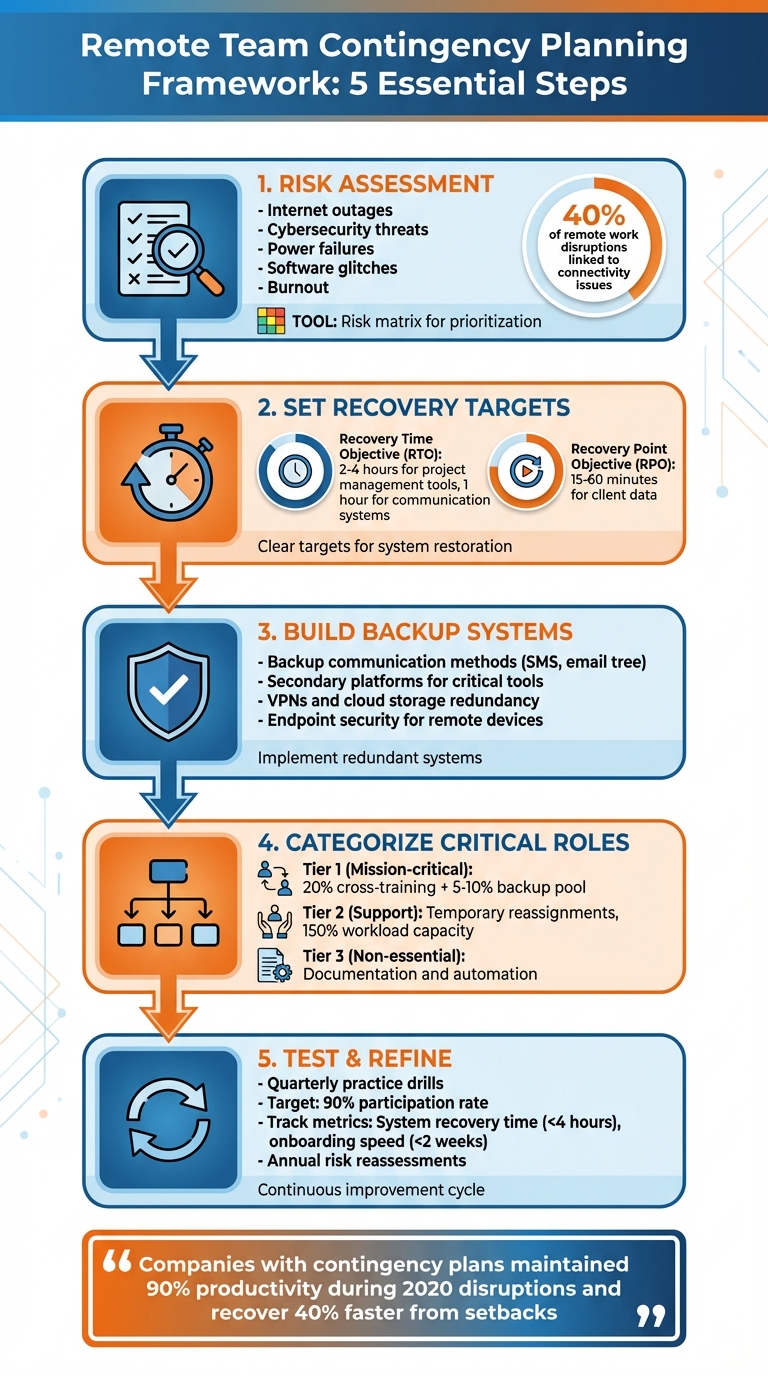
Remote Team Contingency Planning Framework: 5 Essential Steps
Creating the Foundation of Your Remote Contingency Plan
Essential Elements of a Remote Contingency Plan
To build a strong remote contingency plan, start by identifying potential threats like internet outages, data breaches, or regional power failures. From there, establish backup communication methods - such as SMS or an email tree - to ensure connectivity if your primary video platform goes down. It’s also wise to have secondary platforms ready for crucial tools, including cloud storage and VPNs, and assign specific crisis-response roles. Document all these procedures in a centralized, cloud-accessible format that your team can easily reference.
Set clear recovery targets to minimize downtime. For example, you might aim for a recovery time objective (RTO) of 2 to 4 hours for project management tools and 1 hour for communication systems, with a recovery point objective (RPO) of 15 to 60 minutes for client data. Form a cross-functional committee that includes IT, HR, and management to oversee the plan, and define roles clearly - using a RACI matrix can help. Assign a plan owner who will update the strategy quarterly, and as your team grows, conduct regular scalability reviews to ensure the plan remains effective.
Once the basic framework is in place, dive deeper into remote-specific risks to identify operational weak points.
How to Assess Risks Specific to Remote Work
Use tools like a SWOT analysis or risk matrix to map out risks unique to remote work. Common challenges include internet outages, cybersecurity breaches from unsecured networks, regional power failures (such as those caused by East Coast storms), software glitches, and even employee burnout. Research shows that 40% of remote work disruptions are linked to connectivity issues[3].
Rank these risks by evaluating both their likelihood and potential impact. High-priority risks, such as internet outages or cybersecurity threats, require immediate attention. Regional challenges, like time zone differences or local events, may call for additional strategies. A risk matrix can help you allocate resources effectively. For instance, if connectivity failures are a top concern, you might allocate around $10,000 for VPN redundancies[2].
Collaborate with IT, HR, and management to audit your current systems. Check whether your CRM has reliable backup protocols and confirm that remote employees have proper endpoint security. Use metrics like downtime frequency or resource gap analyses (e.g., identifying a 20% skills shortfall) to guide your planning and ensure the strategy can scale with your needs.
These insights not only strengthen your contingency plan but also shape your hiring strategy, which is the next critical piece.
Using Talent Partners to Reduce Hiring Risks
Once you’ve assessed technical risks, turn your attention to human resource challenges. Issues like skills gaps, hiring delays, or sudden vacancies can disrupt remote operations, especially during periods of growth. Partnering with specialized talent providers can help. For example, Remotely Talents offers pre-vetted candidates across IT, Marketing, Finance, and Operations from regions like Europe, Latin America, and North America. Their Recruitment as a Service model can cut hiring times by up to 50% and includes a 90-day replacement guarantee.
Pre-vetted talent pools make it easier to quickly fill critical positions, minimizing downtime caused by staffing shortages.
"It helps a lot to have supporting us while we are navigating local market challenges."
- Beata Rajeckaite, Operations Manager, OneRhythm
Talent partners also address time zone alignment by prioritizing hires with overlapping working hours, reducing communication delays during disruptions. In 2024, Pete Geherin, Vice President at TradeCentric, worked with Remotely Talents to fill three key roles during an expansion into Eastern Europe. This collaboration ensured smooth and responsive operations in the new market[1]. By incorporating talent acquisition into your contingency plan, you can turn staffing challenges into an opportunity to strengthen your team.
Addressing Major Risks in Remote Workforce Operations
Infrastructure and Operations Risks
Remote work comes with its share of challenges, especially when it comes to maintaining smooth operations. Power outages, unstable internet connections, and reliance on specific tools can bring productivity to a halt - imagine your main communication platform going down during a critical client deadline. Research highlights connectivity issues as a leading cause of disruptions. To stay ahead, consider setting up backup internet options like mobile hotspots and creating clear escalation procedures. Keep a list of alternative tools handy - for example, switching from a video conferencing platform to SMS or email - and ensure contact trees, including personal phone numbers, are stored securely in multiple cloud locations for easy access during outages.
Adding redundancy to your setup is another smart move. Subsidize stronger home internet connections for employees in key roles, provide standardized equipment with preconfigured security settings, and maintain subscriptions to backup SaaS platforms. Running quarterly drills where teams practice using secondary systems builds the muscle memory needed to act quickly in real scenarios. Don’t forget to bolster your cybersecurity efforts to guard against digital threats.
Cybersecurity and Data Protection Issues
Remote work creates new vulnerabilities, as home networks often lack the robust protections of office environments. Personal devices are also more prone to phishing attacks and data breaches. To protect sensitive information, implement VPNs, enforce multi-factor authentication, and deploy endpoint protection tools. Restrict data access to what employees need for their specific roles and schedule regular encrypted backups. Testing restoration procedures ensures you’re prepared if recovery becomes necessary.
Security awareness training tailored to remote work is a must. Focus on topics like phishing, secure Wi-Fi usage, and incident reporting to strengthen your team’s defenses. These proactive measures serve as the first line of protection against cyber threats.
Talent Pipeline and Staffing Risks
Remote work can also stress staffing systems. High turnover, burnout from blurred boundaries between work and personal life, and time-zone challenges can disrupt operations - especially during periods of rapid growth. Losing a key team member, whether due to resignation, illness, or even a sudden power outage, can stall projects without a quick replacement plan.
To counteract these risks, cross-train team members so multiple people are equipped to handle high-impact tasks. Maintain a clear responsibility matrix that identifies at least two capable individuals for critical roles. Flexible staffing models, like staggered time zones for follow-the-sun coverage, reduce reliance on specific regions. Partnering with talent providers like Remotely Talents can also help you access pre-vetted candidates quickly, minimizing downtime during staffing emergencies. These strategies ensure your team stays resilient, no matter the circumstances.
Building Contingency Strategies That Scale with Growth
Planning for Different Growth and Disruption Scenarios
A solid contingency plan should address both growth opportunities and potential disruptions. Think about specific growth scenarios like doubling your workforce from 50 to 100 employees, expanding into new markets, or managing seasonal demand surges. At the same time, plan for disruptions such as regional outages, system failures, or cyberattacks. A risk matrix can help you set clear objectives (e.g., limiting downtime to under 4 hours) and outline detailed, actionable responses. These could include pre-qualified talent pools and backup communication systems.
Regular quarterly simulations are a must. These practice runs help your team test recovery strategies, ensuring you can meet your targets and spot any weak points before a real crisis hits. These exercises also pave the way for identifying critical roles and establishing backup strategies.
Categorizing Critical Roles and Backup Staffing Plans
Breaking down roles into different tiers is key to effective contingency planning. Here’s a simple framework:
- Tier 1: Mission-critical roles that are essential to operations.
- Tier 2: Support roles that are important but not immediately critical.
- Tier 3: Non-essential roles that can be delayed or automated.
For Tier 1 roles, aim for 20% cross-training among team members and maintain a backup pool covering 5-10% of your headcount. For instance, if you have 10 key developers, ensure at least one trained backup and access to pre-vetted candidates who can step in within 24-48 hours. Tier 2 roles can rely on temporary internal reassignments, with team members trained to handle up to 150% of their usual workload for short periods. Tier 3 roles should have well-documented procedures that allow for automation or brief delays.
Use a substitution matrix to clearly map who covers which roles during emergencies. Store this information, along with contact details, in multiple secure cloud locations. To ensure readiness, run bi-monthly drills where backups take on critical tasks, testing their preparedness in real-world scenarios.
How Talent Partners Support Growth-Focused Planning
As your company grows, staffing risks naturally increase, making flexible talent solutions a critical part of your contingency plan. Remotely Talents offers access to a pool of over 10,000 pre-vetted candidates across Europe, Latin America, and North America. These candidates cover a range of essential functions, from IT and engineering to finance and operations. This "talent-on-demand" approach allows you to quickly fill critical roles - sometimes in just days - when unexpected staffing gaps arise.
For example, Remotely Talents provides two flexible plans:
- Partner Plan: $1,000/month (with a 12-month commitment), offering unlimited hires and a 90-day replacement guarantee.
- On-Demand Option: $1,450/month per role, delivering 3-4 candidates within two weeks.
Imagine your primary development team in Eastern Europe faces an extended power outage. With Remotely Talents, you could quickly onboard pre-screened developers from Latin America to keep projects on track. This kind of agility ensures your contingency plan isn’t just theoretical - it’s ready to be put into action when it matters most.
sbb-itb-88a7fe6
Keeping Your Contingency Plans Current and Effective
Connecting Contingency Plans to Remote Work Policies
To keep your contingency plan effective, make it a natural part of your remote work policies. Start by reviewing your existing guidelines to identify any gaps in handling disruptions. Then, weave contingency procedures into these policies as modular sections. These should detail specific triggers, response steps, and links to practice drills.
For instance, if your team relies on Microsoft Teams for daily communication, your handbook should include backup options like SMS or WhatsApp in case of outages. Store your contingency plan across multiple cloud platforms to ensure uninterrupted access. A cross-functional team - bringing together IT, HR, and management - should align these updates during annual policy reviews. This way, everyone knows exactly where to find and how to use critical information when time is of the essence. Integrating these measures ensures that your team is prepared to act swiftly during disruptions.
Training and Practice Drills for Remote Teams
After embedding your contingency plan into daily policies, regular practice drills are vital to keep it actionable. Quarterly drills are a great way to build familiarity and uncover potential weak points before an actual crisis strikes. For example, run communication drills where teams practice switching from primary tools to backup channels in real-time. You can also conduct cybersecurity role-plays, guiding employees through steps like reporting phishing attempts or isolating security threats.
Full-scale outage scenarios can be especially helpful. For example, simulate an internet failure and have teams manage tasks manually using spreadsheets. Afterward, debrief to identify areas for improvement. These exercises help clarify everyone’s role during emergencies. Aim for 90% participation in drills to ensure the entire team is ready to respond effectively.
Using Metrics and Partner Support for Ongoing Improvement
To keep your contingency plan sharp, track performance metrics and use them to guide updates. Monitor key indicators like time-to-restore critical systems (aiming for under 4 hours), drill participation rates, recovery times, and onboarding speed for backup staff (ideally within 2 weeks). Reviewing these metrics quarterly will help you pinpoint areas for improvement and prioritize updates that deliver the most impact.
For staffing risks, tools like Remotely Talents can be a game-changer. They offer recruitment analytics and access to pre-vetted talent pipelines, reducing the risk of staffing gaps. Their weekly progress reports help fine-tune staffing strategies, and their 90-day replacement guarantee serves as a benchmark for evaluating your hiring process.
"Their process is very optimized in terms of speed and expectations throughout the process." - Kay Tayam, CEO of 88 Affect [1]
Annual risk reassessments are another critical step. Use feedback from drills to refine your plan. For example, if SMS backups fail during a test, consider adding WhatsApp as an additional channel. Directly map these findings to policy updates, ensuring your contingency plan evolves based on real-world performance rather than theoretical scenarios. This ongoing cycle of testing, measuring, and refining keeps your remote team ready to tackle new challenges as they arise.
NALP webinar 2024 January Contingency Planning
Conclusion: Building Resilient Remote Teams Through Planning
Creating a resilient remote team boils down to being ready to pivot when disruptions arise. Companies that weathered the storm during the 2020 pandemic shared a key trait: they had contingency plans in place. These plans included backup communication systems, offline data access, and cross-trained employees. As a result, they maintained 90% productivity, while less-prepared organizations faced weeks of turmoil and financial losses averaging $5,600 per minute during outages.
To make your contingency plan effective, it shouldn't just sit in a folder collecting dust. Instead, weave backup protocols into your daily operations. Conduct quarterly drills to build familiarity, and track metrics like system recovery times and employee participation in these drills. This approach turns theoretical strategies into automatic responses when a crisis hits.
Staffing is another critical piece of the puzzle. A lack of the right people at the right time can hinder growth just as much as technical issues. This is where talent partners like Remotely Talents come into play. They provide quick access to pre-vetted candidates and flexible hiring options, helping you avoid prolonged staffing gaps. Coupled with cross-training and backup staffing strategies, these partnerships ensure your team stays resilient, even during unexpected vacancies or periods of rapid growth.
Ultimately, resilience is about preparation, not chance. By documenting your plans, practicing them, measuring their effectiveness, and leveraging strategic partnerships, you can ensure your team is ready to bounce back quickly from setbacks. Remote teams that embrace these strategies recover 40% faster and see efficiency improvements of 20–30% through consistent monitoring. Start planning now, and those potential crises will feel more like minor detours than major roadblocks.
FAQs
What can remote teams do to stay productive during internet outages?
To keep things running smoothly during internet outages, remote teams need a solid backup plan. This might involve setting up mobile hotspots, enabling offline work modes, or using cloud tools that sync data automatically once the connection is back.
Another smart move is to have backup communication methods ready to go. Options like phone calls or messaging apps can help teams stay connected and coordinated. Testing these solutions regularly is a must - it ensures they’ll work when you need them most. A little preparation can go a long way in helping remote teams stay productive, even when the internet goes down.
What are the essential elements of a contingency plan for remote teams?
A solid contingency plan for remote teams should zero in on three crucial areas:
- Risk assessment: Pinpoint possible hurdles like tech glitches, communication hiccups, or security threats, and lay out clear strategies to tackle them head-on.
- Resource allocation: Make sure your team has everything they need - tools, software, and support - to stay productive even when disruptions occur.
- Scalability strategies: Create a plan that can flex with team growth, shifting business priorities, or sudden changes in workload.
Focusing on these elements helps businesses stay resilient and keep operations running smoothly in a remote work setting.
How do talent partners help reduce staffing risks for remote teams?
Talent partners are essential in mitigating staffing challenges by linking businesses with carefully vetted, top-tier candidates who are well-suited for specific roles. This not only speeds up the hiring process but also reduces the likelihood of hiring mismatches.
With their ability to provide adaptable recruitment options and tap into a global network of professionals, talent partners make it easier for remote teams to grow, respond to evolving demands, and cut down expenses tied to prolonged hiring or employee turnover. Their knowledge streamlines the process of creating a dependable, high-performing remote team.
Related Blog Posts
Read also



Ready to hire without salary-based agency fees?
Book a free 30-minute consultation. We’ll review your role, timeline, and hiring goals, then show you how our fixed-fee remote search works.