Global Hiring: Skills Gaps in Remote Talent


The global talent shortage is intensifying, especially for remote roles requiring advanced technical skills and strong interpersonal abilities. By 2030, 85 million jobs may remain unfilled, leading to trillions in lost productivity. For every 3.2 AI roles, only one qualified candidate exists today, with cybersecurity and cloud engineering facing similar challenges. U.S. companies are particularly impacted, as remote hiring demands higher expertise and self-management.
Key takeaways:
- High-demand skills: AI, cybersecurity, cloud computing, and data analytics lead the list.
- Regional differences: North America dominates in expertise but is costly, while Latin America and Europe offer growing talent pools with lower costs.
- Root causes: Rapid tech evolution outpaces training, outdated education systems, and rigid hiring practices contribute to the gap.
- Solutions: Focus on skills-based hiring, upskill existing teams, and expand global talent networks.
To stay competitive, businesses must modernize hiring strategies, invest in training, and build international talent pipelines.
Global Remote Talent Skills Gap Statistics 2025-2030
Current State of Skills Gaps in Remote Hiring
The Numbers Behind the Skills Gap
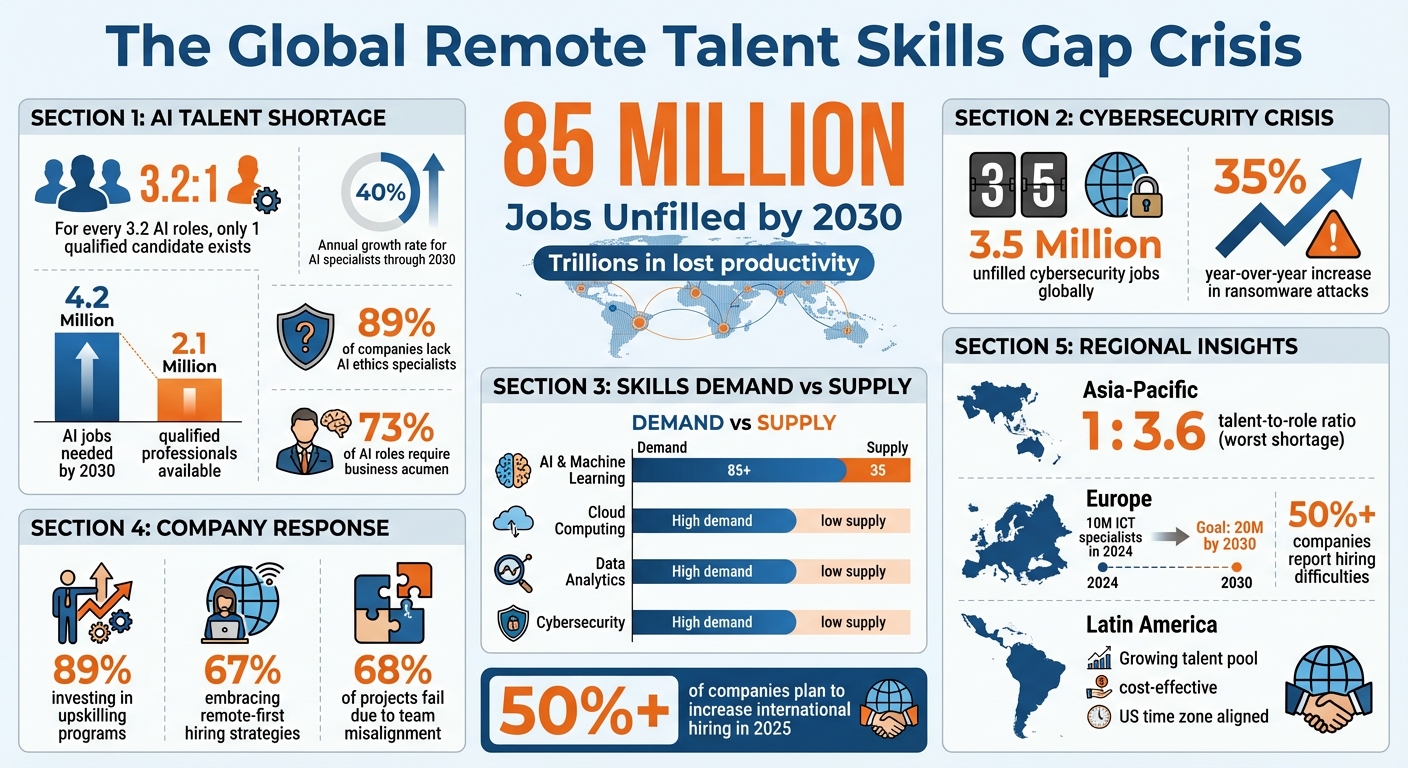
The skills shortage in today's job market is staggering, with businesses already feeling the strain as we approach 2025. Nowhere is this more evident than in the AI industry. For every 3.2 roles in high-demand areas like machine learning engineering, LLM development, and AI ethics, there's only one qualified candidate available [5]. By 2030, the need for AI professionals is expected to hit 4.2 million, while the workforce will only meet about half that demand, at 2.1 million [5]. Emerging tech fields are bearing the brunt of this shortage. According to the World Economic Forum's Future of Jobs Report 2025, AI specialists are the fastest-growing occupation, with an annual growth rate of 40% projected through 2030 [5][7].
Cybersecurity is another area under immense pressure. Globally, over 3.5 million cybersecurity jobs remain unfilled, even as ransomware attacks have surged by 35% year-over-year [11]. Businesses are taking action - 89% are investing in upskilling programs, and 67% have embraced remote-first hiring strategies to tap into talent wherever it resides [5].
Most Needed Skills and Where They're Missing
Four key areas dominate the list of in-demand skills: AI and machine learning, cybersecurity, cloud computing, and data analytics. In AI alone, demand scores soar above 85, while supply trails far behind at just 35 [2][5]. Remote hiring has only heightened the competition, with top-tier professionals commanding higher salaries across global markets [4][6].
But the gaps aren't limited to technical expertise. A striking 73% of AI roles require business acumen, a skill many candidates lack [5]. Additionally, 89% of companies report a critical shortage of specialists in AI ethics [5]. Communication challenges also play a role - 68% of projects fail due to misalignment between teams [5].
Roles in cloud engineering, DevOps, and data engineering are particularly tough to fill, as the pace of digital transformation outstrips the speed of training programs [4][12]. Niche positions like Salesforce developers, Microsoft Dynamics consultants, and MLOps engineers face even tighter constraints [12]. While the gig economy has stepped in to address short-term needs, it hasn't resolved the underlying shortage of specialized tech talent [3].
How Skills Gaps Differ by Region
The availability of talent varies widely across major remote hiring regions for U.S. companies. North America leads in AI and cloud expertise, but the high demand drives up salaries and fuels intense competition [5][12]. In Europe, about half of companies hiring ICT specialists in 2023 reported difficulties filling roles [12]. The region had around 10 million ICT specialists in 2024 but aims to double that number to 20 million by 2030 [12]. However, an aging workforce is shrinking the pool of available talent, especially in cybersecurity [2].
Latin America, on the other hand, offers a growing supply of software engineers, data analysts, and digital marketers at more cost-effective rates compared to North America [13]. The region's time zone alignment with the U.S. also makes remote collaboration smoother [13]. Many countries in Latin America are positioning themselves as go-to outsourcing hubs for IT and digital roles [13].
In the Asia-Pacific region, the shortage is even more pronounced, with a 1:3.6 ratio of available talent to AI roles [5]. Over half of companies surveyed in 2025 plan to ramp up international hiring in the next year, making cross-border recruitment a standard practice rather than an exception [6]. To navigate these regional differences, U.S. businesses increasingly turn to specialized recruitment partners who can connect them with vetted talent and handle the complexities of compliance across multiple countries [6][13].
What's Causing Remote Skills Shortages
Technology Moving Faster Than Training
The pace of technological advancements in areas like AI, cloud computing, and digital tools has outstripped the speed at which training programs can keep up. For example, innovation cycles in AI, cloud technologies, and cybersecurity now operate on 12–24 month timelines. In contrast, traditional education programs and corporate training often take years to update their curricula. By the time new material is finalized and taught, the tools and frameworks companies rely on have already evolved [2][3][7].
This issue is especially apparent in fields like AI/ML engineering, MLOps, and AI ethics, where demand for skilled professionals far exceeds supply [5]. Similar challenges exist in cloud-native engineering, cybersecurity, and advanced data analytics. These roles, particularly remote ones, require expertise in distributed systems, DevOps pipelines, and secure remote access - skills that are often lacking in the workforce [2][4][10].
Remote roles make these gaps even more noticeable. Unlike office-based positions, remote workers are expected to be highly self-directed and proficient with tools from the outset. This mismatch between technological progress and training systems leaves many organizations struggling to find the specialized skills they need for remote positions.
Education Systems Falling Behind
Traditional education systems often prioritize theory and outdated programming languages over the practical, cloud-native skills that today’s jobs demand. Graduates frequently enter the workforce unprepared for roles requiring hands-on, remote-ready digital expertise [2][3][7]. According to the World Economic Forum's Future of Jobs report, some of the fastest-growing roles - like AI specialists, data analysts, and digital transformation experts - require skills that weren’t even part of formal curricula five to ten years ago [2][7].
The gap isn’t just technical. Employers highlight the lack of applied digital skills paired with business context. In other words, many workers struggle to connect their technical expertise to real-world business outcomes [10]. Additionally, most educational programs give little attention to remote collaboration tools, asynchronous communication, or virtual project management. As a result, even technically proficient graduates often aren’t prepared for remote work environments [3][6].
This shortfall forces companies to take on the responsibility of upskilling and reskilling new hires, rather than relying on education systems to produce job-ready talent. If traditional education and corporate training don’t accelerate their pace, the skills gap could widen significantly by 2030 [2][7].
Company Hiring Practices That Don't Work for Remote
Internal hiring practices can also worsen the skills shortage. Many companies stick to rigid job descriptions that require degrees, extensive experience, or location-based criteria, which excludes a large pool of capable remote candidates [2][3][8]. Even as remote work opens up global talent opportunities, employers often fall back on outdated hiring habits, like prioritizing local candidates or insisting on degree qualifications, undermining the benefits of remote recruitment [3][6][9].
Another issue is unclear or underdeveloped remote work policies. When companies lack clear guidelines on eligibility, time zones, communication norms, performance metrics, or equipment support, qualified candidates may view these workplaces as disorganized or unsustainable [3][6]. Ambiguity around career growth and learning opportunities for remote employees can also create a perception of being treated as "second-class citizens", pushing skilled workers to seek out employers with stronger remote cultures [3][6][8].
Many organizations also face challenges with global hiring infrastructure. Fragmented HR systems, concerns about compliance, and limited payroll capabilities across countries often discourage companies from hiring internationally, even when local talent is scarce [6][9]. This is where specialized partners like Remotely Talents come in. By focusing on sourcing and vetting remote professionals across fields like Marketing & eCommerce, IT/Data/Engineering, Finance & Accounting, Operations, and Business Development & Sales, they help U.S. companies modernize their approach to global remote recruiting.
Ultimately, what appears to be a skills shortage is often a combination of outdated policies and infrastructure. Addressing these internal challenges is key to closing the skills gap and building a more agile, remote-ready workforce [3][6].
How to Close Remote Skills Gaps
Hire for Skills Instead of Degrees
Focusing on skills rather than degrees opens up talent pools that traditional hiring practices often miss. Instead of relying on academic credentials, companies are now prioritizing what candidates can actually do - whether it’s setting up cloud infrastructure, running paid search campaigns, or analyzing complex data. This shift is crucial, especially when nearly 90% of companies report challenges in finding and keeping tech talent[15]. Rigid degree requirements often exclude highly capable individuals who have honed their expertise through bootcamps, self-learning, or hands-on experience.
Adopting a skills-based hiring process often involves practical assessments and portfolio reviews to measure technical abilities and remote collaboration skills. For instance, instead of asking candidates to describe past projects, companies might assign a timed coding challenge, request an evaluation of a marketing campaign, or conduct an asynchronous exercise to assess communication abilities.
Remotely Talents supports this approach by offering a pool of pre-vetted professionals across fields like Marketing & eCommerce, IT/Data/Engineering, Finance & Accounting, Operations, and Business Development & Sales. Their recruiters focus on practical skills rather than formal credentials, presenting 3–5 top candidates within just two weeks. This method not only helps identify skilled talent but also sets the stage for upskilling current employees and building diverse global teams.
Train Your Team in New Skills
Hiring alone isn’t enough to close skills gaps - training your existing team is just as important. Upskilling internally often proves faster and more efficient than external hiring. Research shows that continuous training is vital for addressing talent shortages, particularly in rapidly evolving areas like AI, cybersecurity, and cloud technologies[14]. Effective remote training blends live sessions, self-paced modules, and real-world projects over a 6–12 week period, often with feedback from mentors.
The best training programs are tied directly to business objectives. For example, employees might develop AI models using company data or practice cybersecurity by securing actual systems. Companies that dedicate 10–20% of their employees’ work time to development and track outcomes - like filling critical roles internally - tend to see the greatest benefits. In fact, nearly 89% of organizations are now investing in upskilling to address AI-related talent shortages[5].
Build Talent Networks in Multiple Countries
While upskilling is key, expanding your talent network globally is another way to address local shortages. Building connections across multiple countries allows companies to access regions with abundant expertise and lower costs. For example, Eastern and Western Europe are known for their strong engineering, data, and cybersecurity talent, while Latin America offers software development and digital marketing professionals who work in U.S.-aligned time zones.
This strategy is especially valuable for U.S. companies facing rising salaries for roles like AI engineers or cloud architects. Talent in other regions can provide comparable skills at 50–70% lower costs without sacrificing quality or collaboration[1]. However, creating these networks requires a solid understanding of local labor laws, compliance, and payroll systems.
Remotely Talents simplifies this process by leveraging established networks across Europe, Latin America, and North America. They handle sourcing, vetting, and coordinating candidates, enabling U.S. companies to build distributed teams without needing a large internal recruiting infrastructure. For instance, TradeCentric partnered with Remotely Talents to fill three critical roles while expanding into Eastern Europe.
Pete Geherin, Vice President at TradeCentric, shared, "The team was knowledgeable, responsive, professional and very easy to work with. Highly recommended, we will work with them again on future needs"[1].
For businesses with ongoing hiring needs, Remotely Talents offers a Partner Plan at $1,000 per month with a 12-month commitment. This provides a cost-effective way to build and maintain a global remote team.
sbb-itb-88a7fe6
Tracking Results and Planning Ahead
Metrics to Track Your Hiring Success
To understand how well your remote hiring strategies are working, it’s important to track specific metrics. One key metric is time-to-hire - on average, it takes 42 days to fill a tech role, but reducing this to under 30 days should be the goal [15]. Another important measure is training completion rates, with a target of 90% or higher within the first six months [5].
Remote employee retention rates provide insight into whether you’re building a stable team or struggling with frequent turnover. For remote tech roles, the industry average ranges between 75–80%, though some competitive markets see turnover rates as high as 60% [15]. Additionally, tracking cost-per-hire can reveal savings; global recruiting often reduces this cost by 20–30%. Keep an eye on skills proficiency scores too, aiming for at least 85% proficiency in critical areas like AI and cloud technologies [5][15].
Beyond hiring-specific data, it’s worth examining how remote talent contributes to overall business outcomes. For example, productivity among remote employees can be 15–20% higher when teams are equipped with the right skills and training [5][15]. These numbers help you gauge the broader impact of your remote workforce and prepare for future challenges.
What's Coming Next in Remote Work Skills
The future of remote work is evolving rapidly, and staying ahead means understanding emerging trends. For instance, demand for AI specialists is expected to grow by 40% annually through 2030, leading to 4.2 million job openings but only 2.1 million qualified professionals - creating a significant talent gap of 3.2:1 [5][15]. According to the World Economic Forum's Future of Jobs Report 2025, AI specialists are the fastest-growing occupation, with 89% of companies citing a lack of expertise in AI ethics [5][7].
As cloud technologies expand, cybersecurity experts will play a larger role in combating threats like deepfakes. Skills such as MLOps and AI ethics are increasingly sought after [15].
Soft skills are just as critical. For example, 73% of AI roles require strong business acumen, while poor communication is responsible for derailing 68% of projects [5]. Companies must also address resistance to new technologies, with 64% of employees hesitant to adopt them [7]. In Europe, there’s a pressing need to double the number of ICT specialists to 20 million by 2030, as more than half of companies are already facing hiring difficulties [5][6]. Preparing for these changes is essential to building a workforce that can adapt and thrive.
Building a Lasting Remote Talent Strategy
With these trends in mind, creating a sustainable remote talent strategy is more important than ever. Investing in global talent pipelines and continuous skill development is key to building a resilient workforce. Companies that establish networks across multiple countries can tap into regions with abundant and cost-effective talent. In fact, 67% of firms now prioritize remote-first hiring to access global talent pools [5][6]. Given that skills become outdated every 2.5–3 years, regular training is crucial. Long-term success can be measured through retention rates (aiming for 85%) and innovation metrics, such as the number of new projects launched [5][15].
Remotely Talents specializes in helping businesses develop these strategies by connecting them with pre-vetted remote professionals from Europe, Latin America, and North America. Their Recruitment as a Service model focuses on sectors with the most pressing skill shortages, including IT/Data/Engineering, Marketing & eCommerce, Finance & Accounting, Operations, and Business Development & Sales. By managing sourcing, vetting, and ongoing support, they allow companies to concentrate on team development instead of recruitment. With over half of businesses planning to increase international hiring in the coming year, working with experts in global compliance and local labor markets can make the process much smoother [6].
Closing the experience gap – Rethinking how we hire and grow talent
Conclusion
By 2030, an estimated 85 million jobs could go unfilled, potentially costing the global economy trillions of dollars [2]. Right now, the demand for AI talent surpasses supply by a staggering ratio of 3.2:1 [5], and this gap is only expected to grow as technology evolves faster than workforce training can keep up. Outdated hiring and training practices are at the heart of this issue, making immediate action essential.
To address this skills gap, consider these strategies:
- Embrace skills-based hiring: Focus on what candidates can do rather than their formal credentials.
- Invest in ongoing training: As technologies evolve, so do the required skills, making continuous learning a necessity [5].
- Expand global talent pipelines: Tap into specialized skills that might be scarce or costly locally but are accessible elsewhere.
These changes are key to turning the challenge of the skills gap into an opportunity for growth.
To measure progress, track metrics like time-to-hire, retention rates, and training completion. The ultimate goal is to create a workforce that is adaptable, skilled, and ready to meet the demands of emerging technologies.
If you're looking to revamp your hiring strategy, Remotely Talents can help. They specialize in connecting businesses with pre-vetted remote professionals from Europe, Latin America, and North America. Their Recruitment as a Service model takes care of sourcing, screening, and matching candidates for roles in IT, data, engineering, marketing, finance, operations, and sales. This allows you to focus on building your team and driving strategic initiatives. With the right approach and support, bridging remote skills gaps doesn’t just solve a problem - it gives you a competitive edge.
FAQs
What strategies can companies use to close the global skills gap in remote hiring?
To address the global skills gap in remote hiring, companies can collaborate with recruitment agencies like Remotely Talents. These agencies specialize in connecting businesses with highly skilled professionals from regions such as Europe, Latin America, and North America. This targeted approach allows organizations to assemble strong, distributed teams that can seamlessly operate across different time zones.
Beyond recruitment, businesses should prioritize structured onboarding programs, well-defined remote work policies, and continuous training opportunities. These steps not only keep teams engaged and productive but also help close skill gaps, setting the stage for long-term success in remote work.
How does talent availability differ across regions?
Talent availability differs greatly depending on the region, with each area bringing distinct advantages to the table. Europe stands out for its highly skilled, multilingual workforce, making it a prime choice for roles that demand diverse language skills and technical know-how. North America, on the other hand, offers a deep pool of experienced professionals, particularly excelling in technology and creative industries. Over in Latin America, the workforce is known for being cost-efficient and versatile, thriving in remote roles that call for adaptability and quick problem-solving.
These regional distinctions underscore the need to adapt hiring strategies to fill specific skill gaps while making the most of each area's strengths.
Why is there a growing shortage of professionals in AI and cybersecurity?
The growing gap in professionals within AI and cybersecurity is a direct result of the fast-moving world of technology and the rising need for specialized expertise. These fields demand a high level of knowledge and skill, which naturally narrows the pool of qualified candidates around the globe.
On top of that, companies across various sectors are putting digital transformation and security at the forefront of their priorities. This has led to a sharp increase in demand for skilled experts, far outpacing the current supply. Addressing this shortage will require businesses to focus on forward-thinking hiring practices and invest heavily in training and workforce development to bridge this critical gap.
Related Blog Posts
Read also



Ready to hire without salary-based agency fees?
Book a free 30-minute consultation. We’ll review your role, timeline, and hiring goals, then show you how our fixed-fee remote search works.