Paid Leave for Part-Time Remote Workers: Guide


Managing paid leave for part-time remote workers is complicated but crucial. Here's what you need to know:
- State Laws Matter: By December 2024, 18 states and D.C. require paid sick leave, and 13 states offer paid family and medical leave. Remote workers are subject to the laws of the state they work in, not where your business is based.
- Prorated Leave: Part-time workers earn leave based on hours worked. For example, California mandates 1 hour of sick leave for every 30 hours worked.
- FMLA Eligibility: Part-time workers often don’t qualify for FMLA unless they work 24+ hours per week (1,250 hours/year).
- Compliance Risks: Employers must track employee locations and hours accurately to avoid fines or legal issues.
To stay compliant, establish clear policies, track hours precisely, and consider using automated HR tools. Businesses managing remote teams across multiple states need to understand and apply state-specific leave laws effectively.
What remote and hybrid businesses should know about employee leave rights and accommodations.
How Paid Leave Policies Apply to Part-Time Remote Workers
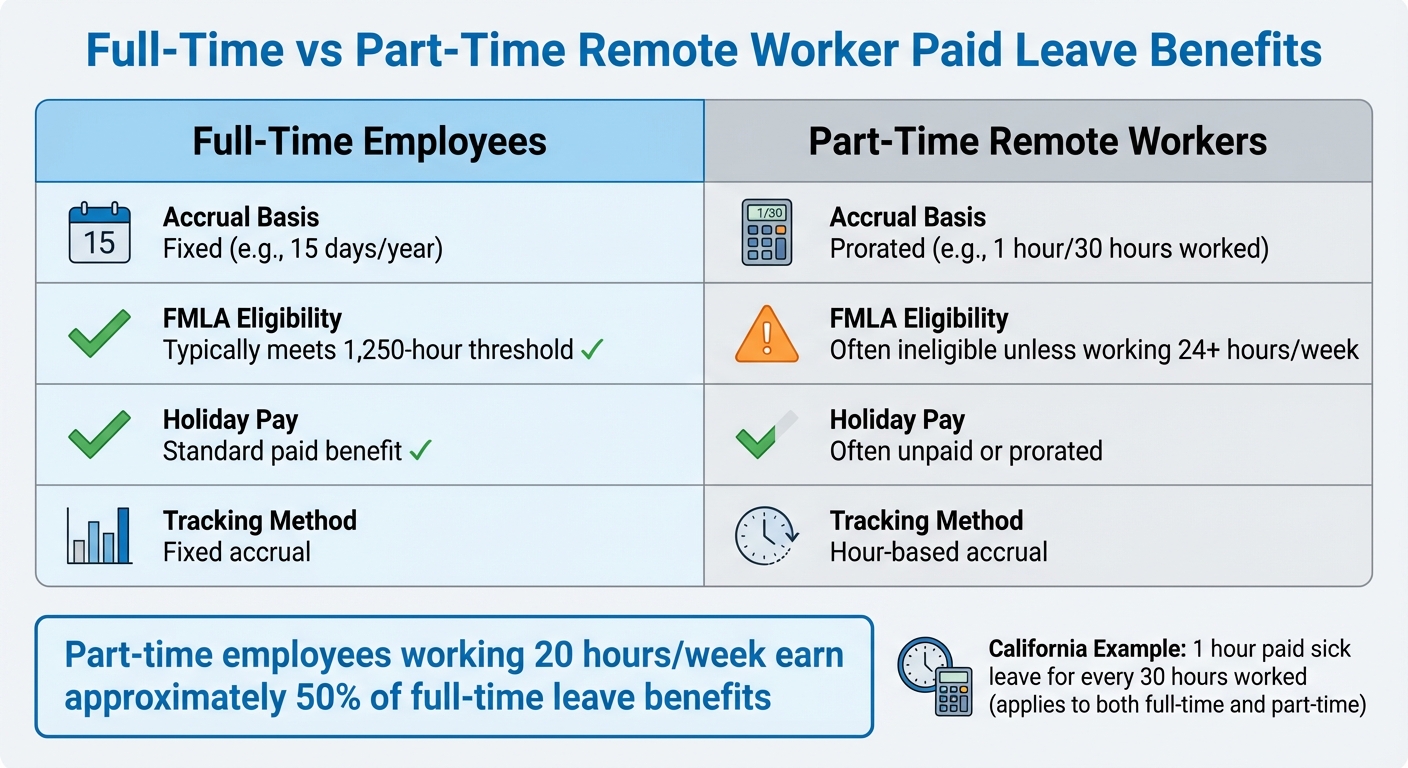
Full-Time vs Part-Time Remote Worker Paid Leave Benefits Comparison
Understanding how to correctly apply leave policies to part-time remote workers starts with clearly defining their classification.
What Qualifies as a Part-Time Remote Worker
The Fair Labor Standards Act (FLSA) doesn’t define “part-time,” leaving it up to employers to set their own thresholds [11]. However, the U.S. Bureau of Labor Statistics generally classifies part-time employees as those working less than 35 hours per week [7]. This means your company can establish its own definition in the employee handbook, whether that’s 30 hours, 32 hours, or another number.
One thing the FLSA does specify: part-time employees must still receive minimum wage, and employers must maintain accurate records of their hours [11]. According to the "suffer or permit" rule, any work an employer knows about must be counted as worked hours [10]. As the Department of Labor explains:
"Work not requested but suffered or permitted is work time... If the employer knows or has reason to believe that the work is being performed, he must count the time as hours worked" [10].
This classification plays a crucial role in determining how benefits and leave policies are applied.
How Part-Time Paid Leave Differs from Full-Time
The most notable difference lies in prorated accruals. While full-time employees generally earn leave in fixed increments, such as 15 days annually, part-time workers accrue leave based on their actual hours worked [7]. For instance, in California, all employees - whether full-time or part-time - accrue at least 1 hour of paid sick leave for every 30 hours worked [7][12]. This prorated system ensures compliance with state-specific labor laws.
Eligibility requirements for other types of leave also differ. For example, to qualify for FMLA’s unpaid, job-protected leave, employees must have worked at least 1,250 hours in the past 12 months [8][9]. Many part-time employees fall short of this threshold, equivalent to working 24 hours per week. Additionally, only hours actually worked count toward the FMLA requirement - meaning vacation time, sick leave, and PTO are excluded [9].
| Feature | Full-Time Employees | Part-Time Remote Workers |
|---|---|---|
| Accrual Basis | Fixed (e.g., 15 days/year) | Prorated (e.g., 1 hour/30 hours worked) |
| FMLA Eligibility | Typically meets 1,250-hour threshold | Often ineligible unless working 24+ hours/week |
| Holiday Pay | Standard paid benefit | Often unpaid or prorated |
| Tracking Method | Fixed accrual | Hour-based accrual |
Providing proportional benefits based on hours worked is key to fairness [7]. For example, a part-time employee working 20 hours per week would earn about half the leave of a full-time employee working 40 hours. This ensures benefits are distributed equitably.
Federal and State Paid Leave Laws
In the United States, private-sector workers are not guaranteed paid family or medical leave. The Family and Medical Leave Act (FMLA) only provides unpaid, job-protected leave[1][8].
Federal Leave Laws: FMLA and Other Requirements
The FMLA allows eligible employees to take up to 12 weeks of unpaid leave within a 12-month period for specific reasons, such as the birth of a child, a serious health condition, or caring for an ill family member[13]. However, its eligibility criteria make it less accessible for part-time workers. The U.S. Department of Labor explains:
"FMLA is designed to help employees balance their work and family responsibilities by allowing them to take reasonable unpaid leave for certain family and medical reasons"[8].
Despite its intent, nearly half of the U.S. workforce does not qualify for FMLA due to its stringent requirements[14]. For instance, the law applies only to employers with 50 or more employees within a 75-mile radius of the worker's job site[13]. For remote employees, this "job site" refers to the physical office they report to, not their home office[16].
Although FMLA leave is unpaid, employers can permit - or require - employees to use accrued paid time off during their leave, which may provide some financial support for eligible part-time workers[13]. Beyond FMLA, many state laws step in to offer broader protections and benefits.
State Leave Laws for Part-Time Workers
State-level regulations address gaps in federal law, offering more inclusive benefits for part-time and remote workers. By January 2025, 13 states and the District of Columbia will have implemented paid family and medical leave programs, while 18 states and D.C. will have paid sick leave laws by December 2024[1].
These state programs are often more accommodating to part-time workers. For example, California mandates that employers provide at least one hour of paid sick leave for every 30 hours worked, up to a minimum accrual of 40 hours (or five days) annually[15]. Part-time employees qualify after working 30 days and completing a 90-day employment period[15]. Importantly, for remote teams, these laws apply based on the employee's physical work location. Employers must carefully track these details to remain compliant. For benefits like disability insurance or paid family leave, California workers need only $300 in gross wages during their base period to qualify[17].
New York's Paid Family Leave program offers partial wage replacement for employees bonding with a new child or caring for seriously ill family members[18]. Similarly, Washington state has a paid family and medical leave program funded by contributions from both workers and employers[3]. These programs often calculate benefits proportionally based on hours worked or earnings, ensuring part-time workers are included.
For remote workers, state laws are tied to their physical location rather than the employer's headquarters[3]. For instance, a part-time remote worker living in California is entitled to that state's paid sick leave benefits, even if their employer is based in another state. Samantha Munro, Senior Counsel at ADP, highlights the importance of keeping accurate records:
"Employers may consider implementing policies requiring employees – no matter whether they work in office, remote or hybrid – to promptly update their addresses within a certain amount of time following a move"[3].
This localized approach requires careful oversight for distributed teams, ensuring remote part-time workers receive the protections their state offers.
sbb-itb-88a7fe6
How to Manage Paid Leave for Part-Time Remote Teams
Handling paid leave for part-time remote workers involves careful calculations, precise tracking, and compliance with state-specific regulations. The challenge grows when your team operates across multiple states, each with its own rules for leave accrual and usage. Below, we’ll break down how to calculate leave, track it accurately, and create consistent policies that work across jurisdictions.
Calculating Prorated Leave for Part-Time Employees
For part-time employees, leave should be proportional to the benefits offered to full-time workers. Here's how one expert explains it:
"In a fair workplace, part-time employees are eligible for the same types of leave as their full-time counterparts, but the amount of leave is adjusted according to the hours they work." [21]
The formula is straightforward: (part-time hours ÷ full-time hours) × full-time entitlement. For instance, if a full-time employee working 40 hours per week gets 20 days of paid leave annually, a part-time employee working 20 hours per week would receive 10 days (20 ÷ 40 × 20 = 10 days) [21].
In some states, leave is tied directly to hours worked. California, for example, mandates one hour of sick leave for every 30 hours worked [19], while Illinois requires one hour for every 40 hours worked [22]. Employers should round up partial days when necessary [20]. If an employee changes their work schedule mid-year, you’ll need to split the calculations: one for the old schedule and another for the new one [21].
Tracking Leave Accruals and Usage
Once you’ve calculated leave, keeping accurate records is essential. Federal and state laws often require employers to retain records for at least three years, including details like hours worked, leave accrued, leave used, and the remaining balance [22]. Relying on manual spreadsheets can quickly become overwhelming, especially for remote teams spread across states with different rules.
To simplify this, many companies use automated HR platforms that calculate state-specific accruals in real time and allow employees to view their leave balances [6]. Another approach is frontloading - providing the full annual leave amount (e.g., 40 hours) at the start of the year or on the hire date. While this eliminates ongoing accrual tracking, the frontloaded leave must still be adjusted proportionally for part-time workers [22].
Creating Consistent Leave Policies Across States
After calculating and tracking leave, the next step is standardizing your policies. This can be tricky since state laws differ in terms of accrual rates, usage purposes, and eligibility. For example, California’s rules focus on sick leave and family care, while Illinois allows leave for any reason.
One practical solution is to adopt the most generous state standard across your entire team. Using California’s 1:30 accrual rate (one hour for every 30 hours worked) as a baseline ensures compliance and simplifies administration, while also guaranteeing that no employee receives less than what their local laws require.
Your written policy should clearly outline the accrual period (e.g., calendar year or anniversary year), set minimum usage increments (like a two-hour minimum, if permitted), and explain notice requirements for foreseeable leave. Make sure all remote employees receive these policies when they’re hired. Additionally, require employees to update their physical work address promptly if they relocate, as this determines which state laws apply [3].
| State | Accrual Rate | Usage Purpose | Annual Cap |
|---|---|---|---|
| California | 1 hour per 30 hours worked | Sick leave, family care | 24 hours (3 days) usage limit |
| Illinois | 1 hour per 40 hours worked | Any reason | 40 hours accrual/usage |
| Federal (FMLA) | N/A (Unpaid) | Serious health conditions | 12 weeks |
To stay compliant, conduct regular audits to confirm where your remote employees are physically working. This can help you avoid legal and tax issues related to state-specific mandates [3]. As your remote team expands, having clear systems and policies in place becomes essential for fair and compliant leave management.
Using Recruitment and HR Support for Remote Teams
Managing paid leave for part-time remote workers can be a challenge, but specialized recruitment and HR services can make it much simpler. These services handle tasks like tracking hours, determining jurisdictional requirements, and automating leave calculations, which helps businesses stay compliant and organized[4]. One standout option in this space is Remotely Talents, a company offering customized solutions for remote recruitment.
Working with Remotely Talents
Remotely Talents connects businesses with pre-screened remote professionals from Europe, Latin America, and North America. Their expertise spans various industries, including Marketing & eCommerce, IT/Data/Engineering, Finance & Accounting, Operations, and Business Development & Sales - fields where part-time remote work is becoming increasingly popular.
To accommodate different hiring needs, they offer three pricing options:
- Self-Service: For a one-time fee of $299, your job is promoted to over 10,000 pre-vetted candidates.
- On-Demand: Costs $1,450 per month per open role, with no long-term commitment and a 90-day replacement guarantee.
- Partner: Priced at $1,000 per month with a 12-month commitment, this tier allows unlimited hires, though only one active role can be filled at a time[2].
Beyond recruitment, working with agencies like Remotely Talents can lead to significant cost savings. Businesses can reduce staffing expenses by 50% to 70%, making this a practical choice for budget-conscious companies[2]. As Beata Rajeckaite, Operations Manager at OneRhythm, shared:
"It helps a lot to have [Remotely Talents] supporting us while we are navigating local market challenges."[2]
While recruitment is a key focus, long-term HR support is equally important for managing the complexities of leave policies.
Supporting Remote Teams Long-Term
Keeping leave policies compliant over time requires ongoing HR support, especially as regulations evolve. Specialized services play a critical role by accurately tracking hours based on jurisdiction. This is particularly important since many paid leave laws are only triggered after employees reach specific hourly thresholds. These services also manage leave in standardized increments - such as one, two, or four hours - to ensure legal compliance[4].
Another essential step is training compliance teams to stay informed about jurisdiction-specific rules. For instance, states like Nevada allow employees to take paid leave for any reason, while others limit it to medical or family-related needs[4]. Regularly reviewing policies helps businesses stay up-to-date, while automated HR platforms simplify the process by tracking unpaid leave separately from paid time off. These systems also give managers a clear view of upcoming time-off requests, making it easier to plan resources and manage workloads effectively[23][24].
Conclusion
Managing paid leave for part-time remote workers requires a solid grasp of federal and state regulations. As highlighted earlier, the rules governing leave eligibility - such as FMLA and state-specific mandates - depend on the employee's physical work location, not your company's headquarters. This creates a complex web of compliance requirements that demands careful attention to detail.
Accurate tracking of work hours is a cornerstone of compliance. Jim Coleman, Attorney at Constangy, Brooks, Smith & Prophete, emphasizes:
"The single greatest challenge in employing remote nonexempt employees is creating an accurate record of hours worked each day."[5]
It's not just about logging total hours worked; understanding where those hours are recorded is equally important. Many state laws grant benefits once specific hourly thresholds are met. Additionally, prorating leave based on actual schedules - rather than a default 40-hour workweek - ensures both fairness and adherence to legal standards.
Establishing consistent policies can simplify administration and minimize risk. Clearly outlining notice requirements for leave and defining how leave can be taken (e.g., in one-hour or four-hour increments) helps maintain uniformity across your team. This consistency not only strengthens compliance but also supports the broader strategy for managing a distributed workforce. Cloud-based HR tools can further ease the process by automating time-off tracking, providing managers with visibility into requests, and enabling employees to monitor their own leave balances.
For businesses looking to streamline operations and stay compliant, external expertise can be invaluable. Services like Remotely Talents assist companies in navigating the challenges of hiring and managing remote workers across different jurisdictions. Additionally, specialized HR platforms can help track leave by location, train teams on state-specific regulations, and ensure policies remain up to date as laws change.
FAQs
How do state laws affect paid leave for part-time remote employees?
State laws play a major role in deciding whether part-time remote employees qualify for paid leave, and these laws can differ significantly from one state to another. Generally, eligibility depends on the number of hours worked within a specific state. This means part-time employees often earn leave on a pro-rated basis. For instance, in California, workers earn one hour of paid sick leave for every 30 hours worked. In Illinois, the rate is one hour for every 40 hours worked. Meanwhile, in New York, part-time employees working fewer than 20 hours per week become eligible for Paid Family Leave after completing 175 days of service.
One critical point to keep in mind is that the laws of the state where the work is performed - not where the employer is based - determine the applicable regulations. Employers need to carefully track each remote worker’s primary work location and hours to stay compliant with state-specific rules for leave accrual and eligibility. Open communication with employees is also key. Encouraging workers to inform employers about changes in their work locations can help prevent compliance challenges while ensuring fair leave benefits for all.
How does paid leave work differently for full-time and part-time remote employees?
Full-time remote workers generally enjoy a set amount of paid leave each year, allocated on a consistent schedule. On the other hand, part-time remote employees accumulate leave based on the number of hours they work. This often results in lower accrual rates, along with specific rules that might govern eligibility, carry-over limits, or how the leave can be used.
Part-time employees should carefully review their company's leave policies, as these can differ significantly depending on the organization's practices and any applicable legal regulations.
How can employers efficiently manage paid leave for remote employees working across different states?
To handle paid leave for remote teams spread across various states, a centralized system is key. Such a system should track where employees are working and automatically apply the appropriate state-specific leave rules. Begin by keeping an up-to-date database of employee work locations. Ideally, this database should sync with your HR or payroll system to ensure compliance with state regulations. Since many states tie leave accruals and eligibility to hours worked within their borders, tracking work hours by state is a must.
Practical methods include leveraging time-tracking tools equipped with geofencing or IP-based verification to log hours based on location. Configure your HR system to align leave policies with employee addresses, and regularly review location data and leave balances to avoid compliance hiccups. Additionally, offering employees access to a self-service portal with clear, state-specific leave guidelines can simplify the process for everyone.
For companies expanding their remote teams, Remotely Talents offers a solution to seamlessly integrate compliant leave management practices from the outset, helping new hires get started with the right tools and policies in place.
Related Blog Posts
Read also



Ready to hire without salary-based agency fees?
Book a free 30-minute consultation. We’ll review your role, timeline, and hiring goals, then show you how our fixed-fee remote search works.