Best Benefits to Attract Remote Talent in 2026


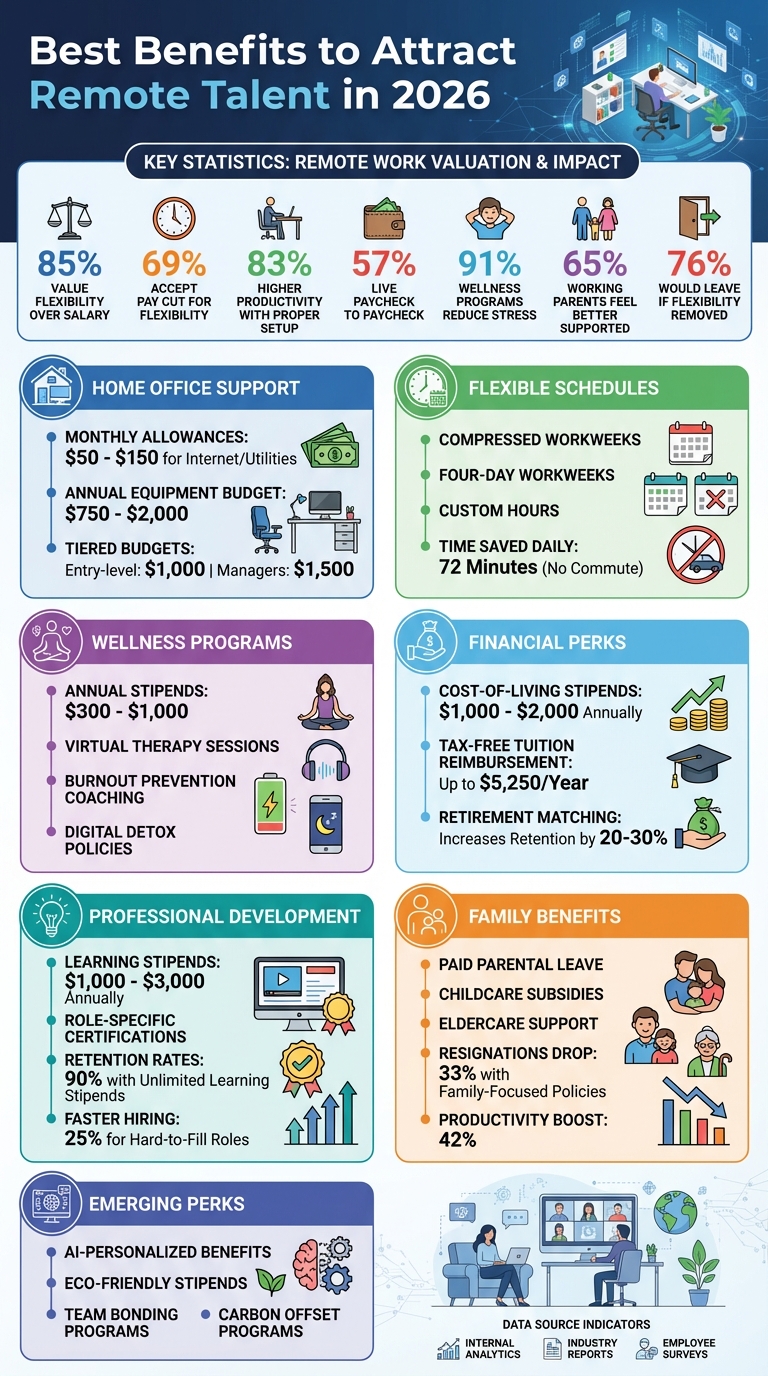
Remote work has become a priority for most professionals, with 85% of workers valuing flexibility over salary. To attract and retain top remote talent in 2026, companies need to offer benefits that address productivity, well-being, financial stability, and family needs. Here's what employees are looking for:
- Home Office Support: Stipends for ergonomic furniture, internet, and equipment upgrades.
- Flexible Schedules: Options like compressed workweeks or four-day workweeks.
- Wellness Programs: Virtual therapy, burnout prevention, and wellness stipends.
- Financial Perks: Retirement matching, student loan assistance, and cost-of-living stipends.
- Professional Development: Learning stipends and role-specific certifications.
- Family Benefits: Paid parental leave, childcare subsidies, and eldercare support.
- Emerging Perks: AI-personalized benefits, eco-friendly options, and team bonding programs.
Companies that align benefits with these priorities can stand out in the competitive remote job market. Recruitment partners like Remotely Talents also play a key role by connecting businesses with skilled professionals and offering tailored hiring solutions.
Top Remote Work Benefits and Statistics 2026
Stop Losing Talent: The 2026 Benefits Playbook
1. Core Benefits for Remote Work
Supporting remote employees requires more than just providing the basics - it demands thoughtful and practical solutions. Companies aiming to attract top talent globally understand that offering a strong benefits package tailored to remote work is key. A FlexJobs 2026 Trends Report highlights this, noting that nearly 69% of workers would willingly accept a pay cut in exchange for the flexibility and support that remote work offers. Building a solid framework for remote work starts with these essential measures.
1.1 Home Office Stipends
A productive home office isn’t just about having a desk and chair; it’s about creating an environment that fosters focus and comfort. Employers can step in by providing home office stipends to cover costs like ergonomic furniture, high-speed internet, monitors, or even coworking space memberships. For instance, companies might offer monthly allowances of $50–$150 for internet and utility expenses or a one-time annual payment between $750 and $2,000 for equipment upgrades. Some companies even adjust these amounts based on roles, offering around $1,000 for entry-level employees and $1,500 for managers. These investments make a difference - about 83% of workers say they’re more productive when they have the right tools and setup at home [7].
1.2 Flexible Work Schedules
Rigid work hours often fall short for remote employees. Flexible schedules allow workers to set hours that suit their needs, try compressed workweeks, or even adopt a four-day workweek. These options help employees balance their professional and personal lives more effectively. Surveys reveal that about 50% of employees would accept a lower salary for remote work, 65% of working parents feel remote work better supports their families, and 76% of workers would consider leaving if flexible options were no longer available [3][5].
1.3 Health and Wellness Programs
While remote work offers many advantages, it can also lead to feelings of isolation or burnout. To address these challenges, companies are expanding their benefits to include more than just traditional health insurance. Popular initiatives now feature virtual therapy sessions, on-demand counseling, burnout prevention coaching, and resilience workshops. Many employers also provide wellness stipends - ranging from $300 to $1,000 annually - for activities like gym memberships, yoga classes, or subscriptions to mental health apps. Some are even introducing digital detox policies and scheduled rest days to promote well-being. These efforts matter - 91% of employees say wellness programs help them manage work-related stress, and virtual care platforms make it easier to support distributed teams cost-effectively [1].
2. Financial and Career Growth Benefits
For remote professionals, financial stability and clear career advancement are top priorities. With 57% of Americans living paycheck to paycheck, addressing financial stress is more than just a perk - it’s a necessity [3]. Companies that offer thoughtful benefits aimed at easing financial burdens and promoting career growth stand out in today’s competitive hiring landscape. These programs don’t just tackle immediate concerns; they also set the stage for long-term success.
2.1 Financial Wellness Programs
Financial wellness programs are a game-changer for employees, helping them reduce money-related stress and build a stable future. These offerings often include retirement plans with employer matching, student loan repayment assistance, personal finance coaching, savings-match programs, and cost-of-living adjustment stipends ranging from $1,000 to $2,000 annually [4][6].
Education-related benefits are another standout feature. Under U.S. tax law, companies can reimburse employees up to $5,250 per year in tuition costs tax-free [4][6]. On top of that, platforms like Betterment and Fidelity provide personal finance coaching to guide employees through challenges like managing debt, planning for retirement, or making big purchases. These programs aren’t just “nice extras” - they’re proven to boost employee loyalty. For example, retirement matching programs alone can increase retention rates by 20–30%, making them a win-win for both employees and employers [2][6].
2.2 Professional Development and Training
Remote workers often use the time saved from commuting to focus on skill-building, which makes professional development an especially sought-after benefit [8]. Providing access to online learning platforms with annual stipends between $1,000 and $3,000 is a great way to support this [2][6]. Certifications in areas like AI, data analysis, and other technical fields not only keep employees competitive but also enhance the company’s capabilities.
While financial wellness addresses immediate concerns, professional development ensures long-term growth. Virtual mentorship programs and AI-powered learning paths allow employees to customize their development based on their career goals. Companies like Buffer and GitLab show how impactful this can be: offering unlimited learning stipends has helped them achieve 90% retention rates, while role-specific certifications and internal growth initiatives enable 25% faster hiring for hard-to-fill roles [4][6]. When workers see their employers investing in their future, they’re far more likely to stay and grow alongside the company.
3. Family-Focused Benefits
Beyond financial stability and career growth, companies are now zeroing in on family-focused benefits to retain employees. With remote work reshaping how people manage their personal lives, businesses that adapt by supporting employees' caregiving responsibilities gain a strong advantage in attracting and keeping top talent.
3.1 Customizable Health Coverage
Traditional health plans often miss the mark for modern employees. Remote workers, in particular, need flexible options that allow them to tailor coverage to their family's unique needs. This could mean adding dependents, accessing telehealth services, or even including extras like pet insurance or legal assistance. In fact, 91% of employees report that access to wellness resources, including virtual care, helps them manage stress more effectively [1]. Telehealth stands out for remote teams because it works no matter where they live and is often more affordable, ensuring families can access urgent or behavioral health care without geographical limitations.
With 57% of Americans living paycheck to paycheck [3], affordable and adaptable health benefits have become essential. Modular benefits platforms let employees choose what fits their life stage - whether that's full family coverage or specialized services - showing that employers genuinely understand and care about their workforce's diverse needs. This level of personalization not only meets immediate health needs but also reinforces employee loyalty.
3.2 Family and Caregiving Support
Paid parental leave, childcare subsidies, eldercare assistance, and flexible schedules have shifted from being perks to necessities. Companies offering these benefits often see tangible results: hybrid workplaces with strong family-focused policies report a 33% drop in resignations, while leading remote-friendly organizations have noted productivity boosts of up to 42% [9].
Remote work also offers a unique benefit - saving employees 72 minutes daily by eliminating commutes. This extra time can be redirected to caregiving responsibilities, whether for children or elderly family members. Providing eldercare resources like on-demand counseling, resilience workshops, and flexible scheduling addresses growing caregiving demands [6]. Notably, 65% of working parents say remote work better supports their families, emphasizing how critical comprehensive family benefits are for employee satisfaction and long-term retention [5].
sbb-itb-88a7fe6
4. Emerging Perks for Remote Teams in 2026
As companies rethink traditional benefits, they're finding innovative ways to stand out. The latest perks are all about personalization, sustainability, and building real human connections - key priorities for today's remote workforce.
4.1 AI-Powered Benefits Customization
Gone are the days of one-size-fits-all benefits. Companies are now turning to AI-driven platforms to craft personalized offerings for their employees. These platforms analyze various data points - like life stages, work habits, and personal goals - to recommend benefits tailored to individual needs. This modular approach lets remote workers select what matters most, whether it’s wellness programs, financial coaching, or caregiving support.
For instance, a remote-working parent might receive recommendations for childcare subsidies and flexible hours, while someone in a high-pressure role could be offered mental health resources or stipends for relaxation. These AI tools, integrated into HR systems, make it easier to address unique needs, which not only boosts employee satisfaction but also enhances retention. Financial wellness perks, in particular, gain more traction when they feel personalized and relevant.
To implement this, companies can start by surveying their teams to understand preferences and then pilot AI-powered platforms that manage data and compliance. The result? A benefits experience that feels tailored to each employee rather than a generic package.
4.2 Eco-Friendly Benefits
Sustainability is becoming a major draw for remote workers. Many companies are introducing eco-conscious perks as part of their benefits packages. These include carbon offset programs for work-related travel, stipends for energy-efficient home office equipment, and reimbursements for sustainable commuting options like e-bikes or public transit passes.
Some organizations are even funding solar-powered devices or offering carbon-neutral virtual retreats. These perks not only align with environmental values but also enhance remote work setups. Flexible accounts, like lifestyle spending funds, allow employees to put money toward eco-friendly hobbies or purchases that reduce their environmental impact [4].
Beyond their environmental benefits, these perks often help employees save on energy costs, blending practicality with purpose. For companies competing in the global talent market, offering such forward-thinking benefits signals an alignment with the values of environmentally conscious professionals.
4.3 Team Connection and Bonding Programs
While personalization and sustainability are key, fostering team connections is just as important - especially in remote work, where isolation remains a challenge. To address this, many companies are investing in programs designed to strengthen bonds among team members. From virtual team-building activities like online escape rooms to hybrid company retreats and coworking space credits, these initiatives encourage collaboration and community.
Some companies go even further by pairing unlimited PTO with virtual bonding events or implementing four-day workweeks alongside annual global retreats. Digital detox policies are also gaining traction, encouraging employees to recharge without screens. These efforts are paying off: 69% of workers now say they’d accept a pay cut for remote roles that include such perks, an 11% increase from previous years [5].
5. Working with Remotely Talents to Hire and Retain Remote Professionals
Recruitment partners like Remotely Talents play a crucial role in helping businesses secure and retain top remote professionals. While offering competitive benefits is essential for retention, effective recruitment strategies are equally vital. To stand out in the competitive remote hiring market of 2026, companies need a partner that understands global markets, regional intricacies, and the expectations of today's remote workforce. Remotely Talents connects U.S. companies with skilled remote professionals across Europe, Latin America, and North America, managing everything from sourcing candidates to onboarding support.
5.1 Global Talent Recruitment Services
Remotely Talents follows a streamlined three-step process to match businesses with the right candidates. First, they define the role requirements, including skills, seniority, salary range in USD, time zone overlap, and remote-specific soft skills. Next, they tap into a network of 10,000 pre-vetted professionals, presenting 3-4 qualified candidates within just two weeks. Their screening process evaluates technical expertise, English proficiency at a C1+ level, and proven experience in remote work environments.
To simplify cross-border hiring, they coordinate multi-timezone interviews, advise on competitive regional compensation, and design benefit packages tailored to remote professionals. For example, they might recommend USD-based salaries aligned with local markets, along with perks like home-office stipends, mental health resources, and flexible schedules - moving away from traditional office-centric benefits. Additionally, they collaborate with local partners or Employer of Record (EOR) solutions to handle contract structures, statutory benefits, and data privacy compliance, reducing legal risks for U.S. employers.
"The team was knowledgeable, responsive, professional and very easy to work with. Highly recommended, we will work with them again on future needs." - Pete Geherin, Vice President, TradeCentric [10]
Remotely Talents focuses on high-demand roles in Marketing & eCommerce, IT/Data/Engineering, Finance & Accounting, Operations, and Business Development & Sales. These roles are particularly suited for remote work, emphasizing productivity and digital collaboration. By aligning their recruitment strategy with modern benefit trends, they help businesses create remote teams that excel.
5.2 Flexible Recruitment Plans
Operating under a Recruitment-as-a-Service (RaaS) model, Remotely Talents offers three flexible plans to suit different hiring needs:
- Self Service Plan ($299 one-time): Perfect for companies managing hiring internally. This plan promotes your job to over 10,000 pre-vetted candidates for three months, with applications sent directly to your team.
- On-Demand Plan ($1,450/month per open role): Provides full recruitment support without long-term commitments. It includes a senior-level recruiter, an account manager, weekly updates via Slack, and a 90-day replacement guarantee.
- Partner Plan ($1,000/month with a 12-month commitment): Designed for companies with consistent hiring needs. This plan allows unlimited hires (one active project at a time) and offers the same dedicated support and replacement guarantee, making it a cost-effective option for teams planning multiple hires annually.
This subscription-based model ensures predictable recruitment costs, helping businesses budget effectively in USD.
"Had a great experience with Adomas and Daria; they found a couple good candidates for my accounting practice within two weeks. Both were in touch with me through the entire process and we never had any communication hiccups." - Richard Clive, CEO, Venture CPA & Tax Advisors [10]
5.3 Support for Employee Retention
Hiring is just the first step - keeping remote employees engaged and satisfied requires ongoing effort. In 2026, this means focusing on growth opportunities, flexibility, and wellness. Remotely Talents offers post-hire support to help companies retain their remote teams. This includes onboarding checklists tailored for remote roles, covering everything from pre-boarding communication to equipment setup and first-week schedules. They also provide coaching for managers on setting clear expectations for asynchronous work, meeting guidelines, and managing collaboration across multiple time zones.
To enhance retention, they recommend strategies like regular career development discussions, access to online training, and evolving benefits to remain competitive. This might involve expanding wellness programs, introducing financial wellness initiatives, or improving pay transparency.
"I've tried a lot of remote talent services before for our remote expansion as a US company, and they delivered an experience that was far superior in terms of speed, price, and most importantly transparency." - Kay Tayam, CEO, 88 Affect [10]
For added assurance, managed plans include a 90-day replacement guarantee. Remotely Talents also helps companies monitor engagement, benefit usage, and employee feedback across regions. This data allows both the company and Remotely Talents to refine recruitment and retention strategies, ensuring long-term success for remote teams.
Conclusion
Attracting top remote talent in 2026 means rethinking how to support distributed teams. Today’s remote workers value flexibility, personalized benefits, and well-being far more than outdated office perks. In fact, 85% of workers now say remote work is more important than salary when considering a job [5]. Companies that resist adapting to these priorities will find it increasingly hard to compete for the best global talent.
To stay ahead, employers need to craft a remote-focused rewards strategy that goes beyond the basics. This means combining essential remote benefits with programs addressing financial stability, family needs, and other emerging priorities. It’s not just about offering perks - it’s about showing employees you care about their financial security, mental health, work-life balance, and growth.
U.S. companies, in particular, should review their current benefits, expand financial wellness initiatives to tackle paycheck-to-paycheck challenges, and adopt tools that allow for a more personalized approach to rewards [3][4].
For businesses looking to stay competitive, partnering with agencies like Remotely Talents can make a real difference. They specialize in connecting companies with top remote professionals across Europe, Latin America, and North America. Their Recruitment as a Service model doesn’t just help you hire - it provides ongoing insights into why candidates accept offers, what makes them stay, and which gaps in benefits might lead to turnover. With this kind of support, businesses can make smarter hiring decisions and ensure long-term retention.
FAQs
What benefits are most effective for attracting remote talent in 2026?
To bring in the best remote talent by 2026, companies should prioritize a few key strategies: offering flexible hiring options, tapping into a global network of pre-vetted candidates, and ensuring smooth collaboration within shared time zones. These approaches not only make remote hiring more efficient but also position businesses as attractive employers in a competitive market.
On top of that, businesses can enjoy cost reductions of 50%-70% and quicker hiring timelines, making remote recruitment a smart and effective choice. By embracing these benefits, companies can assemble high-performing, distributed teams that are perfectly aligned with their goals.
How can companies use AI to customize benefits for remote employees?
Companies are tapping into AI to craft personalized benefits for their remote teams by analyzing data like work habits, engagement trends, and individual preferences. This approach makes it possible to offer perks that truly resonate, such as flexible work hours, wellness initiatives, or professional growth opportunities tailored to each employee's unique needs.
What’s more, AI can provide real-time feedback and adjust these benefits on the fly, ensuring employees feel recognized and supported. By using these tools, businesses can improve job satisfaction, strengthen employee loyalty, and foster deeper connections with their remote workforce.
Why is offering financial wellness benefits important for remote employees?
Supporting the financial well-being of remote employees is a smart move for any company. Why? Because when people feel secure about their finances, they’re less stressed, more focused, and generally happier in their jobs. This often translates to higher engagement, better productivity, and stronger employee retention.
Offering financial wellness benefits also sends a clear message: the company genuinely cares about its employees. This builds trust and loyalty, which are invaluable in fostering a positive workplace culture. Programs like budgeting tools, retirement planning resources, or student loan assistance can make a real difference in employees’ lives, helping them feel supported both personally and professionally.
Related Blog Posts
Read also



Ready to hire without salary-based agency fees?
Book a free 30-minute consultation. We’ll review your role, timeline, and hiring goals, then show you how our fixed-fee remote search works.