10 Most Popular Remote Marketing Roles in 2026


Remote marketing is booming in 2026, with companies prioritizing specialists over generalists to meet the demands of a $1 trillion global digital ad market. The focus is on hiring experts who can deliver measurable results in specific areas like AI-driven campaigns, first-party data strategies, and platform-specific optimizations. Here’s a quick overview of the most sought-after remote marketing roles this year:
- Creative Strategist / Remote Creative Director: Combines artistic vision with technical skills to manage AI-assisted campaigns. Salaries range from $164,000 to $288,000+.
- Amazon Ads Specialist: Manages AI-powered bidding and ad strategies on Amazon. Average U.S. salary: $93,125.
- Performance Marketing Manager: Oversees paid campaigns on platforms like Meta, Google, and TikTok. Salaries range from $112,794 to $160,000.
- Media Buyer: Executes ad campaigns, optimizing ROAS and CAC. Salaries range from $70,000 to $250,000.
- Email Marketing Specialist: Designs automated workflows to boost retention and LTV. Salaries range from $68,000 to $160,000.
- SEO Strategist: Optimizes for traditional and AI-powered search platforms. Salaries range from $50,000 to $159,660.
- Content Marketing Manager: Oversees AI-assisted content creation and UGC strategies. Salaries range from $60,000 to $275,000.
- Growth Marketer: Optimizes customer funnels with predictive CRO and first-party data strategies. Salaries range from $112,000 to $170,000.
- Marketing Analyst / Attribution Expert: Analyzes data to prove ROI and optimize campaigns. Salaries range from $92,000 to $243,000.
- Affiliate & Influencer Marketing Manager: Builds partnerships with creators and affiliates to drive revenue. Average salary: $112,794.
These roles reflect the shift toward specialization, technical proficiency (AI, Python, SQL), and global hiring strategies. Remote job postings have surged by 177%, with top talent often hired within 10 days. Companies are also embracing fractional hires, project-based teams, and nearshoring to access diverse talent pools. Success hinges on hiring experts who can deliver results in a competitive digital landscape.
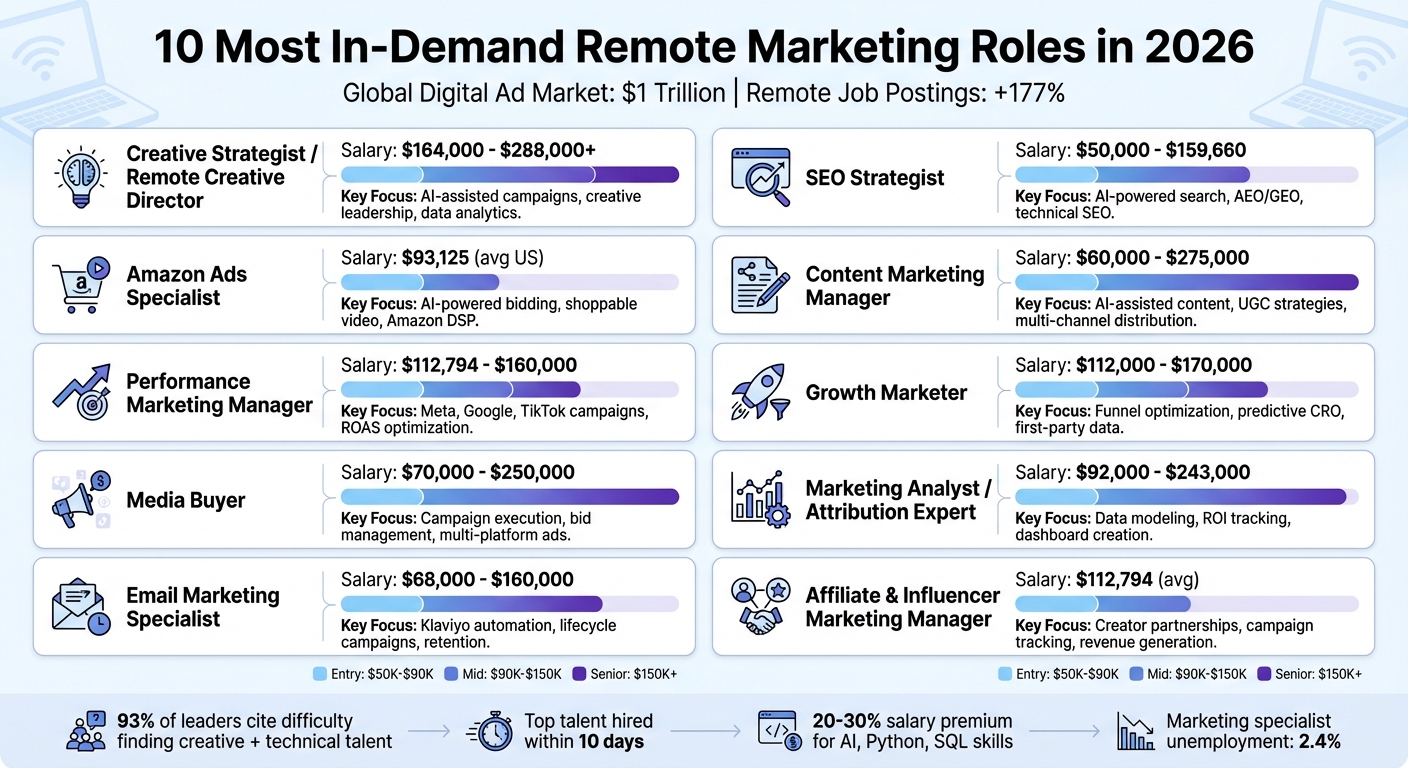
Top 10 Remote Marketing Roles 2026: Salaries and Responsibilities
How to Become a Digital Marketing Specialist in 2026 | Career Roadmap
1. Creative Strategist / Remote Creative Director
In 2026, the role of Creative Strategists and Remote Creative Directors combines artistic vision with technical expertise. This hybrid position integrates creative leadership, data analytics, and AI oversight to manage multi-channel campaigns while utilizing advanced analytics and modern tools. These evolving responsibilities are reshaping team structures and setting new standards for creative leadership.
A major part of the job is guiding AI algorithms to enhance human creativity rather than replace it. As automated systems like Google Performance Max and Meta Advantage+ become more prevalent, creative strategists play a crucial role in maintaining a human touch. They provide essential creative assets and audience insights that these systems need to perform effectively [7]. Another key focus is ensuring that content continues to resonate emotionally and stays true to the brand's identity [7].
"The future belongs to those who can bridge creativity with technical execution. In 2025 and further, marketing roles are becoming less about picking between 'creative' and 'technical' and more about blending both seamlessly." - Olena Teselko, Storyblok [12]
Why This Role Is in High Demand
The demand for this role is skyrocketing, with 63% of marketing leaders pointing to new project pipelines as their top reason for hiring and 93% acknowledging the challenge of finding professionals with the right mix of creative and technical skills [4]. Industries like SaaS, fintech, healthtech, and e-commerce are competing fiercely for talent capable of running Extended Reality (XR) campaigns, crafting AI-driven content strategies, and interpreting first-party data in a privacy-conscious world [5][7].
This demand is also reflected in compensation. Salaries range from $164,000 to $288,000 and beyond for professionals proficient in AI, Python, and headless CMS platforms like Storyblok or Contentful [1][5][10][12].
2. Amazon Ads Specialist / Amazon Performance Marketer
An Amazon Ads Specialist is responsible for crafting and implementing advertising strategies on Amazon to boost brand visibility, drive traffic, and improve ROI [13]. By 2026, this role has grown far beyond simply managing Sponsored Products. It now demands expertise in AI-powered bidding, cross-channel attribution, and the creation of shoppable video content.
These specialists handle full-funnel campaigns, working across Sponsored Products, Sponsored Brands, Sponsored Display, and Amazon DSP. They utilize Amazon Marketing Cloud (AMC) to build custom audiences and track performance [14][16]. Additionally, they manage AI-driven bidding tools while maintaining a "human-in-the-loop" approach, ensuring algorithms align with business objectives rather than just focusing on volume [7]. A key area of focus is shoppable video ads, which are used on platforms like Prime Video, Twitch, and search results, delivering stronger conversion rates compared to static images [15][7]. This expanded scope has made the role essential across industries.
Why Demand Is Surging
With global digital ad spending projected to hit $1 trillion by 2026 [1], brands are fiercely competing for visibility at critical purchase points. Amazon Ads reach over 275 million ad-supported viewers monthly in the U.S. [14], and sponsored products appear in approximately 99% of all Amazon searches [16]. For example, beauty brand Kérastase used AMC and streaming ads to increase brand searches by 80%, boost brand awareness by 6.5%, and grow total sales by 30% [14].
This role is especially sought after by DTC brands, consumer packaged goods companies, electronics retailers, and health & beauty businesses [16]. In the U.S., the average salary for Amazon Ads Specialists is $93,125, while similar roles offer £59,550 in the UK and A$98,950 in Australia [13]. Professionals skilled in AI tools and data analysis (such as Python and SQL) can earn 20-30% more than their peers [1].
3. Performance Marketing Manager (Meta, Google, TikTok)
A Performance Marketing Manager takes charge of paid acquisition strategies across major platforms like Meta, Google, and TikTok. Their primary focus? Achieving measurable outcomes such as Return on Ad Spend (ROAS) and Customer Acquisition Cost (CAC). They oversee full-funnel campaigns and manage AI-driven bidding systems like Google's Performance Max and Meta's Advantage+, ensuring these tools are guided by well-defined business objectives rather than running unchecked. By providing precise audience data and polished creative assets, they make sure these systems deliver results.
On a typical day, these managers juggle tasks like running campaigns, analyzing performance metrics, refining landing pages, and reallocating budgets. To do this, they rely on platforms and tools such as Meta Ads Manager, Google Ads, TikTok Ads, GA4, Looker Studio, Amplitude, and Mixpanel. They often use automation tools like n8n or Zapier to streamline workflows and boost efficiency.
Why Demand Is Surging
With rising competition in the market, companies are increasingly seeking professionals with advanced performance marketing skills. The integration of AI into marketing has created a significant demand for experts in this field, resulting in a 42% salary premium for marketers with AI expertise - adding over $18,000 to their base pay [3]. Additionally, skills in Python, SQL, and data management can push salaries 20–30% higher [1]. Industries like eCommerce, DTC brands, SaaS, fintech, and healthtech are aggressively hiring for this role. In the U.S., Performance Marketing Managers typically earn between $112,794 and $160,000 annually, with remote roles often landing on the higher end of the spectrum [1][5].
"Today's marketing world rewards agility and data literacy, and candidates with data specialties will certainly stand out in today's job market", says Mike Weast, President of IT & Digital Marketing at Addison Group [1].
4. Media Buyer (Remote Paid Ads Expert)
Media Buyers are the go-to specialists for running and optimizing paid ad campaigns on platforms like Google, Meta, TikTok, and Amazon. Unlike Performance Marketing Managers, who focus on broader strategies, Media Buyers dive into the nitty-gritty of campaign execution. They handle tasks like managing bids, testing ad creatives, analyzing performance metrics, and scaling budgets to hit goals like ROAS (Return on Ad Spend) and CAC (Customer Acquisition Cost).
Their toolbox includes platforms such as Meta Ads Manager, Google Ads, TikTok Ads Manager, and Amazon Advertising, along with analytics tools like GA4 and Looker Studio. To make their work more efficient, they often rely on automation tools like n8n, Zapier, and Adobe Firefly for reporting and asset creation. Plus, technical know-how in SQL and Python is becoming a valuable edge, helping them dig into complex data and create custom attribution models. This focus on execution makes Media Buyers stand out in the remote marketing world.
Why Companies Are Hiring More in 2026
Over the past six months, job postings for remote Media Buyers have skyrocketed by 177%. This trend aligns with reports showing that distributed teams are 23% more productive than traditional office setups [9]. Additionally, the rise of AI-driven bidding systems like Google's Performance Max has created a demand for professionals who can step in and refine these systems. Media Buyers bring value by supplying high-quality audience signals and stepping in when automated algorithms don’t deliver desired results.
Companies like DTC brands, eCommerce businesses, SaaS startups, and marketing agencies are on the hunt for Media Buyers who can handle multi-platform campaigns, fine-tune product feeds for shopping ads, and boost direct-to-app conversions. Those with AI marketing expertise are especially sought after, often earning an additional $18,000 on their base salaries. In the U.S., mid-level Media Buyers earn between $70,000 and $105,000 annually, while senior-level strategists with advanced skills can command salaries of up to $250,000 [3][6][8].
5. Email Marketing Specialist (Klaviyo, Lifecycle, Retention)
Email Marketing Specialists play a key role in shaping the customer experience through automated email flows. From welcome series to abandoned cart reminders and re-engagement campaigns, their work is all about driving repeat purchases and boosting Customer Lifetime Value (LTV). In SaaS businesses, they also focus on improving trial-to-paid conversion rates, directly impacting revenue.
These specialists rely on platforms like Klaviyo, Braze, Customer.io, HubSpot, Iterable, and Marketo to design and manage these automated workflows. But it’s not just about creativity - advanced skills like segmentation, A/B testing, and attribution analysis are essential. Many are now diving into predictive analytics to anticipate customer churn and launch personalized re-engagement campaigns. And here’s where it gets interesting: proficiency in SQL and Python is becoming a game-changer. Specialists with these technical skills often earn 20-30% more than their peers [1] [5]. As the role evolves, the demand for email marketing expertise continues to grow.
Why Demand Is Surging in 2026
As third-party cookies fade away and AI Overviews contribute to a 24% drop in organic clicks [7], businesses are doubling down on first-party data strategies and retention-focused email campaigns. The unemployment rate for marketing specialists is just 2.4% - well below the national average [4] - and digital marketing roles are expected to grow by 6% through 2032 [1]. eCommerce and direct-to-consumer (DTC) brands are leading the charge, often hiring fractional Email and SMS specialists to execute these strategies without the cost of full-time staff [17]. This shift highlights the growing importance of agility and data-driven decision-making in marketing.
In the U.S., Email & Marketing Automation Strategists typically earn between $68,000 and $113,000 per year, while Lifecycle Marketing Managers can command salaries ranging from $128,000 to $160,000 [5]. Industries like eCommerce, DTC, SaaS, Fintech, and Healthtech are particularly eager to hire specialists who can build customer loyalty through VIP programs, referral systems, and other retention strategies [17] [5]. For companies focused on engaging high-value customers, mastering these automated processes isn’t just helpful - it’s essential.
6. SEO Strategist (Organic and Technical)
By 2026, SEO strategists have become essential for driving organic visibility across both traditional search engines and newer AI-powered platforms. Their responsibilities now go beyond the basics of keyword research, technical audits, link-building, and creating FAQ-rich content. They also work closely with developers to resolve ranking challenges. The role has expanded to include Answer Engine Optimization (AEO) and Generative Engine Optimization (GEO), ensuring brands show up in Google's AI Overviews and on platforms like ChatGPT, Gemini, and Claude [7].
Today’s SEO strategists rely on a robust set of tools to stay ahead. They use Semrush and Ahrefs for competitive analysis, Surfer SEO and Clearscope for content optimization, and Screaming Frog and Sitebulb for technical audits. Performance is tracked with GA4, while platforms like Gumloop and n8n automate workflows, from competitor monitoring to generating reports [7]. For those with advanced skills in Python and SQL, the ability to create custom attribution models or automate complex tasks can lead to salaries 20–30% higher than average [1]. Armed with these tools and skills, SEO strategists are uniquely prepared to navigate the increasingly AI-driven search landscape.
Why Demand Is Surging in 2026
The shift to AI-powered search has fundamentally changed the SEO game. Google's AI Overviews, now reaching over 1 billion users [20], have reshaped search behavior, contributing to a 24% decline in organic clicks on average [7]. This shift has created an urgent need for specialists who can optimize content for AI-generated answers while maintaining visibility in traditional search results. As Seth Besmertnik, CEO and Co-Founder of Conductor, explains:
"SEO success is no longer just about ranking for clicks - it's about positioning your brand as the AI's go-to source." – Seth Besmertnik [20]
The global SEO services market is expected to hit $146.96 billion by 2027 [21], and job growth for digital marketing professionals is projected to rise by 6% through 2032 [1]. Meanwhile, the unemployment rate for marketing specialists remains low at just 2.4% [4], reflecting the competitive demand for talent.
Compensation for SEO professionals varies widely based on expertise and role. Remote SEO specialists typically earn between $50,000 and $75,000, with advanced skills pushing salaries up to $97,500 or more. SEO-focused Marketing Managers can command annual pay ranging from $112,794 to $159,660, while freelancers charge hourly rates between $100 and $200 [19]. Industries such as technology, healthcare, fintech, e-commerce, and professional services are leading the hiring surge. Companies with global ambitions are particularly eager to recruit multilingual SEO specialists to manage localized strategies for diverse markets [19].
sbb-itb-88a7fe6
7. Content Marketing Manager (Blog, UGC, AI Content)
Content Marketing Managers are the masterminds behind transforming long-form content like webinars and podcasts into bite-sized, engaging clips tailored for platforms like TikTok, Instagram Reels, and LinkedIn. They also oversee AI-generated drafts, curate user-generated content (UGC), and ensure every piece reflects the brand's voice while staying authentic. This role has grown far beyond traditional blog publishing. Today, it involves leveraging low-code tools like n8n or OpenAI's AgentKit to create and manage AI-driven workflows, ensuring content remains fresh and avoids the trap of feeling generic or uninspired [7]. It's a role that blends creativity with technical expertise, perfectly aligning with the shift toward tech-enabled marketing.
These professionals rely on a range of tools to get the job done: WordPress or Webflow for content management, SEMrush and Ahrefs for SEO, GA4 for analytics, and AI-powered video platforms like HeyGen and Synthesia. They also use tools like Zapier, HubSpot, or Salesforce to integrate systems seamlessly [22][25][26]. A key focus is on Answer Engine Optimization (AEO), which involves structuring content to appear in AI-driven platforms like Google’s AI Overviews, ChatGPT, or Claude by using natural language and question-based formats [7].
Why Demand Is Surging in 2026
As businesses grapple with the limitations of fully automated content creation, a shift is underway. The overreliance on generative AI for copywriting has led to what some call a "Trough of Disillusionment."
"Realizing the limitations of GenAI for automated copywriting will be a major trend within marketing within 2026... there will be more focus placed on generating authentic copy and video by micro and employee influencers" - Dr. Dave Chaffey, Smart Insights [7]
This growing awareness has created a demand for managers who can blend AI tools with the human touch that drives real engagement. With 95% of generative AI projects failing to deliver measurable business results due to poor strategic alignment [7], companies are looking for professionals who can strike the right balance between efficiency and creativity.
By 2026, around 35% of businesses are expected to use AI for content production [25]. Professionals who are fluent in AI tools and data management skills - think Python and SQL - are earning 20–30% more than their peers [1]. Remote Content Marketing Managers typically earn between $60,000 and $85,000, but senior roles in booming industries like Fintech, Blockchain, and Healthtech can command salaries ranging from $120,000 to $275,000 [19][23][5]. Meanwhile, the AI agents market is projected to grow from $8.03 billion in 2025 to $11.78 billion by 2026 [25], further fueling the demand for experts who can orchestrate these systems.
Industries leading the charge in hiring for these roles include SaaS & IT, E-commerce & DTC, Fintech & Blockchain, Healthtech & Telehealth, and Cybersecurity. With global digital ad spending predicted to hit $1 trillion by 2026 [1] and short-form video continuing to dominate consumer attention [24], companies need skilled managers who can scale content production while maintaining the authentic tone that resonates with Gen Z and Gen Alpha audiences.
8. Growth Marketer (Funnel Optimization, CRO)
Growth Marketers play a crucial role in refining every step of the customer journey - whether it’s optimizing landing pages or streamlining the checkout process - to turn more visitors into paying customers [17][7]. Unlike roles that focus strictly on media or performance, these marketers take a broader approach, using insights from multiple channels to fine-tune the entire customer funnel.
By 2026, this role has advanced significantly. Growth Marketers no longer just run manual A/B tests. Instead, they leverage predictive CRO (Conversion Rate Optimization), where AI can forecast when users are likely to drop off and automatically serve the most effective page variant [7]. They create data-backed growth plans and manage paid acquisition campaigns across platforms like Meta, Google, and TikTok [17][6]. They also integrate tools like GA4, Segment, and HubSpot to streamline lead tracking and management [5][6].
The tools of the trade have become increasingly sophisticated. Platforms such as VWO, Optimizely, Fullstory, Google Optimize, ChatGPT, and Jasper are now standard [6]. Many Growth Marketers are also turning to low-code solutions, like n8n and AgentKit, to build custom AI tools for reporting and analysis [7]. In 2026, a key priority is creating frictionless checkout experiences, including biometric one-tap payments and AI-driven, 24/7 chat support [7]. As third-party cookies phase out, these professionals are also leading the charge in developing ethical first-party data strategies, offering users valuable content in exchange for their information [7]. With a blend of technical know-how and strategic vision, Growth Marketers ensure every touchpoint in the customer journey is optimized for success.
Why Demand Is Surging in 2026
The rise of predictive CRO and the increasing need for human oversight of AI systems have made Growth Marketers indispensable. Companies are seeking experts who can manage complex AI-driven bidding algorithms - like Google Performance Max or Meta Advantage+ - and ensure these systems align with broader business objectives instead of simply chasing high volumes [7].
"Today's marketing world rewards agility and data literacy and candidates with data specialties will certainly stand out in today's job market" – Mike Weast, President of IT & Digital Marketing at Addison Group [1]
With 95% of generative AI pilots failing to produce measurable business outcomes due to poor strategy [7], businesses are urgently hiring Growth Marketers who can bridge the gap between AI capabilities and effective execution.
Remote Growth Marketers are well-compensated, typically earning between $112,000 and $170,000 annually. Digital Marketing Managers average $112,794 nationally, while Directors of Growth Marketing command salaries ranging from $150,000 to $170,000 [1][6]. Skills in AI, Python, and SQL can boost salaries by 20–30% [1][3]. High-growth industries like eCommerce, DTC brands, Fintech, and SaaS are leading the demand. With global digital ad spending projected to hit $1 trillion by 2026 [1], and remote marketing job postings on LinkedIn up by 177% [9], the future for Growth Marketers looks incredibly promising.
9. Marketing Analyst / Attribution Expert
Marketing Analysts and Attribution Experts have become essential players in remote marketing teams. They don’t just crunch numbers - they design reporting systems, build real-time dashboards to monitor KPIs across the marketing funnel, and pinpoint which channels actually drive revenue [27]. By 2026, their role has expanded to include running experiments, conducting A/B tests, creating predictive models, and collaborating with teams like Product, Sales, and Finance to offer data-backed recommendations that shape strategic decisions [27]. This shift reflects the growing technical demands across all areas of remote marketing.
These professionals rely on a sophisticated toolkit. For data modeling, they use SQL, Python, and R. Data warehousing platforms like Snowflake, Google BigQuery, and dbt are standard, while visualization tools such as Tableau, Power BI, and Looker help bring insights to life. Tracking user behavior involves platforms like GA4, Amplitude, and Mixpanel, while attribution tools such as Hockeystack and Appsflyer map customer journeys. They also integrate with CRM systems like Salesforce, HubSpot, and Marketo to ensure seamless workflows [27].
The demand for these roles is skyrocketing, largely because companies are drowning in data but struggle to extract actionable insights. With global digital ad spending projected to hit $1 trillion by 2026 [1], businesses are desperate for experts who can untangle complex multi-channel campaigns and prove ROI. The unemployment rate for marketing specialists is just 2.4%, and 44% of managers report hiring due to gaps in their teams’ data skills [4]. Those with expertise in AI, Python, and SQL can earn 20–30% more than their less technically skilled peers [1].
Industries like Cybersecurity, Healthtech, B2B SaaS, Fintech, eCommerce, and AdTech are hiring aggressively [27]. Entry-level roles typically start at around $60,000, while mid-level analysts earn between $92,000 and $155,000. Senior roles range from $92,000 to $202,000, and Principal-level positions can command salaries between $180,000 and $243,000 [27]. While areas like the San Francisco Bay Area and Greater Seattle Area offer the highest pay, remote opportunities are booming, with job listings for remote marketing roles surging by 177% recently [9].
To stand out, top candidates go beyond mastering the basics. They excel in the modern data stack and often earn certifications from platforms like Google Analytics, HubSpot, or SEMrush to validate their expertise [27]. The real game-changer in 2026 is the ability to move beyond straightforward reporting to influence product strategies and revenue forecasts. This evolution - sometimes referred to as "Marketing Science" - reflects a growing need for specialists who can manage AI-driven campaigns while delivering strategic insights that automation alone cannot provide [27]. Businesses are looking for analysts who can bridge the gap between data and decision-making.
10. Affiliate & Influencer Marketing Manager
Affiliate and Influencer Marketing Managers play a key role in driving revenue by building affiliate programs and collaborating with social media creators. Their day-to-day responsibilities include evaluating potential partners, negotiating contracts, managing campaign logistics, and tracking performance metrics like ROI, clicks, and conversions [2][28]. To measure the success of campaigns, they rely on analytics tools such as GA4, Tableau, and Amplitude. They also use project management platforms to coordinate deliverables and increasingly turn to generative AI tools like ChatGPT and Jasper to streamline outreach and create compelling briefs [5][23][4][6].
Why Demand Is Surging
The demand for these professionals is climbing as brands shift budgets toward creator-led content. The digital marketing industry is expected to grow to $786.2 billion by 2026, with a projected annual growth rate of 13.9%. Within this space, influencer marketing alone was valued at $16.4 billion in 2022 [28]. As AI-generated content becomes more common, companies are doubling down on hiring managers who can cultivate genuine connections through trusted creators [4]. Around 72% of marketing budgets now focus on digital channels, with 63% of businesses reporting increased digital spend [28].
Industries like e-commerce, retail, technology, SaaS, fintech, healthtech, and consumer products are particularly active in hiring for these roles [4][5][6]. Salaries vary depending on location, with the national average for digital marketing managers at approximately $112,794, and higher pay in major metropolitan areas [1][2][9]. Professionals with expertise in data tools like SQL and Python can earn 20–30% more [1].
"Today's marketing world rewards agility and data literacy, and candidates with data specialties will certainly stand out in today's job market."
– Mike Weast, President, IT & Digital Marketing, Addison Group [1]
Top candidates in this field excel at using AI tools to enhance workflows, hold certifications such as Google Analytics and HubSpot, and focus on tying partner performance to meaningful business outcomes rather than vanity metrics [2][18]. As companies prioritize specialists who can manage entire marketing channels remotely, affiliate and influencer marketing managers with a mix of technical expertise and strong relationship-building skills have become essential.
Why These Roles Are in High Demand in 2026
The rise of remote teams has reshaped hiring priorities. Companies no longer want marketers who can "do a little bit of everything." Instead, they’re actively seeking specialists who can dominate specific platforms - like TikTok ads for e-commerce or technical SEO for SaaS - and deliver measurable results. Metrics like ROAS, lower customer acquisition costs, and higher conversion rates now take center stage, leaving behind generic execution as a thing of the past [23,30]. This shift toward specialization also comes with the challenge of managing increasingly diverse platforms.
The growing fragmentation of platforms has created a need for professionals with in-depth, platform-specific expertise. Complex systems like Google Performance Max and Meta Advantage+ demand a deep understanding of their algorithms to deliver results [7]. Add to that the rise of Answer Engine Optimization (AEO) and Generative Engine Optimization (GEO), which has fueled demand for strategists skilled in optimizing content for AI assistants like ChatGPT and Google’s AI Overviews. Research even shows a 24% drop in organic clicks when these AI Overviews appear, making this expertise critical [7].
Technical skills like AI, Python, and SQL are now driving up salaries, with professionals who possess these skills earning 20–30% more than their peers [1]. In today’s data-driven world, these abilities have become non-negotiable for marketers looking to stand out.
"Today's marketing world rewards agility and data literacy and candidates with data specialties will certainly stand out in today's job market." – Mike Weast, President of IT & Digital Marketing at Addison Group [1]
As AI continues to automate workflows like reporting and SEO analysis, marketers are shifting their focus to high-level strategy, prompt engineering, and auditing AI-driven decisions instead of repetitive tasks [7]. This evolution pairs seamlessly with new hiring trends in a competitive global market.
At the same time, the demand for authentic, human-centered content is skyrocketing. In a sea of generic AI-generated output, brands are leaning heavily on user-generated content (UGC) and employee advocacy to build trust [7]. Companies are also embracing flexible hiring models, turning to fractional specialists, contract-based marketers, and project-specific creative teams. These approaches allow businesses to stay nimble without the burden of long-term overhead [23,47]. Nearshoring and global talent sourcing are further fueling this trend, with U.S. and European companies increasingly tapping into talent from regions like Latin America and Canada [23,47].
With global digital ad spending projected to hit $1 trillion by 2026 and remote job postings climbing 49% year-over-year [1,24], the competition for remote marketing specialists is heating up. Companies that build their teams around these roles are positioning themselves for success in an ever-evolving marketing landscape.
Remote Marketing Team Trends in 2026
The way companies build remote marketing teams is evolving. Instead of relying on full-time generalists, many businesses are turning to project-based creative pods. These are small, agile teams made up of specialists - like creative strategists, media buyers, and content managers - who collaborate on clearly defined projects. Once a campaign wraps up, the team reconfigures for the next one. This approach offers flexibility to scale without the burden of long-term overhead costs [1][29].
Another key trend is nearshoring, particularly to Latin America and Europe. Companies are increasingly hiring talent from these regions, requiring candidates to have 5–8 hours of overlapping work with U.S. time zones (PST or EST) for seamless collaboration [11]. Major tech players like Atlassian, Mozilla, and Grafana Labs are actively recruiting in countries such as Poland, Spain, and France, while Shopify and GitLab are expanding their hiring efforts across the Americas. This strategy not only ensures time zone alignment but also taps into diverse skill sets and bilingual talent, which are essential for managing global campaigns [10].
Traditional siloed roles are being replaced by cross-functional hires, as companies seek marketers who can bridge gaps between product, sales, and customer experience teams. Professionals skilled in low-code tools like n8n or AgentBuilder are especially in demand. As previously noted, technical fluency in areas like AI, Python, and SQL is becoming a highly sought-after skill set, often commanding salaries 20–30% higher than average [1][7]. This shift highlights the growing importance of outcome-driven recruitment strategies.
In this new landscape, companies are prioritizing fractional and contract-based marketers. These professionals are evaluated based on specific deliverables, such as improving ROAS, boosting conversion rates, or refining attribution models, rather than being hired as full-time staff. With top marketing talent often securing roles within just 10 days of receiving an offer, businesses are under pressure to act quickly and hire globally [1].
The competition for specialized remote marketers is only intensifying. Recent data shows a 177% increase in remote job listings and digital ad spending projected to hit nearly $1 trillion by 2026 [1][9]. By embracing nearshoring, project-based teams, and cross-functional hiring, companies are positioning themselves to build high-performing remote teams. These trends are reshaping the dynamics of remote marketing in profound ways.
Conclusion
Remote marketing in 2026 looks nothing like it did just a few years ago. With global digital ad spending projected to hit a staggering $1 trillion by 2026 [1], and LinkedIn reporting a 177% surge in remote marketing job listings [9], the demand for skilled marketing professionals is skyrocketing.
Businesses are moving away from generalists and embracing globally sourced, channel-specific teams. Mike Weast, President of IT & Digital Marketing at Addison Group, emphasizes that today’s marketing landscape prioritizes agility and data expertise. Candidates with skills in AI, Python, and SQL are not only in high demand but also command salaries 20–30% higher than their peers. And here’s the kicker - top talent is often snapped up within just 10 days [1]. To stay competitive, companies are broadening their talent search across borders. Strategies like nearshoring, hiring fractional experts, and forming project-based creative teams allow businesses to scale without the hefty costs of traditional models. In fact, 77% of marketing leaders plan to increase their reliance on contract talent for specialized roles [4].
Success in building a high-performing remote marketing team by 2026 boils down to three key factors: hiring specialists for specific channels, prioritizing data literacy, and aligning teams with clear goals like improving ROAS, optimizing conversions, and refining attribution accuracy. Companies that act quickly and think globally will set the pace in this increasingly competitive digital landscape.
FAQs
What are the most important skills for remote marketing roles in 2026?
In 2026, remote marketers will need a blend of technical know-how, data-driven insights, and strong interpersonal skills to stay ahead. On the technical side, familiarity with platforms like Meta, Google, TikTok, and Amazon Ads will be essential, along with expertise in SEO/SEM tools. Experience with marketing automation and AI-powered workflows - such as generative AI for crafting copy or programmatic ad bidding - will also be highly valued.
Data skills will play a crucial role, as marketers must be adept at analyzing metrics and understanding attribution using tools like GA4 and performance dashboards. These insights will help shape strategies and optimize campaigns. On the creative front, skills in copywriting, email marketing platforms like Klaviyo, and producing user-generated content (UGC) will remain in demand.
Equally critical are soft skills like managing time effectively, being self-motivated, communicating virtually, and collaborating across diverse teams. These abilities are key to thriving in remote environments and meeting the needs of DTC brands, SaaS companies, agencies, and e-commerce businesses in a competitive landscape.
How has AI transformed the role of a Creative Strategist in marketing?
AI has revolutionized what it means to be a Creative Strategist. No longer limited to just brainstorming ideas, today's strategists are stepping into a leadership role, using advanced tools to shape campaigns. Modern AI platforms can whip up copy, visuals, and even videos in mere seconds. This frees up strategists to focus on steering AI, crafting precise prompts, and making sure the results align perfectly with brand guidelines.
With access to mountains of audience data, Creative Strategists can now weave insights into compelling stories that truly resonate with their target audience. This evolution has also given rise to hybrid roles like AI-Enabled Creative Strategist and Prompt Engineer, which mix creative thinking with technical know-how. Strategists today are not just idea generators - they’re tool selectors, output refiners, and integration experts. By combining human ingenuity with the efficiency of AI, they’re helping campaigns achieve stronger results and better returns.
Why are companies increasingly hiring fractional and project-based marketers?
The increasing popularity of fractional and project-based marketers comes from their ability to deliver targeted expertise without the need for a full-time commitment. Companies can bring on seasoned professionals - like fractional CMOs, performance marketing managers, or SEO specialists - on a part-time or contract basis to tackle specific, high-priority projects. This setup lets businesses channel their budgets toward achieving measurable goals, such as boosting ROAS, lowering CAC, or improving conversion rates.
The shift toward remote work has further opened up access to a global pool of talent, making it easier to build flexible, project-specific teams for campaigns or growth initiatives. Employers appreciate the adaptability these marketers offer, allowing them to quickly scale efforts for product launches, seasonal promotions, or testing new platforms. This model fits perfectly with the growing trend of outcome-focused hiring in today’s fast-changing, tech-driven marketing world.
Related Blog Posts
Read also



Ready to hire without salary-based agency fees?
Book a free 30-minute consultation. We’ll review your role, timeline, and hiring goals, then show you how our fixed-fee remote search works.