Top Remote Marketing Role Salaries in Europe, LATAM, and North America (2026)


Remote marketing salaries vary widely in 2026, shaped by region, expertise, and demand.
- North America: High pay, with roles like Performance Marketing Managers earning $80,000–$135,000 annually. Creative Directors average $299,502. Specialists in AI and automation earn 42% more.
- Europe: Salaries depend on the country. Western Europe (e.g., Germany, UK) offers competitive rates, while Eastern Europe (e.g., Poland) provides cost savings. Creative Strategists in Berlin earn ~€62,000.
- LATAM: Cost-effective talent pool with salaries 40–85% lower than the U.S. Performance Marketing Managers earn $10,000–$48,000 annually, with strong time zone alignment for U.S. companies.
Key Trends:
- AI expertise boosts pay by $15,000–$25,000.
- Fractional leadership saves 30–50% vs. full-time hires.
- Remote roles increased by 156% in three years, with 73% of marketing teams now remote.
Companies leverage regional salary differences while marketers benefit from location-agnostic pay. LATAM and Eastern Europe offer cost savings, while North America leads in high-paying roles.
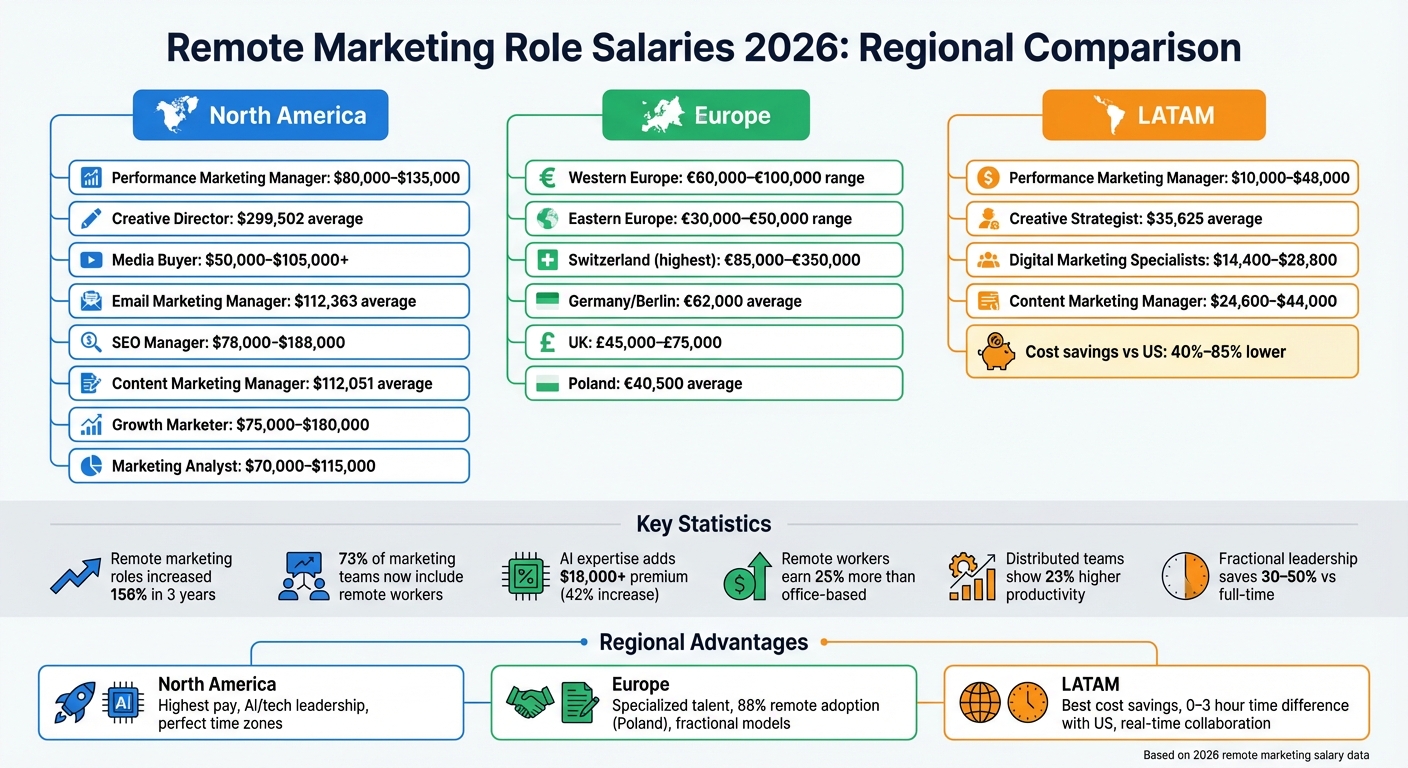
Remote Marketing Salaries by Region 2026: North America vs Europe vs LATAM Comparison
Top 10 Highest Paying Jobs In Digital Marketing | Digital Marketing Jobs 2026 | Simplilearn

1. Performance Marketing Manager
Performance Marketing Managers are the masterminds behind paid acquisition campaigns. They focus on optimizing ad spend across platforms to improve key metrics such as CAC (Customer Acquisition Cost), ROAS (Return on Ad Spend), and LTV (Lifetime Value). Their work involves building attribution models, conducting A/B tests, and making real-time budget adjustments based on data insights.
Salary Ranges by Region
In North America, remote Performance Marketing Managers in senior roles earn between $80,000 and $135,000 annually, with the average total compensation landing at $114,265 [5][6]. Across Europe, salaries vary widely depending on location. Cities like Amsterdam and Berlin offer higher rates, while regions with lower living costs, such as Lisbon, Prague, and Warsaw, tend to pay about 20–30% less but still attract strong talent [1]. Latin America is gaining recognition as a cost-effective talent hub, with specialists earning between $10,000 and $48,000 annually [4].
Here’s a quick look at how salaries compare across regions:
Regional Demand Trends
"Performance marketing specialists thrive. ROI focus intensifies everywhere. Attribution modeling gains importance. Budget optimization requires expertise. Numbers drive decisions." - Keith Kipkemboi [7]
Remote marketing roles have surged, with job postings increasing by 156% over the three years leading up to 2025. Currently, 73% of marketing teams include remote professionals [7]. North America remains at the forefront of remote-first adoption, offering high-paying roles. Europe benefits from digital nomad visas and robust labor protections, making it an attractive option for distributed teams [7]. Latin America stands out for its overlapping time zones with North America, allowing for seamless real-time collaboration - something harder to achieve with European or Asian teams [7][4].
These trends highlight the shifting dynamics in the global talent market, offering valuable context for hiring decisions.
Role-Specific Hiring Considerations
Performance Marketing Managers with expertise in AI and automation are in high demand, earning a salary premium of approximately $18,000, or 42% more than their peers [3]. Companies actively seek professionals skilled in predictive analytics, automated budget management, and sophisticated attribution modeling [7]. Research shows that distributed marketing teams are about 23% more productive than traditional office-based setups, and the rise of location-independent pay structures means professionals are negotiating salaries based on company headquarters rates rather than local cost-of-living standards [7][1].
2. Creative Strategist / Creative Director
Creative Strategists and Directors play a pivotal role in shaping brand stories, crafting campaign concepts, and leading teams to align a brand's vision with audience engagement. Their work spans visual and multi-channel storytelling, and as we move into 2026, these roles are evolving. The rise of AI tools is transforming creative processes, and companies are looking for leaders who can combine artistic flair with data-driven insights.
Let’s dive into regional salary benchmarks and hiring trends for these creative positions.
Salary Ranges by Region
In North America, remote Creative Directors earn an impressive average of $299,502 annually [5]. For remote Creative Strategists in the U.S., salaries typically range between $105,250 and $120,948 [4]. Over in Europe, pay varies widely depending on the country. For instance:
- In Switzerland, CMOs can earn as much as €350,000.
- Senior marketing managers in Norway average around €125,000.
- Berlin, a hub for creative talent, offers salaries around €62,000, adjusted for the local cost of living [1].
In Latin America, Creative Strategists earn an average of $35,625 annually. This represents a cost savings of about 65–75% compared to U.S. hires, without compromising on quality [4].
For businesses seeking flexibility, fractional leadership is becoming a popular option. This model provides access to executive-level expertise at significantly lower costs - 30–50% less than full-time hires. Monthly rates range from €6,000 to €18,000 in Western Europe and €12,000 to €25,000 in Switzerland. Additionally, fractional leaders can be onboarded in just 1–3 weeks, compared to the 2–4 months typically needed for full-time executive recruitment [1].
These salary figures highlight how local market conditions and demand influence compensation, with regional dynamics playing a key role in hiring strategies.
Regional Demand Trends
Certain cities and regions are emerging as hotspots for creative talent. In Europe, Berlin and Stockholm stand out. Berlin's international appeal and vibrant creative scene attract top-tier professionals, while Stockholm’s booming fintech and gaming sectors drive demand for creative directors skilled in blending storytelling with growth strategies [1]. Remote work adoption is also high in this region, with the Netherlands at 52% and Sweden at 45%. Poland leads the pack with an impressive 88% remote work adoption among knowledge workers, showcasing a strong infrastructure for distributed teams [1].
In North America, companies are increasingly turning to Latin America as a talent pool for creative roles. The overlapping time zones make real-time collaboration seamless, and the cost benefits are substantial [4]. Remote marketing professionals in North America also earn about 25% more than their office-based counterparts, reflecting the premium placed on securing top talent [3].
Role-Specific Hiring Considerations
The integration of AI into creative workflows has elevated the value of creative professionals. Those with expertise in AI-driven tools and processes now command premiums of 20–40% over generalists [1]. Employers are prioritizing candidates with portfolios that showcase measurable ROI from campaigns and social initiatives, emphasizing the importance of data-backed creativity in today’s market [5]. In Europe, multilingual skills are particularly sought after for managing campaigns across diverse regions [1].
Another factor shaping compensation is location arbitrage. Many creative professionals base their salary expectations on the location of the company’s headquarters rather than their own residence [1]. For startups and companies with tight budgets, fractional executive models are especially appealing. Western European companies, for example, can save an average of 33% by opting for fractional leadership. This approach also provides operational flexibility, with 30-day notice periods allowing businesses to test high-level creative talent before committing long-term [1].
3. Amazon Ads / Marketplace Marketing Specialist
Amazon advertising has become a specialized field that directly impacts sales growth. As e-commerce continues to dominate retail in 2026, the demand for experts who can navigate Amazon's intricate advertising platform remains high. These specialists handle PPC campaigns, fine-tune product listings, and leverage attribution data to maximize returns on ad spend. Like other remote marketing roles, salaries for this position vary widely based on expertise and regional market conditions.
Salary Ranges by Region
North America leads in compensation for Amazon Ads Specialists. Professionals in this region earn between $70,000 and $120,000 annually, with total compensation - including bonuses and incentives - averaging around $100,750[8]. Digital Marketing Managers in charge of marketplace strategies see even higher earnings, with base salaries averaging $114,265 and total compensation reaching $133,362[5].
In Europe, salaries differ significantly by country. For instance, digital marketing specialists in Switzerland earn approximately €85,000 (around $90,000), nearly double the European average[1]. The UK offers salaries ranging from £45,000 to £75,000 (about $55,000 to $92,000). In Eastern Europe, such as Poland, marketing managers earn around €40,500 (approximately $43,000), while in Spain, salaries range from €29,782 to €53,593 (about $31,500 to $57,000), depending on experience[1].
Latin America offers a cost-effective alternative for businesses. Amazon Ads Specialists in this region earn between $10,000 and $48,000 annually, which represents savings of 40% to 80% compared to U.S.-based hires[4]. Despite the lower pay, many LATAM professionals bring strong technical expertise and work seamlessly with North American companies due to time zone alignment.
These salary figures highlight the interplay between regional demand and compensation trends.
Regional Demand Trends
North America remains the epicenter of demand for marketplace experts, as brands compete fiercely for visibility on Amazon's increasingly saturated platform. In Europe, demand is concentrated in e-commerce hubs like Amsterdam, where 83% of the workforce possesses digital skills and the marketplace ecosystem is well-established[1].
"Hiring an Ads Specialist from Latin America can save businesses 40% – 80% in salary costs while still accessing skilled professionals with experience in running high-performing ad campaigns." - Juli Brown, CEO, WOW Remote Teams[4]
Role-Specific Hiring Considerations
Expertise in AI and automation is becoming a must-have for marketplace specialists. Skills in AI-driven bidding strategies, automated campaign management, and predictive analytics can boost pay by 42%, translating to an additional $18,000+ annually[3]. Many companies now use location-based pay scales, adjusting salaries based on where remote employees live rather than offering uniform rates[1].
For employers aiming to balance cost and quality, regions like Eastern Europe and LATAM stand out. A U.S.-based specialist typically costs between $4,167 and $6,917 per month, whereas a LATAM professional costs around A U.S.-based specialist typically costs between $4,167 and $6,917 per month, whereas a LATAM professional costs around $1,200 to $2,400 per month,200 to $2,800 per month[4]. In Europe, multilingual skills are highly valued for managing campaigns across various marketplaces, particularly in cities like Geneva or Zurich[1]. Across all regions, hiring managers prioritize candidates who can deliver clear ROI metrics, optimize customer acquisition costs, and tie ad performance to revenue growth[1].
As with other remote marketing roles, regional differences and specialized skills heavily influence salaries, with automation expertise continuing to drive higher compensation.
4. Media Buyer (Meta, TikTok, Google)
Media buyers create and manage paid campaigns on platforms like Meta, TikTok, and Google Ads to drive both traffic and conversions. By 2026, their expertise is more sought after than ever, as businesses focus on achieving measurable returns on investment. These professionals excel in ad optimization, attribution, and running campaigns across multiple platforms. Salaries for media buyers vary widely depending on location, reflecting both local market conditions and the global competition for skilled talent.
Salary Ranges by Region
In North America, media buyers enjoy some of the highest salaries. Remote Ads Specialists typically earn between $50,000 and $83,000 annually, while experienced Paid Social Managers can command salaries of around $100,000. For senior-level roles managing complex attribution models, pay can exceed $105,000[4][5][7].
In Europe, salaries vary significantly by country. The UK offers compensation ranging from £45,000 to £75,000 (approximately $55,000 to $92,000), while Switzerland leads the region with salaries around €85,000 (about $90,000). In contrast, Southern and Eastern Europe offer lower salaries but better purchasing power. For instance, media buyers in Spain earn between €29,782 and €53,593 ($31,500 to $57,000), while Portugal tops out at €25,000 (roughly $26,500)[1].
Latin America stands out as a cost-effective hiring region for employers. Media buyers in this area earn between $10,000 and $48,000 annually, which represents a 40% to 80% savings compared to hiring U.S.-based professionals.
"Hiring an Ads Specialist from Latin America can save businesses 40% – 80% in salary costs." - Juli Brown, CEO, WOW Remote Teams[4]
These salary differences highlight how local economic factors shape compensation across regions.
Regional Demand Trends
North America remains a leader in remote-first policies and high-paying roles, with companies emphasizing ROI-driven results and performance marketing expertise. Between 2020 and the mid-2020s, remote marketing job postings in the region grew by 156%[7].
In Europe, remote work adoption varies widely. Poland leads with 88% of knowledge workers embracing remote work, while the Netherlands boasts 83% digital skills penetration. The UK continues to be a key market for PPC and social media expertise, even as Southern European countries like Spain and Italy lag behind, with remote adoption rates around 22%[1].
Meanwhile, Latin America has become a favored hiring destination for North American companies aiming to reduce costs while maintaining quality. The region's time zone alignment with the U.S. facilitates real-time collaboration, and reports suggest that distributed marketing teams in this area achieve 23% higher productivity compared to traditional office setups[7].
As these trends evolve, skills in AI tools and platform certifications are becoming increasingly important for media buyers.
Role-Specific Hiring Considerations
In 2026, AI proficiency is a must-have skill for media buyers. Those who use automation tools for ad bidding and creative testing often command higher salaries[3]. Employers should also look for candidates with up-to-date certifications like Meta Blueprint or Google Ads, which demonstrate expertise in navigating ever-changing ad platforms[7].
Performance metrics are another critical factor. Hiring managers prioritize candidates who understand metrics like attribution modeling, Customer Acquisition Cost (CAC), and Return on Ad Spend (ROAS). Compensation is increasingly tied to measurable results rather than activity-based metrics[7].
For companies balancing cost and quality, hiring from regions like Latin America or Eastern Europe offers significant savings. A U.S.-based media buyer typically costs $24 to $40 per hour, while a professional in Latin America with similar skills costs around $7 to $14 per hour. Eastern European markets, such as Poland and the Czech Republic, provide another cost-effective option, offering specialized talent at rates far below those in Western Europe or North America[1][4].
"Location-independent professionals can now command compensation based on where companies are headquartered rather than where they physically reside." - The Digital Bloom[1]
Finally, multi-language skills and cultural awareness can be a major asset, particularly for campaigns targeting diverse markets. When hiring internationally, companies should also consider offering comprehensive compensation packages, including home office stipends (typically $1,000 to $5,000 annually) and budgets for ongoing education on advertising platforms[7].
5. Email Marketing Manager / Lifecycle Manager
Email Marketing and Lifecycle Managers have become central to driving customer engagement in remote teams. By 2026, their responsibilities stretch far beyond running individual campaigns. These professionals now manage comprehensive strategies, diving deep into audience analytics and linking efforts to revenue outcomes. Using tools like Klaviyo, HubSpot, and Mailchimp, they handle automated workflows, audience segmentation, and key performance metrics such as open rates, click-through rates, and customer lifetime value. As businesses focus on owned channels to lower customer acquisition costs, the demand for skilled email marketers continues to climb globally.
Salary Ranges by Region
North America leads in compensation for Email Marketing Managers. In the United States, the average base salary is $112,363, with senior roles offering total compensation of up to $165,000 for those with seven or more years of experience[5]. Entry-level positions generally pay between $67,313 and $85,554 per year, equating to $32 to $41 per hour[4].
In Europe, salaries vary significantly by country. Switzerland tops the list, with digital marketing professionals earning around €85,000 (approximately $90,000). In contrast, starting salaries in Portugal can be as low as €18,000 ($19,000). The United Kingdom offers mid-range salaries, typically between £45,000 and £75,000 (about $55,000 to $92,000)[1]. Western European countries generally offer 20% to 30% more than their Eastern European counterparts for similar roles.
In Latin America, salaries are notably lower, creating cost-saving opportunities for employers. Annual earnings for Email Marketing Specialists range from $10,000 to $48,000, with monthly pay between $833 and $4,000. This translates to potential savings of 40% to 85% compared to U.S.-based hires[4].
"By hiring an Email Marketing Specialist from Latin America, businesses can save 40% – 85% in salary costs." – Juli Brown, CEO, WOW Remote Teams[4]
These salary differences highlight how market demand and evolving job expectations influence compensation across regions.
Regional Demand Trends
North American companies are increasingly turning to Latin America for Email Marketing talent. The region's time zone compatibility with the U.S. allows for real-time collaboration, making it a popular choice for distributed teams[4]. In the U.S., Email Marketing Managers are in high demand, with compensation often exceeding that of general marketing positions[5].
Specialists with expertise in AI-driven marketing tools see a $18,000 pay premium, reflecting a 42% higher salary[3]. Additionally, remote marketers tend to earn 25% more than their office-based counterparts, underscoring the competitiveness of the remote job market[3].
While North America remains the hub for top-paying roles, Europe and Latin America have become go-to regions for sourcing diverse, cost-effective remote talent. However, salary transparency remains a concern. As of late 2024, 68% of companies were reported to underpay remote staff, driving the demand for more accurate, location-specific salary data in 2026[3].
Role-Specific Hiring Considerations
This role has shifted from managing individual campaigns to overseeing full-funnel strategies, making expertise in revenue attribution a top priority for hiring managers[1]. Candidates with a strong background in marketing automation tools often command a 20% to 40% salary premium over generalists[1]. Proficiency in AI-driven marketing tools is now a must-have for staying competitive.
Key skills that boost earning potential include audience analytics, brand strategy, and customer acquisition strategies[5]. Professionals who can demonstrate measurable results, such as reducing customer acquisition costs (CAC) or proving clear revenue attribution, are better positioned to secure higher pay[1]. Many companies have also adopted location-based pay scales, leading to 20% to 30% salary variations for the same work depending on where employees live[1].
For businesses balancing cost and quality, hiring from regions like Latin America or Eastern Europe offers significant savings without sacrificing performance. Additionally, many remote-first companies in 2026 are offering monthly stipends of $200 to $500 to cover home office expenses and attract top talent[3].
6. SEO Strategist
In 2026, SEO Strategists play a crucial role in driving organic growth by combining technical SEO, content optimization, and user experience enhancements. This position requires expertise in AI-driven tools and automation, as businesses prioritize professionals who can deliver measurable ROI.
Salary Ranges by Region
North America leads in compensation for SEO professionals. In the United States, remote SEO Specialists earn between $38,000 and $130,000 annually, with the average salary landing at $81,782[4]. SEO Managers, however, command higher pay, ranging from $78,000 to $188,000, with an average of $113,050[5]. This represents a $31,000 difference in average pay between Managers and Specialists.
Europe shows notable salary variations depending on the country. Switzerland tops the charts, with digital marketing specialists earning around €85,000 (roughly $90,000). In the United Kingdom, salaries range from £45,000 to £75,000 (approximately $55,000 to $92,000), while Spain offers between €29,782 and €53,593[1]. Eastern Europe, such as Poland, provides competitive talent at lower rates, with marketing managers earning an average of €40,500. This is further offset by a lower cost-of-living index of 43.7[1].
Latin America offers the most cost-effective talent. SEO Specialists in the region earn between $9,600 and $48,000 annually, making it a budget-friendly option for employers[4]. The region's time zone alignment with North America enhances its appeal for real-time collaboration without the added expense.
These salary benchmarks highlight how regional factors shape compensation for SEO professionals.
Regional Demand Trends
Beyond salaries, regional market dynamics also influence demand and hiring trends. In Europe, mature digital markets like the United Kingdom, Germany (notably Berlin), and Sweden (Stockholm) exhibit strong demand for SEO expertise, bolstered by active startup and fintech sectors[1]. Poland stands out as a leader in remote work adoption, with 88% of knowledge workers operating remotely. The country’s IT and digital outsourcing market is expected to reach $7.17 billion by 2029, further cementing its reputation as a talent hub[1].
North America remains a dominant market, with companies focusing heavily on optimizing organic traffic and enhancing user experiences across multiple platforms[4][5]. Meanwhile, Latin America has become a strategic talent pool for North American businesses, driven by cost-saving opportunities and favorable time zone overlaps[4].
Across all regions, SEO specialists earn 20% to 40% more than general marketing managers due to the technical expertise required for search optimization[1]. Professionals with skills in AI and automation are particularly in demand, with AI expertise boosting salaries by approximately $18,000, representing a 42% increase[3].
Role-Specific Hiring Considerations
While technical SEO skills remain essential, proficiency in AI tools and integration now sets top candidates apart[3][1]. Certifications can also enhance earning potential, adding $15,000 to $25,000 to base salaries[3].
Another trend shaping the market is the shift toward basing salaries on employer headquarters rather than employee location[1]. Many European companies now adjust pay scales by 20% to 30%, depending on the employee's country of residence, to balance costs and maintain quality[1].
For employers seeking to optimize budgets, Eastern Europe and Latin America offer excellent talent at lower costs, supported by strong remote work cultures. Companies are also turning to fractional leadership models for high-level SEO strategy, cutting costs by 30% to 50% compared to hiring full-time executives[1]. Additionally, many remote-first organizations now provide monthly stipends of $200 to $500 to cover home office expenses, making them more competitive in attracting specialized SEO talent[3].
sbb-itb-88a7fe6
7. Content Marketing Manager
By 2026, the role of Content Marketing Managers has expanded far beyond managing editorial calendars. These professionals now lead strategic content initiatives, often requiring proficiency in AI tools and techniques. The job involves close collaboration with sales and performance marketing teams, alongside a focus on demonstrating content ROI through audience analytics and revenue attribution[1][5]. Companies are increasingly seeking candidates who can seamlessly integrate AI into content workflows and deliver measurable business outcomes.
Salary Ranges by Region
North America offers the most lucrative compensation for remote Content Marketing Managers, with salaries ranging from $40,000 to $180,000 annually. The average sits at $112,051, while entry-level roles typically start around $75,000. Experienced professionals with seven or more years in the field can command salaries averaging $145,305[3][5]. This wide range reflects the growing gap between generalist roles and specialized positions requiring expertise in AI or niche industries.
Europe demonstrates significant salary variation depending on the country. Switzerland leads, offering salaries between €200,000 and €210,000 (approximately $212,000 to $223,000), though its high cost of living impacts purchasing power[1]. Norway follows with €125,000 to €130,000, while the Netherlands offers €95,000 to €100,000. In mid-tier markets, the United Kingdom pays £53,000 to £75,000 (roughly $68,000 to $97,000), Germany ranges from €61,500 to €62,000, and Spain offers €45,000 to €70,000. Eastern Europe presents competitive options, with Poland averaging €40,500 to €42,000 and Portugal ranging between €28,000 and €40,000[1].
Latin America provides an affordable alternative for employers, with salaries ranging from $24,600 to $44,000 annually. This represents 50% to 70% savings compared to U.S. salaries, while still delivering high-quality work[4]. The region’s time zone alignment with North America adds to its appeal, making it a strategic choice for many companies.
These salary benchmarks highlight the regional differences in compensation and underline how market dynamics shape demand for talent.
Regional Demand Trends
Regional demand trends reveal additional insights into how talent is valued. In North America, professionals with expertise in AI marketing tools and strategies are highly sought after. These skills can boost salaries by 42%, translating to an annual premium of over $18,000[3]. Employers prioritize candidates who can connect content strategies to customer acquisition costs and revenue outcomes.
In Europe, demand is strongest in digitally advanced markets like the Netherlands, where 83% of the workforce possesses digital skills and 52% of jobs offer flexible work options[1]. Startup hubs such as Berlin and Stockholm are actively hiring content professionals who can rapidly scale brand visibility. Meanwhile, Eastern Europe, particularly Poland, has become a hotspot for remote marketing talent, with 88% of knowledge workers adopting remote work practices[1].
In Latin America, the appeal extends beyond cost efficiency. U.S. companies increasingly view the region as a source of skilled professionals capable of real-time collaboration. LATAM marketers have honed expertise in areas like SEO, social media growth, and marketing automation, making them valuable assets for global teams[4].
Role-Specific Hiring Considerations
AI proficiency is no longer optional - it’s now a must-have skill for Content Marketing Managers. Specialized certifications can add $15,000 to $25,000 to a candidate’s base salary[3]. However, hiring managers often value a strong portfolio over formal credentials. Demonstrated results, such as successful SEO campaigns, measurable social media growth, and proven revenue attribution, carry significant weight.
Remote marketers generally earn 25% more than their office-based counterparts. Companies offering monthly stipends of $200 to $500 for home office expenses are gaining a competitive edge in attracting top talent[3].
For organizations with tighter budgets, fractional leadership models provide access to executive-level content strategy at a fraction of the cost[1]. Additionally, many companies are leveraging location-based pay adjustments to remain competitive. For example, firms headquartered in high-cost regions often attract top talent from lower-cost areas like Portugal or Poland by offering salaries aligned with the company’s location rather than the employee’s residence[1].
8. Growth Marketer
In 2026, Growth Marketers are among the most in-demand remote marketing professionals. Their role goes beyond traditional marketing, combining data analytics, AI expertise, and tried-and-true marketing strategies to achieve scalable results. Unlike generalists, Growth Marketers zero in on customer acquisition, optimizing retention, and driving revenue growth. To excel, they need strong skills in attribution modeling, marketing automation, and predictive analytics - skills that come with a higher salary tag.
Salary Ranges by Region
North America leads the way in compensation for remote Growth Marketers. Annual salaries range from $75,000 to $150,000, with a median of $105,000, while senior positions can top $180,000 [9]. In the U.S., the median climbs to $115,000, with a typical range of $80,000 to $145,000 [9]. Canadian salaries are slightly lower, with a median of $100,000 and a range of $80,000 to $120,000 [9]. Proficiency in AI tools can boost salaries by over 42%, adding $18,000+ to annual earnings [3].
In Europe, salaries vary by country, with Germany offering the highest median at $98,000, followed by the UK at $85,000, with ranges between $60,000 and $110,000 [9]. Across the broader European market, the median stands at $75,000, with most salaries falling between $60,000 and $90,000 [9]. Switzerland is an outlier, where salaries can reach $120,000, though employers must account for social contributions that can increase costs by up to 59% [10][12].
Latin America has become an attractive option for hiring Growth Marketers. Median salaries hover around $75,000, with ranges from $50,000 to $90,000 [9]. Key markets like Brazil, Mexico, Colombia, and Argentina offer medians of $95,000, with ranges between $60,000 and $125,000 [9]. This represents a 40% to 80% cost saving compared to U.S. salaries, while allowing for real-time collaboration due to overlapping time zones [4].
These regional salary trends highlight how the demand for Growth Marketers is shaped by global market dynamics.
Regional Demand Trends
Demand for remote marketing roles has skyrocketed, with job postings increasing by 156% over the last three years, and Growth Marketing leading the charge [7]. Today, 73% of marketing departments include remote team members, and distributed teams report 23% higher productivity compared to traditional office setups [7]. North America has long been a leader in remote-first policies, but Europe is catching up fast, aided by digital nomad visas and supportive labor laws.
Latin America continues to grow as a nearshore talent hub for North American companies. Businesses are drawn to the region's combination of 30% to 80% lower labor costs and overlapping time zones, which allow for seamless collaboration [4]. Additionally, the region has built strong expertise in data-driven marketing, making it a top choice for growth-focused roles.
The blending of technical data analysis with traditional marketing is reshaping how companies hire for Growth Marketing roles. In 2026, these professionals are expected to master tools like API integrations and predictive analytics, and companies are increasingly adopting location-agnostic pay scales to secure top-tier talent [7].
Role-Specific Hiring Considerations
When hiring Growth Marketers, businesses should focus on "T-shaped" professionals - those with deep expertise in areas like data analysis and attribution modeling, paired with a broad understanding of content strategy and performance marketing. Only 1% to 2% of digital marketing managers specialize in customer acquisition or audience analytics, making such candidates highly competitive [5].
AI proficiency is now a must. Growth Marketers skilled in AI tools enjoy salary premiums of about $18,000, and this gap is expected to grow [3]. Fractional leadership models are also gaining traction, offering cost savings of 30% to 50% compared to full-time hires [1]. To attract top talent, companies often provide remote work stipends ranging from $200 to $500 per month and annual home office budgets between $1,000 and $5,000 [3].
For companies aiming to optimize budgets, cities like Berlin, Prague, and Lisbon offer access to high-quality talent at lower costs while maintaining strong remote work infrastructure [1]. Poland stands out with 88% remote adoption among knowledge workers, while the Netherlands offers 52% flexible work arrangements [1]. These markets provide skilled Growth Marketers at rates 26% to 48% lower than major U.S. tech hubs [10][11].
9. Influencer / Affiliate Marketing Manager
Influencer and Affiliate Marketing Managers play a pivotal role in driving revenue through partnerships and performance-based campaigns. These professionals handle influencer relationships, negotiate contracts, track campaign performance, and fine-tune commission structures. By 2026, expertise in creator platforms, affiliate tracking tools, and audience analytics will be highly sought after, as these specialized skills remain uncommon yet essential. As with other remote marketing roles, compensation for these positions reflects regional trends and the growing demand for expertise.
Salary Ranges by Region
North America leads in compensation for remote Influencer and Affiliate Marketing Managers. Digital marketing managers, a closely related role, earn an average of $114,265 annually, with experienced professionals making up to $145,305[5]. Remote marketing roles overall range between $49,628 and $162,220, with an average of $88,750[2]. Notably, affiliate marketing expertise is rare, with only about 1% of digital marketing managers listing it as a primary skill[5]. Professionals with AI marketing expertise can expect an additional $18,000+ premium on their base salary[3].
Europe offers varied pay depending on the country. In Switzerland, digital marketing specialists earn around €85,000 (approximately $92,000), nearly double the European average[1]. In the UK, salaries range from £45,000 to £75,000 (about $57,000 to $95,000), while Spain offers lower ranges of €29,782 to €53,593 (approximately $32,000 to $58,000)[1]. Tech hubs like Stockholm and Berlin maintain steady demand for growth marketing talent, with the UK leading the way in remote work adoption at 40%[1].
Latin America offers significant cost advantages for employers. Social media specialists, who often handle influencer management tasks, earn between $15,360 and $42,240 annually[4].
"Hiring a Social Media Specialist from Latin America can save businesses 40% – 75% in salary costs" - Juli Brown, CEO of WOW Remote Teams[4]
Digital marketing specialists in the region earn between $14,400 and $28,800, making Latin America an attractive talent pool for North American companies[4].
Regional Demand Trends
In North America, demand for skilled affiliate marketers remains high. Remote-first companies often pay above-market rates to secure top talent, especially as location-based pay calculators become more common[3]. However, a 2024 study revealed that 68% of companies underpaid remote staff, highlighting the importance of competitive benchmarking for 2026[3].
In Europe, many organizations are adopting fractional leadership models for influencer and affiliate strategies, reducing costs by 30% to 50% compared to hiring full-time executives[1]. Poland boasts the highest remote work adoption rate among knowledge workers at 88%, followed by the Netherlands (52%) and Sweden (45%)[1]. Additionally, European professionals are increasingly negotiating salaries based on company headquarters rather than their local cost of living, leveraging location arbitrage to boost earnings[1].
Latin America has become a key sourcing region for North American companies scaling influencer and social media marketing. Shared time zones enable real-time collaboration, and U.S. companies can hire highly skilled professionals at monthly rates of $1,280 to $3,520, compared to U.S. rates of $4,298 to $6,147[4]. These trends make Latin America a strategic choice for cost-effective hiring.
Role-Specific Hiring Considerations
When hiring Influencer and Affiliate Marketing Managers, prioritize candidates with strong audience analytics and AI skills. These capabilities not only enhance team performance but also justify higher salaries. Performance-based affiliate marketing specialists can earn 20% to 40% more than generalist marketing managers[1]. Professionals with over seven years of experience in this field can command salaries averaging $145,305[5].
AI proficiency and advanced analytics expertise can add $18,000+ to base salaries[3]. To stay competitive, employers should consider offering remote work stipends ranging from $200 to $500 per month, as remote employees save an average of $11,000+ annually on work-related expenses[3]. For cost-effective hiring, consider candidates from Latin America for social media and influencer roles or explore European hubs like Berlin, Prague, and Lisbon, which offer top-tier talent at a fraction of the cost compared to major U.S. tech cities[1].
10. Marketing Analyst / Attribution Specialist
Marketing Analysts and Attribution Specialists play a crucial role in remote marketing teams. They’re the data experts who monitor campaign performance, create attribution models, and turn complex datasets into actionable strategies. By 2026, these professionals are leveraging tools like Google Analytics, Tableau, and AI-driven platforms to measure ROI across multiple channels. With companies demanding verified ROI from their marketing efforts, the need for skilled analysts has grown significantly worldwide.
Salary Ranges by Region
In North America, remote Marketing Analysts earn an average base salary of $90,833, with most salaries falling between $70,000 and $115,000[5][8]. Senior positions, such as Marketing Operations Managers, can earn between $80,000 and $200,000, with an average of $138,682[5]. Professionals with AI expertise often see a premium of $18,000+ added to their base pay, and roles requiring AI-related skills can command salaries that are 42% higher than similar positions without these requirements[3].
In Europe, salaries vary widely by country. Switzerland leads the pack, with digital marketing specialists earning around €85,000 (approximately $92,000)[1]. In the UK, salaries range from £45,000 to £75,000 (about $57,000 to $95,000)[1]. Germany offers mid-level analyst roles with pay between €61,500 and €70,000 (roughly $66,000 to $76,000), while Spain offers lower ranges of €29,782 to €53,593 (approximately $32,000 to $58,000)[1]. Poland has become a key player for remote marketing talent, boasting an 88% remote work adoption rate among knowledge workers - the highest in Europe[1].
In Latin America, salaries are significantly lower, offering cost advantages for companies. Digital marketing specialists with analytical skills typically earn between $14,400 and $28,800 annually, while ad specialists with data expertise can make anywhere from $10,000 to $48,000[4]. This represents a 50% to 80% savings compared to U.S. hires, making LATAM an appealing option for North American companies building remote teams[4].
Regional Demand Trends
Looking at regional trends, North America sees strong demand for analysts skilled in predictive modeling and automated attribution. Remote Marketing Analysts now earn about 25% more than their in-office counterparts. However, a 2024 study found that 68% of companies underpay their remote staff, emphasizing the importance of transparent salary benchmarks in 2026[3]. Interestingly, only 2% of remote Digital Marketing Managers list "Audience Analytics" as a core skill, indicating a high demand for specialists in this area[5].
In Europe, demand is especially high in established digital markets like the UK, Netherlands, and Germany. The Netherlands, for example, has the highest digital skills penetration in the EU at 83%, creating a strong ecosystem for analysts[1]. Many professionals in Europe are now negotiating their salaries based on the location of their company’s headquarters (e.g., London or Berlin) rather than their own residence (e.g., Lisbon or Warsaw), leveraging location arbitrage to maximize income[1].
In LATAM, the shared time zones with North America make real-time collaboration easier, further boosting the region’s popularity for analytical roles. Companies can hire highly skilled professionals at a fraction of U.S. salary benchmarks while maintaining quality output[4].
Role-Specific Hiring Considerations
AI and automation expertise are becoming essential for roles in this field. Candidates with these skills can expect salaries to increase by 20% to 40%[1]. Additionally, industry certifications can add anywhere from $15,000 to $25,000 to base salaries[3]. Offering competitive remote work stipends can also make roles more attractive, as remote employees save an average of $11,000+ annually on work-related expenses[3]. To balance cost and quality, companies should consider talent from LATAM or European hubs like Poland, which offer high remote work adoption rates and competitive pricing[1][4].
Regional Hiring Comparison: Advantages and Disadvantages
Building on the salary benchmarks outlined earlier, this analysis dives into the costs, time zone compatibility, and specialized expertise offered by North America, Europe, and LATAM. Knowing the trade-offs can help businesses make smarter hiring decisions when assembling a remote marketing team in 2026. Each region brings its own strengths depending on budget constraints, collaboration requirements, and the need for specific expertise.
North America stands out for its high-level expertise, particularly in roles like AI-integrated marketing and brand strategy that demand a deep understanding of American consumer behavior. Remote marketers in the U.S. earn 25% more than their in-office counterparts[3], reflecting the premium placed on advanced skills. However, North American salaries set the standard globally, with other regions offering savings of up to 85%.
LATAM is a leader in cost efficiency and offers excellent time zone compatibility for North American businesses. For instance, hiring an Ads Specialist from this region can cut costs by 40% to 80% compared to U.S. rates[4]. Content Marketing Managers in LATAM typically earn between $24,600 and $44,000 annually, yielding savings of around 50% to 70%[4]. Brazil has become a creative hub for social media and influencer marketing, while Colombia is gaining recognition in e-commerce and digital advertising. The close time zone alignment with the U.S. allows for seamless real-time collaboration, making LATAM a great choice for roles like Social Media Specialists and Paid Ads Managers.
Europe offers a balanced option, with notable internal differences between Western and Eastern regions. Western Europe, including cities like London, Amsterdam, and Berlin, is known for its highly specialized talent in areas such as fintech, AI, and data science marketing. However, costs here can rival North America - Marketing Managers in Berlin earn approximately €62,000 ($67,000), while in Zurich, the figure rises to around €200,000 (about $218,000)[1]. Eastern and Southern Europe, on the other hand, provide significant cost savings of 20% to 30% while maintaining strong skill levels. For example, Poland boasts an 88% remote work adoption rate among knowledge workers[1], the highest in Europe, showcasing a workforce adept at asynchronous communication despite the 7 to 10-hour time difference with North America. Additionally, the Netherlands leads in digital skills penetration at 83%[1], fueling analytical roles. Fractional CMO models are also gaining traction in Europe, delivering executive marketing leadership at 30% to 50% of the cost of full-time hires, with onboarding timelines of just 1 to 3 weeks compared to the 2 to 4 months required for traditional hires[1].
Here’s a summarized comparison of these regional differences:
| Factor | North America | LATAM | Western Europe | Eastern Europe |
|---|---|---|---|---|
| Average Cost Level | $88,750+ | $10,000–$48,000 | €60,000–€100,000 | €30,000–€50,000 |
| Cost Savings vs. U.S. | Baseline | 30%–85% | 20%–40% | 20%–30% |
| Time Zone (U.S. East Coast) | Perfect alignment | 0–3 hours difference | 6–9 hours difference | 7–10 hours difference |
| Remote Work Adoption | High | Growing rapidly | High (e.g., 52% in the Netherlands) | Very high (e.g., 88% in Poland) |
| Key Strengths | AI/tech leadership, brand strategy | Creative execution, real-time collaboration | Specialized niches (fintech, AI) | Technical skills (SEO, automation) |
| Best Use Cases | Strategic roles, U.S. market expertise | Ads management, social media, content | Fractional leadership, data science | Performance marketing, analytics |
The data paints a clear picture: 37% of senior marketing leadership roles report a shortage of candidates with the required digital skills[11]. Companies that strategically combine cost savings and specialized talent - such as hiring fractional CMOs from Western Europe, performance marketers from Eastern Europe or LATAM, and keeping strategic leadership in North America - can create highly competitive teams. With remote marketing roles seeing a 51% increase in availability in 2026[9] and a median salary of $100,000[9], understanding these regional trends is crucial for managing budgets while staying ahead in the talent race.
Conclusion
The salary landscape for remote marketing roles in 2026 reveals a clear global hierarchy. North America dominates with higher pay rates - general marketing roles average $88,750, while director-level positions climb to $166,903 [2][3]. In Europe, salaries vary widely, ranging from €35,000 in Lisbon to €210,000 in Zurich [1]. Meanwhile, Latin America (LATAM) offers substantial cost savings, with salaries typically 40% to 85% lower than U.S. benchmarks [4]. These trends not only help employers fine-tune their hiring budgets but also provide marketers with insights to position themselves competitively in the global talent market.
For companies building remote teams, the data points to opportunities that go beyond reducing costs. Cities like Berlin, Prague, and Lisbon offer access to highly skilled talent at more affordable rates, enabling businesses to maintain quality while managing expenses. Factors such as time zone compatibility - especially relevant for LATAM hires working with U.S. teams - and specialized expertise, like AI marketing (which commands a 42% pay premium [3]), are critical considerations for strategic hiring.
Marketers, on the other hand, should evaluate compensation packages holistically. Remote work can save individuals an estimated $11,000 annually in personal expenses [3]. Additionally, understanding location-based negotiation strategies - such as leveraging a company's headquarters location rather than their local cost of living - can strengthen bargaining power and ensure better outcomes.
FAQs
How do salary differences across regions influence hiring strategies for remote marketing roles?
Regional salary differences play a big role in shaping how companies hire remote marketing professionals. For example, marketers in North America tend to earn some of the highest salaries worldwide, with an average of $88,750 per year. Senior-level roles can go as high as $162,000 annually. Meanwhile, in Latin America (LATAM), salaries are typically about half of that, and Eastern Europe offers competitive rates that are slightly higher than LATAM.
These variations give companies the chance to stretch their budgets by hiring talented professionals from LATAM or Eastern Europe. By doing so, businesses can save up to 70% on labor costs while still tapping into expertise in areas like SEO, performance marketing, and growth hacking. That said, it’s not just about the numbers - factors like cost-of-living differences, the availability of skilled talent, and time zone compatibility are also crucial when choosing where to hire.
By aligning hiring strategies with regional salary benchmarks, companies can strike a balance between attracting top talent, managing budgets wisely, and investing in key roles or additional perks. This approach ensures a productive and well-rounded remote marketing team.
What are the most in-demand skills for remote marketing jobs in 2026?
In 2026, remote marketing roles will require a blend of AI know-how, data-driven skills, and strategic creativity. Employers are on the lookout for professionals who are adept at using AI tools like predictive analytics, automated content platforms, and chatbots to boost marketing results. Being skilled in data-related areas - such as attribution modeling and making the most of first-party data - is equally important for delivering measurable outcomes.
On top of that, marketers will need to pair strategic thinking with storytelling to design impactful, data-supported campaigns. The ability to craft personalized experiences - whether through AI-powered content or social commerce approaches - will help candidates stand out. In essence, the most sought-after marketers will seamlessly combine technical expertise, creative flair, and a strong strategic mindset to succeed in the ever-changing digital world.
How does having AI expertise impact salaries in remote marketing roles?
Marketers with AI expertise are seeing a notable boost in salaries, especially in remote roles. Why? AI has become a highly sought-after skill in the industry. Professionals who can effectively use AI-driven tools, predictive analytics, and automation platforms are in high demand. These technologies not only improve campaign results but also make workflows more efficient and enhance the accuracy of performance tracking. Employers recognize this value and are willing to pay extra for such specialized knowledge.
For instance, roles like performance marketing managers leveraging machine learning for programmatic bidding or growth marketers refining funnels with AI often sit at the higher end of the salary spectrum. Geographically, North America leads with the highest pay for these positions, followed by Western Europe and LATAM. On average, marketers with AI expertise can earn 5–10% more than their peers who lack these skills. This trend underscores the increasing importance of specialization in today’s marketing landscape.
Related Blog Posts
Read also



Ready to hire without salary-based agency fees?
Book a free 30-minute consultation. We’ll review your role, timeline, and hiring goals, then show you how our fixed-fee remote search works.