Amazon PPC vs DSP: What’s the Difference and Who Should You Hire in 2026?


Deciding between Amazon PPC and DSP depends on your business goals, budget, and growth stage. PPC drives immediate sales through keyword-targeted ads on Amazon’s marketplace, while DSP focuses on broader brand awareness and retargeting across Amazon-owned platforms and third-party sites. Here’s a quick breakdown:
- Amazon PPC: Cost-per-click model, ideal for driving quick sales and boosting visibility for products. Accessible with low budgets (starting at $1/day) and suited for small to medium businesses.
- Amazon DSP: Cost-per-thousand-impressions (CPM) model, designed for full-funnel campaigns, including awareness and retargeting. Requires higher budgets ($10K–$50K/month) and technical expertise, making it better for larger brands.
Who to hire?
- PPC Specialist: Best for startups or brands spending under $10,000/month to optimize Sponsored Product campaigns.
- DSP Expert: Recommended for brands with $10,000+ monthly ad spend, focusing on programmatic campaigns and audience segmentation.
- Both: For budgets over $50,000/month, combining PPC and DSP boosts performance, as DSP creates awareness that enhances PPC conversions.
Quick Comparison:
| Feature | Amazon PPC | Amazon DSP |
|---|---|---|
| Pricing Model | Cost-Per-Click (CPC) | Cost-Per-Thousand Impressions (CPM) |
| Ad Placement | Amazon search results | Amazon platforms + third-party sites |
| Minimum Budget | $1/day | $10K–$50K/month |
| Goal | Immediate sales | Awareness + retargeting |
| Difficulty | Moderate | High (requires programmatic skills) |
Start with PPC for immediate results, and expand to DSP as your business scales.
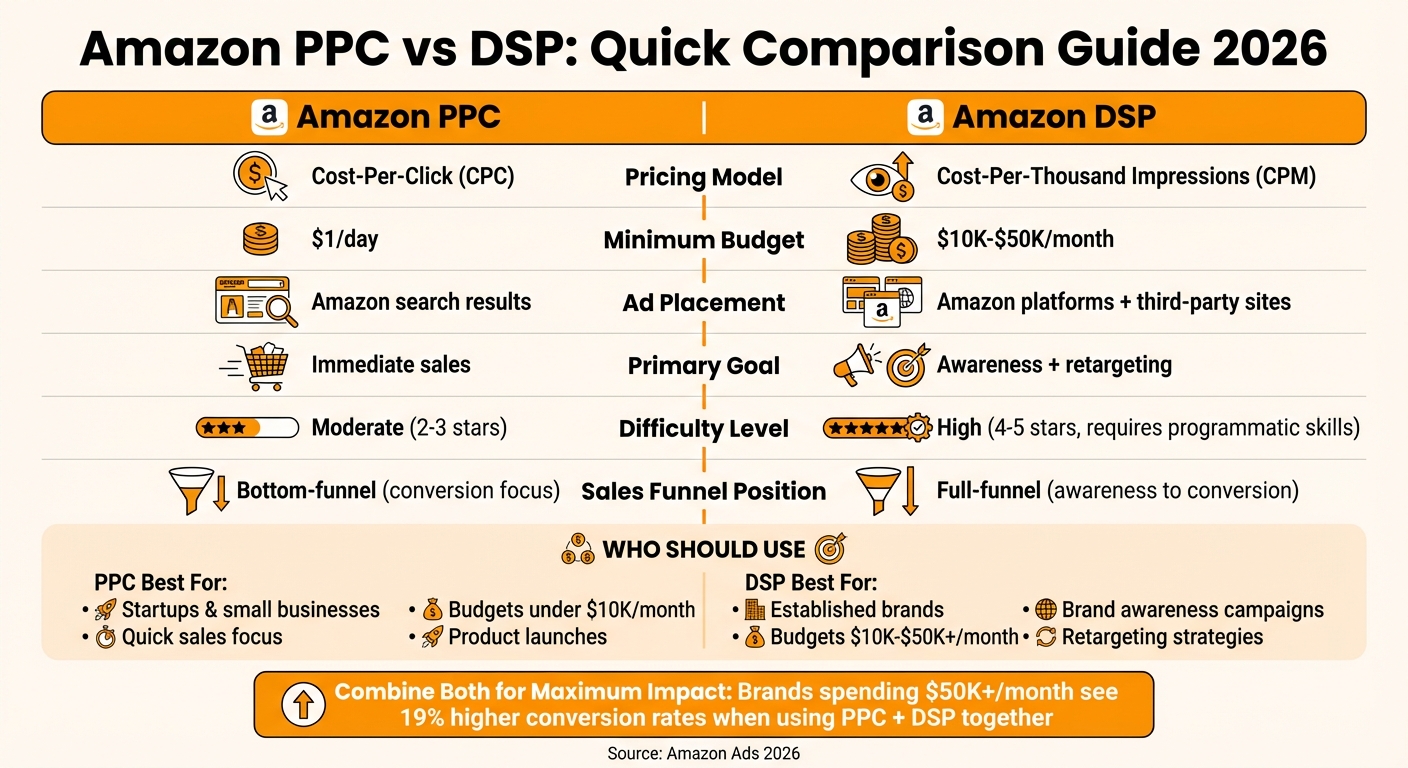
Amazon PPC vs DSP Comparison Chart 2026
Amazon PPC vs. DSP Advertising: Which Is Better for Scaling Your Brand?
What Is Amazon PPC in 2026?
Amazon PPC, or Pay-Per-Click, is an advertising model where brands pay only when a shopper clicks on their ad [1]. It works on a bidding system, allowing advertisers to bid on specific keywords or ASINs (Amazon Standard Identification Numbers) to secure ad placements in search results and on product detail pages [1]. This approach targets shoppers who are already in the "ready to buy" phase, making it an effective tool for driving quick sales.
Ad placement is determined by two factors: the bid amount and the relevance of the ad [1]. This means that even smaller brands can compete effectively if their listings are well-optimized and their targeting is precise.
"Amazon PPC (pay-per-click) is exactly what it sounds like - you pay Amazon each time a customer clicks on your ad, whether they purchase your product or not."
- Brian Connolly, Ecommerce Expert & Writer, Jungle Scout [10]
How Amazon PPC Works
Amazon PPC offers three main types of ads - Sponsored Products, Sponsored Brands, and Sponsored Display - to help businesses boost sales and visibility [1].
- Sponsored Products: These ads promote individual product listings and appear in search results and on product pages, directly driving sales.
- Sponsored Brands: These ads feature your brand logo, a custom headline, and multiple products in a banner format, often displayed at the top of search results. They focus on building brand awareness.
- Sponsored Display: These ads expand your reach beyond Amazon, allowing you to retarget potential customers on third-party websites and apps.
Advertisers can choose from several targeting methods. Keyword targeting aligns ads with specific search queries, while ASIN targeting places ads on competitor product pages. There’s also automatic targeting, which uses Amazon's algorithms to match ads with relevant keywords [1]. With a daily budget option starting as low as $1.00, Amazon PPC is accessible to businesses of all sizes [4].
Main Uses and Advantages
Amazon PPC is a powerful tool for generating traffic and driving immediate sales on the platform. It’s especially useful for launching new products. By pushing products to the top of search results, PPC helps generate early sales and reviews, which are crucial when organic rankings are still building [10]. Over time, these sales improve your product’s organic search ranking, creating a "flywheel effect" that boosts visibility for relevant keywords [10].
The impact of Amazon PPC is clear: 59% of shoppers say they’re more likely to buy a product featured in an Amazon ad, and 36% of total U.S. small business sales are driven by Amazon Ads [7]. For brands spending between $1,000 and $5,000 monthly, PPC provides a scalable, measurable way to achieve a solid return on investment.
PPC also serves other goals, like promoting seasonal items during events such as Prime Day, clearing out excess inventory, defending your brand against competitors, and reaching new customers. Notably, 35% of shoppers discover new brands while browsing on Amazon, making PPC a valuable tool for brand discovery [7].
Common PPC Tools
By 2026, PPC specialists rely on a mix of Amazon’s native tools and third-party platforms to manage campaigns effectively. The Amazon Ads Console (Campaign Manager) is the go-to tool for setting up campaigns, adjusting bids, and monitoring performance [11]. For keyword research and competitor analysis, tools like Helium 10 and Jungle Scout help identify high-traffic search terms and assess market trends [11].
AI-powered platforms, such as Perpetua and Ad Badger, streamline campaign management by automating bids and optimizing performance in real time [11]. Additional tools like Sellics and DataHawk track essential metrics, including ACoS (Advertising Cost of Sale), ROAS (Return on Ad Spend), and TACoS, to evaluate the overall effectiveness of advertising efforts [11].
This structured approach to PPC lays the groundwork for exploring how it compares to DSP in the next sections.
What Is Amazon DSP in 2026?
Amazon DSP (Demand-Side Platform) goes beyond Amazon PPC by offering programmatic ad placements that extend outside Amazon’s marketplace. This platform allows advertisers to buy display, video, and audio ads on Amazon-owned platforms like Twitch, IMDb, and Prime Video, as well as across thousands of third-party websites. Using Amazon’s first-party data, DSP enables precise audience targeting without relying on traditional cookies [9][3]. Unlike PPC, Amazon DSP operates on a CPM (cost-per-thousand impressions) model, making it particularly effective for building brand awareness and retargeting throughout the marketing funnel [12][4].
"Amazon DSP is an omnichannel marketing solution that provides choice and flexibility to drive meaningful moments between brands and consumers." - Amazon Ads [6]
Amazon DSP’s reach has grown significantly, now engaging over 275 million users monthly in the U.S. Brands using Amazon display ads have reported a 47% boost in non-Amazon sales, while advertisers utilizing AI-driven features like Performance+ have achieved a 51% reduction in acquisition costs [7][13].
However, DSP requires a substantial budget. Managed services start at $35,000–$50,000 per month, while self-service options begin at $10,000 [9][6][12]. This investment grants access to advanced features like behavioral targeting, lookalike audiences, and cross-channel attribution through Amazon Marketing Cloud (AMC) [9][13]. These tools make DSP an ideal choice for brands looking to execute comprehensive, full-funnel campaigns.
How Amazon DSP Works
Amazon DSP uses real-time bidding to place ads across various formats, including display, video, OTT (over-the-top), and audio. It analyzes vast data sets to adjust bids based on the likelihood of conversions [9][13]. Unlike traditional keyword targeting, DSP offers three main audience categories:
- Amazon Audiences: Based on shopping and streaming behaviors.
- Advertiser Audiences: Built from a brand’s own customer data for remarketing.
- Third-party Audiences: Broader groups like car buyers or cable subscribers [9].
For example, a CPG brand achieved a 20x ROAS (Return on Ad Spend) by leveraging contextual targeting through DSP [9]. This automated, data-driven approach allows DSP to excel in ad placement and in crafting effective full-funnel marketing strategies.
Main Uses and Advantages
Amazon DSP shines in full-funnel marketing by addressing all stages of the customer journey - from awareness to consideration to conversion [9][3][13]. For instance, Califia Farms ran a DSP campaign during Veganuary in the U.K., achieving a 58% increase in detail page views and a 45% rise in new-to-brand sales [6]. Similarly, Nestlé partnered with GroupM to create custom audiences in Amazon Marketing Cloud, targeting users who clicked on Sponsored Products ads but didn’t purchase. This strategy helped recapture potential customers and improved conversion rates [3].
Streaming TV ads through DSP have also shown strong results. Among customers influenced by these ads, 57% were new-to-brand, compared to 45% among those not exposed [12]. Aveeno Baby found that combining DSP video ads with search and display formats led to higher purchase rates than using a single format [3]. Additionally, running DSP alongside Sponsored Products can boost conversion rates by 19%, as top-of-funnel awareness amplifies the effectiveness of search ads [12].
Budget Requirements and Platform Access
Using Amazon DSP requires a significant investment. Managed-service options, which include Amazon account executive support, typically cost between $35,000 and $50,000 per month. Self-service options start at $10,000 per month, which allows brands to take control of their campaigns [6][12][4]. These high minimums are necessary to ensure DSP’s AI-driven algorithms have enough data to optimize performance. Brands with smaller budgets can work with agencies that already have DSP access, enabling them to run campaigns without meeting the platform's direct minimum spending requirements [12].
Most DSP budgets focus on awareness and retargeting rather than immediate sales. For example, 70% of streaming TV-driven purchases happen within 3 to 14 days after a customer’s first interaction with an ad [12].
Common DSP Tools
Marketers working with Amazon DSP rely heavily on the platform’s user interface and Amazon Marketing Cloud (AMC) for SQL-based analytics and cross-channel attribution [9][6][13]. Additional tools like Northbeam and DataHawk can help track attribution across multiple touchpoints [11]. Amazon DSP also integrates with Amazon Publisher Direct, providing access to premium ad inventory on platforms like Prime Video and Twitch [9][3]. For creative optimization, the platform supports standard IAB ad sizes along with exclusive Amazon e-commerce templates that automatically incorporate product images, ratings, and pricing [9][6].
sbb-itb-88a7fe6
Amazon PPC vs DSP: Side-by-Side Comparison
This section breaks down the key differences between Amazon PPC and DSP, helping you decide how to allocate your budget and shape your campaign strategy.
Feature Comparison Table
| Feature | Amazon PPC (Sponsored Ads) | Amazon DSP |
|---|---|---|
| Platform Access | Available to Amazon sellers and vendors only [12][4] | Open to Amazon sellers, non-Amazon brands, and agencies [9][12] |
| Pricing Model | Cost-Per-Click (CPC) [15][17] | Cost-Per-Mille (CPM) for every 1,000 impressions [15][12] |
| Targeting Method | Keywords, product ASINs, categories [7][4] | Behavioral data, demographics, lifestyle signals, and lookalike audiences [9][12] |
| Ad Formats | Sponsored Products, Sponsored Brands, Sponsored Display [7][4] | Display, video (OTT/STV), and audio ads [9][12] |
| Ad Placement | Amazon search results and product detail pages [12] | Amazon platforms (Prime Video, Twitch, IMDb, Fire TV) and third-party sites/apps [9][12] |
| Minimum Budget | Starts at $1–$10 per day [7][4] | Requires $35K–$50K per month [15][12] |
| Sales Funnel Position | Bottom-funnel (focused on conversions) [12][14] | Full-funnel (spanning awareness, consideration, and conversion) [9][12] |
| Primary Goal | Driving direct sales and maximizing ROAS [15][16] | Increasing brand awareness, retargeting, and acquiring new customers [9][12] |
| Difficulty Level | Moderate (self-service through Advertising Console) [7] | High (requires programmatic expertise) [12][3] |
| Creative Control | Limited to standard templates [12] | High, with custom display, video, and audio options [9] |
These distinctions highlight how each platform serves different campaign goals and audience needs.
Campaign Objectives and Applications
Amazon PPC excels at converting high-intent shoppers. For example, a Sponsored Products ad targeting the search term "organic protein powder" can quickly drive a sale. This bottom-funnel approach makes PPC perfect for generating immediate revenue and boosting product visibility. By 2026, 71% of third-party sellers and 79% of first-party vendors are expected to use at least one form of Amazon PPC [10].
On the other hand, Amazon DSP focuses on building brand awareness and retargeting potential customers. Take Pip & Nut as an example: leveraging a full-funnel DSP strategy, they achieved a 40% increase in sales and a 30% boost in brand awareness [6]. DSP shines when it comes to creating broad awareness through Streaming TV ads on Prime Video, retargeting shoppers who browsed but didn’t purchase, and generating lookalike audiences based on your best customers.
When used together, these platforms can amplify results. Research shows that Sponsored Products conversion rates increase by 19% when paired with Amazon DSP compared to using Sponsored Products alone [12]. DSP helps create top-of-funnel awareness, which makes PPC campaigns more effective. Additionally, 57% of customers influenced by Streaming TV ads via DSP were new-to-brand, compared to 45% for those who weren’t exposed to these ads [12].
Skill Requirements and Difficulty
Understanding the skill sets needed for each platform is just as important as defining your campaign goals.
Managing Amazon PPC requires a solid grasp of keyword research, bid optimization, and campaign structuring. The self-service Advertising Console is relatively easy to navigate. As of 2026, the average cost-per-click is around $0.91, with an average Advertising Cost of Sales (ACoS) of 28.97% [17][18].
Amazon DSP, however, demands advanced programmatic expertise. You’ll need to master audience segmentation, CPM bidding, and attribution modeling through tools like Amazon Marketing Cloud (AMC). Unlike PPC, DSP operates with a higher budget and a longer conversion cycle. For example, 70% of purchases driven by Streaming TV ads occur within 3–14 days of the initial interaction [12]. This requires a deeper understanding of view-through attribution and patience, as results often take longer to materialize compared to PPC. Having the right expertise in place is essential for success with DSP, whether you manage it in-house or hire an Amazon PPC specialist to handle the technical execution.
Who to Hire: PPC Specialist, DSP Expert, or Both?
Deciding between hiring a PPC specialist, a DSP expert, or both depends on your advertising budget, business stage, and campaign objectives. A PPC specialist focuses on managing Sponsored Products and Sponsored Brands, handling tasks like keyword research, bid adjustments, and ACOS optimization to drive immediate sales [4][8]. On the other hand, a DSP expert specializes in programmatic media buying, leveraging Amazon-owned properties and third-party sites. Their expertise includes real-time bidding (RTB) and audience segmentation, making DSP campaigns more technically demanding and requiring a steeper learning curve compared to PPC [3][6]. Let’s break down their roles and required skills.
Job Descriptions and Required Skills
PPC specialists concentrate on cost-per-click campaigns within the Amazon Ads Console. They identify effective keywords, structure campaigns to maximize return on ad spend (ROAS), and fine-tune product pages for better results. Familiarity with industry-standard PPC tools is essential. Before hiring a PPC specialist, ensure your product listings are optimized with at least 3.5-star ratings, five or more reviews, and high-quality images to improve campaign performance [8].
DSP experts, however, bring a different skill set to the table. They design and manage programmatic campaigns by using behavioral data, lifestyle insights, and lookalike audiences. Proficiency in tools like Amazon Marketing Cloud (AMC) is critical, as AMC provides in-depth analytics [6][9]. These experts also coordinate full-funnel strategies across display, video, and streaming TV ads on platforms like Prime Video, Twitch, and IMDb. For instance, in 2023, Nestlé Coffee Partners used AMC and DSP to analyze factors driving new-to-brand sales for Starbucks Coffee At Home, achieving greater ad sales scale and ROAS [2].
Hiring Guide by Budget and Company Size
Your monthly advertising spend plays a big role in determining which specialist to hire.
- Startups spending under $10,000 per month should prioritize hiring a PPC specialist. Sponsored Products campaigns can start with daily budgets as low as $1.00, making it a low-risk way to test strategies [4][7]. In fact, Amazon Ads drive 36% of sales for U.S. small businesses [7].
- Scaling brands with budgets between $10,000 and $50,000 per month should keep a PPC specialist while beginning to explore DSP capabilities. Retargeting becomes essential at this stage since 91% of shoppers don’t purchase on their first visit. DSP enables brands to re-engage these high-intent shoppers across the web. For example, Califia Farms used DSP during a UK Veganuary campaign and saw a 58% increase in detail page views and a 45% jump in new-to-brand sales [6].
- Established brands and aggregators spending over $50,000 monthly should hire both specialists. Running PPC and DSP together creates synergy, as Sponsored Products campaigns see a 19% higher conversion rate when paired with DSP [12]. Pip & Nut adopted a full-funnel DSP strategy, leading to a 40% boost in sales and a 30% increase in brand awareness [6]. Keep in mind, managed DSP services often require a $50,000 monthly minimum, but self-service DSP options can eliminate management fees [6][4][5].
2026 Salary and Rate Expectations
Compensation for these roles varies by region and complexity. DSP specialists typically command higher salaries due to their advanced technical expertise and limited availability.
| Role | U.S. (USD/month) | LATAM (USD/month) | Europe (USD/month) | Notes |
|---|---|---|---|---|
| Amazon PPC Specialist | $4,000–$7,000 | $2,500–$4,000 | $3,000–$5,000 | Widely available; freelance and full-time options |
| Amazon DSP Expert | $6,000–$10,000+ | $3,500–$6,000 | $4,000–$7,000 | Limited availability; often fractional or agency-only |
These figures reflect freelance and full-time roles as of January 2026. DSP specialists are harder to find due to the technical demands of RTB, audience modeling, and AMC analytics [3][6].
When to Hire Both Specialists
For aggressive campaigns, combining PPC and DSP efforts can yield powerful results. A PPC specialist captures high-intent shoppers searching for specific products, while a DSP expert builds awareness and retargets users who didn’t convert. For instance, Hasbro used Prime Video ads to test creative messaging for Peppa Pig and Play-Doh, successfully increasing branded searches and improving brand favorability [2].
Collaboration between these roles is key. Your DSP expert can create remarketing campaigns targeting users who clicked on a Sponsored Products ad but didn’t make a purchase. Since 70% of streaming TV purchases occur within 3–14 days of the first interaction [12], understanding longer conversion cycles is critical. To streamline operations, consider hiring a growth lead to oversee both specialists or create a remote performance team where PPC and DSP experts regularly share insights and campaign data.
Conclusion
Amazon PPC and DSP play distinct but complementary roles in any advertising strategy. PPC operates on a cost-per-click model, focusing on high-intent shoppers directly on Amazon through keyword and ASIN targeting. It's an excellent tool for driving conversions. On the other hand, DSP follows a cost-per-thousand-impressions (CPM) model, using programmatic technology to reach audiences both on Amazon-owned platforms like Twitch and across third-party websites. This makes DSP ideal for building brand awareness and running retargeting campaigns. Together, these platforms create a comprehensive advertising approach: PPC captures demand at the bottom of the funnel, while DSP focuses on raising awareness at the top and nurturing consideration in the middle. This synergy sets the stage for strategic hiring decisions.
Choosing the Right Specialist
Your hiring decision should align with your budget and growth phase. For brands spending less than $10,000 monthly, a PPC specialist is the best investment, as they can optimize Sponsored Products campaigns for maximum returns. If your ad spend is between $10,000 and $50,000, it’s wise to retain PPC expertise while starting to explore DSP for retargeting opportunities. For brands surpassing $50,000 in monthly ad spend, hiring both PPC and DSP specialists becomes crucial. Combining these platforms at this level amplifies performance across the board.
When assessing candidates, focus on their hands-on experience with the necessary tools. PPC specialists should excel in keyword harvesting and bid optimization within the Amazon Ads Console. Meanwhile, DSP experts need strong programmatic media buying skills and a solid understanding of Amazon Marketing Cloud (AMC) for cross-channel analytics. As the Amazon Ads Guide points out:
"Programmatic requires a learning curve that may initially feel overwhelming" [3]
This underscores the importance of hiring individuals with proven expertise.
Start by building momentum with PPC, then integrate DSP once your budget and objectives support the expansion. The key is to align specialist skills with your growth stage and advertising goals for maximum impact.
FAQs
How do I decide between Amazon PPC and DSP for my advertising strategy?
Deciding between Amazon PPC and Amazon DSP comes down to what you want to achieve, your budget, and the audience you're targeting.
If you're looking to drive direct sales on Amazon, Amazon PPC is a great option. It uses keyword and ASIN targeting, making it ideal for businesses with smaller budgets, typically starting at $1,000–$5,000 per month. On the other hand, Amazon DSP is built for programmatic advertising, offering advanced targeting options like behavioral and demographic audiences. It's best suited for brands with larger budgets (usually $10,000+ per month) that want to focus on brand awareness and reaching audiences beyond Amazon.
Here’s a simple way to decide: If your priority is boosting conversions within Amazon through straightforward campaigns, PPC is the way to go. But if you're aiming to scale, retarget customers, or expand your reach across multiple channels, DSP is a better fit.
When building your team, consider hiring a PPC specialist for keyword-driven campaigns or a DSP expert for programmatic strategies and creative execution.
What are the budget differences between Amazon PPC and DSP?
Amazon PPC tends to be a more cost-effective choice, with campaign budgets typically ranging from $1,000 to $5,000 per month. This makes it a great option for startups and small to mid-sized brands looking to manage their advertising spend.
On the other hand, Amazon DSP usually requires a bigger financial commitment. Most advertisers invest $10,000 or more per month to take advantage of its advanced audience targeting and premium ad placements. While some agencies now offer DSP services starting at $2,000 to $5,000 per month, it’s still better suited for brands with larger budgets that are focused on scaling their efforts or broadening their audience reach.
What key skills are needed to successfully manage Amazon DSP campaigns?
Managing Amazon DSP campaigns successfully involves a blend of technical know-how, analytical thinking, and creative flair. To start, a solid grasp of programmatic media buying is key. This includes setting up campaigns, managing bids, and fine-tuning ad placements across Amazon’s extensive inventory. Equally important is the ability to excel in audience segmentation and targeting, as Amazon DSP relies heavily on behavioral, demographic, and lookalike audience data rather than traditional keyword targeting.
On the creative side, being skilled in ad design and execution is essential. Crafting engaging display and video ads can make all the difference in boosting brand awareness, retargeting potential customers, and driving conversions at scale.
Another critical aspect is staying adept with automation tools and AI-powered workflows. These tools help streamline tasks like setting campaign rules, analyzing performance metrics, and making data-driven optimizations to enhance outcomes. When these skills come together, campaigns become not only efficient but also highly effective.
Related Blog Posts
- Creative Strategist vs. Creative Director: What’s the Difference & Who Should You Hire in 2026?
- Top Amazon Marketing Roles You Should Hire in 2026
- Amazon Marketing Role Salaries in Europe, Latin America, and North America (2026)
- How to Hire an Amazon Marketing Specialist in 2026: Skills, Tools & Hiring Platforms
Read also



Ready to hire without salary-based agency fees?
Book a free 30-minute consultation. We’ll review your role, timeline, and hiring goals, then show you how our fixed-fee remote search works.