How to Build Your Remote Amazon Growth Team in 2026

In 2026, succeeding on Amazon requires more than a one-person effort. To thrive, you need a remote team with specialized skills to manage ads, optimize listings, and analyze data. Here's the core takeaway:
- Amazon's Complexity: Selling now involves advanced PPC strategies, DSP campaigns, and analytics. Metrics like TACoS (Total Advertising Cost of Sales) are key to measuring success.
- Remote Teams: Hiring specialists remotely reduces costs while improving efficiency. Offshore talent can handle tasks like reporting and tracking, freeing leadership for strategy.
- Key Roles: A strong team includes PPC specialists, DSP experts, account managers, content creators, and analytics professionals. Each role focuses on a critical aspect of Amazon growth.
- Scalable Structures: Start lean with freelancers and part-time hires. Scale to full-time specialists as revenue grows beyond $150K monthly sales.
Amazon ecommerce hiring employee | Building an ecommerce team | Amazon virtual assistant #amazonfba
Core Roles in a Remote Amazon Growth Team
Assembling a remote Amazon growth team in 2026 means bringing together experts who specialize in different aspects of the platform's ecosystem. Gone are the days when one person could handle it all - Amazon marketing now operates within a highly competitive and interconnected system where visibility, conversion rates, and profit margins are tightly linked [11]. Each role outlined below plays a vital part in navigating this complex landscape.
Amazon PPC Specialist
This role focuses on managing Sponsored Products, Sponsored Brands, and Sponsored Display campaigns within Amazon's marketplace. The goal? To capture high-intent shoppers actively searching for products [5]. PPC specialists handle keyword research, adjust bids, and remove low-intent keywords like "cheap" or "used" to ensure ad budgets are spent wisely [10]. Their strategy typically follows a tiered approach: start with Auto-Discovery for identifying profitable keywords, transition to broad or phrase match for refinement, and finally use exact match for precise targeting and maximum ROI.
With an average Amazon PPC conversion rate of 10.33% - far above the eCommerce average of 1.33% - this role is critical for driving sales [4]. Interestingly, shoppers who click on Sponsored Brand ads are 55% more likely to subscribe via Subscribe & Save compared to those who click on Sponsored Product ads [3].
Amazon DSP Specialist
While PPC focuses on shoppers already in the market, DSP specialists target audiences even before they begin searching. They manage programmatic ads - display, video, and audio - across Amazon-owned properties and third-party platforms [5]. By leveraging Amazon's first-party data, DSP specialists create audience segments based on lifestyle, interests, and browsing behavior. This role is essential for building brand awareness at the top of the funnel and retargeting potential customers who viewed products but didn’t make a purchase.
Amazon Ads provides access to around 80 million Connected TV (CTV) households in the U.S., making DSP a powerful method for expanding a brand’s reach [3]. However, achieving impactful results often requires a significant monthly budget - $50,000 or more [5].
Amazon Account Manager
Account Managers are the operational backbone of any Amazon growth team. They oversee key tasks like inventory forecasting, ensuring listing compliance, optimizing for the Buy Box, and managing Seller or Vendor Central accounts [11]. Their primary focus is profitability, often analyzing contribution margins by SKU and monitoring Total Advertising Cost of Sales (TACoS). Regular compliance audits help avoid account suspensions and listing suppressions, which have become more common as Amazon tightens its enforcement policies.
Inventory management is a particularly critical task. Stockouts can disrupt organic rankings and hinder ad performance, as Amazon deprioritizes ads for products with inconsistent availability. To stay ahead, Account Managers use tools like Amazon Marketing Cloud (AMC) and Brand Analytics to monitor retail performance and prevent disruptions [11].
Content Creator and SEO Specialist
This role combines creativity and strategy to develop the visual and written assets needed to convert browsers into buyers. Content creators optimize product titles, descriptions, and backend keywords using long-tail research [6]. They also produce A+ Content, Enhanced Brand Content (EBC), and video ads, focusing on engaging formats like infographics and lifestyle photography, which cater to how customers scan listings [11].
Video content has become especially important, with short explainer clips helping to reduce buyer hesitation and minimize return rates. Products with over 50 reviews tend to see higher conversion rates, so content creators often collaborate on strategies to generate more reviews. A/B testing is another key part of the job, ensuring that visuals and copy effectively address customer needs [11].
Analytics and Attribution Expert
Analytics experts track critical metrics such as TACoS, ACoS, ROAS, and sales velocity [5]. By using Amazon Attribution, they evaluate how external channels like social media and email contribute to Amazon sales. Modern growth teams prioritize TACoS over ACoS, as it measures ad spend against total revenue - both paid and organic - capturing the broader impact of advertising on organic sales growth [3][4]. A declining TACoS over time signals that ad investments are driving organic growth effectively.
These experts also tailor strategies to a product's lifecycle stage - whether it’s in launch, growth, or maturity - and provide data-driven insights for budget allocation and creative testing [10]. Together, these roles form a cohesive team, as summarized in the table below:
| Role | Primary Focus | Key Metrics |
|---|---|---|
| PPC Specialist | Sponsored Products/Brands | ACoS, CTR, Sales Velocity |
| DSP Specialist | Off-Amazon Retargeting | New-to-Brand (NTB), Impressions |
| Account Manager | Operations & Compliance | Buy Box %, Inventory Health |
| SEO/Content Specialist | Listing Optimization | Conversion Rate (CVR), Organic Rank |
| Analytics Expert | Data-Driven Strategy | TACoS, ROAS, Attribution |
Team Structures by Business Stage
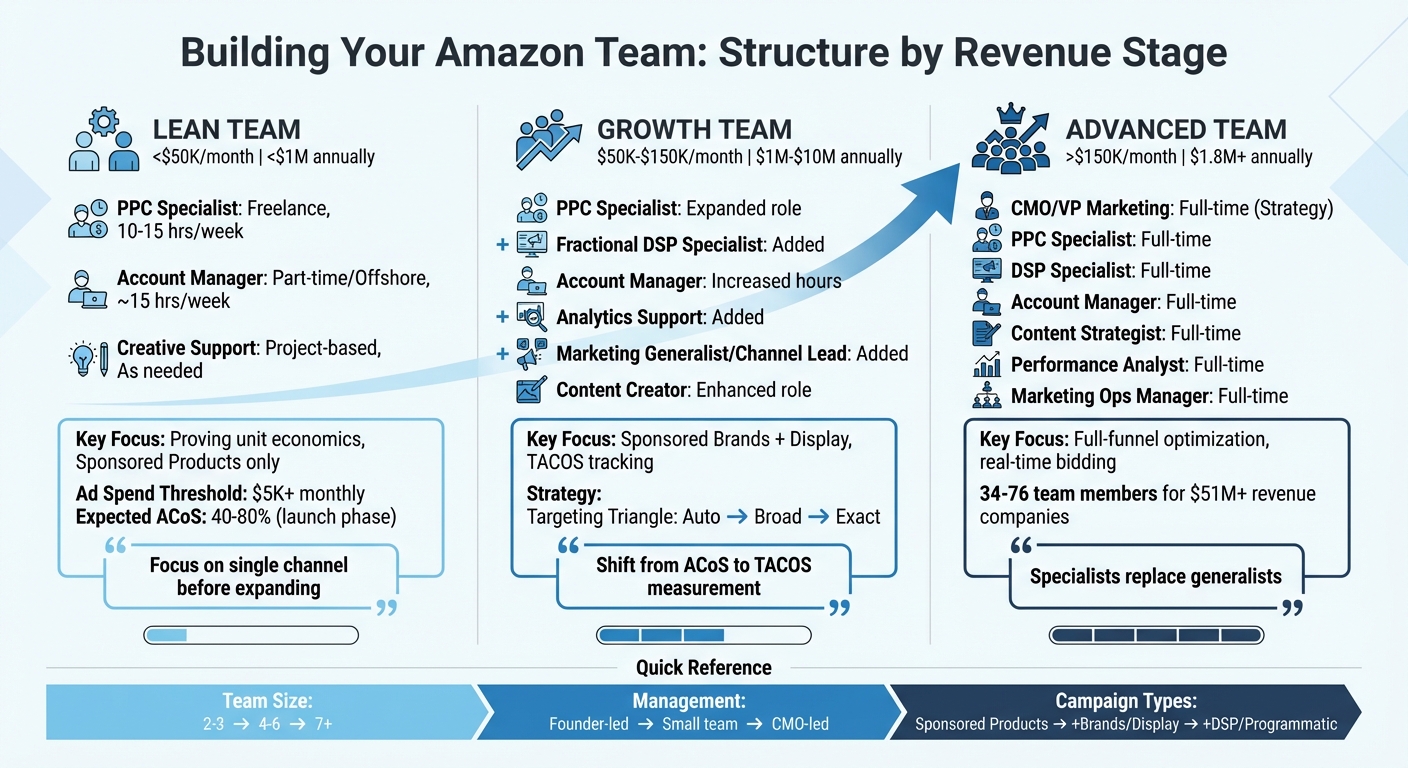
Amazon Growth Team Structure by Revenue Stage: Roles, Hours, and Hiring Models
Creating the right Amazon team depends on your business's stage of growth. Your team structure should reflect your current revenue, ad spend, and operational needs. A company pulling in $30,000 a month will require a very different setup than one making $300,000. Here's how to shape your team based on where you are today.
Lean Team: Under $50K Monthly Sales
If your monthly sales are under $50,000 (or less than $1 million annually), the founder typically takes the lead on marketing. At this stage, the focus is on proving unit economics through Amazon Sponsored Products rather than building a full-fledged department.
Start by hiring a freelance PPC specialist for 10–15 hours a week. Once your ad spend exceeds $5,000 monthly, outsourcing ad management becomes critical for professional optimization. The PPC specialist should focus on tasks like keyword harvesting, bid adjustments, and updating negative keywords to minimize wasted spend. During a launch phase, expect an ACoS (Advertising Cost of Sales) between 40% and 80% as you work to build sales momentum.
Next, bring on a part-time account manager (around 15 hours per week) to handle listing health, inventory tracking, and basic reporting. Many businesses at this stage use offshore talent or growth assistants to handle repetitive tasks, allowing the founder to concentrate on strategy. For creative needs - like infographics, A+ content, and lifestyle images - project-based freelancers from platforms like Fiverr or 99designs are a practical choice.
"A common mistake is spreading across too many platforms too early. The correct approach is to stay disciplined, focus on a single channel, refine creatives, and build repeatable results." – Jesse Pujji, Co-Founder and Chairman, GrowthAssistant
Before investing heavily in ads, ensure your listings are fully optimized. Driving traffic without conversions only wastes your budget. Leveraging AI tools and automation can also help you scale your output without increasing your team size.
| Role | Hiring Model | Hours/Week | Primary Focus |
|---|---|---|---|
| PPC Specialist | Freelance | 10–15 | Sponsored Products, keyword harvesting |
| Account Manager | Part-time/Offshore | ~15 | Listing health, inventory, reporting |
| Creative Support | Project-based | As needed | Infographics, A+ content, images |
Growth Team: $50K–$150K Monthly Sales
As your monthly revenue grows to $50,000–$150,000, your team structure needs to evolve. This phase requires additional specialized roles and more advanced campaign strategies.
When your annual revenue hits $1 million to $10 million, it’s time to shift from founder-led marketing to a small, specialized team. Expand your ad strategy to include Sponsored Brands for boosting brand presence and Sponsored Display for retargeting.
Consider hiring a fractional DSP specialist to manage programmatic ads across Amazon properties and third-party platforms. This role helps increase top-of-funnel awareness and re-engage high-intent audiences. At this stage, it’s also critical to add analytics support, shifting your focus from ACoS to TACOS (Total Advertising Cost of Sales), which highlights how ads drive organic growth. A marketing generalist or channel lead can oversee strategy and close execution gaps.
Your PPC campaigns should adopt a "Targeting Triangle" approach: using auto-discovery for keyword research, broad match for validation, and exact match for precise control. Negative keyword matching is key to maintaining data accuracy.
Formal reporting systems become essential as operations mature. Offshore marketing assistants can handle daily tasks and reporting, ensuring consistency while preventing founder burnout. Meanwhile, your content creator can take on additional responsibilities, such as auditing A+ content, producing video ads, and addressing common customer objections.
Advanced Team: Over $150K Monthly Sales
Once your monthly sales exceed $150,000 (or roughly $1.8 million annually), you’ll need a fully staffed team to sustain and accelerate growth. At this stage, generalists are replaced by specialists, and a Chief Marketing Officer (CMO) or VP of Marketing should oversee the team, ensuring collaboration between brand and performance functions.
Your core team should include:
- A full-time PPC specialist to manage Sponsored Products, Brands, and Display campaigns.
- A dedicated DSP specialist to handle off-platform programmatic ads and retargeting.
- A full-time account manager to oversee operations, compliance, and inventory forecasting.
- A content strategist to manage A+ content, video ads, and creative testing.
- A performance analyst or head of growth to focus on attribution models, forecasting, and New-to-Brand metrics.
Additionally, a Marketing Operations Manager becomes essential for managing your tech stack and automation processes, reducing manual workloads. Many advanced brands also use Amazon Marketing Stream for real-time bid optimization during peak periods.
"The objective isn't to perpetually buy sales. It's to use paid advertising as a strategic tool to make Amazon's organic algorithm work for you." – Headline Marketing Agency
| Role | Hiring Model | Focus Area |
|---|---|---|
| CMO / VP of Marketing | Full-time | Strategy, budget ownership, executive communication |
| PPC Specialist | Full-time | Sponsored Products, Brands, Display |
| DSP Specialist | Full-time | Programmatic ads, retargeting |
| Account Manager | Full-time | Operations, compliance, inventory forecasting |
| Content Strategist | Full-time | A+ content, video ads, creative testing |
| Performance Analyst | Full-time | Attribution, TACOS, forecasting |
| Marketing Ops Manager | Full-time | Tech stack, automation, BI dashboards |
For companies generating over $51 million annually, teams typically range from 34 to 76 members. It’s wise to keep strategy, brand voice, and analytics in-house while outsourcing highly specialized tasks like technical SEO audits or managing high-volume DSP campaigns.
Freelance vs. Full-Time vs. Agency: Choosing Your Hiring Model
Once you’ve identified the roles your business needs, the next step is deciding how to fill them. You have three main options: freelancers, full-time employees, and agencies. Each comes with its own balance of cost, control, and management demands.
Freelancers: Flexible and Cost-Effective
Freelancers are a great option when you’re testing out a new role, tackling a one-off project, or addressing a specific skill gap without committing to a permanent hire [1]. Startups or small teams - especially those with fewer than five people - often rely on freelancers to stay lean while focusing on profitability.
The biggest advantage here is flexibility. You can adjust their hours based on your needs or budget, and you’re not tied down by benefits, taxes, or long-term contracts. Freelancers are especially useful for tasks like design, video editing, or technical SEO audits [1].
But freelancers do require clear instructions and regular check-ins to keep things on track [13]. If you’re already stretched thin as a founder, managing multiple freelancers can quickly become overwhelming. Plus, freelancers typically lack the deeper understanding of your business that full-time employees develop, which can slow down decision-making.
For businesses looking for long-term stability and ownership of critical functions, a full-time hire might be the better choice.
Full-Time Employees: Ownership and Control
Full-time employees are ideal when you need someone fully invested in your business and capable of managing key areas like strategy, brand voice, or proprietary knowledge [1]. They’re particularly valuable for companies that are scaling and need a dedicated team for the long haul.
The biggest draw of full-time hires is ownership. These employees immerse themselves in your brand, develop a deep understanding of your business, and make decisions without constant oversight. They’re also easier to manage day-to-day compared to coordinating with multiple freelancers.
However, this level of commitment comes at a cost. Total compensation - including benefits, taxes, and perks - can double the base salary [12]. For example, a digital marketing manager with a base salary of $101,499 could end up costing your business over $200,000 annually. In ecommerce, it’s common to start lean, grow the team as needed, and maintain a few key roles even during slower periods [12].
Agencies: Expertise on Demand
Agencies offer specialized expertise and pre-built teams, making them an attractive option for businesses looking to move quickly or handle overflow work [1][8]. They’re particularly useful when you need skills that aren’t available in-house, like managing complex DSP campaigns or conducting technical SEO audits.
The main advantage of working with agencies is speed. They come equipped with proven processes, advanced tools, and experienced teams, allowing them to deliver results quickly - perfect for peak seasons or product launches. However, this convenience comes at a price. Reputable agencies typically charge $2,000 or more per month, while premium agencies with dedicated teams start at $3,000+ [13].
The downside? You’ll have less visibility into their day-to-day operations since you’re not managing the team directly. Additionally, agencies often juggle multiple clients, which means their attention may be divided. It’s also crucial that they fully understand both your product and its purpose to deliver the best results [12].
Comparing the Models
Here’s a quick breakdown of how each option stacks up:
| Model | Best For | Key Advantage | Key Drawback |
|---|---|---|---|
| Freelance | Specific projects, testing roles | Low cost, high flexibility | Requires heavy oversight |
| Full-Time | Core functions, brand strategy | Direct control, long-term ownership | High cost, slower to scale |
| Agency | Specialized expertise, overflow | Quick results, expert tools | Expensive, less transparency |
Many brands find success with a hybrid approach, keeping a lean in-house team for strategy while outsourcing repetitive tasks - like reporting and tracking - to offshore talent or growth assistants [2]. This model strikes a balance, allowing you to maintain control over high-level decisions while reducing costs on day-to-day operations.
sbb-itb-88a7fe6
Regional Salary and Rate Benchmarks for 2026
When planning your hiring strategy, it’s crucial to understand how compensation varies by region. This knowledge helps you set a realistic budget while tapping into a global talent pool.
Salary Benchmarks by Role and Region
Remote hiring allows businesses to access skilled professionals worldwide, often at significantly different costs depending on the region. Here’s an overview of expected salaries for key Amazon growth roles in 2026:
| Role | U.S. & Canada | Latin America | Eastern Europe | Notes |
|---|---|---|---|---|
| PPC Specialist | $4,000–$7,000/mo | $2,500–$4,000/mo | $3,000–$5,000/mo | Manages Sponsored Products, Brands, and Display ads |
| DSP Expert | $6,000–$10,000/mo | $3,500–$6,000/mo | $4,000–$7,000/mo | Often hired fractionally due to their specialized skill set |
| Account Manager | $4,000–$6,500/mo | $2,000–$3,500/mo | $2,500–$4,500/mo | Oversees operations, listings, and compliance |
| Content Creator | $3,000–$5,000/mo | $1,500–$3,000/mo | $2,000–$3,500/mo | Develops A+ content, listing images, and videos |
| Analytics Expert | $5,000–$8,000/mo | $3,000–$5,000/mo | $3,500–$6,000/mo | Specializes in ROAS tracking, attribution, and reporting |
The table highlights baseline salary differences across regions. Keep in mind that salaries in the U.S. reflect base pay only. When you add in taxes, benefits, and other perks, the total cost of hiring can easily double. For instance, a Digital Marketing Manager with an annual salary of $101,499 could cost your company over $200,000 when all expenses are factored in [12].
This is where offshore talent can be a game-changer. Many companies use a hybrid model, employing a U.S.-based marketing lead for strategy and relying on offshore Growth Assistants for execution-heavy tasks [2]. For businesses earning between $1M and $10M annually, a common setup includes one U.S.-based marketing generalist paired with two offshore assistants. These assistants handle tasks like reporting, tracking, and day-to-day campaign management [2]. This approach allows you to maintain strategic oversight without committing to the high costs of an entirely U.S.-based team.
Understanding these regional benchmarks is a key step in building a cost-effective and efficient remote team.
Tools and Workflows for Managing a Remote Amazon Team
Core Tools for Remote Team Management
To effectively manage a remote Amazon team, a well-curated tech stack is essential - especially one that reduces the need for constant meetings. For ad optimization, tools like Perpetua and Sellozo are invaluable. In fact, Sellozo users have reported a 70% profit boost within the first month of use [9]. For keyword research, Helium 10 is a go-to, while SmartScout provides insights into brand scores and traffic flow [7][9]. To bring all marketplace data together in one place, platforms like DataHawk and beBOLD Analytics offer real-time, consolidated dashboards.
On the creative side, Canva simplifies quick asset creation, while AI writing assistants can help scale listing content without compromising quality. By integrating these tools into a unified weekly KPI dashboard, teams can access key metrics instantly, streamlining decision-making and minimizing delays.
Best Practices for Async Collaboration
With the right tools in place, the next step is to refine workflows for asynchronous collaboration. Take advantage of time zone differences by structuring tasks in a way that avoids the need for constant cross-continental meetings. A weekly KPI dashboard tracking metrics like Total Advertising Cost of Sale (TACOS), New-to-Brand performance, and Share of Voice can keep everyone aligned, no matter where they’re located [3].
"Invest in ops early - even one person saves hours across team." – Matt, Social Rails [1]
Consistency is key for seamless collaboration. Establish clear naming conventions for campaigns, reports, and creative assets. For instance, when transitioning tasks from a PPC specialist in Eastern Europe to a U.S.-based account manager, standardized naming systems can significantly reduce confusion. Additionally, implementing a negative exact match process ensures ad budgets are spent wisely, avoiding unnecessary waste [4].
This structured approach allows offshore Growth Assistants to handle routine tasks like reporting and bid adjustments efficiently, freeing senior team members to focus on high-level strategy and growth initiatives.
Conclusion
By 2026, growing on Amazon will require more than relying on one person to juggle ads, listings, creatives, and operations. Success will come to brands that build streamlined, well-rounded teams. Start with execution-focused support and gradually scale into specialized roles as your revenue increases.
Hiring globally isn’t just a nice-to-have anymore - it’s essential. Tapping into offshore talent pools, such as those in Latin America and Eastern Europe, allows you to secure cost-efficient, execution-driven support while your senior leaders stay focused on strategy [2]. This approach not only reduces founder burnout but also ensures critical tasks are handled effectively.
The process doesn’t have to be overwhelming. Begin with freelancers or part-time specialists to test your unit economics. Once your monthly sales hit $50K–$150K, consider transitioning to fractional or full-time hires. When sales exceed $150K, it’s time to build a full-fledged team, complete with analysts and creative strategists.
When it comes to ad strategy, focus on TACOS instead of ACoS to ensure your efforts are driving long-term organic growth [3][4]. This strategy doesn’t just boost immediate sales - it also helps establish a lasting competitive advantage on Amazon.
Looking to build your remote Amazon team without the usual overhead? Global talent solutions with pre-vetted specialists can have you up and running in just weeks.
FAQs
What roles are essential for building a remote Amazon growth team?
To build a successful remote team for Amazon growth, you'll need a diverse group of experts to handle advertising, content creation, data analysis, and account management. Here’s a breakdown of the key roles:
- Amazon PPC Specialist: This person focuses on managing and fine-tuning Sponsored Products, Sponsored Brands, and Sponsored Display campaigns to boost ad performance.
- Amazon DSP Specialist: Handles programmatic campaigns outside of Amazon, such as video, display, and retargeting, to increase brand visibility and reach a broader audience.
- Amazon Account Manager: Responsible for day-to-day tasks like managing product listings, monitoring inventory, ensuring compliance, and liaising with seller support to keep operations running smoothly.
- Amazon SEO & Listings Specialist: Works on optimizing product listings using keyword research, effective titles, and backend search terms to improve organic search rankings.
- Amazon Content Creator: Produces high-quality visuals, videos, and A+ content to enhance both advertising campaigns and product listings.
- Analytics Expert: Monitors essential metrics like ROAS (Return on Ad Spend) and attribution data, offering insights to help scale the business effectively.
By combining the expertise of these roles, you can create a growth strategy that integrates advertising, compelling content, and data-driven decisions to achieve maximum results.
How can I efficiently manage a remote Amazon team working across different time zones?
Managing a remote Amazon team spread across various time zones requires a thoughtful mix of real-time and asynchronous communication. Tools like Slack or Microsoft Teams are great for quick, real-time updates, while platforms such as ClickUp or Trello help keep tasks organized and ensure everyone stays on the same page without needing to be online at the same time. For asynchronous work, centralize important resources - like SOPs, campaign briefs, or performance dashboards - in shared platforms like Notion or Confluence, so team members can access what they need anytime.
To make collaboration smoother, establish predictable overlap periods that respect everyone’s core working hours. For example, a 2–3 hour block around midday Eastern Time can work well for teams spanning the U.S., LATAM, and Europe. Rotate meeting times periodically to ensure one region doesn’t bear the brunt of inconvenient schedules, and encourage flexible work hours while setting clear expectations for response times (e.g., respond within 4 hours). Tools like World Time Buddy or Timezone.io can make scheduling across time zones much easier.
You can also introduce a weekly asynchronous update process. For instance, team members can record short Loom videos summarizing key metrics, challenges, and next steps. This keeps everyone informed and aligned without needing to sync schedules. By combining clear communication, strategic scheduling, and the right tools, your team can transform time zone differences into an opportunity for greater productivity.
What is the difference between TACoS and ACoS, and why does TACoS matter?
TACoS, or Total Advertising Cost of Sales, measures your ad spend as a percentage of your total sales, which includes both organic and paid sales. In contrast, ACoS (Advertising Cost of Sales) focuses solely on ad spend as a percentage of sales directly generated through ads.
Why does TACoS matter? It offers a more comprehensive perspective on how your advertising efforts impact overall business growth and profitability. By keeping an eye on TACoS, you can assess whether your ads are contributing to long-term, sustainable success - not just boosting short-term paid sales.
Related Blog Posts
Read also



Ready to hire without salary-based agency fees?
Book a free 30-minute consultation. We’ll review your role, timeline, and hiring goals, then show you how our fixed-fee remote search works.