Cost to Hire a Remote Marketer by Country (2026)


Hiring remote marketers in 2026 can save businesses 50% to 75% compared to U.S. salaries, depending on the country. This article breaks down salaries, compliance rules, and hiring timelines for seven regions: the U.S./Canada, Mexico, Brazil, Argentina, Poland, Ukraine, and Romania. Here's a quick overview:
- United States/Canada: Highest costs, but top talent. Mid-level marketers earn $116,310/year on average.
- Mexico: Save up to 75% on salaries. Mid-level roles pay $2,500–$3,200/month.
- Brazil: Salaries range from $1,200 to $5,000/month, with strong timezone overlap.
- Argentina: Competitive rates ($1,500–$3,200/month) and high English proficiency.
- Poland: Mid-level salaries average $1,500–$3,000/month; GDPR compliance is a plus.
- Ukraine: Cost-efficient ($1,500–$3,000/month) with excellent tech skills.
- Romania: Strong technical talent, salaries between $1,800–$3,200/month.
Key Takeaways:
- Latin America offers cost savings and timezone alignment for U.S. businesses.
- Eastern Europe provides skilled professionals but with limited U.S. overlap.
- Using Employer of Record (EOR) services simplifies compliance and hiring.
Quick Comparison:
| Country/Region | Cost Savings vs. U.S. | Mid-Level Salary (Monthly) | Timezone Compatibility (U.S.) | Key Benefits |
|---|---|---|---|---|
| U.S./Canada | Baseline | $9,692 | Perfect | Top talent, no language barriers |
| Mexico | 55%–75% | $2,500–$3,200 | High | Strong timezone overlap |
| Brazil | 50%–70% | $1,200–$5,000 | High | Multilingual workforce |
| Argentina | 55%–75% | $1,500–$3,200 | High | High English proficiency |
| Poland | 55%–70% | $1,500–$3,000 | Low | GDPR compliance |
| Ukraine | 55%–75% | $1,500–$3,000 | Low | Tech-savvy professionals |
| Romania | 55%–75% | $1,800–$3,200 | Low | Technical expertise |
Hiring decisions should weigh costs, timezone alignment, and compliance needs. Latin America is ideal for real-time collaboration, while Eastern Europe offers skilled professionals at competitive rates. For streamlined processes, consider EOR services to manage payroll and legal requirements.
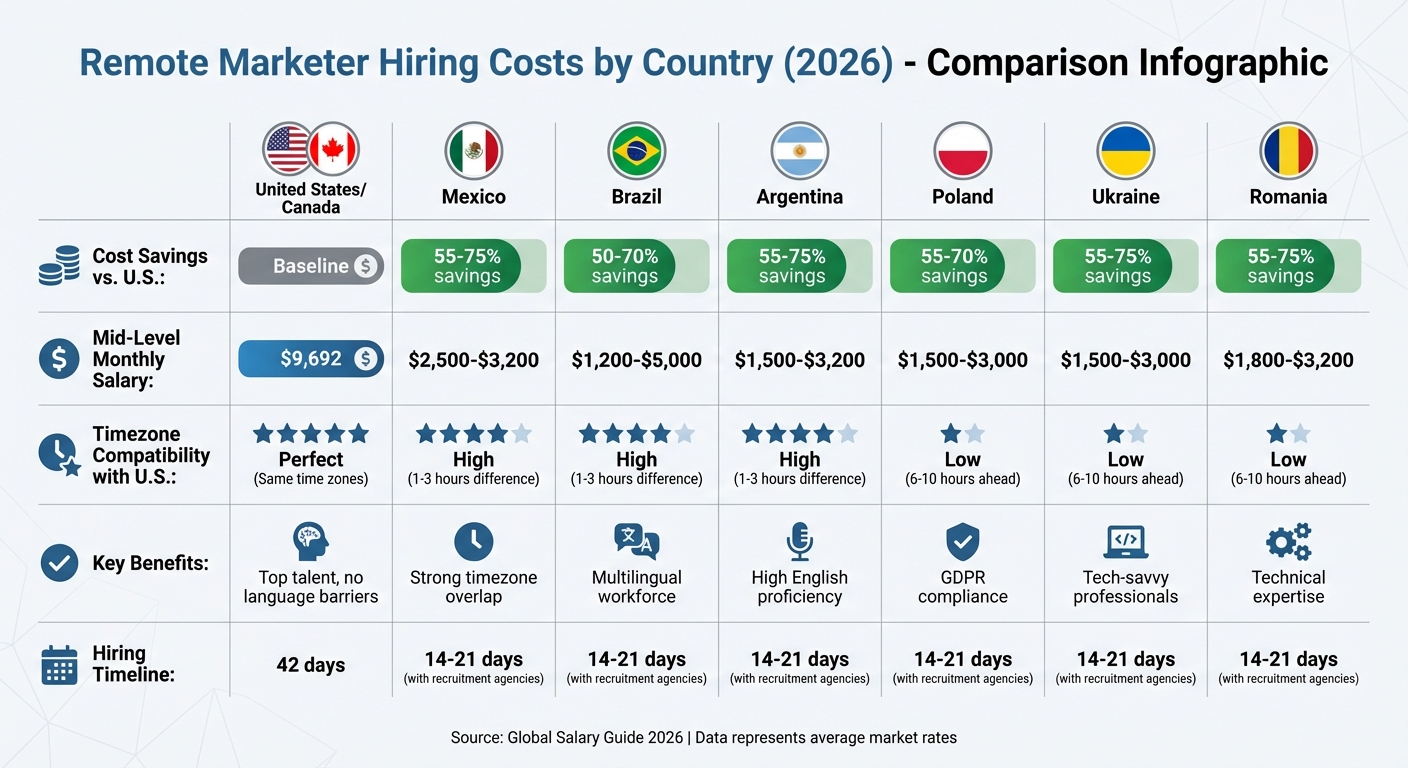
Remote Marketer Hiring Costs by Country 2026 Comparison
What Digital Marketing Really Costs (No Hype, Just Real Numbers)
sbb-itb-88a7fe6
1. United States/Canada
Hiring remote marketers in the U.S. and Canada comes with higher costs but access to top talent. In the U.S., mid-level remote marketers earn an average of $116,310, with entry-level salaries around $65,825 and director-level roles reaching up to $185,793. In Canada, mid-level roles typically range between C$90,000 and C$125,000[4][7].
The average time-to-hire for remote marketing positions in these regions is 42 days, from job posting to closing[7]. Companies are shifting from traditional resume reviews to skills-based assessments, emphasizing real-world capabilities and proficiency with modern collaboration tools and AI technologies[5]. Notably, 66% of remote job postings focus on mid-to-senior level professionals, underscoring the strategic importance of these roles[8].
Expectations for remote marketers in North America are steep. Professionals are often required to demonstrate advanced AI skills, such as creating automated workflows and leveraging AI for performance tracking[5]. Salaries for these specialized roles can surpass $138,000, reflecting the demand for expertise[4].
Legal and Compliance Considerations
The U.S. and Canada have distinct legal frameworks for employment. The U.S. follows an "at-will" employment model, while Canada mandates reasonable notice periods for termination without cause[6]. U.S. companies hiring in Canada often classify workers as independent contractors, set up a local entity, or partner with an Employer of Record (EOR) to manage payroll and compliance[6].
Canadian employers also face specific contributions: 5.95% to the Canada Pension Plan on earnings up to $74,600, along with $2.28 per $100 of insurable earnings for Employment Insurance in 2026[6].
Compensation Adjustments
Even in fully remote roles, location-based pay adjustments are standard. Many U.S. companies tailor salaries based on the candidate's cost of living or state tax obligations[8]. For example, a marketer in a high-cost area may earn significantly more than one in a lower-cost region, even if their responsibilities are identical. This approach ensures fair compensation while accounting for regional economic differences.
2. Mexico
Hiring remote marketers in Mexico offers 55%–75% savings compared to U.S. salaries, along with convenient timezone alignment for seamless collaboration[10]. Monthly salaries vary depending on the role: mid-level affiliate marketing managers earn around $1,500, while senior Head of eCommerce positions can command up to $5,500[10]. Other roles, like growth marketing managers, typically earn between $2,500 and $3,200 per month, and email marketing managers see compensation in the range of $2,300 to $3,000[10]. For paid media buyers and UX/UI designers, monthly salaries hover between $1,800 and $2,500[10].
Specialized recruitment agencies in Mexico can match companies with pre-vetted candidates in as little as 14–21 days, streamlining the hiring process and reducing time-to-productivity[10]. The overlapping time zones with North America further enhance communication, allowing for real-time teamwork and faster decision-making[10]. Before hiring, it’s important to familiarize yourself with Mexico’s labor compliance regulations.
Legal and Compliance Considerations
In 2021, Mexico introduced labor reforms that banned traditional personnel outsourcing. Companies now have three options for hiring: set up a local entity, work with a registered specialized service provider (REPSE), or partner with a compliant Employer of Record (EOR)[11][15]. Establishing a local entity can be a lengthy process, costing approximately MX $88,411 and taking 4 to 5 months. In contrast, using an EOR allows businesses to hire in just 1 to 2 business days[12].
Employers are required to provide several mandatory benefits, including a 13th-month bonus (equivalent to 15 days’ salary), a 25% vacation premium, and social security contributions ranging from 19.15% to 38% of the gross salary[12][13][15]. Remote employees must also receive a monthly allowance of about MX $1,000 to cover work-from-home expenses like internet and electricity[12]. Compliance is essential, as misclassification fines since 2021 have exceeded MXN 500,000[12].
Mexico is gradually shifting its 48-hour workweek to 40 hours by 2030. New overtime rules cap "double" overtime at 12 hours per week and require employers to pay "triple" rates (200% above the regular wage) for any additional hours worked[14][15]. Written contracts are mandatory and must outline key details such as probation periods (up to 30 days for most roles), salary, and benefits. These contracts protect both employers and employees in case of disputes brought to labor courts[12][15].
3. Brazil
Brazil stands out as a cost-effective option for hiring, offering 50–70% savings on U.S. salary costs while maintaining strong compatibility in terms of culture and time zones (GMT-3) [16]. Monthly salaries for specialized roles range between $1,200 and $5,000 USD, with annual earnings structured as follows: entry-level professionals earn $5,100–$9,600, mid-level roles bring in $9,600–$18,800, and senior marketers can make $18,900–$35,300. Marketing directors typically see annual salaries of about $16,800 USD [17].
When it comes to onboarding, an Employer of Record (EOR) can simplify the process significantly, taking 3–7 business days to onboard employees, compared to 1–3 days for independent contractors and 4–8 weeks for setting up a local entity [16]. Specialized recruitment agencies often deliver 3–4 qualified candidates within two weeks, leveraging pre-vetted databases to streamline the hiring process. While speed matters, understanding Brazil's intricate labor laws is equally critical.
Legal and Compliance Considerations
Brazil's labor laws are governed by the CLT (Consolidação das Leis do Trabalho), a comprehensive framework that prioritizes employee rights [16][18]. Employers must provide several mandatory benefits, including a 13th-month salary (split across November and December), 30 days of paid vacation with a 1/3 salary bonus, and an 8% contribution of gross salary to the FGTS severance fund [16][19]. Additionally, social security contributions (INSS) range from 20–28% of an employee's salary [19]. Altogether, these obligations typically push employer costs to 26–30% above the base salary [16].
Employers must also register all employees on the eSocial platform and include remote work arrangements in contracts, specifying policies for equipment reimbursements [19]. Companies with over 100 employees are required to comply with Law No. 14.611/2023, which mandates reporting on gender-based wage disparities [17]. Misclassifying workers can lead to severe penalties, prompting many international businesses to use EOR services to ensure compliance rather than taking the risk of hiring independent contractors [16][18].
4. Argentina
Argentina stands out as a great option for remote marketers, offering a strong balance between cost and quality. Monthly salaries typically range from $1,500 to $3,200 USD, which translates to 55–75% savings compared to U.S. rates [10]. Aside from competitive pay, Argentina also boasts high English proficiency and a time zone (GMT-3) that aligns well with North American business hours [9][10].
Hiring Speed and Process
Recruiting in Argentina is impressively efficient. Recruitment agencies can present 3–4 pre-vetted candidates within two weeks, leading to a 14–21 day hiring cycle [10]. This streamlined approach, combined with time zone compatibility, ensures faster decision-making. For example, in 2023, Kevin, the Founder of Kiki Commerce, successfully hired three employees within just three weeks using a well-optimized remote hiring process [10].
The overlapping time zones also make interview scheduling smoother, allowing for same-day feedback and quicker progress. As Kay Tayam, CEO of 88 Affect, noted:
"Their process is very optimized in terms of speed and expectations throughout the process" [10].
Legal and Compliance Framework
While the hiring process is fast, it’s important to navigate Argentina’s legal requirements carefully for smooth operations. Many international companies opt for direct hiring to lower costs and maintain flexibility [10]. Partnering with recruitment services that specialize in compliance can help ensure contracts meet local regulations. This includes thorough screening methods like skills tests, reference checks, and structured interviews to secure top-tier talent [10]. Additionally, prioritizing candidates with advanced English skills (C1 or higher) is key for seamless integration into global teams and effective communication [10].
5. Poland
Poland offers an attractive option for remote marketing hires by combining European work standards with cost-effective salaries. Mid-level remote marketing roles typically pay between $1,500 and $3,000 USD, while senior specialists earn $3,000 to $5,500 USD. This translates to 55–70% savings compared to U.S. rates, without compromising quality standards[23][2]. On average, digital marketing strategists in Poland earn $52,825 annually, with junior roles starting at $31,695 and senior positions reaching up to $95,085[22].
The remote marketing sector in Poland has seen rapid growth. By February 2026, 47% of marketing specialist roles were remote, a significant jump from 18% in January 2026[21]. This shift, coupled with competitive costs, has made recruitment in Poland both efficient and appealing.
Hiring Speed and Market Dynamics
Recruiting in Poland is notably quick, typically taking 14–21 days to present 3–4 pre-vetted candidates within two weeks. When interviewing, it is crucial to use targeted remote marketing interview questions to assess technical skills and cultural fit. The GMT+1 timezone aligns well with European operations and provides reasonable overlap with U.S. East Coast hours[2]. Pete Geherin, Vice President at TradeCentric, shared his experience:
"The team was knowledgeable, responsive, professional and very easy to work with... to fill three very important positions as we expanded our team and operations into Eastern Europe"[2].
Polish professionals excel in technical roles like paid media and data analytics. Many hold Associate or Bachelor’s degrees in Marketing and demonstrate high English proficiency, making them a strong fit for international teams[20][22].
Legal and Compliance Considerations
Poland's straightforward labor laws simplify compliance, making it easier for companies to manage remote hires. Many businesses work with specialized recruitment partners to maintain flexibility and reduce costs[2]. Standard benefits packages in Poland often include health insurance, home office allowances, paid time off, and professional development budgets[22]. After a 32% tax deduction, the average strategist takes home approximately $2,993 per month[22].
Recruitment partners with expertise in Polish labor law ensure contracts meet local requirements, protecting both employers and employees. Beata Rajeckaite, Operations Manager at OneRhythm, highlighted this advantage:
"It helps a lot to have supporting us while we are navigating local market challenges"[2].
6. Ukraine
When it comes to cost efficiency, Ukraine stands out with 55–75% savings compared to U.S. rates [10]. For example, mid-level roles like Paid Media Buyers typically earn $1,500 to $2,500 USD per month, while Email Marketing Managers see salaries ranging from $1,800 to $2,500 USD per month. On the higher end, senior roles such as Growth Marketing Managers earn $2,500 to $3,000 USD monthly, and executive positions like Head of eCommerce command salaries of $5,000 to $5,500 USD [10].
Hiring Speed and Market Dynamics
Recruiting in Ukraine is relatively quick, with timelines averaging 14–21 days when working with specialized agencies that have pre-vetted talent pools [10]. Ukrainian marketers bring expertise in tools like Google Tag Manager, DoubleClick, and Klaviyo, combined with strong English skills that make real-time collaboration with international teams seamless [10]. The country's GMT+2 timezone aligns well with European work hours and overlaps with the U.S. East Coast, making it an attractive option for global businesses.
Legal and Compliance Considerations
Handling Ukrainian labor laws becomes much easier with the help of recruitment partners who manage compliance, tax contributions, and currency conversions [9]. These platforms also streamline the creation of locally compliant contracts. Beata Rajeckaite, Operations Manager at OneRhythm, highlighted the benefits of such partnerships:
"Working with Remotely Talents was enjoyable, organised and professional... It helps a lot to have supporting us while we are navigating local market challenges" [2].
7. Romania
Romania offers competitive rates for technical marketing talent, paired with strong English proficiency and a convenient European time zone (GMT+2) for collaboration[9]. For example, mid-level Data Analysts in Romania typically earn between $1,800 and $3,200 USD per month, while Support Engineers earn $2,200 to $3,800 USD per month[9]. These salary ranges make Romania an appealing option for companies looking for cost-effective analytical and technical marketing support.
Recruitment providers in Romania simplify the hiring process by connecting businesses with pre-vetted marketing professionals. Many Romanian marketers bring multilingual skills to the table, often fluent in both English and German, which is a significant asset for campaigns targeting broader European markets[25]. However, ensuring compliance with local labor laws is crucial when hiring in Romania.
For U.S. companies, using an Employer of Record (EOR) is a practical solution for managing payroll, compliance, and social contributions for full-time Romanian employees[3][25]. EOR services typically cost about $599 per employee per month, offering peace of mind by reducing the risk of misclassification[24][3]. For contractors, Contractor of Record services - starting at $325 per month - ensure proper worker classification and provide legal protection during audits[3].
Pros and Cons by Country
Drawing from the salary and compliance data above, here’s a breakdown of the key considerations for hiring in different countries. Decisions often hinge on factors like cost savings, timezone compatibility, and the complexity of compliance. Hiring in Central/Eastern Europe and Latin America can cut costs by 55% to 75% compared to U.S. hires[10].
Latin America offers outstanding timezone alignment with U.S. and Canadian teams, allowing for real-time collaboration during standard business hours[10]. However, additional costs like mandatory 13th- or 14th-month bonuses and compliance expenses can add up. For instance, in Argentina, an annual salary of $60,000 comes with $15,731.76 in employer costs for pensions, social welfare, and healthcare[26].
Eastern Europe - countries like Poland, Ukraine, and Romania - provides a strong talent pool with high English proficiency and specialized skills. However, timezone overlap with U.S. teams is limited to mornings on the East Coast[10]. Poland stands out for its stringent data security regulations and GDPR compliance, making it ideal for roles involving sensitive data[27]. Ukraine offers tech-savvy professionals ready for remote work[27]. Across the region, labor laws and social contributions can increase costs to 1.25 to 1.4 times the base salary[26].
"When you understand how hiring costs play out in the particular country... you'll be better able to select the countries that will connect you with the workforce you need while crafting rewards packages that are both genuinely responsive to their needs and realistic in terms of your budget."
- Nadia Vatalidis, VP of People, Remote[26]
Here’s a summary table comparing cost savings, timezone alignment, and other factors by region:
| Country/Region | Cost Savings vs. U.S. | Timezone Compatibility (U.S.) | Key Advantages | Key Drawbacks |
|---|---|---|---|---|
| United States/Canada | Baseline (Highest Cost) | Perfect (0 hours) | No language barriers; domestic compliance | High salaries; competitive market |
| Mexico | 55% – 75%[10] | High (1–3 hours difference) | Real-time collaboration; cultural alignment | Mandatory bonuses; complex labor laws[26] |
| Brazil | 55% – 75%[10] | High (1–3 hours difference) | Multilingual talent (Portuguese, Spanish, Italian)[27] | 13th-month bonuses; higher compliance costs[26] |
| Argentina | 55% – 75%[10] | High (1–3 hours difference) | Cost-effective; strong English proficiency | High employer taxes ($15,731.76 on $60k salary)[26] |
| Poland | 55% – 75%[10] | Low (6–9 hours ahead) | GDPR compliance; strong data security standards[27] | Limited U.S. overlap; higher social contributions[26] |
| Ukraine | 55% – 75%[10] | Low (7–10 hours ahead) | Tech-savvy; remote-ready workforce[27] | Limited U.S. overlap |
| Romania | 55% – 75%[10] | Low (7–9 hours ahead) | Multilingual (English, German); technical expertise | Limited U.S. overlap |
This comparison provides a clearer picture of which region might best suit your hiring goals.
For full-time hires, an Employer of Record (EOR) service can manage payroll, taxes, and benefits, eliminating the need to set up a local entity. EOR services typically cost $599 per employee per month[3]. Alternatively, Contractor of Record services, priced at $325 per month[3], can help mitigate misclassification risks and ensure compliance during audits.
Conclusion
By 2026, hiring remote marketers will revolve around three main factors: cost, timezone alignment, and compliance. For companies looking to optimize these, Latin America stands out with an impressive balance of cost and quality for marketing roles. Meanwhile, Eastern Europe offers solid savings, though with less favorable timezone alignment for North American businesses. Both regions can help cut hiring expenses by 55% to 75%, while still providing strong English proficiency and specialized expertise[2][9].
When evaluating these cost advantages, don’t forget to account for additional expenses like employer contributions - healthcare, retirement, and unemployment insurance. These costs vary significantly by country and can impact your overall budget. Including them in your financial planning ensures a more accurate understanding of total employment expenses.
This wraps up the framework for assessing cost, risk, and hiring speed. With these insights, you’re better equipped to make informed, role-specific decisions.
To take the next step, download the Global Salary Guide – 2026 to compare competitive rates across Europe, Latin America, and North America before making offers[1]. If you're looking for pre-vetted candidates delivered in just 14–21 days, RemotelyTalents.com can connect you with the top 1% of remote marketing professionals. They even offer a 90-day replacement guarantee. Pricing starts at $1,450 per month per open role with no long-term commitment on the On-Demand plan. Alternatively, the Partner plan allows unlimited hiring at $1,000 per month with a 12-month agreement[2].
"RemotelyTalents provided an amazing 5 STAR service for our marketing company... I've tried a lot of remote talent services before for our remote expansion as a US company, and they delivered an experience that was far superior in terms of speed, price, and most importantly transparency."
- Kay Tayam, CEO, 88 Affect[2]
You can request sample profiles or schedule a free consultation to discuss your specific needs - whether it’s timezone considerations, budget constraints, or role expectations. Fill your key marketing roles in under three weeks while saving more than half on costs.
Related Blog Posts
Read also



Ready to hire without salary-based agency fees?
Book a free 30-minute consultation. We’ll review your role, timeline, and hiring goals, then show you how our fixed-fee remote search works.