How to Hire a Remote Bookkeeper or Staff Accountant for a US Business (2026)


Hiring the right finance professional can save your business time, money, and errors. Here's what you need to know:
- Bookkeepers focus on daily financial tasks like recording transactions, payroll, and reconciliations. Average salary: $49,200/year.
- Staff Accountants handle higher-level tasks like financial analysis, compliance, and reporting. Median salary: $82,500/year.
- Offshore professionals offer savings of up to 70%, with costs ranging from $14,400 to $30,000/year for experienced hires.
Key takeaway: Choose a bookkeeper for basic recordkeeping or a staff accountant for advanced financial management. Test candidates with practical tasks to ensure they meet your needs. For faster hiring, consider specialized recruitment platforms like RemotelyTalents.com.
Bookkeeper vs Staff Accountant: Core Differences

Bookkeeper vs Staff Accountant: Roles, Responsibilities, and Salary Comparison 2026
Understanding the differences between a bookkeeper and a staff accountant is essential, especially when poor hiring decisions in finance can be costly.
What Each Role Does
A bookkeeper handles the day-to-day recording of financial transactions, such as purchases, sales, receipts, and payments. Their responsibilities include posting debits and credits, generating invoices, managing payroll, and reconciling ledgers to keep the general ledger accurate and ensure bills are paid promptly. As of 2026, the average annual salary for bookkeepers in the U.S. is $49,200 (or $23.65 per hour).
A staff accountant, on the other hand, focuses on analyzing financial data to provide actionable insights. They handle tasks like verifying financial records, preparing profit and loss statements, performing audits, and ensuring compliance with regulations. Senior staff accountants take on more complex responsibilities, such as overseeing month-end and year-end closings and assisting with tax preparation. D'Arcy Becker, an accounting professor at the University of Wisconsin-Whitewater, puts it succinctly:
Bookkeeping is designed to generate data about the activities of an organization. Accounting is designed to turn data into information [3].
In 2026, the median salary for accountants in the U.S. is $82,500 per year (or $39.66 per hour), with senior staff accountants earning between $67,000 and $98,000 annually.
When it comes to qualifications, bookkeepers generally need proficiency in accounting software, backed by Level 1 Certification and a few years of experience, typically in a small business setting. Staff accountants, however, require a deeper knowledge of GAAP, full-cycle accounting experience, and a bachelor's degree or certifications like CPA or CMA. The table below outlines the key differences between these roles.
Side-by-Side Comparison
| Feature | Bookkeeper | Staff Accountant |
|---|---|---|
| Primary Focus | Daily data entry & recordkeeping [3] | Financial analysis and reporting [1] |
| Key Tasks | Invoicing, payroll, bank reconciliations, ledger balancing [3] | Audits, tax preparation, forecasting, and GAAP compliance [1] |
| Education | High school/Associate's; certifications optional [3] | Bachelor's degree; CPA/CMA/CFA often required [3] |
| Software Use | QuickBooks, Xero (transactional level) [3] | Enterprise tools like NetSuite, Sage, and advanced Excel (e.g., pivot tables) [1] |
| Business Impact | Maintains organized financial records [3] | Provides strategic insights for growth [3] |
| US Salary (2026) | ~$49,200/year | $67,000–$98,000/year |
These differences make it easier to identify which role fits your business needs. Let’s take a closer look at how to decide.
Which Role Fits Your Business
Hire a bookkeeper if your business needs someone to maintain accurate daily records and handle basic payroll functions. Bookkeepers are ideal for companies with straightforward financial transactions and minimal reporting requirements.
Hire a staff accountant if your business requires more comprehensive financial management, such as tax planning, advanced reporting, or support during audits. If you’re dealing with delayed reports, discrepancies in reconciliations, or require GAAP-compliant statements for investors, a senior staff accountant is the better choice. As Adeel Ahmed Khan from Pavago explains:
The key distinction: a bookkeeper records transactions. A senior staff accountant owns the accuracy of the entire financial picture [1].
When interviewing candidates, consider asking them to explain the difference between accrual and cash basis accounting. A candidate who can only describe software operations without understanding the underlying concepts is more suited for a bookkeeper role. This distinction is critical because hiring someone without the right expertise can lead to issues like cash flow problems, delayed decisions, or exposure during audits.
sbb-itb-88a7fe6
How to Decide Which Role You Need
Choosing the right financial role depends on factors like transaction volume, software demands, cash flow management, and your budget. By understanding how these elements align with the responsibilities of bookkeepers and staff accountants, you can make a choice that supports both financial accuracy and your broader goals.
Transaction Volume and Reporting Requirements
For businesses handling a high volume of transactions, a bookkeeper is essential to maintain accurate records. They focus on precise documentation and keeping everything organized [2].
When it comes to complex reporting, however, a staff accountant is the better fit. If you need formal financial statements - like profit and loss reports, balance sheets, or cash flow statements - for investors, lenders, or strategic decisions, a bookkeeper won’t meet those needs [2][1]. Staff accountants take ownership of the month-end close process, ensuring all journal entries and reconciliations are not only recorded but also accurate. This expertise becomes critical if you're seeking financing, preparing for audits, or need to comply with GAAP standards [1].
A clear red flag? If your CPA spends too much time fixing errors at year-end, it’s a sign you need a staff accountant instead of relying on a bookkeeper [1]. Many small businesses go through multiple freelance bookkeepers before realizing they need someone who can fully manage their financial function [1].
Beyond transaction volume, the complexity of your software and cash flow needs will help narrow down your choice.
Software Complexity and Cash Flow Needs
The tools you use for accounting can indicate which role is right for you. Bookkeepers typically work with systems like QuickBooks or Xero, handling tasks like data entry and basic bank reconciliations. On the other hand, staff accountants can manage more advanced systems like NetSuite or Sage. They also create custom reconciliation tools in Excel, using features like pivot tables and VLOOKUP, and even develop financial models [1].
Cash flow management is another key distinction. Bookkeepers handle administrative tasks like tracking customer payments and vendor invoices. Staff accountants, however, take a strategic approach - managing aging reports, approving payments, analyzing budget variances, and ensuring there’s enough cash to keep the business running smoothly [2][1].
Cash flow management is critical for the survival of small and medium-sized businesses. If your financial reports are consistently delayed or reconciliations don’t balance, it’s likely your business has outgrown what a bookkeeper can handle [1].
Once you’ve assessed these operational needs, it’s time to think about your budget and how much oversight you can provide.
Budget and Management Capacity
Your budget will influence what you can afford, but your ability to manage the hire is just as important. Bookkeepers require oversight - you or a manager will need to check their work to ensure accuracy. Staff accountants, on the other hand, can take full ownership of the financial function and often supervise junior staff or bookkeepers themselves [1].
For businesses generating over $500,000 in annual revenue or those needing strategic financial advice, complex tax planning, or forecasting, a staff accountant is often the best choice [5].
In the U.S., senior staff accountants typically earn between $65,000 and $95,000 annually, with total employer costs ranging from $80,000 to $120,000 [1]. Alternatively, offshore professionals with similar expertise are available for $1,200 to $2,500 per month, potentially saving up to 70% [1]. Many companies adopt a hybrid approach, keeping internal staff for strategic roles while outsourcing transactional tasks to remote providers to balance costs and maintain control [4].
To ensure you hire the right candidate, consider using a paid reconciliation test with a few intentional errors. This will help you verify their understanding of accounting principles, not just their ability to operate software. These considerations will guide your hiring process and budget, which we’ll dive into next.
What Remote Finance Professionals Cost in 2026
Now that we’ve outlined the roles and their requirements, let’s dive into the financial side of hiring remote finance professionals in 2026.
Salary Ranges by Role
For U.S.-based remote finance roles, bookkeepers typically earn between $45,000 and $60,000 annually. Staff accountants fall into a similar range, earning $45,000 to $65,000, while senior staff accountants with 5–10 years of experience command salaries ranging from $65,000 to $95,000 per year [1].
When you factor in benefits, payroll taxes, and administrative costs, the total cost to employ a U.S.-based senior staff accountant can climb to $80,000 to $120,000 annually. Entry-level roles (0–1 years of experience) start at around $52,500, while lead-level professionals with over a decade of experience can earn up to $150,000 [7].
On average, a remote accountant in the U.S. earns a base salary of $92,824, with additional compensation (bonuses, profit-sharing) bringing the total to approximately $100,963 annually [6].
US vs International Remote Hiring Costs
Offshore hiring offers a significant cost advantage, with operational savings of up to 70% compared to U.S.-based hires [1]. For example, senior accountants in countries like Pakistan, the Philippines, and South Africa, with 5–10 years of experience, typically cost between $1,200 and $2,500 per month, or $14,400 to $30,000 annually, excluding benefits.
In March 2026, Pavago reported that businesses switching to offshore senior accountants achieved notable cost reductions while maintaining comparable experience levels [1]. These professionals are well-versed in global standards such as IFRS and GAAP, and they use the same accounting tools - QuickBooks, Xero, NetSuite, or Sage - as their U.S. counterparts. Many also hold globally recognized certifications like ACCA or CA, which are often equivalent to U.S. CPA qualifications [1].
Small and medium-sized businesses are increasingly opting for dedicated offshore hires over freelance bookkeepers from platforms like Upwork. The shift helps them retain institutional knowledge and achieve better financial management outcomes [1]. These cost differences are critical for aligning financial expertise with your budget and business goals.
What Changes the Price
Several factors influence the cost of hiring remote finance professionals:
- Seniority and responsibilities: A staff accountant typically handles daily transactions, while a senior accountant manages more complex tasks like financial statements and compliance [1].
- Industry expertise: Specialized knowledge in sectors like construction, healthcare, or SaaS can drive up salaries [8].
- Software proficiency: Advanced skills in tools like QuickBooks, Xero, NetSuite, and Excel (including pivot tables and financial modeling) often lead to higher compensation [1].
- Reporting needs: Costs increase with transaction volume, reconciliation requirements, and complex reporting such as budget variance and cash flow analysis [1][8].
- Location: Salaries in the U.S. vary significantly by state due to differences in the local supply of qualified professionals [8].
Freelance senior accountants in the U.S. charge between $40 and $75 per hour, which can become more expensive over time than hiring a dedicated employee. Meanwhile, flat-rate online bookkeeping services start at around $599 per month for businesses with expenses up to $30,000 [8].
Additionally, the true cost of an in-house employee is 1.25 to 1.4 times their base salary when benefits and overhead are included. For bookkeeping services, small businesses should allocate between 1% and 3% of their annual revenue [8].
This breakdown provides a clearer picture of the financial considerations, helping you make informed decisions when choosing the right finance professional for your needs.
How to Hire Your Remote Finance Professional
Once you've nailed down the roles and budget, the next step is building a hiring process that prioritizes technical skills, software expertise, and alignment with your team’s values. The way you screen candidates can make or break your hiring success - it’s about more than just where you look for talent.
Hiring Checklist
Start by clearly defining the role. For example, a bookkeeper should excel in recording transactions and be comfortable with tools like QuickBooks Online or Xero. Meanwhile, a staff accountant needs experience with full-cycle closings, a solid understanding of GAAP, and the ability to independently prepare financial statements. Be specific in your job description - list the required software, reporting cadence, and reconciliation workload.
When sourcing candidates, focus on specialized recruitment platforms rather than general job boards. These platforms often pre-screen finance professionals, saving you time and reducing the chance of unqualified applicants. During the screening process, test candidates’ grasp of key accounting concepts to ensure they go beyond basic data entry.
A practical way to filter candidates is through a paid reconciliation test. Include 3–5 intentional errors and give candidates 60–90 minutes to complete it. For finalists, ask them to create a profit and loss (P&L) statement and a balance sheet from a trial balance. Evaluate not only their accuracy but also how clearly they annotate their work.
For roles requiring advanced Excel skills, ask candidates to create reconciliation workbooks using pivot tables and functions like VLOOKUP or INDEX-MATCH. Once you’ve narrowed down your options, use a two-week trial period (as suggested earlier) to evaluate their real-world performance. This includes their speed, communication style, and ability to identify potential issues. Keep in mind that new hires may take 2–4 weeks to adapt to your systems and workflows.
After completing the screening tests, use the following interview scorecard to further assess candidates.
Interview Scorecard
When interviewing candidates, focus on these four key areas:
- Technical accuracy: Have candidates walk you through their month-end close process. Pay attention to how they handle journal entry reviews, variance analysis, and reconciliations. Strong candidates will emphasize double-checking their work before submitting reports.
"The ones who perform best treat accuracy as a personal standard, not just a job requirement. They double-check before anyone asks." - Adeel Ahmed Khan, Growth Marketer [1]
- Software proficiency: Verify their certifications and hands-on experience with the tools your business uses. Ask for examples of how they’ve resolved software-related issues, like fixing duplicate transactions or reclassifying expenses.
- Communication skills: Test their ability to explain complex financial concepts in simple terms. Also, gauge their comfort with collaboration tools like Slack and Zoom.
- Cultural fit: Look for signs of accountability and proactive problem-solving. Ask about a time they spotted an error in the books and how they handled it.
To simplify this process, consider using a service like RemotelyTalents.com, which specializes in recruiting finance professionals.
Why RemotelyTalents.com Works for Finance Hiring
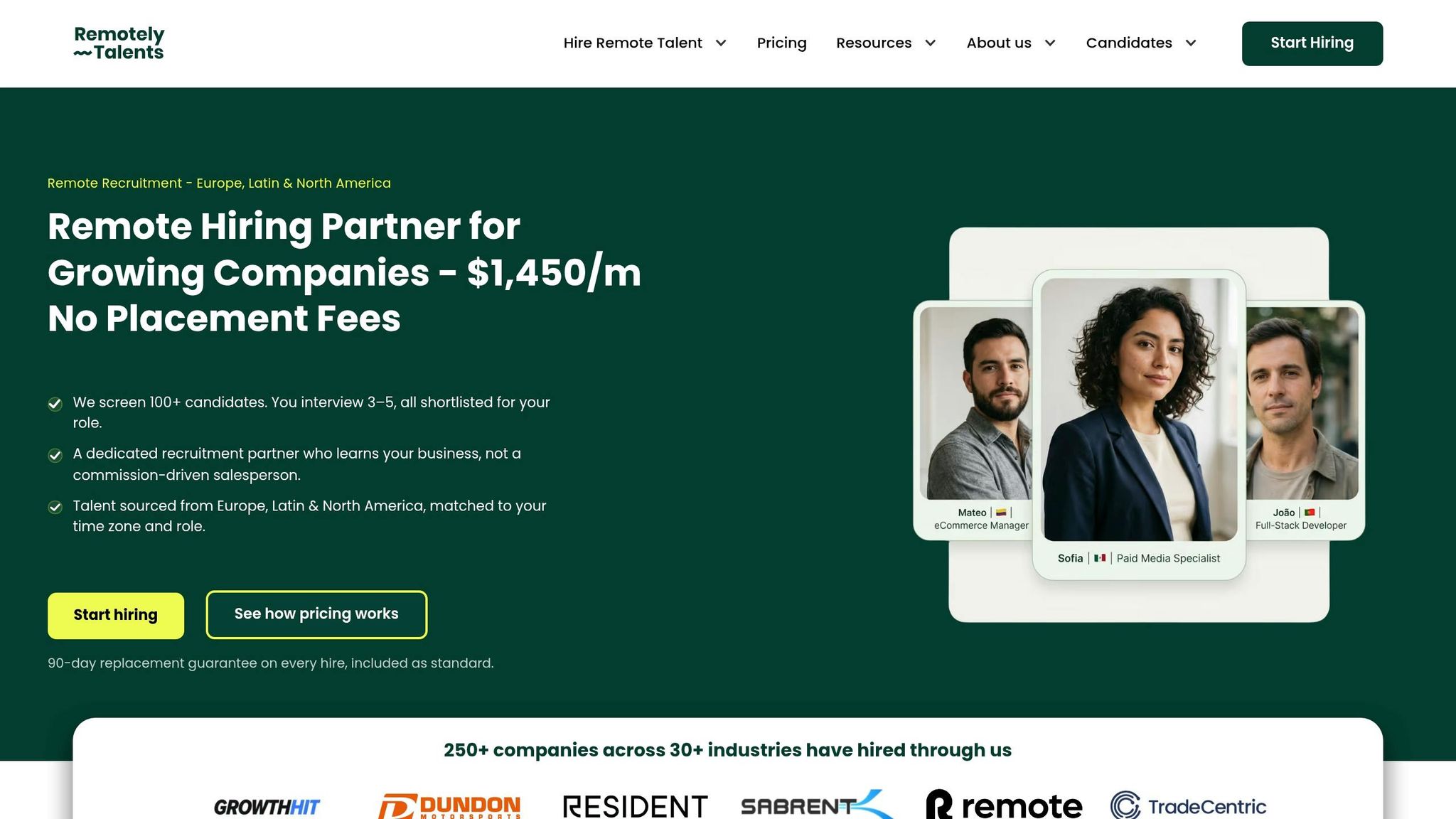
RemotelyTalents.com focuses on connecting businesses with pre-screened finance professionals across Europe, Latin America, and North America. Their recruitment plans are subscription-based, competitively priced ($1,000–$1,450/month), and include a 90-day replacement guarantee. They typically help businesses secure hires within 5–7 weeks.
Here’s a breakdown of their plans:
- On-Demand Plan: $1,450 per month per open role, including a 90-day replacement guarantee.
- Partner Plan: $1,000 per month with a 12-month commitment, allowing unlimited hiring (one active role at a time).
- Self-Service Plan: A one-time fee of $299 to promote your job to a network of pre-vetted candidates.
Each client works closely with a senior-level recruiter and account manager who oversee the entire hiring process, from sourcing candidates to making the final offer. Communication is streamlined via Slack, with weekly progress updates. With over 10,000 screened candidates and more than a decade of experience, RemotelyTalents.com understands the nuances of finance roles - whether it’s bookkeeping or accounting. They ensure candidates are vetted for software expertise, GAAP knowledge, and strong communication skills, making them a trusted partner for over 250 businesses.
Conclusion
Key Takeaways
Understanding the differences between a bookkeeper and a staff accountant is crucial for making the right hiring decision. A bookkeeper focuses on maintaining daily financial records, while a staff accountant ensures the overall accuracy of your financial picture, handling tasks like month-end close, compliance, and detailed reporting. For startups with simple financial needs, a bookkeeper might be sufficient. But if you need monthly P&L statements, balance sheets, or audit preparation, a staff accountant with knowledge of GAAP is the better choice.
When hiring, remember that quality matters as much as cost. US-based senior staff accountants typically earn between $65,000 and $95,000 annually. Offshore options, however, can range from $1,200 to $2,500 per month, offering up to 70% savings [1]. To ensure you're hiring the right candidate, test their understanding of core accounting principles. Paid reconciliation tests and trial periods can help you filter out unqualified applicants and assess their performance in real-world scenarios.
"The key distinction: a bookkeeper records transactions. A senior staff accountant owns the accuracy of the entire financial picture." - Pavago [1]
Avoid common pitfalls in finance hiring by ensuring candidates grasp essential concepts like the difference between accrual and cash-basis accounting. It's not just about knowing tools like QuickBooks; it's about understanding the foundation of sound financial management.
Your Next Steps
Use this framework to streamline your hiring process. Start by clearly defining the role and creating a job description that outlines your software requirements, reporting frequency, and reconciliation needs. Choose a hiring method that fits your timeline and budget. Specialized recruitment platforms can simplify the process by pre-screening candidates for technical expertise and compatibility with your team.
For example, RemotelyTalents.com offers subscription-based recruitment services at $1,000 per month, including a 90-day replacement guarantee and senior-level support. Most hires are finalized within 5–7 weeks, and you'll work directly with an account manager who understands finance staffing needs. You can request a candidate shortlist or schedule a consultation to begin building your finance team today.
FAQs
What’s the fastest way to tell if I need a bookkeeper or a staff accountant?
If you're trying to make a quick decision, start by evaluating your financial needs. For routine tasks like reconciliations, managing bank statements, and basic record-keeping, a bookkeeper will do the job. However, if you need help with more complex responsibilities - such as maintaining the general ledger, handling month-end closings, preparing financial reports, or ensuring compliance - a staff accountant is the better choice. The key is determining whether you require support with daily transactions or more in-depth financial analysis and reporting.
How do I test a remote candidate’s accuracy before I hire them?
To gauge a remote candidate's accuracy, focus on practical assessments that mirror actual job responsibilities. For instance, you could have them reconcile bank statements or create sample journal entries. Another effective approach is assigning a small, paid trial task. This allows you to evaluate their attention to detail and the quality of their work in a real-world scenario. These steps help ensure the candidate aligns with your business standards while reducing potential risks before making a hiring decision.
What should I expect to pay for a remote bookkeeper or staff accountant in 2026?
In 2026, hiring remote bookkeepers or staff accountants offshore typically costs between $1,200 and $2,500 per month. In contrast, U.S.-based professionals earn an annual salary ranging from $65,000 to $95,000. These costs can fluctuate depending on factors like location, experience level, and the complexity of the role.
Related Blog Posts
- Top 5 Staffing and Recruiting Companies for Hiring Remote Finance Roles in 2026
- How US Companies Can Hire Remote Finance & Accounting Talent in LATAM (2026)
- How to Hire a Remote Bookkeeper or Staff Accountant for a US Business (2026)
- How US Companies Can Hire Remote Finance & Accounting Talent in LATAM (2026)
Read also


Ready to hire without salary-based agency fees?
Book a free 30-minute consultation. We’ll review your role, timeline, and hiring goals, then show you how our fixed-fee remote search works.