Contractor vs EOR vs Direct Employee for Your First Global Hire


When hiring internationally, you have three main options: Independent Contractor, Employer of Record (EOR), or Direct Employee. Each comes with its own costs, risks, and management requirements. Here’s the quick breakdown:
- Independent Contractor: Best for short-term projects. Fast to hire, low cost, but high legal risks if misclassified.
- Employer of Record (EOR): Ideal for first international hires (up to 10 employees). Handles compliance, payroll, and taxes for a monthly fee ($200–$600 per employee). Moderate cost, low risk.
- Direct Employee: Suited for long-term roles or teams of 10+ in one country. Requires setting up a local legal entity, which is costly and time-consuming but offers full control.
Quick Comparison
| Feature | Independent Contractor | Employer of Record (EOR) | Direct Employee |
|---|---|---|---|
| Legal Employer | Self-employed | EOR provider | Your local legal entity |
| Speed to Hire | Days | 1–4 weeks | 2–6 months |
| Setup Cost | $0 | $0 | $15,000–$50,000 |
| Monthly Cost | Lowest (no benefits/taxes) | Moderate ($200–$600 + salary) | High upfront, lower per-head |
| Compliance Risk | High (misclassification) | Low (EOR assumes risk) | Medium (you own liability) |
| Best For | Short-term projects (<6 months) | First hires (<10 employees) | Long-term teams (10+ employees) |
Key takeaway: Contractors are flexible for temporary roles but come with compliance risks. EORs simplify hiring for small teams without the need for a local entity. Direct employment is a better long-term solution for scaling in one country. Choose based on your timeline, budget, and the role’s requirements.

Contractor vs EOR vs Direct Employee: Cost, Speed, and Risk Comparison
How to Hire International Talent: Contractors, EOR, and Entities Compared
sbb-itb-88a7fe6
The 3 Hiring Models Explained
When hiring internationally for the first time, you’ll need to decide between three primary approaches: Independent Contractor, Employer of Record (EOR), or Direct Employee. Each model impacts legal responsibilities, costs, and control in unique ways. Knowing these differences upfront can help you navigate compliance challenges and avoid costly mistakes.
Independent Contractor
An independent contractor is a self-employed individual hired for specific tasks or projects. In this arrangement, the contractor handles their own taxes, social contributions, and schedules, while you pay based on results rather than hours worked.
This model is ideal for short-term projects or specialized roles requiring minimal oversight. Contractors can often be onboarded within days, and there’s no need to cover payroll taxes, benefits, or statutory contributions. However, this simplicity comes with legal risks. If you provide equipment, set working hours, or demand exclusivity, local authorities may reclassify the contractor as an employee, leading to penalties.
Additionally, managing contractors can involve extra administrative work, such as handling invoices, verifying tax documents, and ensuring compliance across borders. While manageable for one-off projects, this can become overwhelming for ongoing roles.
Next, let’s explore the EOR model, which simplifies compliance and reduces legal risks.
Employer of Record (EOR)
An Employer of Record (EOR) is a third-party service that acts as the legal employer for your international worker. They handle payroll, tax withholding, statutory benefits, and compliance with local labor laws, allowing you to focus on day-to-day management.
EORs offer a quick and hassle-free onboarding process, typically taking 1 to 4 weeks. They’re especially useful for first-time international hires or small teams of fewer than 10 employees, as they take on the legal risks associated with employment classification. This reduces the likelihood of compliance penalties.
However, this convenience comes at a price. EOR providers typically charge $200 to $600 per employee per month, and statutory costs can raise the total salary by 30%–40%. While cost-effective for small teams, EORs may lose their appeal as your headcount grows (usually beyond 8–12 employees in the same country) due to recurring fees.
Now, let’s look at the direct employment model, which is better suited for companies ready to establish a local presence.
Direct Employee
A direct employee is hired through your own legal entity in the worker’s country. This model gives you full control over employment contracts, payroll, and compliance with local labor laws.
Direct employment offers maximum control over terms, intellectual property, and company culture. It’s particularly cost-efficient for long-term roles or when building regional hubs with 10–15 employees. However, setting up a local entity involves significant time and financial investment. For example, establishing a legal entity in Latin America can take 4 to 12 weeks and cost between $15,000 and $50,000. In Mexico, setup costs often range from $16,000 to $30,000, with annual maintenance adding $10,000 to $30,000 for compliance, accounting, and legal filings.
Additionally, you’ll assume full responsibility for payroll taxes, social security, and severance accruals. There’s also the risk of triggering Permanent Establishment (PE) tax exposure, which can complicate operations further.
Comparison Table: Contractor vs EOR vs Direct Employee
| Feature | Independent Contractor | Employer of Record (EOR) | Direct Employee |
|---|---|---|---|
| Legal Employer | The worker (self-employed) | The EOR provider | Your local legal entity |
| Speed to Hire | Instant to days | 1–4 weeks | 2–6 months |
| Setup Cost | $0 | $0 | $15,000–$50,000 |
| Monthly Cost | Lowest (no benefits/taxes) | Moderate ($200–$600/month + salary & statutory costs) | High upfront, lowest per-head at scale |
| Compliance Risk | High (misclassification) | Low (provider assumes risk) | Medium (you own liability) |
| Management Effort | Low (results-oriented) | Moderate (daily tasks) | High (HR, payroll, legal) |
| Best For | Short-term projects (<6 months) | First international hires (up to 10 employees) | Long-term hubs (10+ employees) |
How to Choose the Right Model
Deciding between a contractor, Employer of Record (EOR), or direct employee boils down to what works best for your unique needs. Factors like how quickly you need to hire, your budget (both upfront and long-term), legal risk tolerance, desired level of management involvement, and the role’s specifics all play a part in the decision.
Speed-to-Hire
If time is critical, contractors are the quickest option - they can often start within days. For a slightly longer timeline of 1–4 weeks, an EOR can step in as a faster alternative to setting up a local entity. The EOR handles the legal groundwork, leaving you to focus on interviewing and onboarding. A good example is Chaos, which used an EOR in early 2026 to hire 15 employees across nine countries, including Vietnam, India, and Mexico, or working with recruitment firms in Latin America, avoiding the lengthy process of establishing local entities [2].
Once you’ve considered timing, the next step is to weigh the costs.
Total Cost and Hidden Fees
Contractors may seem like the most cost-effective option due to their fixed rates, but there are often hidden risks. EORs typically charge between $200 and $600 per employee each month, while direct employment requires a significant upfront investment - ranging from $5,000 to over $50,000. However, direct employment becomes more economical as your team grows, especially with 10–15 employees. For instance, Chaos saved about $135,000 in setup costs by opting for an EOR instead of creating local entities [2][4].
Compliance and Misclassification Risk
One of the biggest challenges in international hiring is avoiding worker misclassification. If you impose fixed hours, provide proprietary tools, or require exclusivity, your contractor could legally be considered an employee. Misclassification in countries like Spain can result in fines of up to €12,000 [2], and in some cases, liabilities have exceeded $200 million [5]. An EOR can help you navigate these risks by taking on employment compliance, whereas direct employment shifts this responsibility entirely to your company.
Beyond legal concerns, it’s also important to think about how much management effort each model requires.
Management Overhead
Contractors are the easiest to manage - they work independently, and you only need to handle deliverables and invoices. With an EOR, they take care of payroll, taxes, and benefits, leaving you to focus on day-to-day tasks. On the other hand, direct employment means your team takes on full HR and legal responsibilities, which can be overwhelming without dedicated support [2].
Role Type and Expected Tenure
For short-term projects lasting less than six months, contractors are usually the best fit. However, for long-term roles or core team members, an EOR or direct employment is a better choice. Keep in mind that contractor agreements exceeding six to nine months could risk reclassification as employment. If the role involves fixed hours and close collaboration - such as in development, design, or marketing - it’s often better to hire them as employees from the outset.
Cost Breakdown by Model (2026)
Understanding the real costs of different hiring models is key to effective budgeting. Expenses can vary widely based on factors like the region, the role's seniority, and how quickly you need to fill the position. Here's a closer look at the numbers, complementing earlier points on speed, compliance, and management.
Contractor Costs
Independent contractors typically charge $25–$150 per hour, with rates heavily influenced by their location and expertise. For example, in Latin America, mid-level professionals like developers or marketers generally charge $30–$60 per hour, while senior-level specialists may demand $75–$100 per hour. If a contractor works full-time (160 hours per month), you'll be looking at $4,800–$16,000 monthly in direct payments.
Keep in mind, international wire transfers add an extra $25–$50 per transaction, or you can opt for a Contractor of Record service, which costs about $299 per month to handle payments and basic compliance[3]. Contractors typically factor in their own taxes and benefits when setting their rates[1][3].
EOR Costs
Employers of Record (EOR) services charge a monthly fee of $200–$600 per employee, which usually equates to 8–20% of the worker's total compensation[2]. This fee is in addition to the employee's gross salary and covers payroll, tax filings, benefits, and compliance management. This model is ideal for quick hiring and reducing compliance risks.
For instance, hiring a mid-level marketing manager in Mexico with a $4,000 monthly salary might cost an additional $400–$600 in EOR fees, plus mandatory benefits like social security and health insurance. In countries with stricter labor laws, such as Brazil, you could see total costs rise by 30–40% above the base salary due to statutory contributions.
Direct Employee Costs
Setting up a local legal entity involves an upfront cost ranging from $5,000 to $50,000+, with a timeline of 2–6 months[2]. After the initial setup, you'll also face ongoing expenses for legal support, accounting, payroll software, and possibly a local director.
This model becomes more cost-efficient when you're hiring 10–15 employees or more in a single country[2][4]. For smaller teams or first-time international hires, EOR fees are generally more economical than the combined setup and maintenance costs of establishing a local entity. Unless you're planning to scale rapidly in that market, creating a legal entity may not be the best financial choice.
Where to Find and Hire Global Talent
Once you've weighed the pros and cons of contractor, EOR, and direct employee models, the next step is finding the right global talent. The method you choose to source talent plays a big role in determining candidate quality, costs, and how quickly you can onboard new hires. There are three main approaches to consider: recruitment agencies, EOR platforms, or in-house hiring.
Recruitment Agencies vs. EOR Platforms vs. In-House Hiring
Recruitment agencies specialize in finding and vetting candidates for you. They take care of job postings, screen resumes, conduct interviews, and present you with a shortlist of qualified candidates. Traditional agencies charge a one-time fee based on a percentage of the candidate's first-year salary. Alternatively, subscription-based recruitment services offer flat monthly fees, which can be easier to budget for if you're new to international hiring.
EOR platforms focus on handling the legal and payroll aspects of hiring across borders, but they don't assist with finding candidates. You'll need to manage job postings, screen applications, and conduct interviews on your own.
In-house hiring gives you the most control over the process but requires a significant investment of time and expertise. You'll need to navigate international job boards and comply with local hiring laws, which can be complex. For first-time international hires, this process can take anywhere from two to six months and often requires internal HR resources that smaller teams may lack. In-house hiring becomes more practical once you're consistently hiring in the same region and have developed a strong understanding of the local job market. However, if you're making your first international hire, a more streamlined approach is usually the better option.
Why RemotelyTalents.com Is Ideal for First International Hires
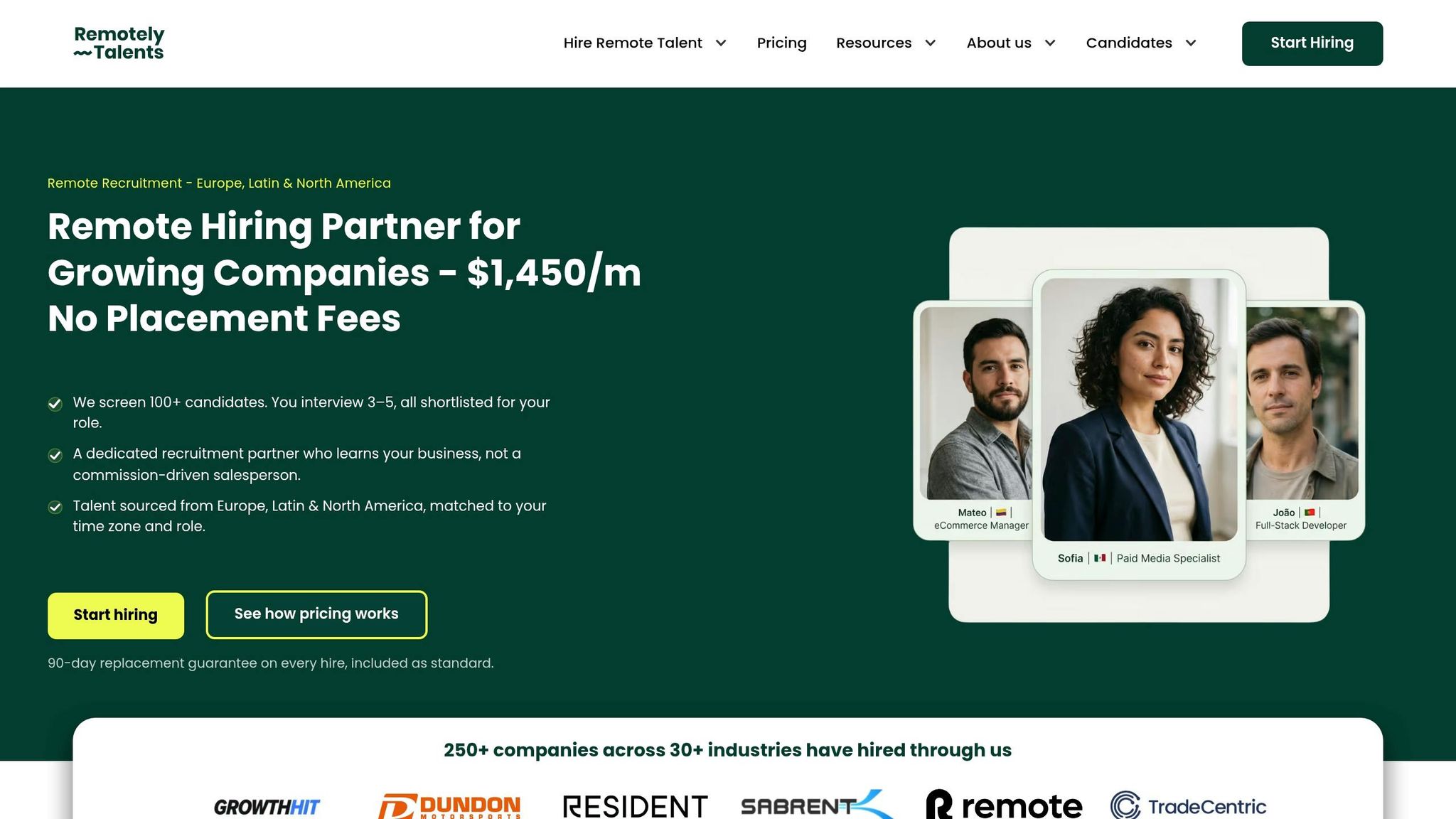
For businesses looking to simplify their global hiring process, RemotelyTalents.com offers a tailored recruitment solution designed specifically for first-time international hires. Unlike traditional agencies, they use a subscription-based pricing model.
- On-Demand Plan: $1,450 per month, cancel anytime, with a maximum of two months per project.
- Partner Plan: $1,000 per month with a 12-month commitment, covering one active role at a time.
With these plans, you'll have access to a dedicated senior recruiter and account manager who provide weekly reports and updates via Slack. Most hires are completed within 5–7 weeks, and you'll typically receive 3–4 qualified candidates within the first two weeks. Plus, they offer a 90-day replacement guarantee if the hire doesn't work out.
The team at RemotelyTalents.com is based in Europe and Latin America and has a database of over 10,000 pre-vetted candidates. They focus on roles in Marketing & eCommerce, IT/Data/Engineering, Operations & VAs, and Finance & Accounting, covering remote talent across Europe, Latin America, and North America. With over a decade of experience and a track record of supporting more than 250 companies, they understand the unique challenges U.S. small and medium-sized businesses face when hiring internationally.
For companies that prefer to manage the hiring process themselves but need access to a pool of quality candidates, RemotelyTalents.com also offers a Self-Service plan for a one-time fee of $299. This plan promotes your job to their candidate database and hiring networks for three months, with applications sent directly to your inbox or applicant tracking system (ATS).
Conclusion
Deciding between a contractor, EOR, or direct employee comes down to speed, compliance risk, cost structure, and role longevity. This guide compared these models based on how quickly you can hire, total costs, compliance risks, and management overhead. If you’re looking for someone to handle a short-term project and work independently, a contractor is often the best fit. On the other hand, for ongoing roles that require team integration and benefits, an EOR provides a safer and more practical solution. Setting up a local entity only makes sense when hiring 10 or more people in the same country, as fewer hires can lead to unnecessary delays and expenses.
Cutting costs by treating full-time roles as contractor positions is a risky move. Misclassification can lead to severe liabilities - some companies have faced penalties exceeding $200 million for this mistake[5]. Misclassification risks are particularly high in many jurisdictions[2]. If you’re controlling work hours, providing tools, or requiring exclusivity, the law likely considers the worker an employee, regardless of the contract. It’s critical to align your hiring model with legal requirements to avoid these pitfalls.
Start by evaluating the role: Is the position temporary or ongoing? Does it demand full integration with your team, or is it better suited for independent, project-based work? Does the candidate need benefits and job security, or do they prefer flexibility? Answering these questions will point you toward the right hiring model.
When making your decision, focus on the key factors - speed, cost, risk, and management effort - and ensure your choice supports your operational goals. If you’re still uncertain, consider reaching out to RemotelyTalents.com for guidance. They’ve helped more than 250 companies connect with top remote talent across Europe, Latin America, and North America. With a deep understanding of compliance, cost, and operational challenges faced by U.S. small and medium-sized businesses, they can help you navigate the process. Most hires are completed in just 5–7 weeks, and their subscription-based recruitment starts at $1,000 per month - no placement fees or hidden costs.
Don’t wait to secure the right global talent. The perfect hiring model exists for your business - it’s all about matching it to the role, timeline, and level of control you need. Start there, and everything else will fall into place.
FAQs
When does a contractor become an employee risk?
When a contractor's working arrangement starts to resemble that of an employee - such as setting their work hours, supplying them with tools, or closely managing their tasks - it can create a misclassification risk. If a contractor is incorrectly classified as an independent worker instead of an employee, your business could face legal penalties and compliance problems.
At what headcount should I switch from an EOR to my own entity?
For most US small and medium-sized businesses (SMBs), switching from an Employer of Record (EOR) to setting up a local entity becomes more cost-effective once they hit around 20 employees in a single country. Below this number, using an EOR is a simpler and compliant option. However, as the workforce grows, having a local entity tends to lower long-term expenses while offering more control over operations, employee benefits, and compliance matters.
How do I estimate the true all-in cost per country?
To get a full picture of hiring costs in any country, you need to account for both visible and hidden expenses. The main components include:
- Base salary or contractor fee: The straightforward payment to the employee or contractor.
- Legal and setup costs: This might involve expenses for an Employer of Record (EOR) or setting up a local entity.
- Benefits and compliance expenses: These include mandatory benefits, taxes, and compliance with local labor laws.
- Hidden costs: Factors like onboarding, the risk of worker misclassification, and management overhead can also add up.
By combining these elements, you’ll have a clear and realistic understanding of the total cost of hiring, helping you plan your budget and steer clear of unexpected expenses.
Related Blog Posts
Read also


Ready to hire without salary-based agency fees?
Book a free 30-minute consultation. We’ll review your role, timeline, and hiring goals, then show you how our fixed-fee remote search works.