Contractor vs EOR vs Direct Employee for Your First International Hire (2026)


Making your first international hire? Here’s what you need to know:
- Independent Contractors: Fast and low-cost but risky for compliance. Best for short-term, project-based work.
- Employer of Record (EOR): Ideal for small teams or quick expansion. Handles compliance, payroll, and benefits for you.
- Direct Employees: Offers full control but comes with high setup costs and administrative effort. Suited for long-term growth or larger teams.
Quick Comparison:
| Feature | Independent Contractor | Employer of Record (EOR) | Direct Employee (Local Entity) |
|---|---|---|---|
| Speed to Hire | 1–3 days | 1–2 weeks | 2–6 months |
| Upfront Cost | Low | Moderate ($200–$600/month) | High ($5,000–$50,000+) |
| Compliance Risk | High | Low | Medium |
| Best For | Short-term projects | First hires, small teams | Long-term market presence |
Hiring internationally in 2026 is more complex due to stricter labor laws, higher fines for misclassification, and potential tax risks from permanent establishment (PE). Choose the right model based on your timeline, budget, and compliance needs.

Contractor vs EOR vs Direct Employee Comparison Chart for International Hiring
Contractor vs EOR vs Direct Employee: What Each Model Means
How Each Model Works
Independent contractors are self-employed professionals who provide specific services. You sign a business-to-business (B2B) agreement with them, and they invoice you for their completed work. They handle their own taxes, benefits, and insurance. This relationship revolves around deliverables rather than tracking hours. Contractors usually use their own tools, set their own schedules, and often work with several clients at once. However, this model can bring heightened legal and financial risks, especially concerning misclassification [1][3].
Employer of Record (EOR) services act as the official employer in a country where your company doesn’t have a registered legal entity. The EOR takes care of payroll, taxes, mandatory benefits, and compliance with local labor laws. You remain responsible for overseeing daily tasks, performance, and projects, but the EOR assumes legal responsibility and manages the employment contract [1][5].
Direct employee (local entity) hiring involves creating your own legal business entity in the target country. This means managing payroll systems, tax registrations, benefits, and ensuring compliance with all local labor laws. While this option grants total control over operations and employment, it comes with significant upfront costs and ongoing administrative efforts [1][5].
Comparison Table: Contractor vs EOR vs Direct Employee
| Feature | Independent Contractor | Employer of Record (EOR) | Direct Employee (Local Entity) |
|---|---|---|---|
| Speed to Hire | Immediate / 1–3 days | 1–2 weeks | 2–6 months |
| Upfront Cost | Minimal (contract only) | Moderate ($200–$600/month) | High ($5,000–$50,000+ setup) |
| Compliance Risk | High (misclassification) | Low (provider assumes risk) | Medium (company owns risk) |
| Control Over Work | Low (deliverables only) | High (daily management) | Full (legal & operational) |
| Management Overhead | Low (autonomous worker) | Moderate (provider handles admin) | High (full HR/payroll responsibility) |
| Best For | Short-term projects (<6 months) | First hires / Small teams (<10 people) | Regional hubs or long-term market presence (15+ employees) |
Each hiring model has its strengths and weaknesses, making it essential to carefully weigh your business needs against these trade-offs. If you need help deciding, you can consult with a hiring expert to find the best fit.
Where Each Model Works and Where It Fails
Independent contractors shine in short-term roles, specialized projects, or when testing new markets. They’re ideal for situations requiring minimal supervision and high autonomy. But if the role involves fixed hours, company equipment, or integration into core workflows, the risk of misclassification grows. For instance, if a contractor exclusively works for your company, uses internal communication tools, attends daily meetings, and follows a set schedule, this could lead to legal complications [1].
EOR services are perfect for rapid hiring - often within 1–2 weeks - without the hassle of setting up a local entity. They’re especially effective for small teams (fewer than 10 employees) or when expanding into new markets, such as by using recruitment firms for remote talent in Latin America. However, as your team size grows beyond 10–15 employees in a single country, the monthly fees (typically 8–20% of salaries) may become less cost-effective. Even so, EORs can still reduce expansion costs by up to 40% compared to setting up a local entity [4][5][6].
Direct employee hiring through a local entity works best for building long-term regional hubs, hiring leadership roles requiring legal authority, or establishing a permanent presence in a market. But this approach is less practical for initial international hires due to the lengthy setup process (2–6 months), high upfront costs ($5,000–$50,000+), and ongoing legal and administrative responsibilities [1][5].
sbb-itb-88a7fe6
How to Choose the Right Model for Your First Hire
5 Factors That Determine the Right Model
When deciding how to hire internationally, consider these five key factors: speed-to-hire, total cost, compliance risk, management overhead, and role requirements. Let’s break them down:
- Speed-to-hire: How quickly do you need someone in the role? Contractors can often start immediately, while hiring through an Employer of Record (EOR) typically takes 1–2 weeks. On the other hand, direct hires through a local entity can take anywhere from 2 to 6 months.
- Total cost: This includes both upfront and recurring expenses. Contractors come with minimal setup costs, EORs charge between $200–$600 monthly per employee, and establishing a local entity can cost anywhere from $5,000 to over $50,000 just to set up [1].
- Compliance risk: Misclassifying workers is one of the biggest risks for first-time international employers. Contractors carry the highest risk of misclassification, which can lead to hefty penalties. For instance, Spain imposes fines of up to €12,000 per misclassified worker [1]. Some companies have faced liabilities exceeding $200 million for similar issues [6]. EORs take on this legal responsibility, making them the safest choice, while direct entities leave compliance entirely on your shoulders.
- Management overhead: If you need to control how, when, and where someone works - or provide company equipment - you’ll need an employee relationship through an EOR or local entity [6][1]. Contractors, however, must maintain independence, meaning you focus on deliverables rather than day-to-day oversight.
"The nature of the work matters as much as the duration. If someone has a set schedule or a fixed shift, that carries a different classification risk than someone doing async work on their own time" [3].
- Peter Lyons, Advisor at RemotePass
- Role requirements: The type of work also determines the hiring model. Core business functions or roles requiring sensitive data access often call for employee arrangements, while specialized, independent tasks align better with contractor relationships.
A practical guideline is the "Rule of 10": use an EOR for fewer than 10 employees in a single country. Once your team grows to 10–15 people, consider setting up a local entity, as EOR fees (8–20% of salaries) may become less cost-effective [1][5]. For example, in 2026, Chaos, a software company, used RemotePass as an EOR to hire 15 employees across 9 countries, saving around $135,000 in entity setup costs while ensuring local benefits like health insurance and social security [1].
Lastly, for U.S. companies hiring foreign contractors, it’s essential to collect IRS Form W-8BEN (for individuals) or W-8BEN-E (for entities) before making payments. This ensures the contractor is not subject to a default 30% withholding tax [6].
Matching Role Type to Hiring Model
Once you’ve considered the factors above, you can align specific roles with the best hiring model.
- Project-based work: Tasks with clear deliverables and defined timelines - like a website redesign, market research, or a software audit - are ideal for contractors. These engagements typically last 6–9 months. Beyond that, the relationship often resembles permanent employment and may require transitioning to an EOR or direct hire [5]. Contractors manage their own schedules and tools, maintaining their independence [1][2].
- Temporary roles: Positions lasting 6–18 months, such as covering parental leave, launching a product, or testing new markets, fit well with EOR arrangements. This model allows you to maintain operational control without creating a foreign legal entity. The EOR handles payroll, taxes, and mandatory benefits like 13th-month salaries, common in many European and LATAM countries [1][5].
- Long-term positions: Roles that are integral to your core team - such as leadership positions, jobs involving sensitive data, or key business functions - require either an EOR (for smaller teams) or a local entity (for larger regional hubs). Once your team in a single country grows to 10–15 employees, the cost savings and control of a local entity often outweigh the convenience of an EOR [1][5].
"Global expansion rarely fails because of talent. It fails because structure lags behind ambition" [5].
- Emilio García, Pluria
Mistakes First-Time International Hirers Make
First-time international employers often fall into these common traps:
- Worker misclassification: Even if a contract labels someone as an "independent contractor", legal tests focus on whether you control how, when, and where they work [6]. For example, Alts Digital, a gaming tech company, initially managed over 20 contractors across Brazil, Peru, India, and Europe. They later switched to a Contractor of Record (CoR) model through RemotePass to centralize compliance and eliminate the hassle of verifying quarterly tax documents [1][2].
- Underestimating setup costs and timelines: Founders often assume they can quickly establish a local entity, only to face 2–6 month delays and setup costs ranging from $5,000 to $50,000+ [1][5]. Hidden expenses, like international wire transfer fees ($25–$50 per transaction) and mandatory local benefits, can further strain budgets. Using an EOR can cut expansion costs by about 40% compared to traditional entity setups [6].
- Ignoring local labor laws: Hiring contractors with the authority to sign contracts or perform core business activities may trigger permanent establishment (PE) risk, leading to unexpected corporate tax obligations - even without a local office [6][2]. Additionally, different countries have strict rules on benefits, termination, and intellectual property rights. For instance, some jurisdictions enforce "moral rights", which require explicit contracts to address work ownership [6]. Without local expertise, compliance can become a significant challenge.
Cost Breakdown: What Each Model Actually Costs in 2026
2026 Cost Ranges by Model
When evaluating the costs of different hiring models, it's important to look beyond just base salaries. Contractors might seem like the cheapest option initially - you only pay their agreed rate without worrying about benefits or payroll taxes. However, there’s a catch: if regulators reclassify the contractor relationship, you could face hefty penalties. On the other hand, Employer of Record (EOR) services typically charge between $200 and $600 per employee per month, letting you bypass the expense and complexity of setting up a legal entity. Directly hiring employees through a local entity comes with upfront setup costs ranging from $5,000 to over $50,000, plus ongoing maintenance expenses for the entity itself [1].
Employee costs also include mandatory social contributions and benefits. For example, in the U.S., a $100,000 salary costs employers between $130,000 and $145,000 a year - a multiplier of 1.3× to 1.45× - due to FICA taxes, health insurance, and 401(k) contributions [9]. In countries like France or Brazil, this multiplier can climb to 1.6× to 1.75× [9]. Latin American countries often require additional payments, such as a 13th-month salary, while Mexico mandates a 25% vacation premium and a year-end bonus equivalent to 15–30 days' salary [8]. These statutory obligations apply whether you use an EOR or set up a local entity.
Recruiting internationally also comes with its own set of costs. By 2025, the average cost-per-hire for global roles had climbed to $10,500, reflecting a 23% increase from the previous year [7]. This figure includes:
- Recruiting and sourcing: $3,500
- Compliance and legal: $1,750
- Onboarding and administration: $1,875
- Technology and tools: $1,000
- Agency fees: $4,875
Interestingly, companies using integrated providers for payroll, compliance, and recruiting have managed to reduce their cost-per-hire to around $6,500 [7].
Hidden Costs and Compliance Penalties
The risks of non-compliance are a financial minefield. Misclassifying contractors, for instance, can lead to severe penalties - Spanish regulators impose fines of up to €12,000 per misclassified contractor, and some cases have resulted in liabilities exceeding $200 million [1][6]. On average, international hiring compliance failures result in fines of about $22,500 [7]. Beyond fines, companies may also owe back wages, unpaid benefits, retroactive social security contributions, and interest stretching back years.
Another hidden risk is Permanent Establishment (PE). If a contractor signs contracts on your behalf or takes on core business functions, their activities might trigger corporate tax obligations in their country - even if you don’t have a registered office there [2][6]. Other potential costs include GDPR fines, which averaged $156,250 in 2025, and termination-related penalties, which typically cost around $40,000 per incident. Even small fees like international wire transfer charges - ranging from $25 to $50 per transaction - can add up over time [6][7].
Maintaining a legal entity also comes with ongoing expenses. After spending between $37,000 and $100,000 to establish one, companies must continue to budget for local accounting, annual audits, registered agents, and compliance filings [7].
"The math is simple: setting up a legal entity costs £30,000-80,000 and takes 4-6 months. EOR lets you hire in two weeks with zero entity cost."
Cost Examples for Common Roles
Let’s break down the costs for three common roles across hiring models to see how they stack up.
A software developer in Latin America earns between $25,000 and $55,000 annually. As a contractor, you pay this rate directly, plus transaction fees. With an EOR, you’d add roughly $4,800 in annual fees (at $400/month), bringing the total to $29,800 to $59,800, which also covers statutory benefits like a 13th-month salary. Direct hiring through a local entity increases costs further, with an employer multiplier of 1.6× to 1.75× (common in Brazil), plus the initial entity setup fee [1][9].
An operations manager in Southeast Asia earns between $18,000 and $45,000 annually. Under the contractor model, costs are limited to their salary, but this exposes you to misclassification risks if the role involves fixed hours or company equipment. Using an EOR adds $2,400 to $7,200 annually in service fees. Direct hiring requires compliance with local labor laws, provident fund contributions, and health insurance, resulting in an employer multiplier of 1.15× to 1.25× [9].
A virtual assistant working part-time in Latin America costs $15,000 to $25,000 annually. For short-term projects (under six months), the contractor model can be cost-efficient. However, for longer engagements, there’s a risk of the relationship being reclassified as employment. Companies using an EOR avoid entity setup costs, which average around $56,250 per hire [7].
Where to Find and Hire International Talent
Agencies vs EOR Platforms vs Self-Sourcing
Once you've decided on your hiring model - whether it's a contractor, EOR, or direct employee - the next big step is figuring out the best sourcing strategy. This choice can make or break your international hiring process, impacting both speed and compliance.
Self-sourcing means taking full control of the recruitment process. You post job openings on platforms like LinkedIn, Upwork, or niche job boards and handle everything in-house. While this option has the lowest upfront costs, it tends to be time-consuming and carries higher risks of misclassification and compliance issues.
EOR platforms (Employer of Record) simplify payroll, taxes, and compliance by acting as the legal employer. However, they don't assist with finding candidates. If you've already identified a candidate - through a referral or networking, for example - an EOR can onboard them in as little as one to two weeks. A notable example: a software company saved about $135,000 in upfront costs by using an EOR for their international hires.
Recruitment agencies specialize in finding and vetting candidates for you. Traditional agencies charge placement fees ranging from 15% to 25% of the candidate's first-year salary. That can amount to $15,000 to $25,000 for a mid-level hire. Alternatively, subscription-based recruitment services offer a flat monthly fee, making costs more predictable. It's worth noting that 73% of companies have expanded their global workforce using international hiring solutions, often by combining recruitment agencies with EOR platforms to manage both sourcing and compliance effectively [6]. These strategies highlight how a Recruitment-as-a-Service (RaaS) model can streamline the entire hiring process.
Why RemotelyTalents.com Works for First International Hires
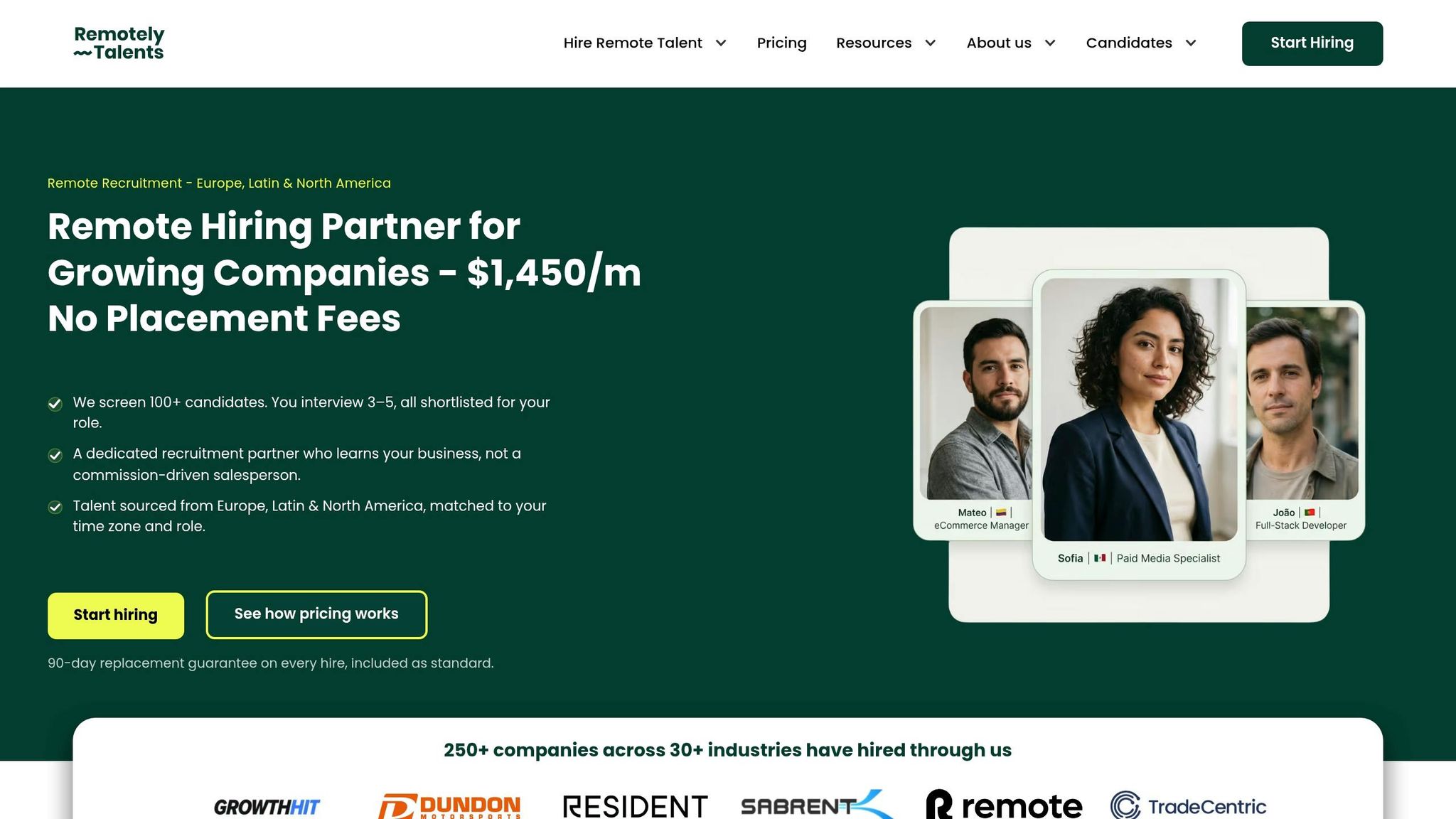
RemotelyTalents.com uses a Recruitment-as-a-Service (RaaS) model, offering a flat monthly subscription instead of the traditional success fees charged by agencies. This pricing structure is ideal for first-time international hiring, as it avoids unexpected costs and simplifies budgeting. Subscription plans start at $1,000 per month under the Partner Plan, which includes a 90-day replacement guarantee - if your hire doesn’t work out within three months, they’ll find a replacement at no extra cost.
Each client is paired with a dedicated senior recruiter and account manager, ensuring consistent communication through Slack and weekly updates. Most hires are completed within five to seven weeks, striking a balance between thorough vetting and efficiency. This contrasts with the faster one to two-week onboarding offered by EOR platforms, which typically require a pre-identified candidate. RemotelyTalents boasts a database of over 10,000 screened candidates and a recruitment team based in Europe and Latin America. With more than 10 years of experience and trusted by 250+ companies, they specialize in roles across Marketing & eCommerce, IT/Data/Engineering, Operations & VAs, and Finance & Accounting, covering talent pools in Europe, Latin America, and North America.
Flexible Plans That Scale With Your Hiring Needs
Managing costs and risks is critical when making your first international hire. RemotelyTalents.com offers three pricing plans designed to adapt to different hiring needs and budgets:
- On-Demand Plan: Priced at $1,450 per month per open role, this plan is perfect for startups or companies testing new markets. It includes a 90-day replacement guarantee and delivers three to four qualified candidates within two weeks. You can cancel anytime.
- Partner Plan: At $1,000 per month with a 12-month commitment, this plan is ideal for businesses with ongoing hiring needs. You can onboard multiple roles over time, though only one position can be active at a time. It's a cost-effective choice for companies aiming to hire four to six roles annually.
- Self-Service Plan: For a one-time fee of $299, this option is tailored to companies that prefer handling recruitment themselves. Your job posting is promoted to RemotelyTalents' candidate database and shared across various hiring networks, with applications sent directly to you.
All plans include access to fluent English speakers (C1+ level), ensuring smooth communication for remote teams. By eliminating placement fees, RemotelyTalents offers a cost-effective solution while maintaining professional candidate vetting and a replacement guarantee. This makes it an attractive choice for companies looking to avoid high agency fees without compromising on quality.
Conclusion
Summary: Matching Model to Business Need
Selecting the right hiring model depends on factors like team size, speed, market longevity, and the level of control you need.
For roles lasting less than six months or for testing a market, a contractor can work well. This option is quick and has low upfront costs, but it comes with serious misclassification risks if the role evolves into a core part of your business. If you need someone fully integrated into your team, where you control their hours, tools, and workflow, an Employer of Record (EOR) is a better choice. This approach allows for onboarding in one to two weeks, ensures compliance, and eliminates the $5,000 to $50,000+ expense of establishing a local entity [1]. Once your team grows to 8 to 12 employees in a single country, setting up a local entity becomes more cost-effective and provides complete operational control [5].
It's important to note that misclassification risks can be costly. In Spain, fines for misclassified contractors can reach €12,000, while in the U.S., liabilities have exceeded $200 million in some cases [1][6].
By using this framework, you can make informed decisions about your global hiring strategy.
What to Do Next
Now that you have a clear framework, apply it to find the hiring model that aligns with your business goals. When you're ready to proceed, schedule a free consultation with RemotelyTalents.com. A senior recruiter will help you outline the role, timeline, and the most compliant hiring strategy for your needs. Whether you're looking for a contractor for a short-term project or a full-time employee via an EOR, RemotelyTalents takes care of sourcing, vetting, and compliance across Europe, Latin America, and North America.
Plans start at $1,000 per month, and they include a 90-day replacement guarantee. Most hires are completed within five to seven weeks, with predictable pricing and dedicated support through Slack and weekly updates. Schedule your consultation today or request a tailored hiring model recommendation based on your unique requirements.
How to Hire International Talent: Contractors, EOR, and Entities Compared
Once you choose a model, you'll need to pay your international employees and contractors securely while staying compliant with local tax laws.
FAQs
How do I tell if my “contractor” should legally be an employee?
To figure out whether a contractor should legally be considered an employee, take a close look at the nature of the working relationship. Some key indicators include:
- Control over work hours and methods: If you dictate when and how the work is done, this leans toward an employer-employee relationship.
- Providing tools or equipment: Supplying the resources needed for the job could point to employment.
- Integration into your business: Workers closely tied to your operations or treated like part of the team may be employees.
- Payment based on hours worked: Paying by the hour rather than per project is another sign of employment.
If these factors are present, the worker is likely an employee. Misclassifying them as a contractor can lead to serious consequences, including fines and legal troubles. Always focus on the actual working conditions rather than relying on how the contract is labeled.
When does it make financial sense to switch from an EOR to a local entity?
When your team in a specific country grows beyond 20 employees or your hiring strategy shifts to a long-term focus, transitioning from an Employer of Record (EOR) to a local entity can be a smart financial move. EORs work well for smaller teams or when you're testing a market, but as your operations expand, setting up a local entity can lower overall costs, provide more control over operations, and better support the demands of a growing, sustained presence in the region.
Can hiring a contractor abroad create corporate tax risk for my U.S. company?
Hiring a contractor abroad can bring potential tax risks for your U.S. company. One major concern is the misclassification of contractors as employees, which can lead to fines, penalties, or even legal troubles. Additionally, international tax laws vary significantly, and failing to comply with local regulations may create unexpected liabilities. To steer clear of these issues, it's crucial to ensure your business adheres to the specific rules in the contractor's country.
Related Blog Posts
Read also



Ready to hire without salary-based agency fees?
Book a free 30-minute consultation. We’ll review your role, timeline, and hiring goals, then show you how our fixed-fee remote search works.