Convert Contractor to Employee: Cost, Risk, and Timeline


Converting a contractor to an employee in 2026 is more than just a compliance issue; it’s about managing costs, legal risks, and operational challenges. Misclassification penalties are rising globally, with cases like Swift Transportation’s $100M settlement highlighting the stakes. The process involves assessing worker classification, calculating the Total Cost of Employment (TCE), and navigating regional compliance rules. Here’s what you need to know:
- Costs: Expect to add 20–40% to the contractor’s base salary for taxes, benefits, and overhead in regions like the U.S. and Canada.
- Risks: Misclassification can lead to fines, back taxes, and legal battles. For example, the IRS evaluates factors like control over work and financial arrangements.
- Timeline: Transitioning takes 6–10 weeks, including role definition, offer creation, and onboarding.
- Compliance: Requirements vary by country. For instance, Brazil mandates a 13th-month salary, while Germany requires written contracts with statutory benefits.
Using an Employer of Record (EOR) can simplify the process, especially for international hires, by managing payroll, taxes, and local compliance. This approach reduces setup time and legal exposure. Evaluate costs, legal risks, and team readiness before deciding, and consider tools like decision scorecards to guide the transition.
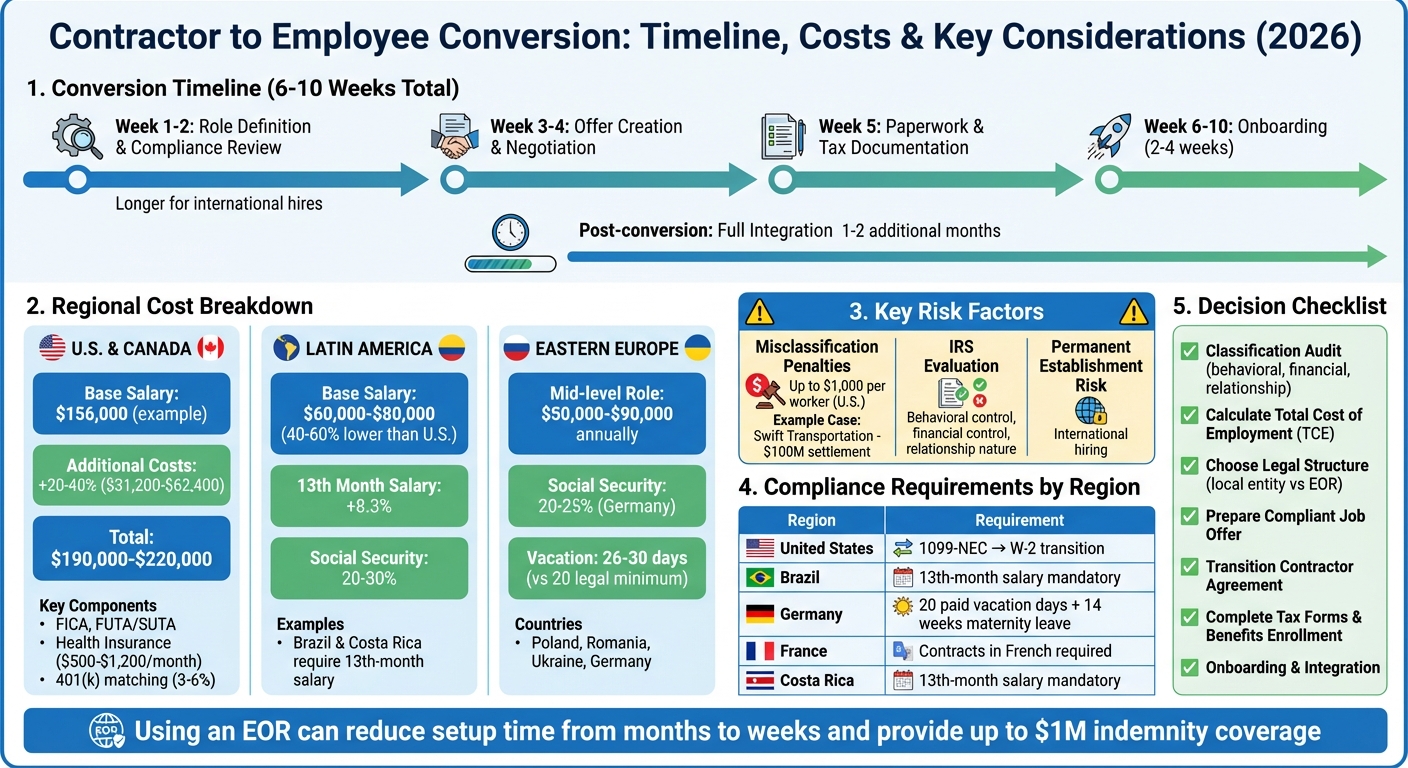
Contractor to Employee Conversion Timeline and Cost Breakdown by Region
How the Conversion Process Works
When to Convert a Contractor to an Employee
You should consider converting a contractor to an employee when you have significant control over their work schedule, finances, or involvement in your company’s operations. For instance, if you set their hours, require them to use specific equipment, or mandate attendance at meetings, these are strong signs of an employer-employee relationship. Similarly, paying a fixed salary, reimbursing expenses, or limiting their ability to take on other clients could indicate misclassification.
Another red flag is repeatedly renewing a contractor’s agreement, which may suggest the role is more permanent than temporary. If the contractor gains access to internal systems or takes on leadership responsibilities, it’s time to formalize their employment.
Intellectual property (IP) is another factor to keep in mind. Converting a contractor to an employee ensures that your company automatically owns the IP they create. Additionally, if the contractor is a standout performer and integral to your operations, offering full-time employment with benefits and job security can help retain them.
As Jemima Owen-Jones from Deel explains:
"Treating a contractor as an employee is against the law and could result in misclassification penalties. Making the full legal transition is the safer option." [4]
Conversion Timeline: What to Expect
Once you decide to convert a contractor, the process typically takes 6 to 10 weeks from start to finish[6]. Here’s how the timeline usually breaks down:
- 1–2 weeks to define the role, review compensation, and ensure compliance (this step may take longer for international hires).
- 1–2 weeks to create and negotiate the employment offer.
- 1 week to handle paperwork and tax documentation.
- 2–4 weeks to complete onboarding.
After these steps, full integration into the team may take an additional 1 to 2 months. For international conversions, expect a longer timeline due to complex local labor laws and tax considerations. If you need to establish a local subsidiary, this could add several months to the process. However, using one of the best Employer of Record (EOR) services can speed things up by allowing you to legally onboard employees without setting up a local entity. An EOR also helps reduce legal risks and streamline compliance.
If the contractor was hired through a staffing agency, check for any conversion fees or minimum tenure clauses (typically 3 to 6 months) before proceeding.
Regional compliance requirements will also influence the final steps of the process.
Country-Specific Compliance Requirements
To avoid legal risks, it’s crucial to follow local compliance rules when converting contractors to employees.
United States:
In the U.S., the conversion process involves switching from 1099-NEC to W-2 reporting. The IRS evaluates factors like behavioral control, financial control, and the overall nature of the working relationship to determine proper classification. Misclassification can lead to penalties of up to $1,000 per worker and, in severe cases, imprisonment for up to one year[7].
LATAM:
In Latin America, employment conversions often come with mandatory bonuses. For example, Brazil and Costa Rica require a 13th-month salary. In Brazil, additional costs include profit-sharing obligations and specific social security contributions, which can increase overall employment expenses.
Europe:
Compliance requirements vary widely across European countries. In Germany, employers must provide written contracts guaranteeing at least 20 paid vacation days and 14 weeks of maternity leave. In France, contracts must be written in French, and authorities consider factors like economic dependency when assessing worker status. Sweden offers one of the most generous parental leave policies, with over 60 weeks of leave available.
A major compliance risk across all regions is inadvertently creating a permanent establishment. If contractors negotiate contracts or manage local clients, your company could establish a taxable presence in that country. Partnering with an EOR can help mitigate this risk by acting as the legal employer on your behalf.
| Region | Key Compliance Requirement | Specific Example |
|---|---|---|
| U.S. | Tax Reporting Transition | Switch from 1099-NEC to W-2 |
| LATAM | Mandatory Bonuses | 13th-month salary (e.g., Brazil, Costa Rica) |
| Europe | Statutory Leave | 14 weeks maternity leave (Germany) |
| Europe | Language Requirements | Contracts must be in French (France) |
sbb-itb-88a7fe6
How to Decide If Conversion Is Right
Total Cost of Conversion
To determine if converting a contractor to an employee makes sense, start by calculating the costs. For instance, a contractor earning $75 per hour works out to about $156,000 annually, based on 2,080 working hours per year. But that’s just the beginning - you also need to account for the Total Cost of Employment (TCE). This includes additional expenses like Social Security, healthcare, retirement contributions, and unemployment taxes, which vary by region. In the U.S., these can significantly increase the base salary. Meanwhile, in countries like Costa Rica, employers are required to budget for a 13th-month salary. In Europe, statutory benefits such as extended maternity leave and pension contributions can further drive up costs.
Don’t forget overhead expenses such as laptops, software licenses, or even shipping costs for international hires. Variable compensation, like performance bonuses, sales commissions, and travel reimbursements, should also be included in your calculations. While contractors often charge higher rates to cover their own taxes and insurance, employees can provide long-term productivity and tighter operational control, which may help offset these upfront costs. These financial factors are a critical starting point when deciding on conversion.
Once you’ve analyzed the costs, it’s essential to weigh the legal and operational risks involved.
Legal and Compliance Risk
Converting a contractor to an employee can expose your business to legal risks, especially if the contractor has been misclassified. For example, if you’ve been treating a contractor like an employee - by controlling their hours, providing equipment, or implementing performance reviews - you could already be at risk of penalties. In the U.S., the IRS looks at factors like behavioral control, financial control, and the overall nature of the relationship to determine proper classification.
"Anyone who performs services for you is your employee if you can control what will be done and how it will be done. This is so even when you give the employee freedom of action. What matters is that you have the right to control the details of how the services are performed." – Internal Revenue Service (IRS) [8]
Penalties for misclassification can add up quickly. For example, failing to file proper contractor tax forms starts at $50 per form and escalates from there. To minimize these risks, conduct a thorough audit of your contractor relationships. Examine factors like the contractor’s autonomy, who owns the equipment they use, and whether they have access to internal systems. Familiarize yourself with local classification rules, such as California’s "ABC" test, IR35 in the UK, or FLSA guidelines in the U.S. If you discover misclassification, addressing it promptly can help you avoid harsher penalties.
Additionally, using an Employer of Record (EOR) can help manage compliance. Many EOR providers even offer indemnity coverage, sometimes up to $1 million, to protect against misclassification risks.
After addressing legal and financial concerns, consider whether your team is ready to support a full-time employee.
Management Capacity and Team Structure
Your team’s ability to manage a full-time employee is another key factor. Converting a contractor often requires closer supervision and seamless integration into your company’s operations. For roles involving leadership, participation in strategic meetings, or handling sensitive data, having the right infrastructure in place is critical.
Intellectual property (IP) security is another important aspect. Employees typically strengthen your company’s IP ownership by default. If the role involves proprietary systems, product development, or strategic assets, converting the contractor to an employee can provide added protection.
Operational readiness is equally important. Managing payroll, statutory benefits, and equipment logistics - especially for international hires - requires robust HR and administrative systems. If you don’t have a legal entity in the contractor’s country, partnering with an EOR can simplify compliance, taxes, and benefits management without the need for local incorporation. Many companies have scaled internationally by outsourcing these tasks to an EOR, avoiding the need for a full-time HR team.
Finally, think about retention. Converting a long-term, high-performing contractor - particularly one who relies heavily on your company for income - can signal commitment and reduce turnover risk. It also helps prevent competitors from poaching talent. By considering these factors, you can determine whether your team is prepared to support the transition to a full-time employee.
Convert Contractors to Full Time Employees in 4 Steps
2026 Cost Breakdown by Region
This section breaks down the costs associated with converting contractors to employees across different regions, providing a clearer picture of the financial impact.
U.S. and Canada Conversion Costs
In the U.S. and Canada, converting a contractor to an employee typically adds 20–40% to the base salary to cover payroll taxes and benefits. These costs include FICA (Social Security and Medicare), federal and state unemployment insurance (FUTA/SUTA), workers' compensation, and health insurance. For instance, converting a contractor with an hourly rate of $75 (approximately $156,000 annually) could mean budgeting an extra $31,200 to $62,400 for these additional expenses.
Employer-sponsored health plans are often the largest expense, ranging from $500 to $1,200 per month. When you factor in 401(k) matching (usually 3–6% of salary), paid time off, and equipment costs, the total employment cost for a mid-level role can climb to $190,000 to $220,000. Additionally, tax reporting transitions from 1099-NEC forms to W-2 forms, requiring updates to payroll and compliance systems.
For companies lacking an HR team, an Employer of Record (EOR) can simplify the process. EORs handle payroll, benefits, and tax compliance for a flat monthly fee, which is especially useful when hiring across states with varying regulations.
LATAM Conversion Costs
Latin America offers lower costs but comes with region-specific compliance requirements. Many countries in this region mandate a 13th-month salary (adding 8.3% to annual payroll) and profit-sharing. Social security contributions are generally lower than in the U.S. For example, in Mexico, contributions to IMSS (Mexican Social Security Institute) range from 20–30% of salary, and base salaries are often 40–60% lower than in the U.S. A senior software engineer in Mexico City might cost $60,000 to $80,000 annually, compared to over $150,000 in the U.S.
Using an EOR in LATAM eliminates the need to establish a local legal entity, which can take months and require significant upfront investment. This approach allows for quicker and more efficient contractor-to-employee transitions, aligning with global hiring strategies.
Eastern Europe Conversion Costs
Eastern Europe offers a balance between U.S. and LATAM costs while providing access to skilled talent. Employer contributions in this region - covering pensions, unemployment insurance, and health insurance - result in annual employment costs of $50,000 to $90,000 for mid-level roles. For example, in Germany, social security contributions range from 20–25% of gross salary, and while the legal minimum for vacation is 20 days, most employers offer 26–30 days to stay competitive [5]. Countries like Poland, Romania, and Ukraine offer lower costs compared to Germany or France.
For companies without a local presence, partnering with an EOR simplifies payroll and compliance while avoiding the significant costs of setting up a local entity. This strategy is effective for navigating the diverse regulatory requirements across Europe.
The next section will provide a practical checklist and decision-making tools to help refine your hiring strategy.
Conversion Checklist and Decision Tools
Building on the earlier discussion about costs and compliance, this section offers a hands-on checklist and scorecard to guide a smooth transition from contractor to employee.
Step-by-Step Conversion Checklist
Turning a contractor into an employee requires a structured approach to avoid compliance issues and operational hiccups. Start with a classification audit that focuses on three key areas: behavioral control (who dictates how and where work is done), financial control (who supplies tools and handles reimbursements), and the nature of the relationship (permanency and benefits eligibility) [2][5]. This step helps identify misclassification risks. For instance, Swift Transportation faced a $100 million payout to 20,000 workers after a decade-long legal battle over misclassification [1].
Next, calculate the Total Cost of Employment (TCE), accounting for taxes, social security, healthcare, and other benefits. This ensures you're prepared for the financial implications of shifting from contractor rates to full employee compensation. Then, decide on your legal structure: will you establish a local entity or rely on an Employer of Record (EOR)? EORs can handle compliance and payroll without the lengthy process of setting up subsidiaries in foreign locations [2][5].
Prepare a compliant job offer that aligns with local laws. For example, Germany mandates at least 20 vacation days, while countries like Brazil and Costa Rica require a 13th-month bonus [5]. Transition the existing contractor agreement to a formal employment contract, covering job responsibilities, work hours, and termination terms [4]. Complete tax forms and benefits enrollment, such as W-4 and W-2 forms in the U.S., and register for local healthcare, pension, and unemployment programs [4][5]. Lastly, handle onboarding and integration by providing necessary equipment, conducting orientation, and adding the new employee to internal systems like communication platforms and performance review cycles [4].
When negotiating pay, avoid directly converting a contractor's hourly rate into a salary. Contractors typically charge higher rates to cover their own taxes and benefits, which you'll now be responsible for. A good starting point is multiplying their hourly rate by 2,080 (the number of work hours in a year) and then factoring in employer-provided benefits [4].
This checklist sets the stage for a smooth transition. The next tool, a decision scorecard, helps refine the process by quantifying risks and benefits.
Conversion Decision Scorecard
Once compliance steps are complete, a decision scorecard helps evaluate whether converting a contractor into an employee is the right move. This tool simplifies the process by quantifying risks and benefits. Analyze each contractor against 13 risk factors, such as whether they set their own work hours, have autonomy over tasks, access internal systems, or supervise other team members [1][3]. High scores in these areas suggest a "pseudo-employee" relationship, which could expose you to legal risks.
The scorecard evaluates three main areas: legal compliance (misclassification risks), strategic value (importance of the role and intellectual property concerns), and financial viability (TCE compared to contractor costs). For example, if a contractor creates core assets like software or designs, converting them to an employee strengthens intellectual property protections. In many places, contractors retain ownership of their work unless explicitly assigned, while employee-created work typically belongs to the employer [2][4][5].
| Scorecard Category | High-Risk/Conversion Indicator | Low-Risk/Contractor Indicator |
|---|---|---|
| Control | Company dictates hours and methods | Worker sets their own hours and methods |
| Equipment | Company provides tools and software | Worker uses their own tools |
| Exclusivity | Worker has no other clients | Worker serves multiple clients |
| Integration | Worker manages staff or core projects | Worker handles independent, project-based tasks |
| Duration | Long-term or indefinite relationship | Short-term, project-specific relationship |
The scorecard serves as a trigger for action when behavioral control, financial integration, or intellectual property concerns become significant. For example, in the UK, Uber was forced to reclassify its drivers as "workers" after a five-year legal dispute, granting them rights like minimum wage and holiday pay [1]. Using a scorecard can help you address potential risks before they escalate into legal challenges.
"Contractors are mercenaries by trade, jumping from one project to the next, while employees who are fairly compensated for their time can commit all their energies to a single mission." - Pedro Barros, Remote [2]
Why Specialized Recruitment Matters
Specialized recruitment isn’t just a buzzword - it’s a game-changer for companies looking to reduce risks and improve their return on investment (ROI). By focusing on legal compliance and tailored hiring processes, specialized recruitment ensures smoother contractor-to-employee transitions and avoids costly pitfalls.
Why Generalist Hiring Falls Short in Conversions
Generalist hiring teams often miss critical details when converting contractors to employees, especially in global hiring scenarios. Here are three major risks they overlook:
- Legal Missteps in Worker Classification: Many countries require specific employment tests to classify workers correctly. Generalist teams may not fully understand these requirements, leading to misclassification. The result? Hefty penalties and legal battles that can drain resources.
- Intellectual Property Risks: In some jurisdictions, contractors retain ownership of their work unless specific IP assignment clauses are included in contracts. Generic templates often fail to hold up in courts, especially in countries like Brazil or Germany, leaving companies vulnerable.
- Tax Liabilities from Permanent Establishment: Hiring international workers without proper guidance can accidentally trigger permanent establishment status, resulting in unexpected corporate tax obligations in foreign countries.
These risks aren’t hypothetical. Companies have faced millions in payouts after misclassifying workers, proving that global hiring is far more than just checking boxes. It requires a compliance-first approach to avoid financial and legal disasters.
How Specialization Boosts ROI and Retention
Specialized recruitment agencies are experts in navigating the complexities of global hiring, helping companies save money and retain talent. Here’s how they make a difference:
- Cost Savings: By understanding local labor laws, specialized agencies help businesses avoid penalties, back taxes, and legal fees tied to worker misclassification. Many even offer financial protection against these claims.
- Improved Retention: Contractors often hop between projects, but transitioning them into full-time employees through specialized frameworks encourages long-term commitment. For instance, localized benefits like Germany’s mandatory 20+ vacation days or Costa Rica’s 13th-month bonus are often overlooked by generic HR approaches. These tailored benefits make employees feel valued and more likely to stay.
- Time Efficiency: Specialized agencies handle complex payroll regulations and compliance issues, freeing up management to focus on growth and revenue instead of navigating legal red tape.
Why Choose RemotelyTalents.com for Global Hiring?

When it comes to contractor-to-employee transitions, experience matters. That’s where RemotelyTalents.com shines. They specialize in global hiring across Europe, Latin America, and North America, offering a network of over 10,000 pre-screened candidates and a team of senior recruiters with deep knowledge of regional compliance.
Here’s what sets them apart:
- Tailored Recruitment Experience: Every client is assigned a senior recruiter and account manager who provide weekly updates and are available on Slack for seamless communication.
- Transparent Pricing: Their On-Demand plan costs $1,450 per month per open role, with cancel-anytime flexibility and a 90-day replacement guarantee. For ongoing hiring needs, the Partner plan offers unlimited hires (one active role at a time) for $1,000 per month on a 12-month commitment. Both plans deliver 3–4 qualified candidates within two weeks, with most roles filled in 5–7 weeks. Plus, there are no hidden fees or percentage-based charges.
- Regional Expertise: With over 250 contractor-to-employee transitions under their belt, RemotelyTalents.com knows the ins and outs of local compliance. Whether it’s factoring in Poland’s ZUS social security contributions or Argentina’s aguinaldo (13th-month salary), their recruiters handle it all - from compliance audits to drafting localized contracts.
When you’re deciding whether to transition a contractor in Bogotá or Barcelona, you need a partner who’s done it hundreds of times. That’s the kind of expertise RemotelyTalents.com provides - making them a trusted choice for global hiring.
Conclusion
Key Takeaways
Switching a contractor to an employee involves careful planning to manage costs, mitigate risks, and work within realistic timelines. The costs go beyond just salary - they include mandatory contributions like healthcare, retirement, and social security. Depending on the region, you might also encounter specific expenses, such as 13th-month bonuses in parts of Latin America or costs tied to international equipment shipping and setting up localized payroll systems.
The real risk lies in misclassification. History shows that even long-term contractor relationships can lead to significant financial penalties, including back taxes, fines, and unpaid benefits. With stricter government enforcement looming in 2026, even small errors could have major consequences.
Timing is another critical factor. While the process itself may not be overly complex, it demands time and attention. Steps like verifying classification, drafting compliant offers with statutory benefits, and integrating new employees into payroll systems can be time-intensive. Partnering with an Employer of Record (EOR) can simplify this process, cutting down timelines from months to just weeks.
The approach is straightforward: assess your risk, calculate the full scope of costs, and invest in the right infrastructure. If you're hiring internationally, avoid navigating compliance alone in regions where expertise is lacking. Instead, rely on professionals who understand the intricacies of local labor laws and requirements.
Next Steps
With these insights in hand, you can take action with confidence. Ready to move forward? Schedule a conversion-readiness session with RemotelyTalents.com. Their team of senior recruiters specializes in contractor-to-employee transitions across Europe, Latin America, and North America. They’ll help you evaluate misclassification risks, determine the full cost of employment, and create compliant offers that safeguard your intellectual property and align with local labor laws.
With pricing starting at $1,000/month, a 90-day replacement guarantee, and most roles filled within 5–7 weeks, RemotelyTalents.com makes global hiring simpler and more secure. Take the first step today to ensure compliance and strengthen your hiring strategy.
FAQs
Should I convert this contractor or keep them 1099?
Deciding whether to transition a contractor to an employee or maintain their 1099 status largely depends on the role's purpose and your business objectives. If the individual is taking on a long-term position and becoming a core part of your team, hiring them as an employee can provide greater control, ensure compliance with labor laws, and bring more stability. On the other hand, for temporary or project-based work, keeping them as a 1099 contractor might offer the flexibility you need while reducing administrative overhead. Always carefully assess the risks of misclassification to avoid potential legal and financial issues.
What’s the real all-in cost to make a contractor an employee?
The cost of converting a contractor to an employee in 2026 typically falls between $3,000 and $15,000 or more, influenced by factors such as the seniority of the role, how quickly the transition needs to happen, and the location. In the U.S., these costs tend to be higher compared to regions like Latin America or Eastern Europe. Key expenses usually involve payroll setup, providing benefits, and ensuring compliance with local regulations.
Should I use an Employer of Record (EOR) for this conversion?
Using an Employer of Record (EOR) can simplify the process of converting contractors to employees, particularly when hiring internationally without setting up a local entity. An EOR helps manage compliance, legal requirements, and payroll processing, making it easier to reduce risks and handle administrative tasks across different countries.
Related Blog Posts
Read also



Ready to hire without salary-based agency fees?
Book a free 30-minute consultation. We’ll review your role, timeline, and hiring goals, then show you how our fixed-fee remote search works.