US Company Hiring Foreign Contractors: 2026 Legal Checklist


Hiring foreign contractors can save US companies money and access specialized talent. But without proper legal compliance, these savings can lead to costly risks like worker misclassification, tax penalties, and intellectual property (IP) issues. Here’s what you need to know:
- Misclassification Risks: Treating contractors like employees can result in penalties, back taxes, and lawsuits. For example, Uber settled for $100 million in 2016 due to misclassification.
- Tax Compliance: Collect IRS forms like W-8BEN to avoid a 30% withholding tax and other fines.
- Contracts: Use locally compliant agreements with clear IP clauses, confidentiality terms, and governing laws.
- Cost Savings: Contractors in Latin America and Eastern Europe often cost less than US-based workers, but compliance costs and tax obligations vary by region.
- Permanent Establishment (PE): If a contractor represents your company locally, you may face corporate tax liabilities in their country.
To minimize risks, follow a structured compliance process, including proper classification, tax documentation, and secure contracts. For complex cases, consider outsourcing compliance to a Contractor of Record (CoR) or Employer of Record (EOR).
Key Takeaway: Hiring foreign contractors can be cost-effective, but compliance is non-negotiable. Missteps can lead to severe financial and legal consequences.
How to pay foreign contractors
sbb-itb-88a7fe6
Legal Compliance Checklist: Pre-Hire Through Offboarding
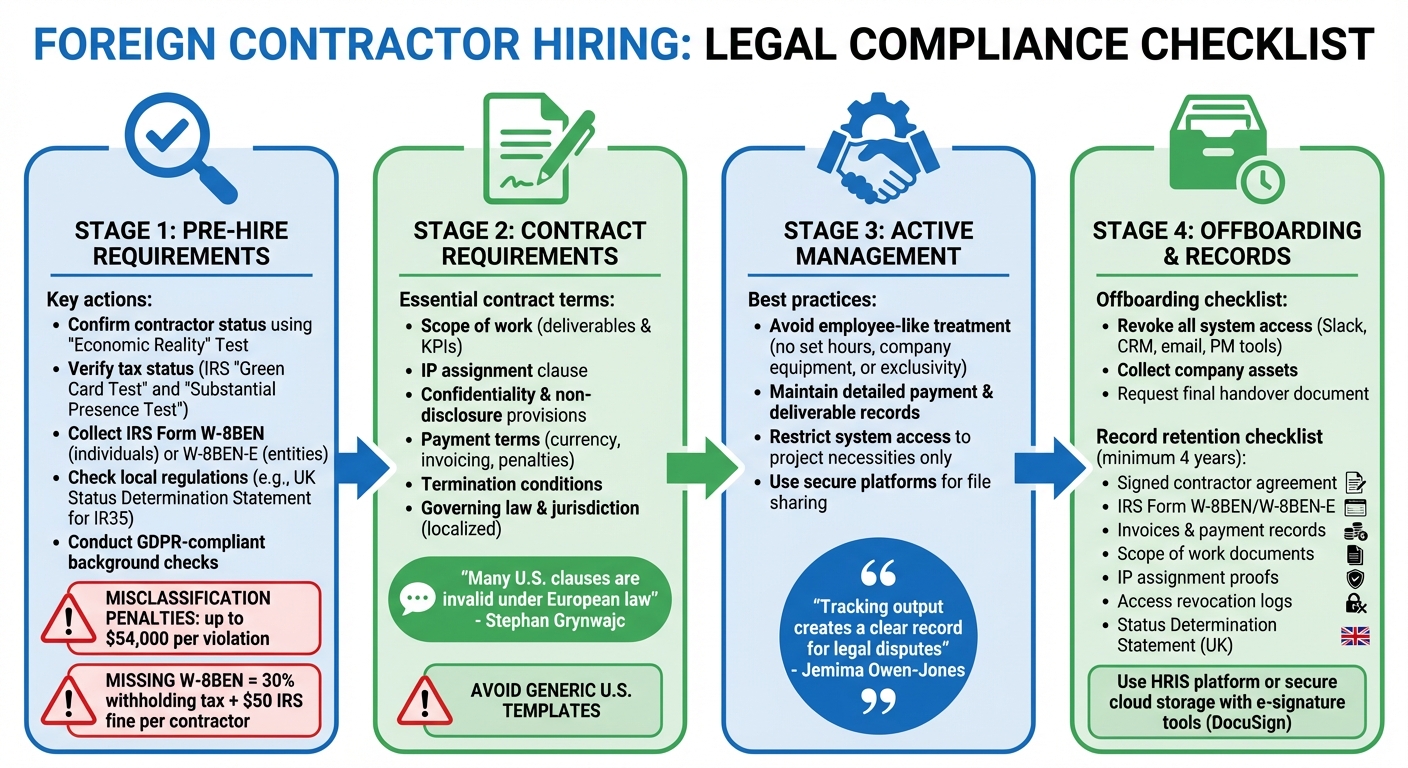
Foreign Contractor Hiring Compliance Checklist: Pre-Hire to Offboarding
Pre-Hire Requirements
Start by confirming the contractor's status using the "Economic Reality" Test, which evaluates control, financial independence, and integration. Misclassification penalties can reach $54,000 per violation in some regions, like Australia [5].
Next, verify tax status with the IRS "Green Card Test" and "Substantial Presence Test." Before issuing the first payment, collect the appropriate tax forms - IRS Form W-8BEN for individuals or W-8BEN-E for entities. This step prevents a 30% backup withholding tax and avoids IRS fines, which start at $50 per contractor [3][5][6].
Check local regulations in the contractor's home country. For example, UK-based contractors require a formal "Status Determination Statement" to comply with IR35 rules [2]. If conducting background checks, ensure compliance with local privacy laws, such as GDPR in Europe [2].
Contract Requirements and Key Terms
A well-drafted contract is essential. It should include:
- Scope of work: Clearly outline deliverables and time-sensitive KPIs to emphasize project-based work [4][6].
- IP assignment clause: Ensure all intellectual property rights are transferred to your company [5][6].
- Confidentiality and non-disclosure provisions: These should extend beyond the contract's duration [4][6].
- Payment terms: Specify currency, invoicing schedules (fixed-rate, milestone-based, or pay-as-you-go), and penalties for late payments [4][6].
- Termination conditions: Include notice periods and procedures for asset returns [4][6].
- Governing law and jurisdiction: Adapt these to reflect the contractor's local labor laws for enforceability [5][6].
"Many U.S. clauses in commercial contracts are either invalid or carry a completely different meaning under European law." - Stephan Grynwajc, International Lawyer [6]
Avoid using generic U.S. contract templates - they often fail to hold up in local courts [5][6].
Managing Active Contractor Relationships
Once the contract is in place, focus on managing the relationship to minimize risks of misclassification and compliance issues.
Avoid treating contractors like employees: refrain from setting specific working hours, providing company-owned equipment, or requiring exclusivity - unless you're using an Employer of Record model [3][5]. Maintain detailed records of payments and deliverables to ensure a clear audit trail [4][6][9].
"Tracking a contractor's output lets you check they're meeting expectations. It also creates a clear record in case questions arise later and you need to resolve a legal dispute." - Jemima Owen-Jones, Content Manager, Deel [4]
Protect intellectual property by restricting system access to only what's necessary for the project. Use secure platforms for file sharing and communication [2][6].
Offboarding and Record Retention
When the contractor's work ends, a thorough offboarding process ensures compliance and safeguards your company.
Offboarding Checklist:
- Revoke access to all internal systems (e.g., Slack, CRM, email, project management tools) [6].
- Collect any company-provided assets [6].
- Request a final handover document detailing all deliverables, code repositories, and work products [6].
Record Retention (minimum of 4 years from contract start):
- Signed contractor agreement [2][4].
- IRS Form W-8BEN or W-8BEN-E [4].
- Invoices and payment records [4][6].
- Scope of work documents [4].
- IP assignment proofs [2][6].
- Access revocation logs [6].
- Status Determination Statement (for UK contractors) [2].
"From the moment the contract begins, you must store these documents [Form W-9 or W-8BEN] for at least four years." - Jemima Owen-Jones, Content Manager, Deel [4]
Keep these records in a centralized system, like an HRIS platform or secure cloud storage. Use e-signature tools like DocuSign to create a strong legal audit trail [2][6][9]. Proper documentation is your best defense if authorities question the contractor's classification years later.
How to Evaluate Foreign Contractor Hiring Options
Budget and Time-to-Hire Analysis
When considering foreign contractors, your costs will hinge on three main factors: the contractor's hourly rate, the region they’re located in, and the compliance model you choose. While hiring contractors often saves money compared to full-time employees, the actual expenses depend on how you structure the arrangement and handle compliance requirements.
Regional Cost Benchmarks (2026):
| Region | Average Hourly Rate (Mid-Level Role) | Time-to-Hire |
|---|---|---|
| North America (US/Canada) | $50–$100 | 3–5 weeks |
| Latin America (Mexico, Brazil, Argentina) | $25–$50 | 4–6 weeks |
| Eastern Europe (Poland, Romania, Ukraine) | $30–$60 | 4–7 weeks |
For example, hiring in North America typically costs $50–$100/hour with a hiring timeline of 3–5 weeks. Meanwhile, Latin America and Eastern Europe offer more affordable rates but often require longer hiring cycles, especially when compliance procedures extend onboarding. The complexity of the role also plays a significant part - specialized positions like senior engineers or finance managers usually take additional time to source and vet. If speed is a priority, be prepared to pay higher rates or work with a smaller candidate pool.
Once you’ve factored in costs and timelines, it’s essential to assess how these intersect with compliance risks.
Compliance Risk Assessment
Managing compliance is critical when hiring foreign contractors, as misclassification risks can lead to penalties like backdated benefits or payroll taxes. For a deeper dive into these risks, refer to the earlier section.
Another key consideration is Permanent Establishment (PE) risk. If a contractor acts as your representative - signing contracts, working exclusively for your company, or conducting business on your behalf in their home country - you might be liable for corporate taxes in that jurisdiction [9][2]. This is especially relevant in regions like the UK, where IR35 regulations require a formal "Status Determination Statement" to confirm contractor status [9][2].
To mitigate these risks, ensure your contracts align with the contractor’s local laws and collect IRS Form W-8BEN before issuing any payments. If managing these legalities internally feels overwhelming, consider using a CoR (Contractor of Record) or EOR (Employer of Record) model to transfer the compliance burden to a professional provider [2][6].
Balancing these legal considerations with financial efficiency is crucial for making an informed hiring decision.
Management Capacity and Team Readiness
Your team’s ability to onboard, manage, and support remote contractors plays a significant role in the success of your hiring strategy. This includes creating thorough project briefs, setting clear KPIs, and maintaining consistent communication [9]. Companies with well-established onboarding processes for global talent often see productivity gains of over 70% [6].
"Great onboarding for global contractors goes beyond logistics. It is about clarity, connection, and culture."
- Eunice Victoria, Executive Career Coach [6]
Time zone alignment is another critical factor. Teams that prioritize overlapping work hours report up to a 40% improvement in collaboration efficiency [6]. Even 2–3 hours of overlap can help prevent delays and maintain team cohesion [2]. For example, if your team operates on East Coast hours and hires in Eastern Europe, real-time communication may be limited.
Additionally, having the right technical infrastructure is non-negotiable. This includes secure access to internal systems like CRMs, Slack, and project management tools, as well as robust security protocols to protect sensitive data [9][2].
2026 Cost Breakdown for Foreign Contractors
Cost Comparison by Region
When planning for foreign contractor expenses in 2026, it's essential to understand both base rates and additional costs tied to compliance and taxes.
Hourly rates for contractors vary widely depending on the region. For mid-level roles, North American contractors charge between $50–$100 per hour, while Latin American contractors typically range from $25–$50 per hour, and Eastern European contractors fall in the $30–$60 per hour range. Keep in mind, these base rates are subject to increases due to taxes and compliance requirements.
Tax obligations can add complexity. For instance, failing to provide IRS Form W-8BEN results in a 30% withholding tax in the U.S. India enforces a 10% Tax Deducted at Source (TDS) on professional services, which doubles to 20% if a contractor lacks a Permanent Account Number (PAN) [3]. Saudi Arabia applies a 15% withholding tax for non-resident services, while Egypt charges 10% for companies and 20% for individuals [3].
| Region | Mid-Level Hourly Rate | Key Tax/Statutory Considerations |
|---|---|---|
| North America | $50–$100 | 30% U.S. withholding without W-8BEN [3] |
| Latin America | $25–$50 | Local VAT/GST may apply (e.g., 5% UAE, 18% India) [3] |
| Eastern Europe | $30–$60 | GDPR compliance costs; tax treaties may reduce withholding [3][9] |
One notable advantage of hiring contractors is the savings on full-time employee benefits like social security, unemployment insurance, and workers' compensation. This can equate to approximately $13.20 per hour in savings [4]. However, there’s always a risk of misclassification, which can lead to costly penalties.
What Affects Total Hiring Costs
Regional differences are just one piece of the puzzle - several other factors play a role in determining the total cost of hiring contractors.
Specialized roles such as senior engineers or finance managers often come with higher hourly rates. However, these professionals usually require less training and oversight, which can offset some of the upfront expense [9][4]. Additionally, contractors who are available to start immediately tend to charge premium rates compared to those with longer notice periods [4].
Investing in compliance tools is another way to manage costs effectively. Services like a Contractor of Record (CoR) or Employer of Record (EOR) can save companies anywhere from $100,000 to $200,000 annually by automating compliance, managing tax forms, and streamlining payment processes [7]. These platforms also help with localized contracts and reduce the risk of non-compliance penalties.
Project duration also impacts costs. For short-term projects (under six months), direct hiring models are often more cost-efficient. On the other hand, long-term projects benefit from a more robust compliance framework to avoid risks like permanent establishment taxes, where your company could become liable for corporate taxes in the contractor's home country [2][3]. For engagements lasting over 12 months, consider the added expense of legal reviews or the potential advantages of transitioning to an EOR model.
Payment methods can further influence your budget. Traditional bank wire transfers often come with poor exchange rates and high fees, adding an extra 3–5% to your total costs [8][2]. Platforms like Wise offer mid-market exchange rates and simplify administration by generating compliant invoices that integrate with accounting software. Paying contractors in their local currency not only shields them from exchange rate fluctuations but also avoids unfair conversion fees [2][6].
This comprehensive breakdown helps decision-makers navigate the balance between cost efficiency and compliance, ensuring a strategic approach to hiring foreign contractors.
Why Use a Specialized Recruitment Agency in 2026
Risks of Managing Recruitment In-House
Handling global recruitment without specialized support can lead to serious operational and legal headaches. Did you know that 10% to 30% of employers misclassify their workers? This mistake has cost companies over $200 million in restitution for treating contractors as employees[6]. A glaring example: Uber’s 2016 settlement of $100 million to resolve misclassification claims in California and Massachusetts[1].
One of the biggest challenges stems from legal discrepancies. Standard U.S. contract templates often fail abroad. Why? Many clauses are either invalid or take on entirely different meanings under European laws. As international lawyer Stephan Grynwajc explains:
"Many U.S. clauses in commercial contracts are either invalid or carry a completely different meaning under European law"[6].
Beyond the legal pitfalls, time-to-hire becomes a logistical nightmare when global recruitment is managed in-house. Without access to pre-vetted talent pools or compliance automation, HR teams can spend weeks juggling background checks, verifying business registrations, managing cross-border payments, and collecting tax forms like W-8BEN. For lean HR teams, keeping up with document retention and payment processes across multiple countries can quickly spiral out of control[4][7]. These inefficiencies highlight why expert recruitment solutions are essential.
How RemotelyTalents.com Reduces Hiring Risk

Specialized recruitment agencies like RemotelyTalents.com tackle these challenges head-on by leveraging proven legal and operational systems. Their subscription-based model ensures compliance and accelerates the hiring process. With a database of over 10,000 pre-screened candidates across Europe, Latin America, and North America, they achieve an average time-to-hire of just 5–7 weeks.
Here’s how their pricing works:
- 12-Month Partner Plan: $1,000/month
- On-Demand Plan: $1,450/month (cancel anytime, up to 2 months per project)
Both options include a dedicated senior recruiter, an account manager, weekly Slack updates, and a 90-day replacement guarantee. Within two weeks of engagement, clients receive 3–4 qualified candidates, all with C1+ English proficiency.
With over a decade of experience, RemotelyTalents.com has helped more than 250 companies fill roles in Marketing & eCommerce, IT/Data/Engineering, Operations & VAs, and Finance & Accounting. Their deep regional knowledge ensures that contracts are tailored to meet each country’s labor laws, tax rules, and IP protections. This eliminates the risks of relying on faulty U.S. templates in foreign markets.
Conclusion
Key Compliance Takeaways
When hiring foreign contractors in 2026, keeping compliance front and center is non-negotiable. Here’s what you need to know:
Worker classification should be your top priority. If you’re dictating a contractor’s hours, tools, or methods, you may have a misclassified employee on your hands. Misclassification can result in hefty penalties - some employers have faced liabilities exceeding $200 million.
Tax documentation is another critical step. Always collect IRS Form W-8BEN or W-8BEN-E before making the first payment. These forms certify non-US taxpayer status, help you avoid the 30% withholding tax, and simplify compliance for at least three years.
Written agreements are your legal safety net. Contracts should include localized clauses covering intellectual property rights, confidentiality, scope of work, and governing law. International lawyer Stephan Grynwajc highlights the risks of using generic US templates abroad:
"Many U.S. clauses in commercial contracts are either invalid or carry a completely different meaning under European law."
To protect your business, use contracts tailored to the contractor’s home country. This ensures they’re enforceable and aligned with local regulations.
By focusing on these compliance strategies, you can reduce risks tied to taxes, intellectual property, and worker misclassification while confidently hiring global talent.
Your Next Steps
Start by reviewing your current contractor relationships. Leverage tools like the IRS "economic reality" test or the UK's CEST tool to confirm proper worker classification. For new hires, follow a structured process: verify tax forms, secure IP rights through written agreements, and stick to traceable, business-grade payment platforms.
If managing compliance feels overwhelming, consider outsourcing the process. Platforms like RemotelyTalents.com can simplify global hiring. With a database of over 10,000 pre-vetted candidates across Europe, Latin America, and North America, they deliver 3–4 qualified candidates within two weeks. Most positions are filled in 5–7 weeks. Starting at $1,000/month, their plans include a 90-day replacement guarantee, a senior recruiter, and weekly Slack updates - taking the hassle out of international recruitment.
Take the first step by requesting a contractor compliance review today and secure your global hiring process.
FAQs
How do I know if my foreign contractor should be treated as an employee?
When working with foreign contractors, there’s a chance they might be classified as employees if authorities see too much employer control in the relationship. Three key areas come under scrutiny: behavioral control, financial arrangements, and the overall nature of the working relationship. If these factors lean more toward an employer-employee setup rather than a genuinely independent contractor arrangement, the risk of misclassification increases.
What tax forms do I need before paying a non-U.S. contractor?
Before making payments to a non-U.S. contractor, U.S. companies generally aren't required to issue Form 1099. This applies unless the contractor is a U.S. tax resident or completed work within the United States. Instead, businesses should gather the correct tax documentation, such as W-8BEN or W-8BEN-E, to verify the contractor's foreign status and comply with tax laws.
When does hiring a contractor create permanent establishment risk?
Hiring a contractor might lead to permanent establishment risk if their activities align with certain business operations. For instance, if they maintain a fixed place of business, negotiate or sign contracts, or take on essential operational tasks, this risk becomes more likely. The danger grows if they work in a foreign country for an extended period, especially over 183 days in a year. To stay compliant, it’s crucial to understand local tax regulations and structure contractor agreements thoughtfully to steer clear of triggering this issue.
Related Blog Posts
Read also



Ready to hire without salary-based agency fees?
Book a free 30-minute consultation. We’ll review your role, timeline, and hiring goals, then show you how our fixed-fee remote search works.