Contractor Termination Letter Pack (With Jurisdiction Notes)


When ending a contractor relationship, you need a structured process to avoid legal issues, misclassification risks, and operational disruptions. This guide covers everything you need to know, including:
- Why proper termination matters: Missteps can lead to tax penalties, lawsuits, or reputational damage. For example, Brazil's labor laws and the UK's IR35 regulations make compliance critical.
- Key steps: Draft clear termination letters, follow notice periods, revoke system access, and settle payments promptly.
- Legal considerations by region: U.S., Latin America, and Europe have specific rules to follow, especially to avoid misclassification.
- Templates and tools: Includes termination letter templates, offboarding checklists, and decision scorecards to streamline the process.
- Replacement options: Services like RemotelyTalents.com can help you find pre-vetted contractors within 5–7 weeks.
How to Write Contractor Termination Letters
Required Components of Every Termination Letter
When drafting a contractor termination letter, it’s essential to include specific details to ensure clarity and safeguard your company. Start by listing the full names of both parties, your company name, the relevant contract or project number, the effective termination date, and the date the notice is issued.
Clearly state the reason for termination using factual, neutral language. Whether the contract is ending due to project completion, a breach of contract, or termination for convenience, avoid emotional or opinionated statements. Be sure to reference the notice period outlined in the contract - commonly 10–14 days, though some agreements may require 30 days or more. Neglecting this notice period could lead to breach-of-contract claims.
"Stick to the facts. A termination letter should provide a straightforward reason for separation… This letter should not have any emotions, opinions or apologies."
- Merrick Dresnin, HR Consultant
Address any outstanding payments, including final invoices, payment methods, and deadlines. Specify any company property that must be returned, such as laptops, keycards, or proprietary materials, and provide clear return instructions. Remind the contractor of any post-termination obligations, like confidentiality clauses, non-disclosure agreements, or non-compete terms. Lastly, include contact information for follow-up questions and a way for the contractor to acknowledge receipt of the notice, such as a signature or electronic confirmation.
A 2022 case in California highlighted the risks of vague language in termination letters. In this instance, a statement encouraging an employee to "focus on her health" was interpreted as discriminatory under the Americans with Disabilities Act, leading to an Equal Employment Opportunity Commission (EEOC) investigation. This underscores the importance of precise, neutral wording.
Next, consider how to tailor your termination letters to different scenarios.
Termination Letter Templates by Scenario
Once the required elements are in place, adapt your letter to fit the specific circumstances of the termination.
For poor performance, use the DESC framework (Describe, Explain, Specify, Consequences) to outline the issues. Be detailed about unmet deliverables, include dates when feedback was provided, and reference the contractual standards that were not met. Keep the tone professional and objective.
For project completion, acknowledge the contractor’s contributions and confirm the natural conclusion of the engagement. This approach helps maintain a positive relationship and leaves the door open for future collaborations. Be sure to outline final deliverables, schedule any necessary knowledge transfer sessions, and include a timeline for revoking system access.
In cases of breach of contract, cite the specific violation and reference the relevant clause in the agreement. For severe breaches, such as misconduct or fraud, immediate termination may be justified without the usual notice period. Use formal legal language to ensure clarity.
Mutual termination letters should outline the agreed-upon terms, focusing on final payments, property returns, and transition arrangements, without assigning fault to either party.
For regional considerations, keep in mind that U.S. contractors require attention to IRS control tests to avoid misclassification. In 18 U.S. states, specific written forms are required at the end of a contractor’s engagement. In Latin America, avoid language that implies an employer–employee relationship to mitigate "permanent establishment" risks. For European contractors, additional notice or payment requirements may apply, particularly for those classified as "dependent contractors."
Each template is designed to uphold professionalism while protecting your company from potential legal complications.
Legal Requirements by Region
Tailor your termination letter to meet the legal standards of the contractor’s jurisdiction by adjusting the language and notice terms accordingly.
In the United States, it’s crucial to maintain the contractor’s "at-will" status and ensure the termination process doesn’t inadvertently trigger IRS employee classification tests. Document any performance issues, missed milestones, or contract breaches to justify the termination.
In Latin America, the risk of misclassification is higher. For example, Brazil’s Labor Code (Article 3, CLT) allows contractors with exclusivity and close supervision to claim employee status, potentially entitling them to full benefits and severance. To avoid this, emphasize the independent nature of the relationship in the termination letter and steer clear of language that suggests traditional employment.
In Europe, navigating "dependent contractor" rules requires careful attention. For instance, the UK’s IR35 legislation scrutinizes contractor relationships, with non-compliance potentially leading to tax penalties. Additionally, some European countries mandate specific notice periods or payments for contractors who derive most of their income from a single client.
"A well-crafted contractor termination letter ensures both parties understand the termination terms, maintains a positive company reputation, and minimizes legal risks."
- Manasa Manogaran, Remote.com
When dealing with international contractors, confirm the local tax documentation requirements before finalizing the termination. Consulting an Employer of Record (EOR) or local legal counsel is highly recommended, especially for contractors in Europe and Latin America. Even without a formal written contract, providing written notice with clear improvement deadlines can establish a "good faith" record, reducing legal risks and ensuring compliance. These steps align with the broader goal of managing contractor terminations responsibly and effectively.
sbb-itb-88a7fe6
Decision Framework: When to Terminate a Contractor
Assessing Performance and Role Fit
Start by evaluating whether the contractor's performance aligns with the project's needs. Look at deliverables, milestones, and any key indicators outlined in the scope of work. For example, assess whether contractual obligations - like meeting deadlines, maintaining quality standards, and adhering to confidentiality agreements - are being fulfilled [4][6].
Communication issues often point to deeper problems. In fact, nearly 47% of companies cite poor communication as the biggest challenge when working with contractors [8]. Warning signs include unresponsiveness, recurring revision requests, or a general lack of engagement. Also, consider the contractor's ability to operate independently. If they require constant supervision, it could signal a poor fit or even raise concerns about misclassification [7].
Sometimes, issues can be resolved mid-project. Roughly 60% of contractor conflicts are fixable through early intervention and structured feedback [8]. Keep detailed records of any performance problems, missed deadlines, or policy violations. This documentation not only protects you legally but also helps you decide whether the relationship can be salvaged.
Once you've assessed performance and role fit, it's essential to weigh the financial implications of termination.
Calculating the Cost Impact
Ending a contractor's agreement isn't just about performance - it's also a financial decision. Compare the remaining value of the contract with the potential costs of hiring a replacement, which can often surpass the original agreement [9][10]. Don’t forget to account for direct exit costs, including final payments, notice period compensation, and any early termination fees [2][4].
"Hiring a replacement subcontractor to complete unfinished work... may cause disruption to the project schedule and other challenges... completing the subcontractor's scope of work may require costs above and beyond the value of the subcontract."
Indirect costs can add up quickly. These might include knowledge transfer sessions, management time spent on offboarding and onboarding, revoking system access, and project delays that could lead to liquidated damages [2][9][10]. If the termination is later deemed wrongful, you might face liability for the contractor’s actual costs, overhead, and even lost profits [9][10]. In some situations, addressing performance issues through supplemental work or overtime may cost less than terminating and replacing the contractor [9][10].
To make an informed decision, create a financial comparison. Include procurement costs for a new vendor, potential higher rates, mobilization fees, and risks of service gaps. Separate corrective work from new scope to strengthen your position if legal action arises [10].
Here’s a breakdown of key financial factors:
| Cost Category | Potential Financial Impact Factors |
|---|---|
| Direct Exit Costs | Final payments, notice period pay, termination fees, dispute settlements. |
| Replacement Costs | Procurement/bidding costs, higher vendor rates, mobilization fees. |
| Project/Schedule Costs | Liquidated damages, expedited shipping/labor, lost revenue from delays. |
| Legal/Compliance | Attorney fees, misclassification penalties, wrongful termination damages. |
| Operational Costs | Knowledge transfer, management overhead, system re-provisioning. |
But finances aren’t the only consideration - legal and compliance risks are equally important.
Managing Legal and Compliance Risk
Legal risks can vary widely depending on the jurisdiction. Start by conducting a misclassification audit. If you’ve exercised too much control over the contractor or offered employee-like benefits, you could face penalties for misclassification [2][3][4]. Misunderstanding the legal distinctions between contractors and employees is the root cause of nearly 60% of disputes involving contractor agreements [2].
Check the contract for notice period requirements to avoid breaching the agreement [4][5]. Some jurisdictions have specific rules on notice periods or may even require severance-like payments for long-term contractors [3][4]. If you're dealing with international contractors, consult an Employer of Record or local legal counsel to ensure compliance with regional labor laws [4][5].
Keep detailed documentation of the reasons for termination. Even in at-will arrangements, records of performance issues, missed deadlines, or contract breaches - like NDA violations - are essential to reduce litigation risks [2][3][4]. Always issue a formal written termination letter, even if the contractor has already been informed verbally. This creates an official record and should be coordinated with immediate actions like revoking system access and providing clear instructions for returning company property to safeguard intellectual property [2][5].
How To Write Contract Termination Letter with Sample and Explanation | Writing Tutorials
Remote Contractor Offboarding: Process and Common Errors
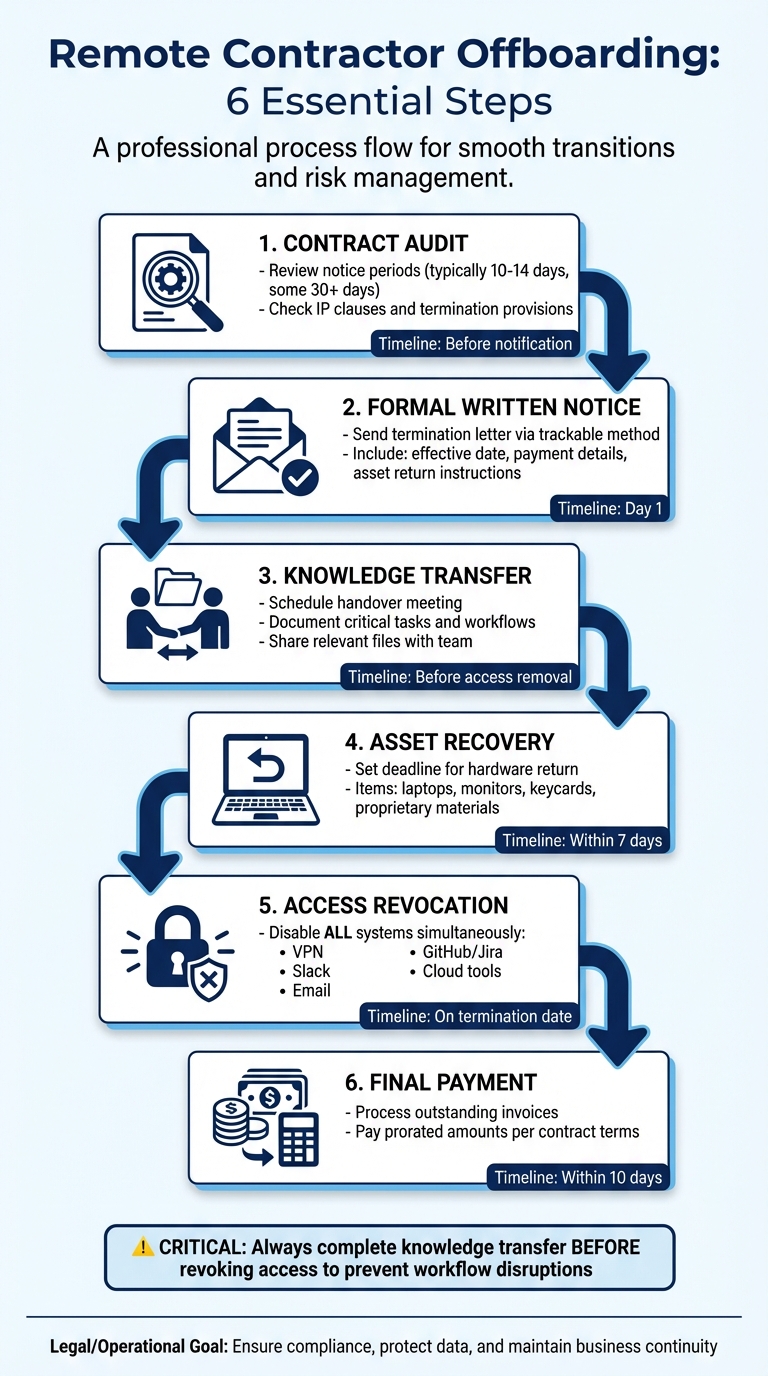
Step-by-Step Remote Contractor Offboarding Process Checklist
Step-by-Step Offboarding Process
A structured offboarding process for remote contractors is essential to safeguard your business and maintain professionalism. Start by reviewing the original contract to understand notice period requirements - most contracts specify 10–14 days, though some may extend to 30 days or more [4]. Adhering to these timelines is critical to avoid breach of contract claims.
Send a formal termination letter through email with a read receipt or certified mail for international contractors [1]. This written notice serves as a verifiable record, ensuring you meet your contractual obligations. The letter should include the effective termination date, details about final payments, and reminders about confidentiality and intellectual property clauses [1][5].
Plan access revocation to coincide with the termination date. Disable access to systems like VPNs, Slack, email, and cloud tools (e.g., GitHub or Jira) [1][2]. Delays in this step can leave your company vulnerable to data security risks.
Before access is revoked, schedule a knowledge transfer session. Ask the contractor to document their work, share relevant files, and brief team members on critical tasks [2]. This helps prevent operational disruptions and ensures a smooth transition. Finally, settle all outstanding invoices and pro-rated payments according to the contract terms to avoid disputes [1][5].
| Offboarding Step | Key Actions | Legal/Operational Goal |
|---|---|---|
| Contract Audit | Review notice periods and IP clauses | Avoid breach of contract claims |
| Written Notice | Send a formal termination letter via trackable methods | Create a legal record of termination |
| Asset Recovery | Arrange for the return of company hardware | Protect company-owned property |
| Access Revocation | Disable VPN, Slack, and other accounts | Safeguard sensitive data |
| Final Settlement | Process invoices and pro-rated payments | Prevent compensation disputes |
| Knowledge Transfer | Conduct documentation and handover meetings | Ensure business continuity |
These steps are designed to balance compliance and operational needs, reducing the risk of legal issues. The next section delves into common mistakes that can lead to complications.
Mistakes That Create Legal Exposure
Avoiding common errors is critical for minimizing risks during contractor termination. One major misstep is treating the process too casually. Always issue a formal termination letter, even if you’ve had verbal discussions, to ensure there’s a clear written record of compliance with contract terms.
Use precise and documented language to prevent misunderstandings about work dates, deliverables, and payment obligations [5][4][2][3]. For example, clearly state the termination date and payment details so both parties are aligned. Many companies fail to document performance issues as they occur, leaving them without evidence when justifying termination. Maintaining a detailed record of missed deadlines, quality concerns, and communication issues is essential. Misclassification claims are common, with nearly 60% of contractor agreement disputes stemming from confusion about the distinction between contractors and employees [2]. Without proper documentation, you risk facing these claims.
Jurisdictional requirements are another area where mistakes can become costly. For instance, in the UK, long-term contractors may acquire employment rights under IR35 legislation. Similarly, in Brazil, contractors working under supervision with regular payments may claim misclassification under Article 3 of the Labor Code (CLT) [1]. When dealing with international contractors, consulting an Employer of Record or local legal experts is key to staying compliant with local laws.
Termination Approach by Company Size
The size of your company often dictates the level of formality and resources available for contractor offboarding.
Startups typically lack formal processes or legal resources. Informal methods like Slack messages or verbal conversations can leave gaps in documentation. At a minimum, use a simple termination letter template and maintain a spreadsheet to track notice periods, final payments, and access revocation dates.
Small businesses (10–50 employees) may have more structure but often struggle with consistency. Assigning an operations manager or HR generalist to oversee the offboarding process can help. A standard checklist covering contract review, formal notification, asset recovery, access revocation, and payment processing ensures no steps are missed.
Mid-market companies (50–250 employees) should adopt formal contractor management systems to handle compliance across multiple jurisdictions. Managing dozens of contractors manually becomes inefficient at this scale. Partnering with an Employer of Record for international contractors or using a specialized recruitment agency like RemotelyTalents.com can streamline processes. Their team can assist with jurisdiction-specific compliance and documentation throughout the contractor lifecycle.
No matter your company’s size, the key is treating contractor termination as a formal business process. Standardizing this approach protects your organization from legal risks and operational challenges.
Contractor Termination Tools and Templates
These tools and templates are designed to simplify contractor termination while ensuring compliance and efficiency throughout the process.
Complete Offboarding Checklist
An offboarding checklist helps you manage all the necessary steps when ending a contractor relationship. Start by reviewing the contract to confirm notice periods - these are often 10–14 days but can extend to 30 days or more - and examine termination clauses before proceeding [4]. Then, send a formal termination letter via email with a read receipt or certified mail. The letter should include the effective termination date, details about final payments, and instructions for returning company property [4] [5].
On the termination date, revoke access to all company systems, including VPNs, Slack, email, GitHub, and Jira [2] [5]. Ensure knowledge transfer is completed before access is removed to avoid workflow disruptions [2]. Finally, process any outstanding invoices and prorated payments as specified in the contract to prevent disputes [4].
| Checklist Item | Key Actions | Timeline |
|---|---|---|
| Contract Audit | Review notice periods, IP clauses, and termination provisions | Before notification |
| Formal Letter | Send via trackable method with effective date, payment details, and asset return instructions | Day 1 |
| Asset Recovery | Set deadline for hardware return (laptops, monitors) | Within 7 days |
| Access Removal | Disable access to all company systems simultaneously | Termination date |
| Knowledge Transfer | Schedule handover meeting and document critical tasks | Before access removal |
| Final Payment | Process outstanding invoices per contract terms | Within 10 days |
Termination Decision Scorecard
A decision scorecard provides a structured way to evaluate whether terminating a contractor is the best course of action or if issues could be resolved mid-project. Research shows that nearly 60% of contractor conflicts can be addressed through early intervention [2].
The scorecard should assess key factors such as performance (missed deadlines, deliverable quality, revision frequency), communication (responsiveness, clarity, proactive updates), cost implications (replacement expenses, project delays, knowledge transfer time), and compliance risks (contract adherence, documentation quality, potential legal exposure) [2]. As poor communication is a leading issue for 47% of companies [2], it should carry significant weight in the evaluation.
To support your decision, document evidence like performance reviews and email records to establish clear grounds for termination and reduce the risk of contract disputes [2] [3]. Before finalizing, double-check the original agreement for notice requirements and specific termination clauses [4]. This scorecard provides a fact-based framework to guide your decision while staying aligned with contractual obligations.
How RemotelyTalents.com Helps Replace Contractors Fast

Replacing an underperforming contractor quickly requires both speed and precision. RemotelyTalents.com specializes in sourcing remote talent from Europe, Latin America, and North America with transparent pricing and defined timelines. Most placements are completed within 5 to 7 weeks, minimizing downtime and reducing compliance risks.
The On-Demand plan costs $1,450/month per open role, offering flexibility with no long-term commitment and a 90-day replacement guarantee. For ongoing hiring needs, the Partner plan costs $1,000/month (with a 12-month commitment) and provides continuous support for one active role at a time. Both plans include a dedicated senior recruiter, account manager, Slack communication, and weekly progress updates.
With a database of over 10,000 pre-screened candidates, RemotelyTalents.com focuses on roles in Marketing & eCommerce, IT/Data/Engineering, Operations & VAs, and Finance & Accounting. Their team of senior recruiters - each with over a decade of experience - delivers 3–4 qualified candidates within two weeks, ensuring a smooth transition after contractor termination.
Need help replacing a terminated contractor? Visit RemotelyTalents.com to find pre-vetted talent from Europe, LATAM, and North America in as little as 5 to 7 weeks - complete with transparent pricing and a 90-day replacement guarantee.
Conclusion
Key Takeaways
Terminating a contractor requires careful attention to formalities, clear communication, and strict adherence to the terms of your service agreement. Unlike employee separations, which are governed by labor laws, contractor relationships depend on the provisions outlined in the contract [11]. It’s essential to review termination clauses to confirm notice periods - commonly between 10 and 30 days - and ensure valid reasons for ending the partnership.
Always issue a formal, trackable termination letter, even if the termination was discussed verbally. This letter serves as legal documentation and should include the termination date, final payment details, and instructions for returning company property. On the termination date, revoke access to all company systems immediately after completing any necessary knowledge transfer.
Ensure all outstanding invoices are settled according to the contract terms. Attempting to dispute payments without legal guidance could expose your company to risks and prolong conflicts. Throughout the process, maintain a professional and factual tone to safeguard your brand’s reputation and reduce the chances of legal retaliation.
Recommended Next Steps
The key takeaways above provide a roadmap for immediate action.
Start by using the offboarding checklist and termination decision scorecard included in this guide. These tools will help you manage the process systematically while staying compliant. Document all performance issues, correspondence, and contract details to create a strong paper trail.
If you need to replace a contractor quickly, consider RemotelyTalents.com. They offer access to pre-vetted professionals from Europe, Latin America, and North America. With placements typically completed in 5–7 weeks, transparent pricing starting at $1,000/month, and a 90-day replacement guarantee, they provide a reliable solution to minimize downtime and keep your projects on track. Their recruiters specialize in remote talent in marketing, eCommerce, IT, finance & operations, ensuring you find the right talent fast.
Take these steps now to stay compliant, reduce risks, and maintain momentum in your projects.
Looking for top remote talent? Reach out to RemotelyTalents.com today to connect with skilled professionals, backed by transparent pricing, dedicated recruiters, and a 90-day replacement guarantee.
FAQs
Do I have to give a reason to terminate a contractor?
You don't have to give a reason when ending a contractor's agreement. However, providing one can promote professionalism, clear up any misunderstandings, and possibly lower legal risks, depending on the contract and local laws. Always check the terms of the agreement and seek legal advice if you're unsure.
How can I terminate an international contractor without risking misclassification?
When ending a contract with an international contractor, it's crucial to minimize the risk of misclassification. Start by strictly adhering to the terms outlined in the contract and ensure compliance with the specific laws of the contractor's jurisdiction. Clear and thorough documentation of the reasons for termination is equally important.
Be cautious in your communication - avoid any language that could inadvertently suggest an employer-employee relationship. Such implications can lead to legal issues. By keeping your documentation precise and following local legal requirements, you can reduce potential risks and ensure a smoother termination process.
What should I do first on the contractor’s last day to protect access and data?
On a contractor's final day, it's crucial to prioritize security by revoking their access to all company systems, accounts, and sensitive data. Acting quickly on this step helps safeguard your information and reduces potential risks.
Related Blog Posts
Read also



Ready to hire without salary-based agency fees?
Book a free 30-minute consultation. We’ll review your role, timeline, and hiring goals, then show you how our fixed-fee remote search works.