Best EOR Alternatives for Hiring Remote Contractors (2026)


By 2026, 73% of business owners expect to hire internationally, making it essential to choose the right hiring model. If you're focused on remote contractors, EORs may not be the most cost-effective option. This guide compares four alternatives for hiring remote contractors:
- Employer of Record (EOR): Best for full-time employees; costs $400–$650+ per month per worker; low compliance risks but slower onboarding.
- Contractor Management Platforms (CMPs): Affordable ($19–$49 per contractor/month); fast onboarding; moderate compliance risks.
- Staffing Agencies: Useful for sourcing talent; higher costs (15–25% of salary or 20–50% markup); compliance depends on the setup.
- Hybrid Global Payroll Tools: Combines EOR and contractor management; flexible pricing; fast for contractors, slower for EOR setups.
Quick Tip: For short-term projects, CMPs offer speed and affordability. For long-term roles, EORs or hybrid tools are better for compliance. Staffing agencies work well for sourcing pre-vetted candidates but are costlier.
| Model | Cost | Compliance Risk | Time-to-Hire | Management Overhead |
|---|---|---|---|---|
| Employer of Record (EOR) | $400–$650+/month | Very Low | Days to weeks | Very Low |
| Contractor Platforms (CMPs) | $19–$49/month | Moderate | Hours to days | Moderate |
| Staffing Agencies | 15–25% of salary/markup | Moderate to High | 2–4 weeks | Low |
| Hybrid Payroll Tools | $19–$650+/month | Low | Hours to weeks | Very Low |
Evaluate your needs based on cost, speed, and compliance to select the best hiring model for your business.

Comparison of 4 Remote Contractor Hiring Models: Cost, Compliance, Speed & Management
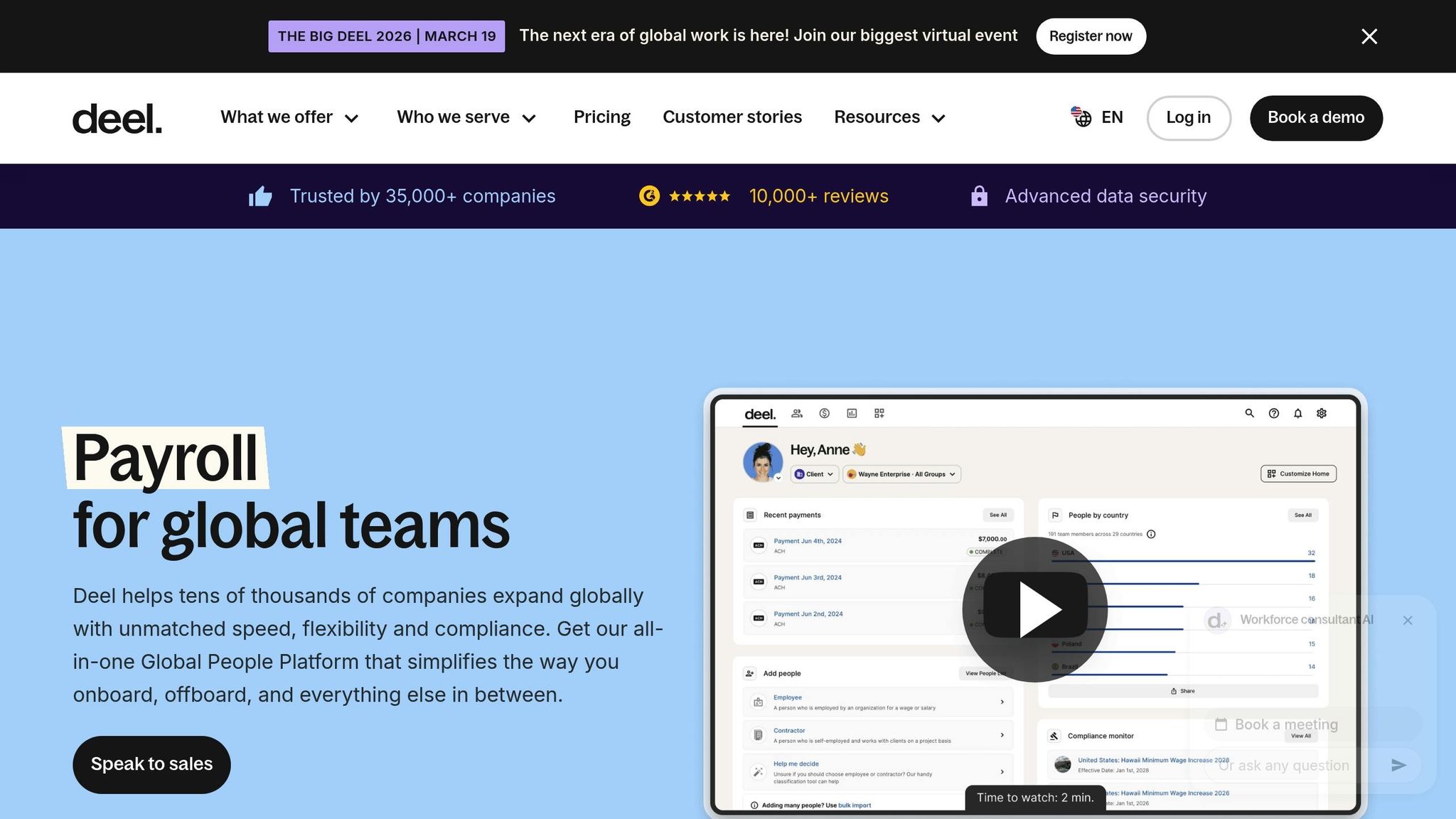
Best Global Payroll Tools for Startups in 2026 (Deel vs Remote)
sbb-itb-88a7fe6
1. Employer of Record (EOR)
An Employer of Record (EOR) serves as the official employer for your team, taking care of payroll, taxes, benefits, and compliance. While EORs are primarily geared toward full-time employees rather than contractors, knowing when to use one can help you avoid unnecessary costs or complications.
Cost per Hire
EOR services typically cost $199 to $650+ per employee per month, depending on the provider and region [1]. For example, conversion services start around $199, while established providers like Multiplier ($400), Oyster HR ($599), and Papaya Global ($650) charge higher fees [1]. Enterprise-level providers, such as Globalization Partners (G-P), often use custom pricing based on a percentage of the employee's salary [1].
In addition to the platform fee, you'll also cover local taxes, social security, and mandatory benefits required by the employee's country. These additional costs, referred to as "total cost of ownership", can add up quickly [5][6]. A real-world example: Pixis, a global AI tech firm, reported saving $100,000 to $200,000 annually by using an EOR, avoiding the need for an in-house compliance team [5][7].
"Deel gave us the confidence to manage compliance across multiple countries without the need to build a large compliance team. This streamlined approach saves us $100,000 to $200,000 annually." - Ajey Hare Prasath, Director of Global HR, Pixis [5]
Compliance Risk
EORs take on the legal responsibility for classifying workers correctly, reducing the risk of misclassification penalties [5][7]. Misclassification is more common than you might think - between 10% and 30% of employers misclassify workers, and some companies have faced fines exceeding $200 million for treating contractors as employees [6][2].
If your contractors have set hours, use company-provided tools, or maintain a long-term working relationship, they could be legally considered employees. In such cases, an EOR can convert them into compliant employees, avoiding potential back taxes or penalties [6][2].
Time-to-Hire
Onboarding employees through an EOR can take several weeks, as it involves creating localized employment contracts, setting up benefits, and handling legal paperwork [1]. This process is much slower compared to contractor onboarding, which can often be completed in just hours or days using automated platforms [1].
For example, Kintsugi, a hypergrowth startup, scaled to 90 employees across 13 countries with the help of an EOR. While this allowed them to grow without a large HR team, it did come with longer setup times compared to hiring contractors [5].
Management Overhead
EORs take care of all the administrative heavy lifting - contracts, tax filings, and benefits administration - significantly reducing the workload for lean teams [5][6]. This makes them a great option if you don't have in-house HR or legal resources. However, if you're hiring contractors for short-term projects where compliance risks are low, the higher costs and slower onboarding times of an EOR might not be worth it [5]. In these cases, a contractor-first approach may offer better speed and cost efficiency.
2. Contractor Management Platforms
Contractor management platforms (CMPs) provide a streamlined way to handle onboarding, contract creation, compliance documentation, and payments for independent contractors [5]. Unlike EORs, which act as the legal employer, CMPs cater to contractors who handle their own taxes and benefits, retaining full control over their work schedules and methods [5]. When choosing a CMP, it's important to weigh factors like cost, speed, compliance risk, and management overhead.
Cost per Hire
CMPs are generally more budget-friendly than EORs, with costs starting at $19 to $50 per contractor per month [5]. Some platforms, like Useme, charge per settlement instead [1]. For comparison, EOR services typically cost $199 to $650+ per employee monthly [1]. Choosing independent contractors over full-time employees can also lead to significant savings - around $13.20 per worker per hour on average - since you bypass expenses like social security contributions, health insurance, and retirement benefits [5][6].
Compliance Risk
One of the biggest compliance concerns with CMPs is worker misclassification. This happens when contractors are treated like employees, such as by assigning fixed hours, providing company equipment, or maintaining direct supervision [3][5]. To address this, modern CMPs use AI-powered tools to evaluate whether a role qualifies as contractor work under local laws [5][7]. They also simplify tax compliance by automating the collection of necessary forms like IRS Form W-9 or W-8BEN and ensuring invoices meet country-specific requirements [3][7].
Time-to-Hire
CMPs excel in speeding up the hiring process, often completing onboarding in just hours to days, as opposed to the weeks required for EOR setups [1]. Top background check services can scan over 200,000 databases across 190 countries in as little as 15 minutes [7]. For example, Cloud9 Esports used a CMP to efficiently hire and manage 223 contractors across 21 countries, streamlining their global payroll and administrative tasks [7]. Similarly, Chirpy, a U.S.-based company, leveraged a contractor platform to quickly onboard specialists in Europe for a high-value project worth over $500,000 [7]. For companies with tight deadlines, this kind of speed is a game-changer.
Management Overhead
CMPs are designed to lighten the administrative load by automating tasks like contract generation, invoice approvals, and bulk payments across different currencies [5][7]. This centralized system is particularly helpful for smaller teams without dedicated HR staff. For businesses focused on project-based or specialized work, CMPs strike a balance between efficiency and compliance [5].
3. Staffing Agencies
Staffing agencies focus on sourcing and placing talent, offering personalized candidate vetting while leaving the contractual and legal structuring up to you. Unlike platforms that automate contractor management, these agencies act as intermediaries - they find candidates, vet them, and present qualified prospects to your team. Once a candidate is placed, they can either work as a contractor or transition to a full-time employee through an Employer of Record (EOR) or your own business entity. This setup is particularly useful when you need help finding talent but want to maintain flexibility in how you structure employment relationships.
Cost per Hire
Staffing agencies typically charge a percentage of the hire's annual salary - usually 15%–25% for permanent hires or a 20%–50% markup for contractors. For example, hiring someone with a $60,000 annual salary could result in agency fees ranging from $9,000 to $15,000 upfront. However, for short-term or project-based needs, the full-service approach of a staffing agency can feel excessive and expensive. While the costs vary, one thing remains constant: compliance is still a key concern.
Compliance Risk
While staffing agencies simplify the process of finding talent, they don't automatically shield you from compliance risks. For instance, if you hire a contractor through an agency but start controlling their hours, providing company equipment, or closely supervising them, you could face worker misclassification issues - even with the agency's involvement [6][7]. Some agencies offer "Contractor of Record" services to help manage this risk by taking on legal responsibility. Beyond compliance, the speed at which candidates are delivered is another important consideration.
Time-to-Hire
Staffing agencies generally deliver candidates faster than building an in-house recruiting team, but they are slower than contractor-first platforms. It usually takes 2–4 weeks to receive candidates from a staffing agency. In contrast, platforms like Toptal or Upwork can place contractors within days for urgent needs [6]. Contractor management platforms can onboard candidates in hours to days, while full EOR setups often take several weeks [1]. Once candidates are sourced, the level of administrative support required varies significantly between models.
Management Overhead
While staffing agencies reduce the initial workload of sourcing and screening candidates, the ongoing management responsibilities depend on how the worker is engaged. If the hire is a contractor, you may need to handle invoicing, payments, and compliance monitoring - unless paired with a contractor platform. On the other hand, if the contractor transitions to an employee through an EOR, the EOR takes over payroll, taxes, and benefits administration. However, this adds another layer of cost, as you’ll pay both the agency’s placement fee and the EOR’s monthly subscription [1]. For teams lacking dedicated HR support, this model can introduce additional operational challenges.
4. Hybrid Global Payroll Tools
Hybrid global payroll tools merge contractor management and Employer of Record (EOR) services into a single platform. Unlike traditional EOR models that primarily handle full-time employees, these tools allow you to manage independent contractors and EOR employees simultaneously. This setup provides the flexibility to start with cost-effective contractor arrangements and transition workers to EOR status as roles evolve or when misclassification risks increase. The platform also consolidates workforce data, making management more straightforward.
Cost per Hire
Hybrid platforms offer flexible pricing by combining contractor and EOR services. For contractors, plans typically begin at $19 per contractor per month [5], while EOR services range from $400 to $650+ per employee per month [1]. For example, if you hire five contractors and two full-time employees, your monthly costs would be around $95 for contractors and between $800 and $1,300 for EOR employees, totaling approximately $895 to $1,395 per month.
Compliance Risk
These platforms help reduce misclassification risks using AI-powered tools that assess whether a contractor should be reclassified as an employee based on local labor laws [3][5]. They also automate processes like collecting tax forms (e.g., W-8BEN, W-9), provide localized contract templates updated by in-house legal teams, and continuously track changes in labor laws across jurisdictions. Some providers even offer "Contractor of Record" (CoR) services, taking on the legal responsibility for worker classification and minimizing financial risks for your company [5][7]. Given that companies have faced over $200 million in penalties for worker misclassification [6], this added protection is a significant advantage.
Time-to-Hire
Hybrid platforms can onboard contractors in just minutes or hours, while transitioning to EOR status may take several weeks due to local legal requirements [1][4]. This speed makes hybrid tools particularly useful when you need to fill positions quickly but want the option to formalize employment later. Jeff Gibson, founder of Kintsugi, shared:
"Deel was our secret weapon; it made what would normally be an unthinkable administrative burden for a founder completely manageable" [5].
In addition to fast onboarding, these platforms simplify other administrative tasks, saving valuable time.
Management Overhead
Hybrid tools dramatically reduce administrative workload by automating key tasks like contract creation, onboarding, bulk payments, and expense tracking [3][5]. Contractors can use self-service portals to handle documents and payments, cutting down on back-and-forth communication with internal teams. A unified dashboard provides a centralized view of both contractor and employee data, while AI agents can automate up to 70% of routine HR, finance, and compliance tasks [4]. This allows your team to focus on strategic projects instead of getting bogged down in paperwork.
Advantages and Disadvantages by Model
Below is a side-by-side comparison of various hiring models, highlighting their core attributes such as cost, compliance risks, time-to-hire, and management overhead.
| Model | Cost | Compliance Risk | Time-to-Hire | Management Overhead |
|---|---|---|---|---|
| Employer of Record (EOR) | High ($400–$650+ per employee/month) | Very Low – The provider assumes legal employer liability | Moderate – Days to weeks for onboarding | Very Low – Payroll, taxes, and benefits are fully outsourced |
| Contractor Management Platforms | Low ($19–$49 per contractor/month) | Moderate – Misclassification risk remains with the hiring company | Very Fast – Hours to days | Moderate – You manage day-to-day work and monitor classifications |
| Staffing Agencies | Variable – Markup or recruitment fees add on | Moderate to High – Depends on whether the agency uses an EOR backend | Fast – Pre-vetted candidates reduce search time | Low – The agency handles sourcing and vetting |
| Hybrid Global Payroll Tools | Modular – Combination pricing (e.g., $19 per contractor plus $400–$650 per EOR employee) | Low – Uses AI-powered classification tools and contractor-of-record options | Fast to Moderate – Hours for contractors; days to weeks for EOR onboarding | Very Low – A unified dashboard can automate up to 70% of HR and finance tasks |
This breakdown connects cost, compliance, hiring speed, and management overhead, offering a clear framework for deciding on the best hiring model.
Choosing an EOR model eliminates the risk of worker misclassification entirely. However, this comes with the highest cost per worker. It's a strong option for businesses seeking long-term hires in employee-like roles without the need to establish a legal entity abroad.
Contractor platforms stand out for their speed and affordability. They allow you to onboard workers in a matter of hours or days at a low monthly cost. But the responsibility for proper worker classification stays with you. If a contractor's role starts resembling that of an employee - such as adhering to set hours or using company-provided tools - you could face severe penalties, including back wages and fines.
Staffing agencies are ideal for reducing internal recruiting efforts. They handle sourcing and vetting candidates, saving time. If the agency uses an EOR backend, you gain added compliance protection. However, keep in mind that this approach combines both agency fees and EOR costs.
Hybrid tools offer a customizable solution, blending contractor and EOR models. They allow you to start with contractors and transition to an EOR setup as your needs grow. These tools also streamline HR and finance tasks through a unified dashboard, making them particularly appealing for mid-sized teams juggling diverse roles.
This comparison highlights the trade-offs of each model, helping you align your hiring strategy with your business goals and priorities.
Conclusion
Picking the right hiring model comes down to your budget, timeline, and risk tolerance. If you’re looking for long-term roles with no risk of worker misclassification, an EOR (Employer of Record) is your best bet. For short-term projects or specialized contractors, contractor management platforms offer quick onboarding - often within hours - and affordable pricing, typically around $19 to $49 per contractor per month. Staffing agencies can save you time by delivering pre-vetted candidates but come with higher costs due to markups. Meanwhile, hybrid tools provide the flexibility to manage both contractors and employees in one system, making them ideal for teams juggling diverse workforce needs.
Real-world examples show how hybrid and contractor-first platforms can save money and simplify compliance. However, the biggest challenge remains finding skilled talent quickly.
This is where RemotelyTalents.com excels. They connect businesses with top remote talent across Europe, Latin America, and North America. Their subscription-based recruitment plans start at $1,000 per month (Partner Plan) or $1,450 per month (On-Demand Plan). Both options include a dedicated senior recruiter, a 90-day replacement guarantee, and most roles filled within 5 to 7 weeks. With a database of over 10,000 pre-screened candidates and 10+ years of experience in remote hiring, they’ve earned the trust of more than 250 companies. They specialize in roles across Marketing & eCommerce, IT/Data/Engineering, Operations & Virtual Assistants, and Finance & Accounting.
For businesses needing contractors, RemotelyTalents.com offers speed and quality. They provide access to English-fluent (C1+) professionals who are pre-vetted and ready to integrate seamlessly into remote teams - without the high monthly costs of an EOR.
Here’s your next step: Evaluate your hiring demands. If you’re planning to fill 4 to 6+ roles annually, the Partner Plan offers the best value. If you need a single role filled quickly, the On-Demand Plan can deliver candidates in just 2 weeks. For long-term, compliance-heavy roles, consider pairing RemotelyTalents.com’s recruitment services with an EOR solution. Choose the path that aligns with your goals for speed, cost, and compliance.
Related Blog Posts
Read also



Ready to hire without salary-based agency fees?
Book a free 30-minute consultation. We’ll review your role, timeline, and hiring goals, then show you how our fixed-fee remote search works.