9 Best Global Employer of Record (EOR) Companies in 2026


Compare employer of record (EOR) providers on the countries and employment setups you need. The top EOR companies in 2026 manage payroll, employment contracts and benefits for international hires. This guide covers nine providers, their pricing, and when direct-hire recruitment is enough. Here’s a quick overview:
- RemotePeople: EOR, payroll, recruitment and contractor management in 150+ countries.
- Remote: Known for owned entities and transparent pricing in over 100 countries, according to Remote.
- Oyster: Lists EOR pricing at $699 per employee per month, with automation for global teams.
- Velocity Global (now Pebl): Covers 185+ countries with risk management and talent sourcing, according to Pebl.
- Playroll: Employment contracts, payroll and local benefits in 180+ countries.
- Rippling: Combines EOR with IT and HR management, ideal for tech companies.
- Multiplier: EOR with annual and monthly pricing plans.
- Skuad: Employment agreements, onboarding, payroll and benefits administration.
- Globalization Partners (G-P): EOR with AI tools and human support in 180+ countries.
Quick Tip: Choose an EOR based on your hiring regions, compliance needs, and budget. For startups, RemotePeople and Oyster are great options. For enterprise hiring, compare G-P’s country-specific proposal.
Here’s everything you need to know about these providers, their pricing, and features to help you make the best decision for your global hiring strategy.
Top 3 Employer of Record (EOR) Software for Global Companies in 2026 | Best EOR Platforms Reviewed
What is an Employer of Record (EOR) in 2026?
An Employer of Record (EOR) is a third-party organization that officially employs workers on behalf of a company, taking care of essential employment responsibilities like payroll, tax compliance, benefits administration, and HR support. EORs use platforms and local employment expertise to help businesses hire internationally without needing to set up local entities. They handle compliance with labor laws in each country while acting as the legal employer for your global hires, according to Remote.
For instance, if you hire someone in Germany, Brazil, or Singapore through an EOR, the EOR becomes the legal employer on paper, but the employee works solely for your company. The EOR handles everything from contracts and payroll to benefits and tax filings.
EOR providers simplify global hiring by managing onboarding, verifying legal documents, adhering to country-specific employment laws, processing payroll in various currencies, and administering benefits. They also help reduce risks tied to worker misclassification or non-compliance. Provider platforms combine contract administration, automated payroll and HR support.
EOR vs. PEO vs. Traditional Staffing: Key Differences
Here’s how EORs compare with other employment models:
| Model | Legal Employer | Entity Required | Best For | Compliance Risk |
|---|---|---|---|---|
| EOR | EOR | No | Global hiring without a local entity | Set by the contract |
| PEO | Shared | Yes | U.S. co-employment, HR support | Shared between client and PEO |
| Staffing | Agency | No | Temp/contract roles | Set by the contract |
An EOR becomes the legal employer, providing an employment option for international hiring when a company lacks a local entity. In contrast, a PEO (Professional Employer Organization) works under a co-employment model, typically within the U.S., where the client has a local entity and shares HR duties with the PEO. Meanwhile, staffing agencies usually supply temporary or contract workers; check who handles employment compliance.
The big edge EORs have over PEOs is their ability to support global hiring without requiring local setups. While PEOs are great for expanding within the U.S., EORs simplify international hiring by eliminating the need to establish subsidiaries in every country.
Why Companies Use EOR Services in 2026
Several hiring needs explain why companies use EOR services in 2026.
Here’s what’s driving this demand:
- Global teams are now the norm. Remote work has shifted from being a temporary fix to a long-term strategy for tapping into global talent. Managing employees across different time zones, currencies, and legal systems requires the kind of infrastructure EORs provide.
- Regulations are becoming more complex. Governments are constantly updating labor laws, tax codes, and employment standards. Most companies don’t have the in-house expertise to navigate these changes, but EORs do, thanks to their dedicated legal and HR teams in each country.
- No entity needed. EORs provide an employment route in new regions without first establishing a subsidiary.
- Flexibility in hiring. Many businesses start with contractors to test new markets and later convert top performers to full-time employees. EORs support this transition by managing both contractor and full-time employment under one platform.
- AI is transforming compliance. By 2026, EORs are leveraging AI tools to automate compliance tasks, customize contracts, and monitor risks. The scope of automation and the human review process vary by provider.
EORs are no longer just a convenience; they’re becoming a critical tool for companies aiming to expand globally while staying compliant and competitive.
1. RemotePeople

Website: remotepeople.com
Remote People has established itself as a leading Employer of Record (EOR) and global payroll provider in 2026, operating in 150+ countries and supporting companies building international teams without setting up local entities. Its approach goes beyond traditional EOR by combining global payroll, in-house recruitment, Contractor of Record, and expansion support into a single platform, making it easier for businesses to scale globally.
Global Coverage and Compliance Infrastructure
Remote People’s strength lies in its integrated compliance and employment infrastructure, which combines local expertise with centralized payroll and HR systems. The platform hires employees via its own network of established entities, meaning companies aren’t subject to subcontractor risk.
Another key differentiator is that Remote People pairs compliance with in-house recruitment and contractor management, allowing companies to source, hire, and employ talent through one provider. This reduces operational fragmentation and ensures consistency across hiring and payroll.
The platform also keeps businesses aligned with changing labor regulations across jurisdictions, which is particularly valuable in regions with complex compliance requirements.
Pricing and Technology Platform
RemotePeople’s standard EOR Global plan starts from $499 per employee per month, and its EOR Select plan starts from $199 per employee per month for selected countries and qualifying salary ranges, per its pricing page (checked October 2026).
The platform combines global payroll, EOR, recruitment, and contractor management into a unified system, enabling companies to manage international teams from a single interface. Payroll includes multi-country processing, tax compliance, and benefits administration.
Rather than being purely SaaS-driven, Remote People emphasizes enterprise-level infrastructure supported by dedicated human experts, providing both technology and hands-on support.
Enhanced Features for 2026
Remote People (formerly known as Horizons) has expanded its capabilities to include incorporation services, allowing businesses to transition from EOR hiring to their own entities.
The platform also provides visa and mobility support, helping companies relocate employees and manage immigration processes.
Remote People has also recently received G2 awards for Best Support and Best Ease of Use in the EOR category, and has been recognized as one of G2’s fastest-growing companies in 2026.
Best Use Cases
Remote People aligns well with companies that want a complete global hiring and payroll solution, at a price built for scaling.
It is particularly effective for startups and enterprises managing international teams across multiple countries, especially those that require both recruitment and employment support. Companies with a mix of employees and contractors benefit from its integrated approach.
For organizations focused on scalable global expansion, simplified payroll, and reduced vendor complexity, Remote People offers strong advantages. Its combination of infrastructure, human support, and competitive pricing makes it a practical option for building and managing global teams.
That said, Remote People is less focused on deep integrations compared to some SaaS-first payroll platforms, which may be a consideration for businesses with highly customized tech stacks.
2. Remote
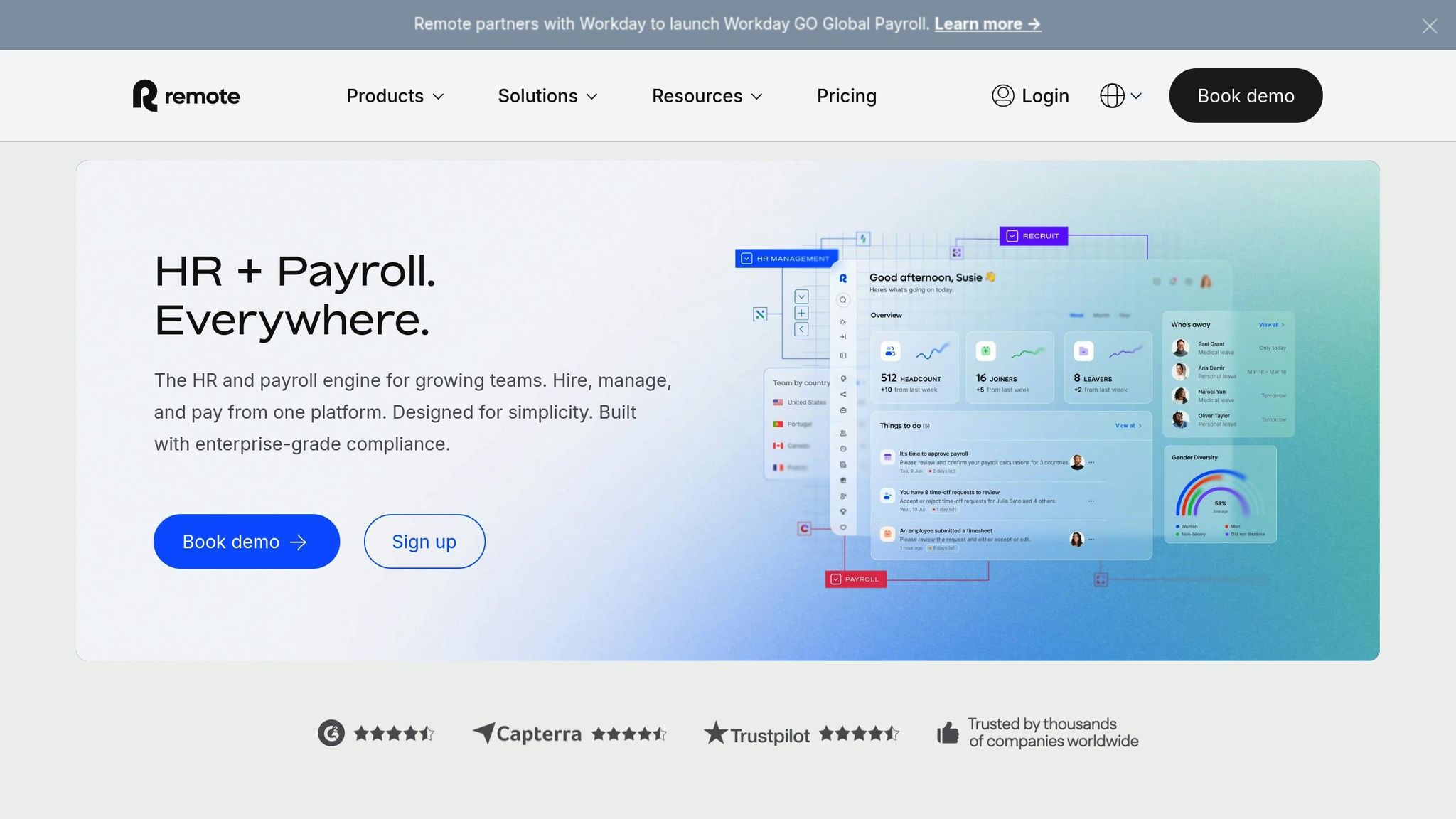
Remote offers EOR, contractor management, payroll and HR tools. With 100+ owned and operated entities, it’s a solution for companies looking to expand their global workforce in 2026, according to Remote.
Compliance Infrastructure and Entity Ownership
One of Remote’s standout features is its focus on compliance through owned local entities in key markets, rather than depending heavily on third-party partnerships. This approach gives businesses control over employment administration when entering new international markets. Remote employs in-house legal and HR experts to support adherence to local labor laws across its supported regions, according to Remote.
Ask how this approach gives businesses better control over compliance and minimizes risks when entering new international markets. Review the allocation of responsibilities in the contract.
The platform includes contract and compliance support, which helps businesses keep pace with changing regulations. This is particularly valuable in regions with complex employment laws, according to Remote.
Check the legal employing entity for each country in your proposal and how the provider handles changes to local employment requirements.
Transparent Pricing Model
Remote lists EOR pricing from $599 per employee per month on annual contracts, per its pricing page (checked October 2026). The fee covers onboarding, payroll, benefits, and compliance services, according to Remote pricing.
The service fee allows businesses to plan their budgets. Salary, employer contributions and optional services need a separate budget.
Technology Platform and User Experience
It consolidates EOR services, contractor management, global payroll, and HR tools into a single dashboard, making workforce management simpler for companies with diverse teams. Key features include integrations with existing HR and payroll systems, localized benefits management, and automated payroll processing in multiple currencies, according to Remote pricing.
Platform Capabilities
Remote’s platform manages both contractors and full-time employees within the same system. Remote also supports converting contractors to employees, offering flexibility for companies with hybrid workforce models. Additionally, the platform’s onboarding process supports new hires starting quickly, for businesses scaling their operations internationally, according to Remote.
Best Use Cases
Remote is a fit for startups, mid-sized companies, and large enterprises looking for reliable global hiring solutions with predictable costs. It’s particularly appealing to organizations that prioritize compliance, transparent pricing, and a single employment platform. Country coverage and the employing entity should be checked for the individual hire.
3. Oyster
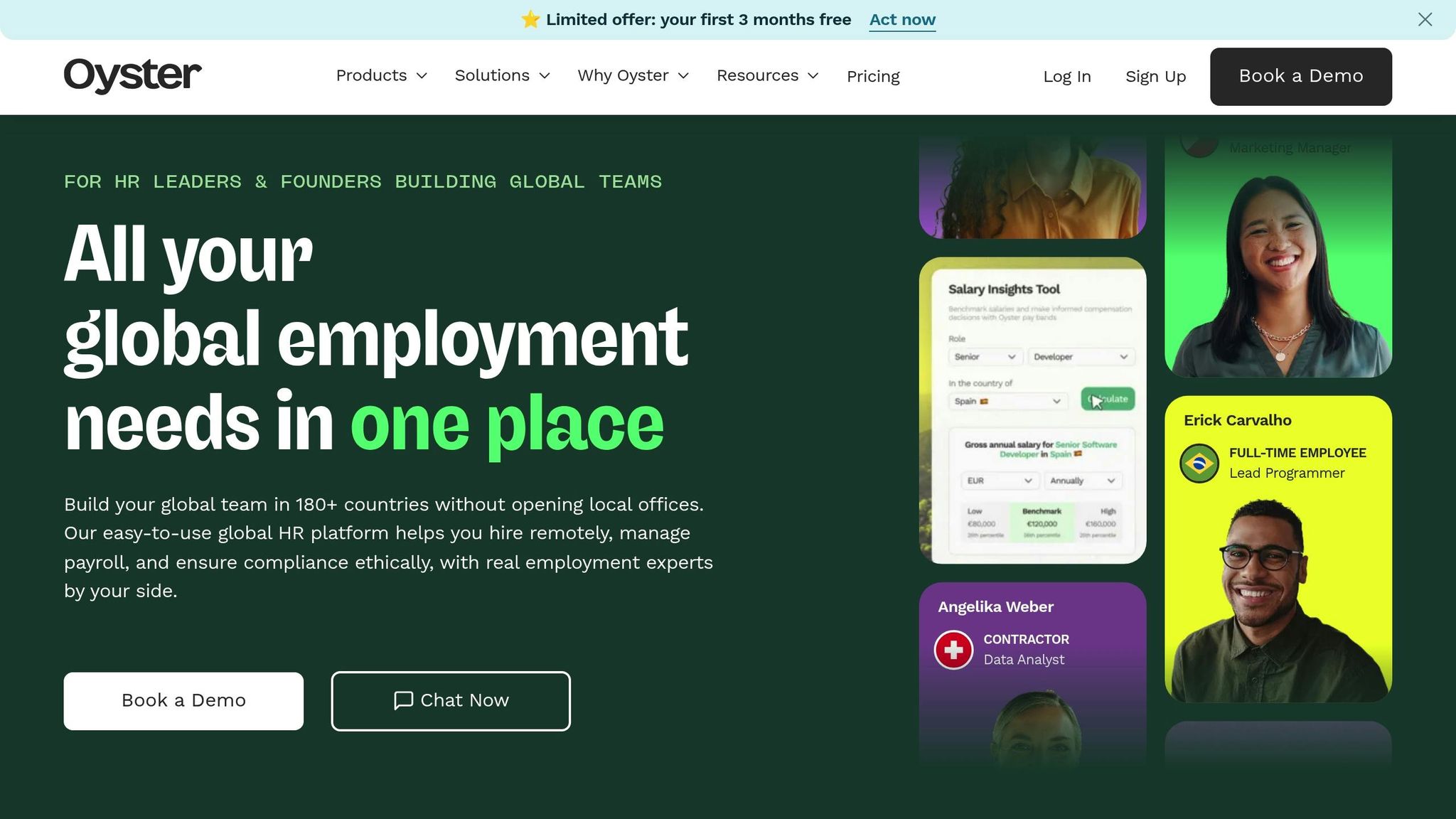
Oyster automates routine employment tasks such as expenses, time-off requests and reports, according to Oyster.
Advanced Compliance and Automation
Oyster combines automation with expert guidance. By reducing administrative tasks through automated workflows, Oyster provides a way for companies to manage global teams efficiently. The platform supports employment without needing to set up local entities and combines multi-country payroll, benefits administration and automated employment workflows, according to Oyster.
Ask how the platform tracks global labor law updates and adjusts contracts and policies across supported regions. If direct entity ownership matters to your hiring plan, ask about reducing reliance on third-party partnerships and how employment issues reach the local team.
Competitive Pricing Structure
Oyster lists EOR at $699 per employee per month, with annual discounts available, per its pricing page (checked October 2026). This flat-rate structure is particularly appealing to startups and growing companies, as it provides predictable service costs for easier budgeting. The fee includes a wide range of services, such as onboarding, payroll processing, benefits management, and ongoing compliance support. Beyond its cost transparency, the platform’s automation tools simplify HR processes, according to Oyster.
Technology and User Experience
The platform includes automation features designed to streamline HR operations. These include automated expenses, time off and reports, plus benefits and visa sponsorship services, according to Oyster.
Hybrid Workforce Management
Oyster also supports hybrid workforce models, enabling businesses to manage both full-time employees and independent contractors. The platform supports transitions from contractor to full-time employee, offering flexibility for dynamic workforce needs, according to Oyster.
Best Use Cases
Oyster is a choice for companies aiming to reduce administrative burdens while managing employment across multiple jurisdictions. It’s particularly well-suited for businesses scaling remote teams or entering new markets quickly. Ask about the employing entity, benefits and the support included for each country.
4. Velocity Global (now Pebl)

Website: hellopebl.com
Velocity Global stands out for its extensive international coverage and strong focus on risk management. It offers employment solutions across a wide range of global markets, operating in over 185 countries, according to Pebl.
Broad Global Reach and Compliance Expertise
Velocity Global now operates as Pebl. Operating in over 185 countries, Velocity Global supports employment through its own entities and local expertise. Its expansive presence is supported by advanced technology and a proactive approach to risk management, according to Pebl. Ask which entity will employ your hire and how country-specific employment responsibilities are divided in the contract.
Ask how its model blends its own entities with carefully selected partners, and how the provider monitors adherence to local regulations. Identify the employer for each country before agreeing to the service.
The platform features tools for monitoring risks and provides immigration expertise for workforce planning and market entry support. By managing local labor laws, tax rules, and benefits administration, Velocity Global helps companies navigate the complexities of global hiring while minimizing compliance risks, according to Pebl.
Integrated Technology Platform
Velocity Global offers a comprehensive technology platform designed to simplify global employment processes. Key features include:
- Consolidated global payroll with automated tax and deduction calculations.
- Integrated benefits management.
- Visa and immigration assistance.
- Global talent sourcing capabilities.
Pebl’s platform supports integrations and API access, connecting HR, finance, talent and workforce systems. It also provides country-specific employment guidance and reporting on global employment activity, costs and employee status, according to Pebl pricing.
Pricing and Service Details
Its EOR pricing page lists $399 per employee per month (checked October 2026), and businesses request a quote for their specific countries and needs, according to Pebl pricing.
Strategic Services and Talent Sourcing
In addition to standard Employer of Record (EOR) services, Velocity Global offers talent sourcing for international hiring. It also provides strategic advice on market entry and mergers and acquisitions (M&A). With in-house immigration experts, the platform supports visa processing and employee relocations, making it a versatile solution for global workforce management.
Ideal Use Cases
Velocity Global is a great fit for companies planning rapid expansion into multiple countries or those managing intricate compliance challenges across diverse regions. It’s especially valuable for businesses entering new markets, overseeing mergers and acquisitions, or managing both full-time employees and contractors worldwide. Its emphasis on risk management and compliance makes it a choice for U.S.-based firms navigating highly regulated international markets, according to Pebl.
5. Playroll
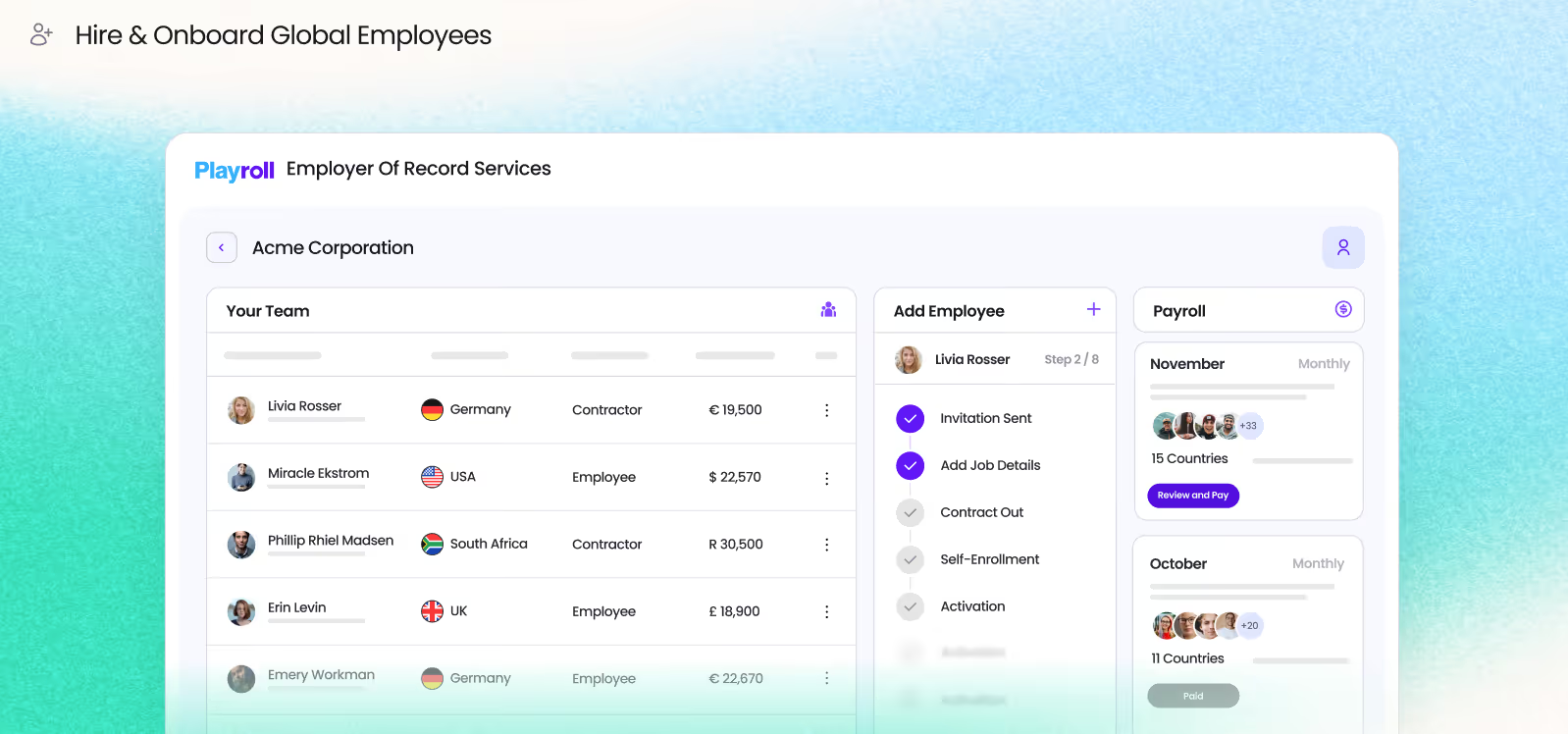
Playroll is a global Employer of Record platform built for companies that want to hire internationally without setting up local entities, covering 180+ countries, according to Playroll.
Compliance Infrastructure and Local Expertise
Playroll's service is built around in-house legal and HR expertise at the country level. The platform manages employment contracts, statutory filings, social contribution registrations, and benefits administration through a centralized dashboard, according to Playroll.
For markets where labor law changes frequently and enforcement is active, ask which local team will support the hire and how updates reach you.
Transparent Pricing
Playroll's EOR pricing starts at $399 per employee per month. The fee covers contract drafting, payroll processing, statutory benefit administration, and ongoing compliance support, according to Playroll.
Playroll requires a fully refundable security deposit when you onboard an employee, equivalent to one month’s salary, according to Playroll.
Technology Platform and User Experience
The Playroll platform is built for HR and finance teams that need visibility across multiple jurisdictions without needing to log into separate country-specific systems. Key features include multi-currency payroll processing, localized benefits management, and integrations with common HRIS tools. The platform also provides onboarding tracking, itemized billing, and employee time management, according to Playroll.
Best Use Cases
Playroll is a fit for startups and mid-market companies expanding into EMEA, Africa, or Southeast Asia. It's also well-suited to companies that want a single platform to manage a mix of full-time international employees and contractors, or those looking to test a new market quickly before committing to a local entity.
6. Rippling
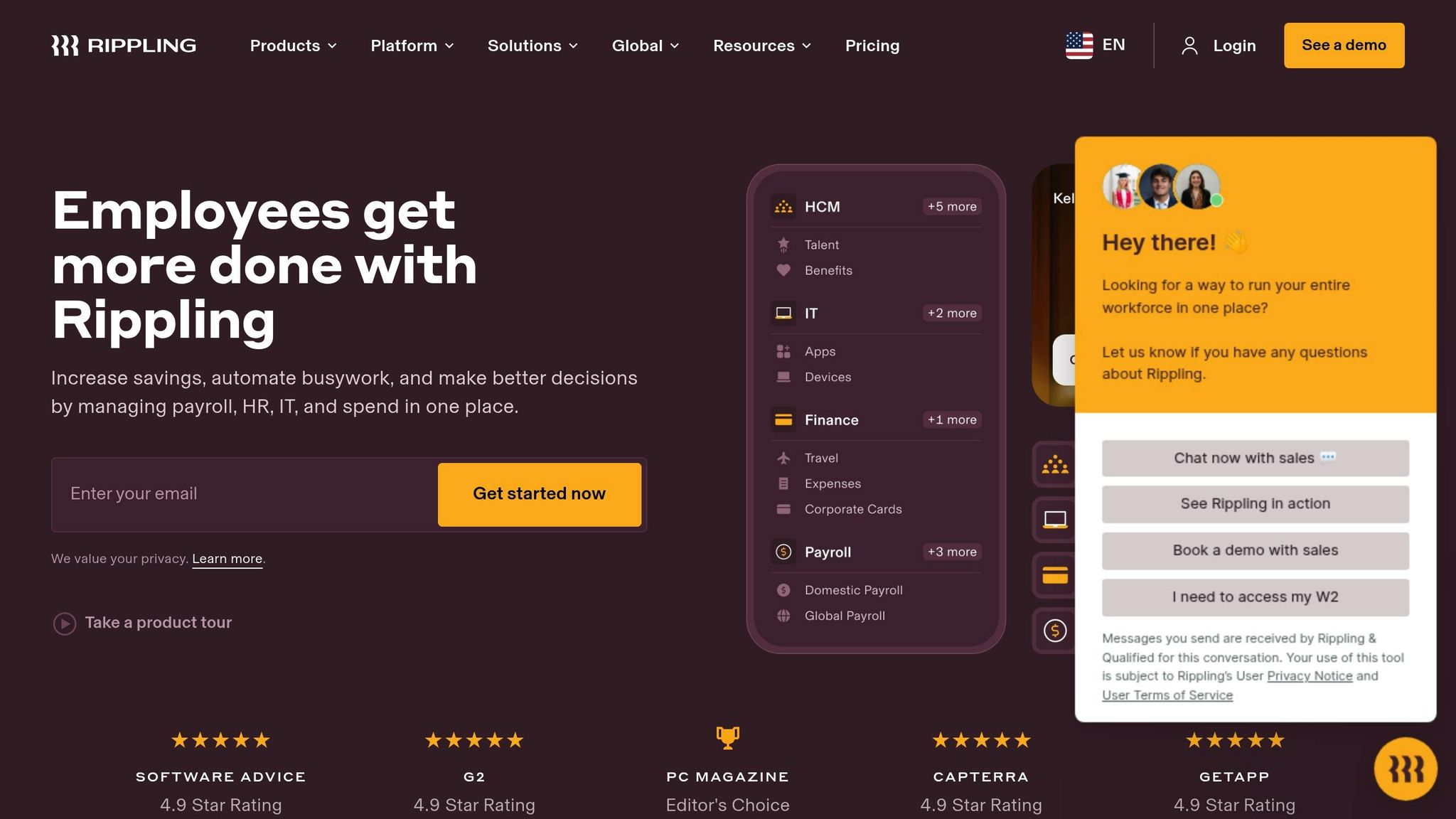
Rippling combines Employer of Record (EOR) services with an all-in-one platform for HR and IT management. It handles global payroll, device management, and employee benefits, according to Rippling pricing.
Payroll Processing
For companies juggling payroll in multiple countries, the platform supports various currencies and takes care of local payroll and tax administration, easing the workload for HR teams. Payroll, taxes, benefits, and employment contracts sit alongside the employee’s information in one system, according to Rippling.
A Centralized Solution for Global Teams
Rippling’s integration-focused design brings together HR, IT, and finance functions into one streamlined dashboard. From onboarding and payroll to benefits and even device provisioning, everything is managed in one place. This eliminates the inefficiencies and errors that often come with juggling multiple disconnected systems. By consolidating these workflows, Rippling not only saves time but also enhances accuracy and compliance, according to Rippling.
Transparent Pricing Model
Rippling does not publish an EOR price on its pricing or EOR pages (checked October 2026), so EOR is custom pricing: you request a quote based on your countries and the services you need, according to Rippling pricing.
Smart Compliance and Automation
Rippling manages local employment agreements, benefits enrollment and reporting. Its software includes policy guardrails updated by local compliance experts, with HR and legal experts providing support. This includes employee information, documents, notice periods, benefits, leave and time policies, performance management and termination, according to Rippling.
Ask how contracts are updated, labor law changes are tracked, and reporting is automated. Compare these workflows against the HR tasks your team will continue to manage.
Tailored for Tech-Savvy Companies
Rippling is particularly well-suited for tech-focused businesses that need HR, IT and finance products in one platform. Compare the employee experience and automation tools against your existing systems before selecting the modules.
7. Multiplier

Website: usemultiplier.com
Multiplier is a global Employer of Record (EOR) solution, with a presence in over 150 countries. Covering regions like North America, Europe, Asia-Pacific, Latin America, Africa, and the Middle East, Multiplier supports businesses managing teams spread across continents, according to Multiplier.
Mobile-First Technology Platform
Multiplier takes a mobile-first approach, enabling employers and employees to manage HR tasks from virtually anywhere. Its intuitive platform simplifies global hiring, offering features like real-time compliance monitoring and automated onboarding workflows. Check the available workflows for your hiring country.
Transparent Pricing Structure
Multiplier lists EOR pricing from $459 per employee per month on annual contracts and $499 on monthly contracts, per its pricing page (checked October 2026). Compliance-mandated add-ons and implementation fees may apply. Get the country-specific employment total alongside the service fee before setting your budget. Multiplier’s fixed-rate plans provide businesses with a clear service cost structure. Compare these transparent plans, paired with automated compliance tools, against the risks and administrative headaches during global expansion.
Strong Compliance Framework
The platform supports adherence to local labor laws, handles tax withholding, and manages statutory benefits across supported countries. With local legal expertise, Multiplier supports businesses operating internationally. The fee includes locally compliant contracts, payroll processing, tax and statutory filings, benefits administration, employee onboarding, and ongoing HR support, according to Multiplier.
Ask how local legal expertise and compliance tools address risks tied to employee misclassification. Compare those responsibilities with the work your own company retains.
Ideal for Multi-Currency Payroll
With support for numerous currencies, Multiplier is a go-to solution for businesses managing complex international payroll needs. Its ability to handle both full-time employees and contractors makes it especially appealing to technology firms, SaaS companies, and professional services scaling globally. Check the employing entity, supported currencies and onboarding process for the countries in your hiring plan.
8. Skuad

Skuad is a tech-powered Employer of Record (EOR) platform designed to help companies hire and manage talent across more than 160 countries, all without the hassle of setting up local entities. Covering major regions like North America, Europe, Asia-Pacific, Latin America, Africa, and the Middle East, it supports international hiring, according to Skuad.
Employment Administration
The platform handles local employment agreements, payroll, labor law and tax compliance, and benefits administration options. Dedicated account managers support the employment workflow, according to Skuad.
Ask how the service keeps tabs on regulatory changes and handles documentation for supported nations. Review payroll checks and error detection, and how the provider deals with misclassification or regulatory issues.
Pricing
Its pricing page lists EOR pricing starting from $199 per employee per month (checked October 2026). The fee includes payroll, benefits administration options and support, according to Skuad.
Get a written quote for the country, role and benefits package you need.
All-in-One Technology Platform
Skuad’s unified dashboard handles onboarding, payroll, benefits, compliance tracking, and document management. Features like contract generation, payroll calculations, and localized benefits administration simplify global operations. Plus, the platform includes third-party integrations. Both employers and employees can access employment information such as payslips, benefits, and support, according to Skuad.
Global Reach
Integrations with HR and payroll systems support its ability to manage global teams, according to Skuad. Review the supported countries and integrations against your hiring plan.
Flexible Hybrid Workforce Management
Whether you’re building hybrid teams or transitioning contractors to full-time roles during international expansion, Skuad supports employees and contractors for startups, scale-ups, and larger enterprises, according to Skuad platform.
Skuad is a fit for tech companies and remote-first organizations looking for employment administration and management of global teams. Review the contract’s allocation of employment responsibilities and how local issues are escalated.
9. Globalization Partners (G-P)
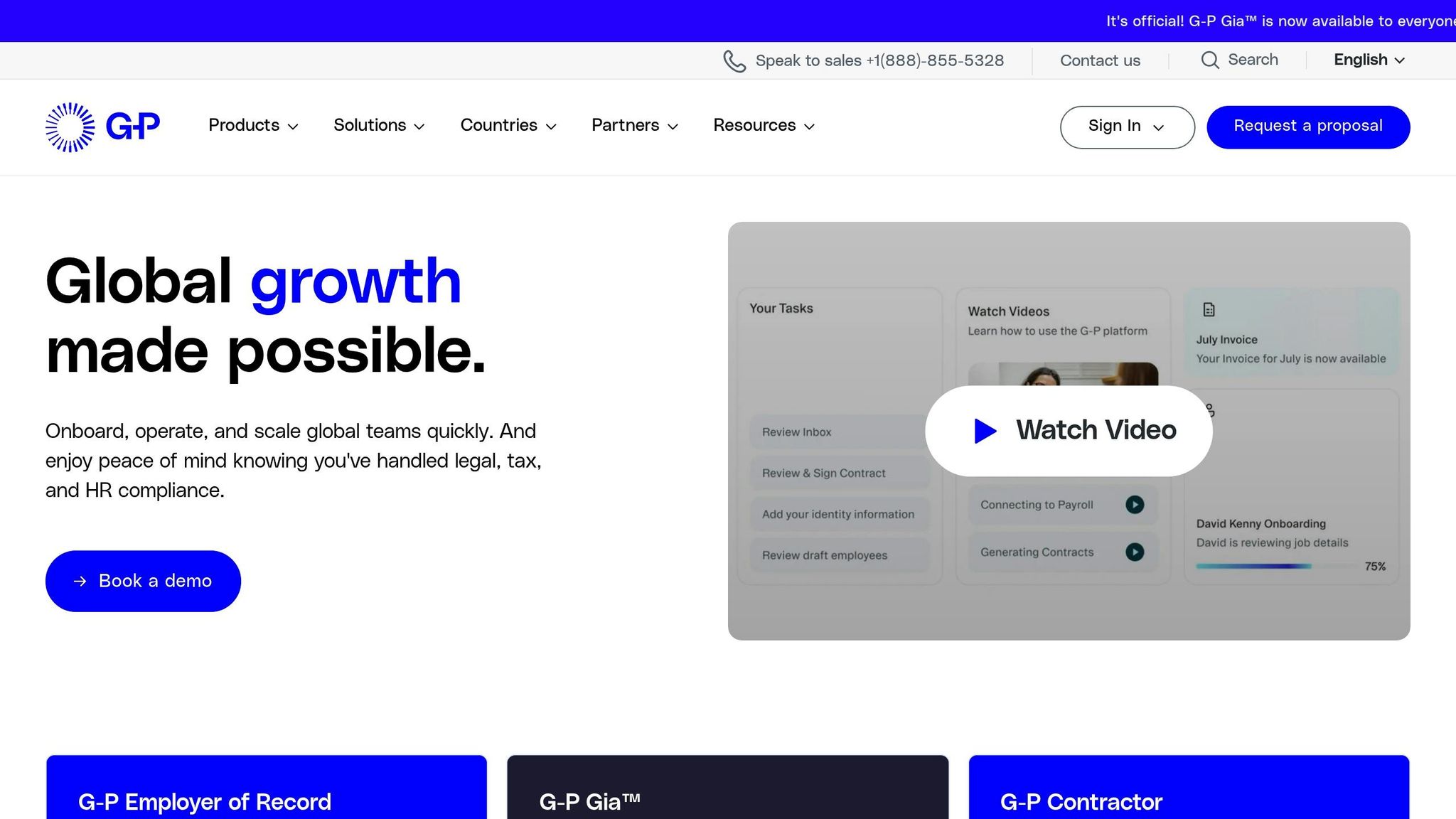
Globalization Partners (G-P) provides Employer of Record (EOR) services for international hiring. Its platform supports employment administration, payroll and benefits, with AI-guided workflows and human support. Companies looking for global expansion can compare G-P’s service quality and control over employment processes, according to G-P.
A Strong Compliance Framework
These professionals provide guidance on labor laws, tax codes, and employment standards across the regions G-P operates in. The platform also automates compliance tasks and manages employment administration. By integrating technology into its employment processes, G-P combines employment contracts, locally aligned benefits, payroll, reporting and integrations, according to G-P.
The Power of G-P Gia™
G-P offers G-P Gia™, an AI-powered global HR assistant designed to simplify workforce management. G-P Gia™ automates routine compliance tasks while also delivering HR guidance and alerts when regulations change. The tool includes document creation and tools to generate, localize and update HR documents from conversational prompts, according to G-P.
Pricing
Its pricing page lists G-P EOR starting at $599 per employee per month, with volume discounts available (checked October 2026). During the sales process, G-P provides detailed, customized quotes to ensure pricing transparency, aligning costs with the specific needs of each client, according to G-P.
HR and Legal Support
G-P provides support from a global network of HR and legal experts. When comparing G-P, ask about the employing entity, onboarding schedule, employment responsibilities, support languages, hours and escalation routes, and the scope and price of G-P Gia separately from EOR.
Ask how these professionals stay on top of labor laws, tax codes, and employment standards across the regions G-P operates in. Establish how personalized guidance throughout the employment lifecycle reaches the person managing your team.
Flexible Workforce Solutions
G-P offers solutions that adapt to various workforce needs, supporting the hiring of both full-time employees and contractors. This flexibility allows companies to scale their teams according to project demands or market entry strategies. Whether managing distributed teams or launching pilot projects in new markets, compare the employment and contractor services included for each country, according to G-P.
Innovations and Market Leadership in 2026
G-P offers AI-driven compliance automation and features for onboarding and employee experiences. Its focus on compliance, combined with technology, supports companies managing large-scale international operations or entering regions with intricate regulatory requirements. Its reporting tools provide information about employment activity and costs across countries. Review the included products and integrations against your HR and finance processes, according to G-P.
G-P is best suited for enterprise-level organizations that prioritize employment support across multiple countries. Evaluate the legal employing entity, service scope and total cost alongside the platform’s technology and support before choosing the provider.
2026 EOR Market Trends
The Employer of Record (EOR) landscape in 2026 is shaping up to meet the growing complexities of global employment. Businesses are seeking flexible, transparent, and tech-driven solutions to navigate a rapidly changing global workforce.
One trend is expansion into new markets, including Latin America, Europe and North America. EOR providers help businesses employ people in these markets without establishing their own local entities.
Another major shift is the adoption of hybrid hiring models. Today’s top EOR providers are offering integrated platforms that manage both full-time employees and contractors, along with global payroll solutions. This approach caters to the growing need for flexibility in workforce management, so companies can handle varied hiring needs across distributed teams.
Leading providers are using artificial intelligence to track regulatory updates, automate contract creation, and identify compliance risks, according to G-P. Compare the automation included in each provider’s service, who reviews its output, and how country-specific employment questions reach a qualified person.
In addition to technological advancements, local entity ownership is becoming a priority. Businesses are increasingly favoring EOR providers that own their local entities rather than relying on third-party partners. The employing entity and allocation of responsibilities should be stated in the agreement. Companies like RemotePeople, Remote, and Globalization Partners have made substantial investments in building their own local entities, offering employers more accountability and robust support.
Published service prices help employers compare providers and plan their budgets. For example, RemotePeople lists EOR Global pricing from $499 per employee per month, while Multiplier and Oyster publish rates on their pricing pages (checked October 2026). Salary, statutory costs, benefits and optional services still need to be included in the total.
Onboarding and payroll schedules matter when comparing providers. Get the expected start date, document requirements and payroll cutoff for the country where the person will work.
Finally, comprehensive technology platforms have become a must-have for managing global workforces. Industry leaders are offering centralized dashboards, automated onboarding, real-time compliance tracking, and multi-currency payroll features. Mobile apps for employee self-service and AI-driven support tools are increasingly common, ensuring a connected experience for both employers and employees.
These trends underline how the EOR industry is evolving to meet the demands of global employers. The focus is on delivering technology-powered solutions that prioritize speed, transparency, and integration, ensuring businesses can adapt to the challenges of global hiring with ease.
EOR Companies Comparison Table
When choosing an Employer of Record (EOR) provider, evaluating compliance, coverage, and pricing is critical. To help you make an informed decision, here’s a comparison of the nine EOR companies, highlighting their features and specialties.
Check country coverage and the employing entity with each provider. Service fees are separate from salary and other employment costs.
| EOR Company | Website | Pricing Model (USD) | Best For | Key Features |
|---|---|---|---|---|
| RemotePeople | remotepeople.com | EOR Global from $499/employee/month; EOR Select from $199 for selected countries and qualifying salaries | Fast-scaling startups, tech companies | Recruitment, EOR, contractor management, incorporation, visa support |
| Remote | remote.com | From $599/employee/month (annual) | Remote-first teams, tech companies | EOR, contractor management, payroll and HR in one dashboard |
| Oyster | oysterhr.com | $699/employee/month | Distributed teams, NGOs | Automated workflows, visa support, local benefits |
| Velocity Global (now Pebl) | hellopebl.com | From $399/employee/month | Enterprises, M&A, complex markets | Global employment, payroll, benefits and integrations |
| Playroll | playroll.com | From $399/employee/month | Global reach, enterprise solutions | Employment contracts, payroll, benefits and HR support |
| Rippling | rippling.com | Custom pricing | Tech-forward companies, automation needs | HR, IT, finance, device management and payroll products |
| Multiplier | usemultiplier.com | From $459/employee/month (annual plan) | Startups, SMBs, mobile-first teams | Annual and monthly EOR plans; add-ons may apply |
| Skuad | skuad.io | From $199/employee/month | Tech startups, digital agencies | Employment agreements, onboarding, payroll and benefits options |
| Globalization Partners | globalization-partners.com | From $599/employee/month | Enterprises, regulated industries | AI-guided workflows and human employment support |
How to Use This Table Effectively
To make the most of this comparison, focus on the factors that align with your business needs:
- Country coverage: Check that the provider supports the country, role and employment setup you need.
- Entity ownership: This impacts compliance and risk management. Identify who legally employs the person, the provider or a partner.
- Technology features: Compare the payroll, benefits, reporting and integrations included in the proposal.
- Use Case: Startups might lean toward RemotePeople or Multiplier for their scalability and simplicity, while enterprises requiring employment and HR services may prefer Globalization Partners or Velocity Global.
Best EOR by Use Case
A quick shortlist, based on the provider profiles and comparison table above. Confirm country coverage and pricing with each provider before you sign.
| Use case | Providers to shortlist | Why, from the profiles above |
|---|---|---|
| Startups and small businesses | RemotePeople, Multiplier, Remote | Published per-employee prices |
| Remote-first teams | Remote | EOR, payroll and contractor management in one platform |
| Enterprise and regulated industries | Globalization Partners, Velocity Global | Enterprise employment support |
| Visa and relocation support | Velocity Global, Oyster, RemotePeople | Country-specific visa and immigration support |
EU Remote Hiring: Questions to Settle Before an Offer
Before an offer for an EU hire, agree where the person will work and how you will engage them. Review classification, employment terms, tax and social security, data protection, equipment and remote-work policy for that country. Rules differ by country.
- Engagement: identify the employing or contracting party and arrange a review of classification and local terms.
- Tax and social security: have qualified advisers assess the working pattern and cross-border responsibilities.
- Remote-work terms: document working hours, equipment, expenses and availability.
- Personal data: document access, storage, sharing and security responsibilities. The European Commission’s data-protection guidance provides a starting point.
- Provider scope: set out what the EOR handles in the country and what remains with your company.
For where to look for candidates, see our European country selection guide.
When You Don't Need an EOR: Direct Hire via a Recruiter
An employer of record becomes the legal employer of someone in a country where you have no entity. It runs their contract, payroll, tax withholding and benefits. An EOR employment contract does not necessarily include candidate sourcing. If what you're missing is the candidate, check whether recruitment is a separate service, according to Remote. Depending on how you engage the hire, you may not need an EOR at all.
Signs You May Not Need an EOR
- The role works as a genuine contract. The person sets their own hours, uses their own equipment and invoices you. Check the classification rules in their country first. Our guide on whether a U.S. company can hire a foreign independent contractor covers the basics.
- You already have an entity in the candidate's country, so you can employ them directly.
- The candidate lives in your own country and can go on your existing payroll.
- You're making one or two hires, not building a team in a new country, and you'd rather not pay a monthly per-employee EOR fee for one or two people.
When an EOR Is Still the Right Call
- You want the person as a full employee, with local benefits, in a country where you have no entity.
- You're hiring several people in one country and aren't ready to open an entity.
- Local rules make a contractor arrangement risky for the role.
For a first hire abroad, compare all three routes in contractor vs EOR vs direct employee for your first international hire, or our list of EOR alternatives for hiring remote contractors.
How a Recruiter and an EOR Fit Together
A recruiter finds, screens and shortlists candidates. An EOR employs the person after you've picked them. You can use both: hire through a recruiter, then put the new hire on an EOR, on your own payroll or on a contractor agreement, depending on the role and the country.
EOR fees come on top of salary and other employment costs and continue for as long as the employment arrangement runs. Our recruitment fee is per hire (see below). Compare the recruitment cost separately from the cost of employing the person.
Direct Hire With RemotelyTalents
We headhunt full-time remote talent from Latin America, Europe and North America. You employ or contract the person directly and manage their work. With one dedicated recruiter throughout, we bring you the 3–5 candidates who fit your brief, with fluent English and the skills your role needs. You interview and make the final decision. Searches take 4–6 weeks on average.
An EOR charges a fee every month. RemotelyTalents has no monthly fee: two fixed fees, $3,900 in total per completed hire. The flat fee is split into $1,450 at kickoff and $2,450 when you hire. The $2,450 placement fee is due only if you hire someone we introduced. Compare the total with the monthly EOR fees above over the time you expect to employ the person.
If the hire doesn't work out in the first 90 days, we find a replacement.
Tell us who you need to hire if you can employ or contract the person yourself.
Background checks apply only to the final candidate you decide to hire, before the hire.
Conclusion
As distributed teams work across different countries and regulatory requirements, EORs offer a way for businesses to scale internationally without the need to establish local entities, according to Remote.
The nine providers highlighted in this guide each bring something different to the table, offering different combinations of employment administration, payroll, technology and support.
When choosing an EOR, it’s crucial to evaluate three key factors: geographic coverage, entity ownership, and pricing. These considerations will help ensure the provider aligns with your hiring locations and budget.
Advancements in technology and onboarding processes are also reshaping the EOR landscape. For complex hiring needs, weigh the platform’s tools alongside its local employment support, according to Rippling.
These features highlight the importance of selecting a provider that matches your specific hiring requirements. Ultimately, the best EOR for your business will depend on your unique needs. A startup looking to expand into Asia-Pacific might find Multiplier’s pricing from $459 per employee per month appealing, according to Multiplier. On the other hand, a highly regulated enterprise could prioritize Velocity Global’s extensive employment coverage, which spans over 185 countries, according to Pebl. Compare the scope for your country before choosing.
To make the right choice, take the time to compare providers using our detailed table. Request demos, read reviews, and weigh pricing and compliance features to identify the EOR that will support your global hiring goals. Get the division of responsibilities in writing before you sign.
FAQs
How can I select the best Employer of Record (EOR) company for my business?
Start with the countries you need and check whether the provider owns its entity there or uses a partner. Then compare the all-in monthly price per employee, the local benefits on offer, onboarding time, contractor support and how payroll and compliance are handled. Ask two or three providers for a written quote for your exact countries before you sign.
What’s the difference between an Employer of Record (EOR) and a Professional Employer Organization (PEO)?
An EOR becomes the legal employer of your worker in a country where you have no entity, and runs their contract, payroll, taxes and benefits. A PEO works under co-employment: it handles HR, payroll and benefits for staff you already employ through your own entity. Use an EOR to hire where you have no entity, and a PEO for HR support where you do.
How do EOR providers use automation in 2026?
Labor and tax rules differ by country and change often, so EOR providers automate much of the routine work: payroll calculations, tax withholding, benefits administration and contract updates. Local legal expertise still matters. When you compare providers, ask how they track rule changes in your countries, what a person reviews and who reviews contracts.
How much does an EOR cost in 2026?
Most EOR platforms charge a monthly fee per employee on top of salary, employer contributions and benefits. Published prices in this guide include Skuad from $199 and Oyster at $699 per employee per month, checked October 2026. Ask for a country-specific quote that separates the service fee, statutory costs, optional benefits, deposits and any implementation charges. Some providers only quote custom pricing, so compare the total yearly cost rather than the headline rate.
Do I need an EOR to hire someone in another country?
Not always. You usually don’t need one if the person works as a genuine independent contractor, if you already have an entity in their country, or if they live in your own country. You do need an EOR, or your own local entity, to employ someone as a full employee in a country where you have no entity, according to Remote.
What should I check before hiring remotely in the EU?
Before an EU offer, check the work location, worker classification, employment terms, tax and social security responsibilities, and data protection. Document working hours, equipment, expenses and availability in the remote-work policy. Ask country-qualified advisers to review the arrangement and put the EOR’s responsibilities in writing. Rules differ by country, so use the actual working pattern when reviewing the hire.
Related Blog Posts
Read also