First International Hire? Contractor vs EOR vs Direct Employee for US SMBs (2026)


Hiring internationally for the first time comes with major decisions: Should you go with a contractor, an Employer of Record (EOR), or set up a legal entity for direct employment? Each option has unique costs, risks, and benefits. Here's the quick breakdown:
- Contractors: Fast and affordable for short-term projects, but high risk of misclassification fines if treated like employees.
- EOR (Employer of Record): Simplifies hiring by managing compliance, payroll, and taxes for a monthly fee. Ideal for testing new markets or hiring fewer than 20 employees.
- Direct Employment: Best for long-term plans with 20+ employees in one country. Offers full control but requires significant upfront and ongoing costs.
Quick Comparison:
| Feature | Contractor | Employer of Record (EOR) | Direct Employee (Entity) |
|---|---|---|---|
| Setup Speed | Days | 48 hours to 2 weeks | 3 to 6 months |
| Upfront Cost | Minimal | Low ($200–$700/month) | $5,000–$150,000 |
| Legal Risk | High | Low | Moderate to High |
| Best For | Short-term tasks | Full-time roles (<20 hires) | Long-term hubs (20+ hires) |
Key Takeaway: For most U.S. SMBs, EOR offers the best balance of speed, cost, and compliance for early international hires. Contractors work for short-term needs, while direct employment is better for larger, long-term investments.
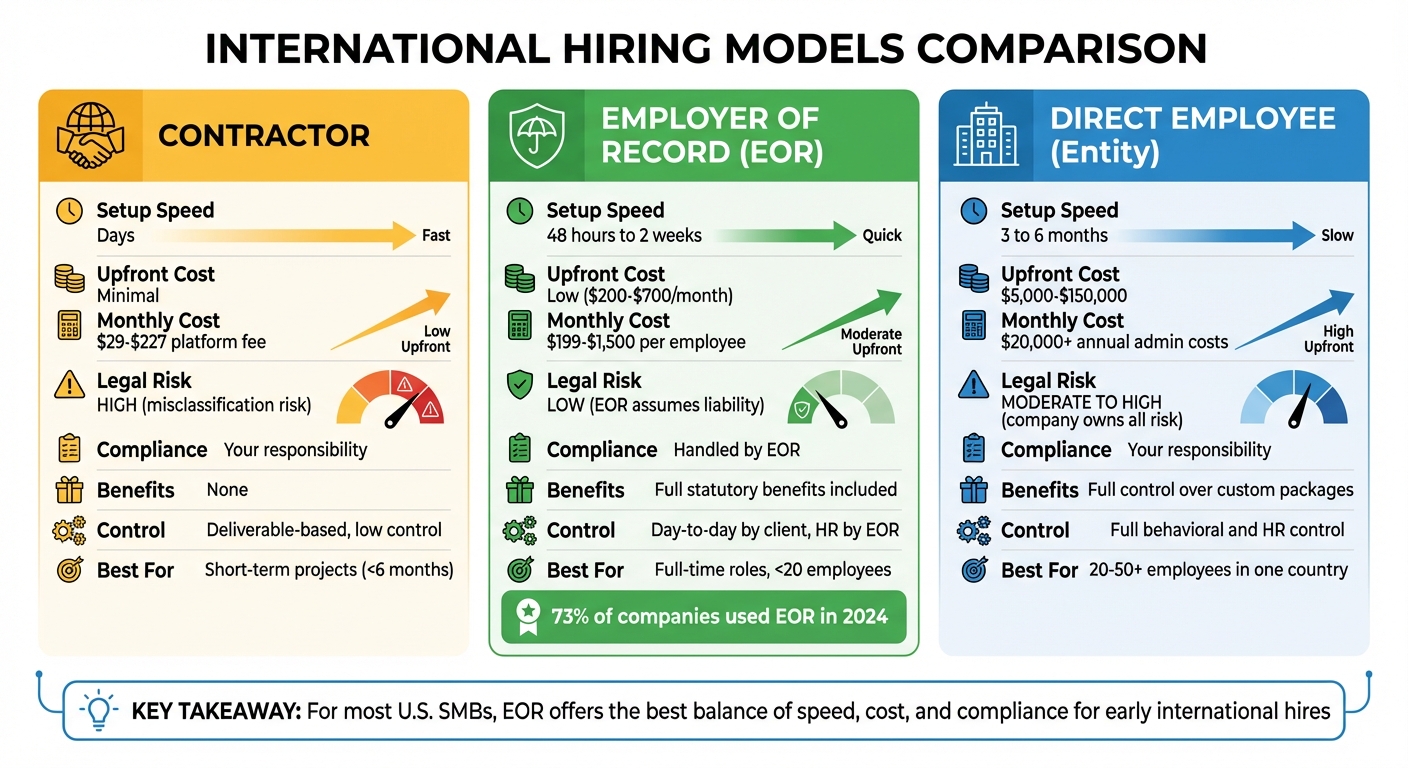
Contractor vs EOR vs Direct Employee Comparison for International Hiring
EOR vs Contractors: How to Pay Overseas Employees the Right Way
sbb-itb-88a7fe6
The 3 Hiring Models Explained
When expanding internationally, choosing the right hiring model is critical. Each option comes with its own costs, benefits, and risks, especially for those first, high-stakes hires abroad.
Contractor Model
A contractor works under a business-to-business (B2B) agreement. They handle their own taxes, insurance, and equipment, while you act as their client - not their employer.
Contractors often cost 15–30% less than full-time employees because you’re not paying for benefits, payroll taxes, or social security contributions [9]. They can be onboarded in just a few days and offer flexibility to scale up or down based on project needs.
However, misclassifying contractors can lead to penalties. If you dictate their hours, provide tools, or treat them like employees, labor authorities might reclassify them as such - resulting in back taxes and fines.
"If you wouldn't treat them like a contractor at home, don't treat them like one abroad. The penalties are global." - Ema Koloski from RemotePass [4]
Best for: Short-term projects, specialized tasks, or roles where the worker controls their schedule and tools.
Not ideal for: Core team positions, roles requiring fixed hours, or jobs where you need to dictate workflows.
Employer of Record (EOR)
An Employer of Record (EOR) simplifies international hiring by managing legal and compliance responsibilities for you.
The EOR becomes the legal employer of record for your international hires, handling payroll, taxes, social security, and statutory benefits. Meanwhile, you focus on managing the employee’s daily work and performance.
"An EOR is a third-party organization that can act as the legal employer of your international workforce. While you retain control over day-to-day processes, it handles all the HR, payroll, and compliance for a fixed, monthly fee." - Deel [3]
EORs can onboard employees in as little as 48 hours to two weeks, compared to the two to six months it takes to set up your own legal entity [8][4]. In 2024, 73% of companies used EOR services to expand globally [3]. Monthly fees range from $199 to $1,500 per employee, with most providers charging between $200 and $700 [6][3].
While the per-employee cost is higher than hiring directly, the speed and compliance benefits often outweigh the expense for early international hires. For example, in 2026, Chaos, a software company, avoided $135,000 in setup costs by using an EOR to hire 15 employees across 9 countries [4].
Best for: Full-time roles, entering new markets, or hiring in countries with complex labor laws.
Not ideal for: Large teams (15+ employees) in one country, where establishing a legal entity becomes more cost-effective.
Direct Employee Model
This model involves setting up your own legal entity, such as a subsidiary or branch, in the worker’s country. You hire employees directly and take responsibility for benefits, compliance, and legal risks.
The direct model provides maximum control and helps establish a local presence, making it ideal for companies planning long-term investments in a specific region. However, it’s the most expensive and time-intensive option. Setting up a legal entity costs between $20,000 and $150,000, with annual operating expenses exceeding $50,000 per location [1][4][11]. The process takes two to six months [8][4].
Employer contributions can add 40–70% on top of base salaries in some regions - 71% in Brazil, 53% in Argentina [9]. Additional costs, like the mandatory "13th-month salary" in many Latin American countries, further increase expenses [10].
Best for: Long-term hiring hubs with 15+ employees, roles requiring physical facilities, or situations where full control over intellectual property and brand presence is essential.
Not ideal for: First international hires, testing new markets, or companies lacking in-house HR and legal expertise.
Each model comes with trade-offs, so consider your budget, timeline, and risk tolerance when deciding.
Contractor vs EOR vs Direct Employee: Comparison Table
The table below provides a clear, side-by-side comparison of contractors, Employers of Record (EOR), and direct employees. Use this to weigh your options based on factors like budget, compliance responsibilities, and how quickly you need to get started.
| Feature | Contractor | Employer of Record (EOR) | Direct Employee (Entity) |
|---|---|---|---|
| Setup Speed | Days | 48 hours to 2 weeks | 3 to 6 months |
| Upfront Cost | Minimal (legal/platform fees) | Low (predictable monthly fee) | $5,000–$150,000 |
| Monthly Cost per Worker | $29–$227 platform fee | $199–$1,500 per employee | $20,000+ annual admin costs |
| Legal Risk | High (misclassification/PE risk) | Low (EOR assumes liability) | Moderate to High (company owns all risk) |
| Compliance Management | Your responsibility | Handled by EOR | Your responsibility |
| Benefits Provided | None (contractor handles own) | Full statutory benefits included | Full control over custom packages |
| Management Control | Deliverable-based; low control | Day-to-day by client; HR by EOR | Full behavioral and HR control |
| IP Protection | Risk of non-retention | Guaranteed via EOR contract | Full direct ownership |
| Best For | Short-term projects (<6 months) | Full-time roles in new markets | 20–50+ employees in one country |
| Operational Effort | Minimal | Low (provider handles payroll/HR) | Very high (local HR/legal needed) |
While contractors offer the fastest onboarding process, they come with significant risks, such as potential penalties for misclassification.
"An EOR acts as a shield against these complexities... incorrectly terminating an employee can lead to massive fines. An EOR ensures every contract and action adheres strictly to local laws." - BIPO Service [8]
For many U.S.-based small and medium businesses hiring abroad, an EOR strikes a balance. It provides access to full-time talent while minimizing legal risks and ensuring smoother operations. This table serves as a starting point for choosing the right model based on your company’s needs and risk tolerance.
How to Choose the Right Model for Your SMB
Picking the right hiring model boils down to aligning your budget, timeline, and risk tolerance with your business goals. Here’s a breakdown of the key factors to help you make an informed decision.
Budget and Total Cost
Your financial plan will heavily influence your choice. Here’s how the costs stack up:
- Contractors: These are the most affordable upfront, with platform fees ranging from $29 to $227 per month [6]. However, keep an eye on hidden costs like international transfer fees. For instance, SWIFT transfers can lose 3%-5% to currency conversion, plus $25 to $50 in intermediary fees. Global remittance transfer costs averaged 6.2%-6.4% for sending $200 in 2024, far exceeding the UN's 3% target [12].
- EORs (Employer of Record): Expect to pay $200 to $700 per employee monthly [6]. Some providers, like RemotePass, start at $349 [2].
- Direct Employment: This is the most expensive route, with setup costs ranging from $15,000 to $20,000 for a legal entity in straightforward markets. In more complex regions, this can skyrocket to $150,000 [1]. Ongoing expenses include local HR staff, audits, and compliance. For example, in Brazil, employer costs can add 60%-80% to salaries due to mandatory contributions like FGTS (8%) and INSS (up to 28.8%) [10]. Generally, direct employment becomes cost-effective when you have 20-50 employees in a single country [2][6].
Setup Speed and Timeline
When time is of the essence, speed matters just as much as cost.
- Contractors: The fastest option, with onboarding completed in 1-2 weeks [7]. You simply draft a service agreement, and work begins without setting up payroll.
- EORs: These offer a quick turnaround, typically onboarding in 3-5 business days or up to 2 weeks [13][2][6]. They leverage existing legal frameworks to bypass lengthy entity setup processes, giving you a competitive edge in talent acquisition.
- Direct Employment: The slowest, taking 2-6 months to establish a subsidiary, open local bank accounts, and set up payroll systems. Country-specific regulations, like Brazil’s CLT or Mexico’s PTU mandates, can further delay the process [10].
Legal Risk and Compliance
Legal compliance is a major consideration, especially when dealing with international hires.
- Contractors: Misclassification poses significant risks. For example, in 2023, the UK’s HMRC collected £36 million in back taxes from one organization due to IR35 violations [1]. Misclassification occurs when contractors are treated like employees - working fixed hours, using company equipment, or being closely supervised. There’s also the risk of creating a Permanent Establishment (PE), which could result in corporate tax liabilities for your U.S. company in a foreign country [5][6].
"If the relationship resembles employment, regulators will treat it as such." - Ema Koloski, RemotePass [5]
- EORs: These take on most compliance risks since they act as the legal employer [6]. However, if an EOR relies on third-party networks instead of owning local entities, accountability issues can arise [13].
- Direct Employment: You bear full responsibility for compliance. This includes strict termination protections, mandatory profit-sharing, and navigating audits. Social security contributions vary widely, from 13% in the UK to 45% in France [1].
Benefits, Retention, and Role Fit
The right benefits package can make or break your ability to attract and retain top talent.
- Contractors: They don’t receive benefits and must handle their own taxes and insurance [7]. This works for short-term projects but makes retention difficult for full-time roles since you can’t offer perks like equity or paid leave.
- EORs: They provide statutory benefits such as health insurance, pensions, and paid leave, with optional extras like private health plans [6]. Comprehensive benefits are crucial for retention - 73% of businesses say timely, accurate payroll is key to employee satisfaction [12]. EORs can also handle equity grants, which are often part of compensation for key roles.
- Direct Employment: This option gives you full control over benefits. You can design tailored health plans, retirement contributions, and equity packages that align with your company’s vision - ideal for building a committed, long-term team.
Management Requirements and Internal Readiness
Consider how much operational bandwidth you have for managing hires.
- Contractors: They require minimal oversight. You manage deliverables, not daily schedules, and skip payroll and benefits administration. This is ideal if your HR capabilities are limited or you’re testing a new role.
- EORs: They handle payroll, taxes, and compliance, leaving you to focus on day-to-day operations [6]. While you’ll need to coordinate with the EOR for onboarding and contract changes, most SMBs find this manageable.
- Direct Employment: This demands dedicated local HR expertise. You’ll need staff familiar with local labor laws, payroll systems, and termination procedures. For instance, terminating an employee with over five years of tenure in Latin America can cost 3-6 months’ salary [10]. Without in-house expertise, you may need to hire costly specialists.
"Choosing a partner that fully owns its local legal entities, rather than outsourcing your team's stability to third-party providers, is the key to long-term reliability." - Adrian Carley, HRBS Global [13]
Each hiring model has its strengths and weaknesses. Contractors are ideal for short-term projects, EORs are a great fit for expanding into new markets, and direct employment becomes viable when you have a larger team in one location. For full-time roles, however, the legal risks and retention challenges of contractors often outweigh the cost savings.
2026 Cost Breakdown by Hiring Model
Let’s dive into the costs for 2026, breaking down key fees and hidden expenses for each hiring model. Understanding the actual costs means looking beyond base salaries. Hidden fees, mandatory benefits, and regional variations can quickly add up if not carefully considered.
Contractor Costs
At first glance, contractors seem cost-effective. You pay an hourly rate or project fee without worrying about benefits, payroll taxes, or social security contributions. In 2026, contractor management software costs range from $29 to $49 per contractor per month [15], making administrative overhead minimal.
However, additional expenses can creep in. Currency exchange markups and wire transfer fees are common. International transfers start at $5 per transaction [15], and FX markups can add 3% to 5% to each payment. Misclassification risks also carry hefty penalties. For instance, in 2023, the UK's HMRC collected £36 million in back taxes from a single organization due to IR35 misclassification [1].
For companies wanting to offload compliance risks, a Contractor of Record (CoR) service is an option. These services cost $299 to $325+ per contractor per month [15]. While they reduce the risk of penalties, they can also negate the cost-saving advantage of hiring contractors.
EOR Costs
Employer of Record (EOR) services offer predictable pricing but come with added employer contributions. EOR providers charge a monthly service fee ranging from $349 to $699 per employee [2]. Some providers use percentage-based pricing, taking 5% to 20% of payroll [11], which can be costly, especially for senior-level hires.
Beyond service fees, employer social security contributions vary by country - 13% in the UK, 20% in Brazil, and up to 45% in France [1]. In Brazil, overall employer costs can reach 60% to 80% of the base salary due to mandatory contributions like FGTS (8%), INSS (up to 28.8%), and meal and transport vouchers [10]. Additional bonuses are also common. For example, Mexico requires a 15-day Christmas bonus (aguinaldo), a 25% vacation premium, and 10% profit sharing [10]. Brazil mandates a 13th-month salary and a one-third vacation bonus [10].
"Using percentages without clear examples signals that hidden fees will likely increase total spend." - HRBS Global [13]
To get a clearer picture of costs, ask your EOR provider for a sample invoice that includes a detailed breakdown for a specific salary in your target country [13].
Direct Employment Costs
Direct employment involves significant upfront and ongoing expenses. Setting up a local legal entity can cost between $15,000 and $20,000 in simpler markets, but in more complex regions, this can exceed $100,000 [2][11]. Some countries also require minimum capital reserves, which can reach $50,000 [1].
Once the entity is operational, annual expenses often surpass $50,000 per location [11]. These include local accounting, payroll systems, tax representation, and compliance audits. Additionally, hiring HR staff familiar with local labor laws becomes essential. For instance, in Latin America, terminating an employee with over five years of tenure may require 3 to 6 months of salary in severance [10].
Employers also face social security contributions ranging from 10% to 50%, depending on the country, along with mandatory bonuses similar to those under the EOR model [11][14]. Direct employment typically becomes more cost-efficient when hiring 15 to 50 employees in a single country [14][2].
"If your EOR bill crosses $20K/month in one market, run the numbers. An entity might save you more than you think." - RemotePass [2]
For a five-person team over one year, here’s how the costs might compare [3]:
| Cost Category | EOR Model | Direct Hire (Owned Entity) |
|---|---|---|
| Upfront Setup | $0 | $24,300 |
| Ongoing Admin/HR | Included | $51,200 |
| Management Fees | $47,000 | $0 |
| Total | $47,000 | $75,500 |
At 20 employees, the cost dynamics change. Direct employment becomes more economical as fixed costs like legal and HR are distributed across a larger workforce, while EOR fees continue to scale linearly. These shifting dynamics play a critical role in determining the best hiring model based on your budget, risk tolerance, and operational needs.
Why Your First Hire Must Be the Right Hire
Legal and Operational Risks of a Bad Hire
Choosing the wrong person for your first international hire can lead to more than just a slower pace - it can open the door to legal and operational troubles that go far beyond their paycheck. These risks include penalties, tax audits, and compliance challenges.
One of the biggest pitfalls is misclassifying a contractor. If you control their hours, provide them with company tools, or involve them in core operations, they may legally qualify as an employee. Missteps here can be costly. For example, in July 2025, CleanNet USA, a janitorial franchisor in Virginia, faced $1,700,000 in penalties for misclassifying workers in California as independent contractors [6]. In Europe, the stakes are just as high, with fines reaching up to €500,000 in Germany and €12,000 per worker in Spain [4][6].
Another major concern is creating a Permanent Establishment (PE). If your hire acts as a key representative - signing contracts, managing clients, or making strategic decisions - local tax authorities might decide your company has established a taxable presence in that country. This could lead to corporate income tax obligations and regulatory filing requirements, even if you don’t have a formal entity there [5][6].
"If your contractor acts as a meaningful representative of your business in their country, tax authorities may determine you've created a taxable presence (Permanent Establishment)." - RemotePass [5]
Operational delays can also pile up. Setting up a local legal entity for a single hire can slow onboarding, which might cost you valuable time in competitive markets [2]. And if the hire doesn’t work out, severance liabilities in regions like Latin America and Europe could mean paying out three to six months’ salary [10].
Given these challenges, bringing in specialized talent becomes essential to minimize compliance risks and avoid costly setbacks.
The Case for Specialized Talent
To avoid the pitfalls of a bad hire, prioritizing specialized talent is key. Someone with the right expertise can hit the ground running, reducing the need for constant management and oversight. This is especially important for remote roles, where independence and strong communication skills are critical.
Remote work often relies on asynchronous communication, meaning your hire must be able to document decisions, provide clear updates, and manage tasks across time zones. Without these skills, they could become a bottleneck instead of a contributor [4]. Additionally, mismatches in communication styles or workplace norms - such as feedback or hierarchy - can lead to early turnover, wasting both time and resources.
"What often looks like a productivity issue is really a communication mismatch." - RemotePass [4]
Attracting and keeping top talent also means offering stability. Benefits like health insurance, pension contributions, and social security are often non-negotiable for international professionals. Without them, your hire may leave for an employer who provides better protections [4].
How Professional Recruitment Reduces Risk
To navigate these risks, professional recruitment services can provide a structured and reliable solution. These agencies carefully screen candidates for technical qualifications, cultural alignment, and compliance, ensuring a smoother hiring process. For example, RemotelyTalents uses a database of over 10,000 pre-screened candidates and assigns a senior recruiter to complete hires within 5–7 weeks, with a 90-day replacement guarantee.
RemotelyTalents focuses specifically on helping U.S. small and medium-sized businesses make their first international hires. Their services cover sourcing, screening, and onboarding, with dedicated recruiters and account managers guiding the entire process.
Here’s a look at their flexible pricing plans:
- On-Demand Plan: $1,450/month per open role, cancel anytime.
- Partner Plan: $1,000/month with a 12-month commitment, covering one active project and the option to add more for $1,000/month each.
- Self-Service Plan: A one-time fee of $299 to promote your job to a network of over 10,000 candidates.
Where to Find International Talent and Why RemotelyTalents.com Works Best
Hiring Channel Comparison
When you're ready to bring on international talent, you’ve got four main routes to explore: freelance platforms, EOR-led sourcing, in-house recruiting, and specialized agencies. Each option comes with its own mix of speed, cost, and risk.
Freelance platforms are great for quick, short-term project hires. But if you treat freelancers like employees, you could face serious misclassification risks [5].
EOR (Employer of Record) sourcing is a streamlined option that combines recruitment with legal and administrative support. Many EOR providers include talent marketplaces that handle payroll, taxes, and benefits from day one. This means you can hire within 1 to 2 weeks while keeping compliance risks minimal since the EOR assumes liability [1]. Expect monthly fees between $200 and $700 per employee [4].
In-house recruiting gives you full control over the process, but it requires significant expertise in local labor laws, tax regulations, and employee benefits. If you’re new to international hiring, you might need to hire an HR specialist or spend months learning compliance rules. Setting up a local entity can cost between $20,000 and $150,000 upfront, with ongoing costs exceeding $50,000 annually [11].
Specialized agencies focus on sourcing highly skilled candidates. However, they often don’t manage payroll or compliance unless they offer EOR services. These agencies are ideal if you’re looking for niche expertise and already have a legal framework in place [11].
| Channel | Speed to Hire | Compliance Risk | Best For |
|---|---|---|---|
| Freelance Platforms | Instant to 1 week [4] | High | Short-term/Project work [7] |
| EOR Sourcing | 1 to 2 weeks [4] | Low | Long-term/Full-time roles [6] |
| In-house Recruiting | 2 to 4 months [4] | Medium/High | Large-scale regional hubs [4] |
| Specialized Agencies | 3 to 7 weeks | Medium | Niche roles with existing setup |
This breakdown highlights why RemotelyTalents.com stands out as a practical alternative.
Why RemotelyTalents.com
RemotelyTalents.com builds on these options by offering a tailored and cost-effective solution. Unlike traditional recruiters who charge a percentage of the hire’s salary, they use a subscription model for predictable pricing. The On-Demand Plan costs $1,450/month per open role with no long-term commitment, while the Partner Plan is $1,000/month with a 12-month commitment for one active role at a time.
Clients benefit from a dedicated senior recruiter and account manager who guide them through the process via Slack, providing weekly updates. Most hires are completed in 5 to 7 weeks - much faster than the 2 to 6 months typically required to establish a local entity [4]. To reduce risk, they include a 90-day replacement guarantee for every placement.
Their platform features a database of over 10,000 vetted candidates across Europe, Latin America, and North America. For instance, hiring in Latin America by U.S. companies jumped 47% year-over-year from Q1 2025 to Q1 2026 [10]. With recruitment firms for remote talent in Latin America, they bring valuable local market insights and compliance expertise.
For those who prefer a hands-on approach, the Self-Service Plan is available for a one-time fee of $299. This plan promotes your job to a large network of candidates and hiring communities, with applications sent directly to you for management.
How RemotelyTalents Handles First International Hires
RemotelyTalents specializes in roles across Marketing & eCommerce, IT/Data/Engineering, Operations & VAs, and Finance & Accounting - fields where remote work is common and where U.S. small and midsize businesses (SMBs) often start their international hiring journey. Within two weeks, their recruiters pre-screen candidates for technical skills, English proficiency, and compatibility with your company’s needs. Typically, they present 3 to 4 qualified candidates for interviews.
This approach minimizes compliance risks and avoids misclassification issues. For example, fines for misclassified contractors can reach $12,000 in Spain [4] or as high as $500,000 in Germany [6]. They also provide ongoing compliance support, helping you navigate local labor laws and reduce the risk of penalties.
Their coverage spans Europe, Latin America, and North America, enabling you to tap into regions with growing talent pools and favorable time zones. In Mexico, for example, over 130,000 software engineers graduate annually, with mid-level salaries ranging from $35,000 to $65,000 - often 40% to 60% lower than U.S. rates [10]. This regional expertise ensures you’re hiring in markets where talent is both accessible and cost-efficient.
For SMBs without a dedicated HR team, RemotelyTalents offers a comprehensive solution that addresses the key concerns of cost, speed, and compliance - all while simplifying the hiring process. Their structured approach eliminates much of the complexity associated with international hiring, making them an effective partner for businesses looking to expand globally. To get started, you can schedule a free consultation to discuss your specific hiring needs.
Conclusion
Making your first international hire is a pivotal decision that impacts your compliance, budget, and operational workflow. Contractors are ideal for short-term needs, while EORs (Employer of Record) are your go-to solution for hiring up to 20 employees with minimal risk. On the other hand, setting up a direct entity only makes sense when you're fully committed to hiring 20–50+ employees in a single country [2][13].
Misclassifying workers can lead to hefty financial penalties, so it's crucial to get it right. Similarly, rushing into entity setup can burden you with significant upfront costs and ongoing administrative overhead [11].
The "messy middle" - managing fewer than 20 employees through an entity - can slow your momentum. Instead, relying on an EOR simplifies the process, saving you from the headaches of entity management while allowing you to maintain control over day-to-day operations [2]. This framework helps you make informed decisions, avoid costly mistakes, and grow efficiently. If you need skilled talent quickly, RemotelyTalents.com offers pre-vetted candidates within 5–7 weeks, backed by a 90-day replacement guarantee. This eliminates compliance risks and misclassification worries, ensuring a smooth first international hire.
"Hiring international employees isn't just doable. It's your next competitive move." - RemotePass [4]
Related Blog Posts
Read also



Ready to hire without salary-based agency fees?
Book a free 30-minute consultation. We’ll review your role, timeline, and hiring goals, then show you how our fixed-fee remote search works.