Best Remote Staffing Agencies for US Startups (2026)


In 2026, building remote teams isn’t just practical - it’s essential for US startups looking to grow fast, save costs, and avoid compliance headaches. Remote staffing agencies can help you hire in 2–4 weeks, cut labor costs by 60–70%, and ensure smooth onboarding. Here's a quick breakdown of the top options:
- RemotelyTalents.com: Best for startups hiring multiple roles after funding. Flat pricing ($1,450/month per role) with a 90-day replacement guarantee. Focuses on Europe, Latin America, and North America.
- Turing.com: Ideal for scaling engineering teams fast. AI-driven platform with global talent. Costs 15–30% of annual salary per hire.
- Andela: Specializes in senior software engineers, primarily from Africa. Premium pricing but highly vetted talent.
- Deel Talent: Great for startups needing Employer of Record (EOR) services. Covers 100+ countries and simplifies hiring compliance.
Quick Tip: Start with a small-scale trial to test an agency’s fit before committing long-term. Hiring the right partner can save time, reduce risks, and help you scale efficiently.
Best Remote Recruitment Agencies in 2026 (Complete Guide)
sbb-itb-88a7fe6
1. RemotelyTalents.com

RemotelyTalents.com is built to help U.S. startups make quick, high-quality hires. The agency specializes in full-cycle recruitment for critical roles in IT, Data, Engineering, Finance, Accounting, Marketing, and Operations - essential positions for startups looking to scale after securing funding. Unlike freelance platforms that focus on short-term contractors, RemotelyTalents connects you with long-term, full-time remote professionals who become an integral part of your team.
Startup Stage Fit
This service is tailored specifically for post-funding startups without an HR team. If you’ve recently raised capital, RemotelyTalents can help you stretch your budget by leveraging global salary differences, potentially cutting labor costs by 60–70%. These savings can give your startup the breathing room to refine your product, achieve market fit, or prepare for the next funding round [4][2].
Time-to-Hire
For fast-growing startups, speed is critical, and RemotelyTalents delivers. Their streamlined process ensures a 2–4 week time-to-fill [4]. By tapping into pre-vetted talent pools and conducting thorough evaluations, including technical, soft-skill, and remote-readiness tests, the agency ensures candidates are fully prepared for U.S. business needs. You’ll typically receive 3–4 qualified candidates within 2 weeks, and the 90-day replacement guarantee provides added peace of mind in case a hire doesn’t work out.
Cost (USD)
The agency uses a flat monthly subscription model instead of traditional placement fees. The On-Demand Plan is priced at $1,450/month per role, with no long-term commitment. For startups hiring 4–6+ roles annually, the Partner Plan costs $1,000/month with a 12-month commitment. Offshore remote roles generally range from $1,200–$2,500/month, compared to $6,000–$7,000 for equivalent U.S.-based positions [4]. For example, a Senior Developer from Latin America costs $3,300–$5,800/month, while the same role in the U.S. could exceed $15,000/month [4]. These cost advantages, paired with access to diverse talent pools, make scaling more affordable.
Regional Talent Strength
RemotelyTalents focuses on talent from Europe, Latin America, and North America, with a particular emphasis on bilingual professionals [4]. This regional diversity ensures startups can find the right fit for their needs. For instance, you can source Customer Support talent from Mexico for strong English skills and matching time zones, or hire Backend/Data experts from Poland for their technical expertise [6][2]. With a database of 10,000+ pre-vetted candidates, all fluent in English (C1+), the agency eliminates communication barriers and ensures smooth onboarding. This regional expertise supports startups in making quick, reliable, and cost-effective hires while reducing integration risks.
2. Turing.com
Turing.com stands out as a remote staffing platform tailored for startups seeking software engineers. Based in Palo Alto, this AI-powered platform specializes in connecting startups with remote developers on a large scale [8]. Backed by $157.2 million in early 2026 funding, Turing emphasizes automation and quick delivery, making it a go-to option for startups needing to scale their engineering teams efficiently [8].
Startup Stage Fit
Turing is ideal for startups that have already achieved product-market fit and are entering a growth phase. Its platform is designed for high-volume hiring, making it particularly useful for startups needing to quickly expand their engineering teams [9]. The automation tools streamline the process, ensuring speed and efficiency in technical recruitment [9].
Time-to-Hire
Thanks to its AI-driven matching system, Turing can deliver qualified candidates in just a few days to a few weeks - far quicker than traditional in-house hiring methods, which can take months [7][10]. Reports show that Turing reduces hiring time by 40%–60% compared to traditional methods [10]. A review from TryKondo highlights this advantage:
If you need to hire multiple engineers quickly, Turing delivers.
This speed can be a game-changer for startups working under tight deadlines or aiming to hit critical milestones [9].
Cost (USD)
Turing operates on a placement fee model, charging 15%–30% of the candidate's annual salary. For example, hiring a Senior Developer with a salary of $80,000/year would cost between $12,000 and $24,000 upfront. While this pricing is in line with industry standards for remote staffing, it can add up quickly for startups looking to fill multiple roles in a short period [10].
Regional Talent Strength
Turing taps into a global network of developers, providing access to professionals with a wide range of technical skills [9]. While its global reach is a strong point, the platform’s automation-first approach may not always account for regional specifics, such as time zone alignment or cultural nuances.
Next, we’ll explore another remote hiring partner that broadens your possibilities.
3. Andela
When startups aim to scale their engineering teams efficiently, Andela steps in as a focused solution. It connects U.S.-based companies with top-tier remote software engineers from a global talent pool [7]. Since Andela specializes exclusively in software engineering, its vetting process and talent network are specifically designed to meet technical hiring needs.
Startup Stage Fit
Andela is an ideal choice for growth-stage startups that have secured funding and need to quickly expand their engineering teams. It helps accelerate hiring while managing costs, which is particularly useful for preserving runway [2]. However, for early-stage startups with limited resources, Andela’s pricing model may feel less predictable than flat-fee alternatives. That said, the trade-off is access to a highly curated network of engineers who have already passed rigorous technical evaluations [7].
Time-to-Hire
Andela’s process is designed to move quickly, typically delivering qualified candidates within 2–4 weeks. This efficiency is driven by its pre-vetted talent pools and detailed role scoping process [4]. For startups racing against tight deadlines or critical milestones, this shorter timeline can be a game-changer.
Cost (USD)
Andela’s pricing structure can be harder to predict compared to subscription-based or flat-fee hiring models, which can pose challenges for startups operating under strict budgets [7]. While exact rates aren’t publicly available, remote staffing agencies in 2026 generally offer significant savings - reducing labor costs by 60–70% compared to hiring locally in the U.S. [2].
For context:
- A senior developer in the U.S. earns an average of $131,312 annually [3].
- In LATAM, similar talent typically costs between $45,000 and $75,000+ per year [2].
- In Eastern Europe, salaries range from $55,000 to $70,000+ annually [2].
Andela’s pricing aligns with these trends, offering cost-effective access to global engineering talent.
Regional Talent Strength
Andela provides a truly global network of engineers across various regions and time zones [7]. This worldwide reach is particularly helpful when sourcing specialized technical skills that may be difficult to find locally. However, the broad geographic distribution requires startups to handle time zone coordination and cultural alignment on their own, as Andela’s platform doesn’t automatically prioritize nearshore or timezone-matched placements. This added layer of management is something to keep in mind when planning your team’s workflow.
4. Deel Talent
Hiring across borders can be a logistical nightmare, especially for startups without the resources to set up legal entities in multiple countries. That’s where Deel Talent steps in. This platform combines talent sourcing with an Employer of Record (EOR) infrastructure, covering over 100 countries[1]. Whether you’re looking to hire a developer in Poland, a designer in Argentina, or a customer success manager in the Philippines, Deel handles the legal and administrative complexities for you.
Startup Stage Fit
Deel Talent is a great fit for early-stage startups aiming to build global teams right from the start but lacking the HR bandwidth to handle international contracts, taxes, and benefits[1]. It brings everything - recruitment, onboarding, contractor management, and payroll - into one platform. This is a game-changer for startups that need to hire quickly while avoiding errors or compliance issues. Deel’s EOR infrastructure ensures that startups stay on the right side of labor laws, which is especially important during funding rounds or acquisitions when clean documentation is a must[1].
Time-to-Hire
Deel operates within the 2–4 week industry standard for 2026, thanks to its network of pre-vetted talent and established EOR infrastructure[4]. Once you’ve identified the right candidate, Deel’s built-in legal framework takes over, speeding up the hiring process in countries where you don’t have a local presence[1]. This streamlined approach saves time and effort for startups looking to scale internationally.
Cost (USD)
Deel’s pricing uses the EOR model: you pay a monthly platform fee per employee, plus their salary and statutory benefits[4]. While rates vary by contract, the overall cost is often far lower than hiring locally in the U.S. For instance, the average salary for a Software Engineer in the U.S. is $131,312 annually, compared to $29,123 in Brazil and $10,379 in India[3]. Even after adding Deel’s management fee, startups can typically cut labor costs by 60–70% compared to U.S.-based hires[2]. To get an accurate picture of your total costs, consider both salary and EOR fees - this approach aligns with the broader remote hiring trends discussed earlier, helping startups focus on growth instead of administrative headaches.
Regional Talent Strength
Deel’s standout feature is its global reach, enabling you to hire in regions where you don’t have a local entity[1]. This is especially valuable for accessing specialized talent in areas like Eastern Europe (renowned for engineering skills), Latin America (offering time zone compatibility for U.S. businesses), and Southeast Asia (ideal for cost-effective operations roles). This borderless hiring capability ensures startups can tap into the best talent worldwide while staying compliant with local laws.
Agency Comparison: Strengths and Weaknesses
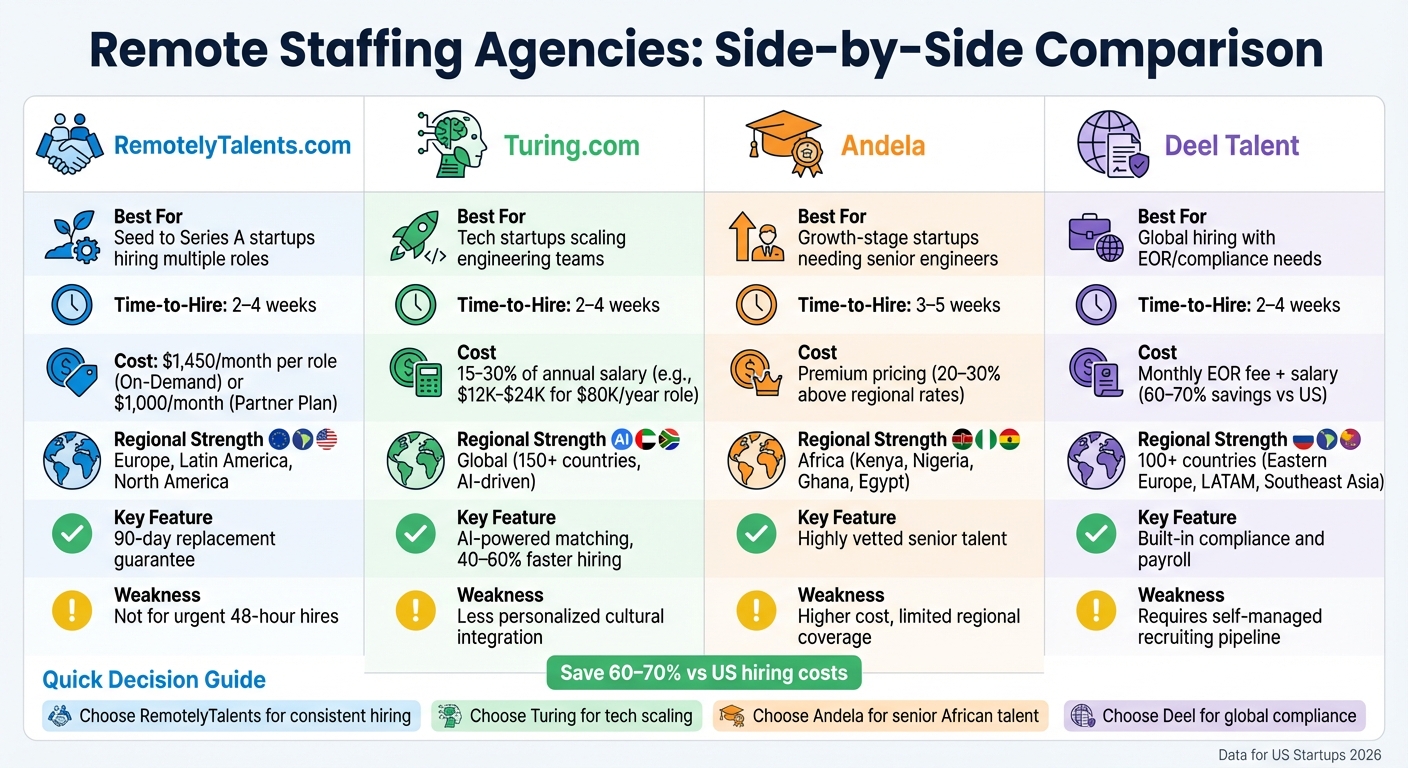
Remote Staffing Agencies Comparison for US Startups 2026
The table below highlights the strengths and weaknesses of four remote staffing agencies - RemotelyTalents.com, Turing.com, Andela, and Deel Talent - based on factors like startup stage fit, time-to-hire, cost, and regional expertise. These are the key considerations for US startups looking to scale their teams effectively.
| Agency | Best For | Time-to-Hire | Cost Structure (USD) | Regional Strength | Key Weakness |
|---|---|---|---|---|---|
| RemotelyTalents.com | Seed to Series A startups hiring consistently across multiple roles | 2–4 weeks | $1,450/month per role (On-Demand); $1,000/month (Partner Plan, 12-month commitment) | Europe, Latin America, North America | Unsuitable for urgent 48-hour hires |
| Turing.com | Tech-focused startups scaling engineering teams quickly | 2–4 weeks | Pricing varies by role and seniority, typically around $40–$100/hour for engineers | Global (AI-driven matching across 150+ countries) | Less personalized cultural integration; may require internal pipeline management |
| Andela | Growth-stage startups needing senior African tech talent for long-term roles | 3–5 weeks | Premium pricing; typically 20–30% above regional market rates for vetted senior engineers | Africa (Kenya, Nigeria, Ghana, Egypt) with growing presence in Latin America | Higher cost than other regional agencies; limited coverage outside core African markets |
| Deel Talent | Startups hiring globally without local entities, needing EOR and compliance support | 2–4 weeks | Monthly EOR fee per employee plus salary; potential savings of 60–70% compared to US hiring costs | Global, with strong coverage in Eastern Europe, Latin America, and Southeast Asia | Viewed more as an HR platform; requires startups to manage their own recruiting pipelines |
Agency Highlights
- RemotelyTalents.com: Offers predictable, flat-fee pricing and a 90-day replacement guarantee, making it ideal for startups with ongoing hiring needs. Their Partner Plan is especially cost-effective, and their focus on Europe, Latin America, and North America provides strong regional coverage. However, they may not be the best fit for companies needing hires within 48 hours.
- Turing.com: Known for its AI-driven approach to matching engineering talent globally, Turing.com is a great option for scaling tech teams quickly. That said, companies may need to handle cultural fit and onboarding internally, which adds effort on the startup’s end.
- Andela: Specializes in connecting growth-stage startups with senior African tech talent. While their engineers are highly vetted, the premium pricing and limited regional coverage outside Africa might not suit every budget or hiring strategy.
- Deel Talent: Perfect for startups needing Employer of Record (EOR) services and global compliance support. Deel Talent can save businesses up to 70% compared to US hiring costs. However, startups must independently source and vet candidates, as Deel operates more as an HR platform than a full-service staffing agency.
Final Thoughts
By weighing factors like startup stage, time-to-hire, cost, and regional expertise, you can identify the agency that aligns best with your team’s needs. Whether it's RemotelyTalents.com for steady hiring, Turing.com for tech scaling, Andela for senior African talent, or Deel Talent for global compliance, the right choice depends on your growth strategy.
Conclusion
Choosing the right hiring agency can be a game-changer for your startup. Using a clear decision framework - focused on budget, time-to-hire, quality risk, and compliance - can help you make an informed choice that supports your growth. For startups in the seed to Series A stages, particularly those hiring consistently across various roles, RemotelyTalents.com stands out. With flat-fee pricing, a 90-day replacement guarantee, and coverage across Europe, Latin America, and North America, it simplifies the hiring process. Their model eliminates the hassle of managing contingency fees and navigating internal compliance issues.
The goal is to find an agency that aligns with your current stage and future plans. As Nick from Startup Resources wisely says:
"The key isn't looking for the best agency but for the one that fits where you are right now and where you're heading" [5].
If your hiring needs span Europe, LATAM, or North America and you value straightforward pricing and low management overhead, RemotelyTalents.com offers a streamlined solution to scale your team efficiently.
To ensure success, start by creating a role scorecard that details seniority, tech stack, language requirements, and time zone preferences. Then, test the waters by piloting one or two hires before committing fully. This lets you evaluate metrics like time-to-fill, hire quality, and team fit, helping you build your remote workforce with confidence.
FAQs
What should I ask a remote staffing agency before signing?
When choosing an agency for your startup, asking the right questions can make all the difference. Start by digging into their replacement policy - what happens if a hire doesn’t work out? Next, understand their vetting process to gauge how thoroughly they screen candidates. Look into their cost structure to ensure it aligns with your budget, and don’t forget to ask about their time-to-hire to see if they can meet your timeline.
For international hires, clarify if the agency manages compliance and payroll, as this can save you a lot of headaches. Also, check if they specialize in certain regions or roles, which might be crucial depending on your needs. Finally, request references or case studies to see their track record and hear from other clients. These questions can help you assess whether the agency is a reliable and effective hiring partner.
How do I estimate total cost to hire remote talent in 2026?
When calculating the total cost of hiring, you need to account for more than just base compensation. Add in employer taxes, benefits, onboarding expenses, and compliance costs - all of which can vary depending on the region and the seniority of the role.
For instance, hiring mid-level professionals in the U.S. or Canada typically costs between $50,000 and $150,000 annually, while in regions like Latin America and Eastern Europe, the range is lower, around $30,000 to $80,000. Additionally, consider factors like how complex the role is, how quickly you need to fill it, and whether you're using an agency for payroll or compliance services. These elements can significantly influence the overall cost.
When should a startup use an EOR for remote hires?
Startups looking to hire remote talent across different regions can benefit greatly from using an Employer of Record (EOR). An EOR takes care of essential tasks like managing contracts, handling payroll, and ensuring compliance with local labor laws. This approach minimizes legal and operational risks, making it a smart choice for companies aiming to expand quickly, explore new markets, or deal with intricate labor regulations in areas such as Europe, Latin America, or North America.
Related Blog Posts
Read also



Ready to hire without salary-based agency fees?
Book a free 30-minute consultation. We’ll review your role, timeline, and hiring goals, then show you how our fixed-fee remote search works.