Cost to Hire a Remote Software Engineer in LATAM vs Eastern Europe (2026)


Hiring remote software engineers in 2026? Here’s the breakdown:
- LATAM offers lower costs (10–30% less than Eastern Europe) and better time zone overlap for U.S. teams, enabling real-time collaboration.
- Eastern Europe provides deeper expertise in AI, cybersecurity, and complex systems, with higher retention rates.
- Annual salaries: LATAM senior developers average $40,000–$50,000; Eastern Europe ranges from $45,000–$62,000.
- Hourly rates: Junior developers in LATAM start at $20/hour; Eastern Europe starts at $25/hour.
- Time-to-hire: Both regions deliver candidates in ~3 weeks, but LATAM is faster for U.S. companies due to time zone alignment.
Quick takeaway: Choose LATAM for cost savings and fast collaboration. Opt for Eastern Europe when technical complexity and long-term stability are priorities. A hybrid approach can combine the strengths of both regions.
Quick Comparison:
| Criteria | LATAM | Eastern Europe |
|---|---|---|
| Cost Savings | 10–30% lower | Slightly higher |
| Time Zone Overlap (U.S.) | 4–8+ hours | 3–5 hours (East Coast only) |
| Technical Expertise | Strong in SaaS, mobile apps | Advanced in AI, cybersecurity |
| Retention | Moderate | Higher |
| Time-to-Hire | ~3 weeks | ~3 weeks |
Next steps: Define your project needs, calculate total costs, and use a hybrid model if both speed and expertise are essential.
Why are U.S. companies hiring in LATAM and how can you do it the right way?
sbb-itb-88a7fe6
Cost Breakdown: LATAM vs Eastern Europe
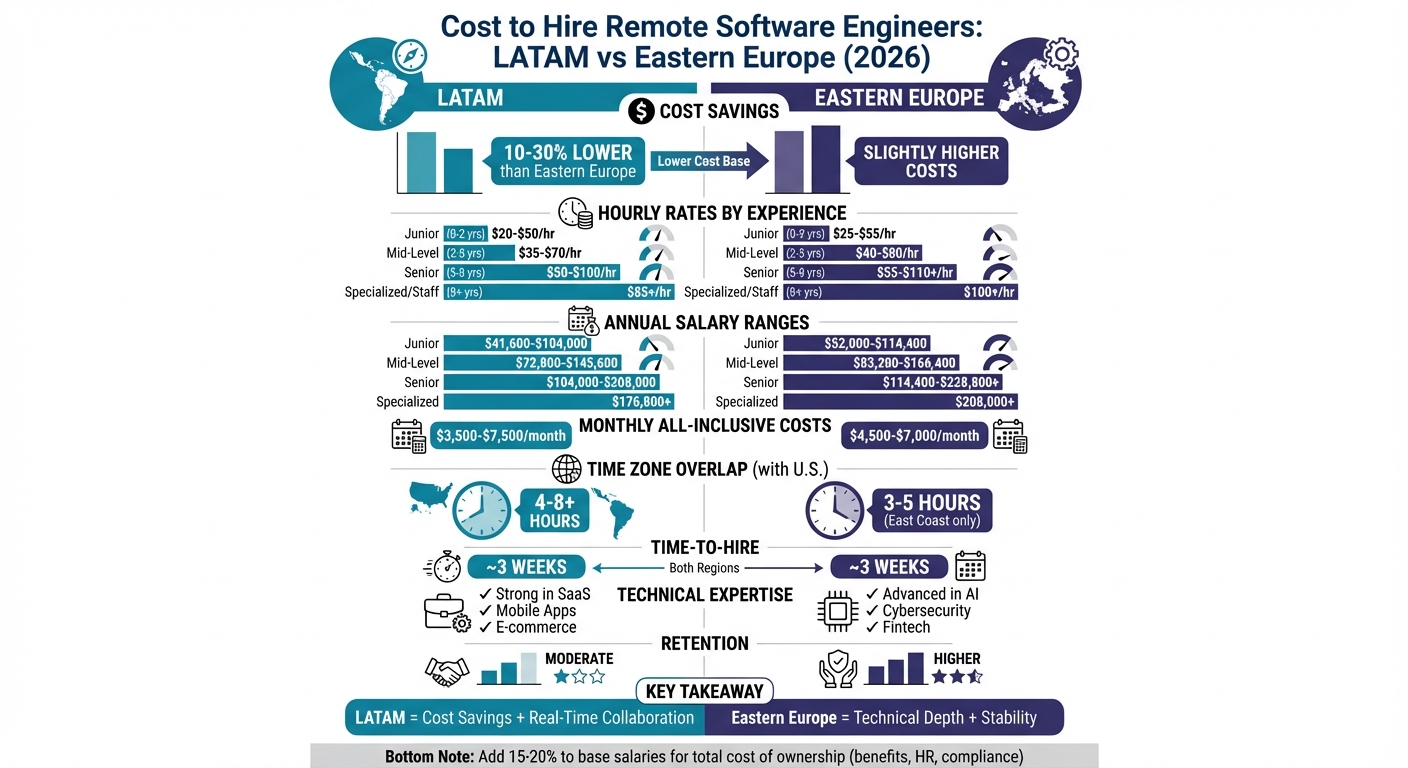
LATAM vs Eastern Europe Software Engineer Hiring Costs 2026 Comparison
2026 Salary Ranges by Experience Level
When comparing costs between LATAM and Eastern Europe, LATAM stands out with 10–30% lower upfront expenses, particularly for mid-to-senior roles [1]. On average, a software engineer in Latin America earns $60,363 annually, while in Central and Eastern Europe, the figure is slightly higher at $62,307 [3]. However, these averages don’t reflect the significant variations across countries and experience levels.
Here’s how hourly rates stack up by experience:
- Junior developers (0–2 years): LATAM rates range from $20 to $50 per hour, compared to $25 to $55 in Eastern Europe [1].
- Mid-level developers (2–5 years): LATAM costs rise to $35–$70 per hour, while Eastern Europe ranges from $40 to $80 [1].
- Senior engineers (5–8 years): LATAM hourly rates fall between $50 and $100, whereas Eastern Europe ranges from $55 to $110+ [1].
- Specialized or staff-level roles (8+ years): LATAM starts at $85+ per hour, while Eastern Europe begins at $100+ [1].
Annual salaries for senior developers also vary significantly by country. For example, Poland averages $50,000, Ukraine $45,000, Argentina $40,000, and Brazil $35,000 [5]. These salaries are roughly 20–29% of what U.S. developers earn, making both regions attractive for cost-conscious hiring [5].
Total Annual Cost Per Hire
Base salaries only tell part of the story. The total cost of ownership (TCO) includes additional expenses like recruitment, HR, payroll, benefits, and compliance. These factors typically add 15–20% to the base salary [2]. For instance, a senior developer in Poland earning $50,000 annually has an actual cost closer to $57,500–$60,000 once employer contributions, health insurance, equipment stipends, and administrative costs are added [2].
Monthly costs follow similar trends:
- LATAM developers: $3,500–$7,500 per month (all-inclusive).
- Eastern Europe developers: $4,500–$7,000 per month [2].
In November 2025, Willo, a video interviewing platform, partnered with Cloud Employee to expand their team using a managed nearshore model. They onboarded two engineers in just three weeks and achieved a developer retention rate exceeding four years. By opting for an all-inclusive monthly contract covering salary, benefits, and compliance, they avoided the typical 15–20% administrative overhead [2].
Side-by-Side Cost Comparison Table
Here’s a quick comparison of hourly and annual rates across regions:
| Seniority Level | LATAM (Hourly) | Eastern Europe (Hourly) | LATAM (Annual) | Eastern Europe (Annual) |
|---|---|---|---|---|
| Junior (0–2 years) | $20–$50 | $25–$55 | $41,600–$104,000 | $52,000–$114,400 |
| Mid-Level (2–5 years) | $35–$70 | $40–$80 | $72,800–$145,600 | $83,200–$166,400 |
| Senior (5–8 years) | $50–$100 | $55–$110+ | $104,000–$208,000 | $114,400–$228,800+ |
| Specialized/Staff (8+ years) | $85+ | $100+ | $176,800+ | $208,000+ |
Annual figures assume 2,080 working hours per year (40 hours/week × 52 weeks). Add 15–20% for total cost of ownership, including benefits and administrative overhead [1][2].
Key takeaway: LATAM offers the best savings for U.S.-based teams, especially when real-time collaboration is essential. Eastern Europe, while slightly more expensive, often justifies the higher cost with deeper expertise in areas like AI, cybersecurity, and advanced engineering [1].
Time-to-Hire and Operational Factors
Average Time-to-Hire by Region
LATAM and Eastern Europe are known for their ability to deliver qualified candidates quickly through professional recruitment services. By 2026, nearshore hiring models are expected to cut recruitment cycles down to just three weeks - much faster than the months-long process often seen with traditional in-house recruitment methods [2].
For U.S.-based companies, LATAM tends to have a slight advantage. The region's alignment with U.S. culture and overlapping time zones make it easier to schedule interviews and make hiring decisions promptly [1]. On the other hand, Eastern Europe offers a rich talent pool, particularly for deep technical roles, making it an excellent choice for highly specialized positions [1].
A great example of this efficiency comes from Willo, which used a nearshore model to onboard two engineers in just three weeks. This approach saved them 825 hours in recruitment time and resulted in a retention rate of over 97% [2]. Shorter hiring cycles like these not only reduce recruitment costs but also help maintain project momentum.
Time Zone Overlap and Real-Time Collaboration
Time zone alignment plays a major role when deciding between LATAM and Eastern Europe. LATAM provides a significant advantage for U.S.-based teams, with 4 to 8+ hours of overlap depending on the location. This overlap allows for real-time collaboration, daily stand-up meetings, and even live pair programming sessions [1]. For U.S. teams, particularly those on the West Coast, this alignment ensures smooth, uninterrupted workflows.
In contrast, Eastern Europe operates 6 to 8 hours ahead of the U.S., leaving East Coast teams with only 3 to 5 hours of overlap - and even less for teams further west [1]. While asynchronous workflows can help bridge this gap, they require careful planning to address urgent, time-sensitive issues.
For companies that prioritize daily interaction and real-time collaboration, LATAM emerges as the preferred option. As Uptalen notes, "Many US firms choose LATAM for seamless flow. It cuts delays and boosts momentum" [1]. Eastern Europe, however, is better suited for projects requiring deep technical expertise, where asynchronous collaboration is more manageable. Regardless of the region, effective onboarding is critical to fully capitalize on time zone advantages.
Onboarding and Integration Challenges
Cultural fit and language proficiency are crucial during the onboarding process. LATAM developers often adapt quickly to U.S. companies due to their familiarity with American media, business tools, and practices, which streamlines integration [1]. Eastern European teams, while equally skilled, tend to have a more formal communication style, even though their English proficiency is strong at senior levels [1]. Both regions offer bilingual talent, but LATAM's cultural alignment often accelerates the integration process, typically within 30 to 60 days.
Managed service models in both regions simplify onboarding by handling HR, compliance, payroll, and benefits under a single monthly fee. This helps avoid the usual 15–20% administrative overhead associated with these tasks [2].
To address potential integration challenges, companies should use technical tests and reference checks during the hiring process to ensure candidates meet their standards [1]. These operational efficiencies can play a key role in determining which region aligns best with your business needs.
Which Region Fits Your Business
When to Choose LATAM
If you're a US-based startup or early-stage company working with tight budgets and a need for speed, LATAM might be your perfect match. With a hiring budget under $50,000 per role, you can build an agile team that thrives on real-time collaboration. Thanks to the region's time zone alignment with the US, your engineers can seamlessly join daily stand-ups, participate in live code reviews, and tackle urgent issues without delays [1].
LATAM developers shine in areas like agile delivery, SaaS development, mobile apps, and e-commerce projects - especially when speed and momentum take priority over intricate architectural challenges [1]. And here's the kicker: hiring from LATAM generally costs 10–30% less than bringing on engineers from Eastern Europe [1].
"LATAM wins pure cost for US teams. It cuts delays and boosts momentum." - Uptalen [1]
When to Choose Eastern Europe
Eastern Europe is a better fit for SMBs and mid-market companies that require advanced technical expertise, strong retention, and long-term stability. If your projects involve AI, cybersecurity, fintech, or complex system architecture, engineers from this region bring the skills and experience to handle these challenges effectively [1]. With a thriving tech scene - Poland alone boasts over 500,000 developers - Eastern Europe is well-equipped to tackle highly technical problems [1].
While hourly rates range from $25 to $110+ depending on seniority, the region's lower turnover rates and strong retention often balance out costs over time [1]. This makes Eastern Europe ideal for building products that demand consistent technical leadership rather than just rapid feature rollouts.
"Europe delivers higher value on complex projects, balancing the rate over time." - Uptalen [1]
If your business needs go beyond fast execution to include long-term technical leadership, Eastern Europe is a solid choice.
Using Both Regions Together
For companies with diverse needs - balancing rapid delivery with technical depth - a hybrid approach can be a game-changer. By combining the strengths of both regions, businesses can achieve the best of both worlds.
Here's how it works: hire junior and mid-level engineers from LATAM to scale your team quickly and keep costs manageable. Then, bring in senior engineers from Eastern Europe for core architecture, technical leadership, and tackling complex problems [1].
This blend allows you to leverage LATAM's speed and cost efficiency for day-to-day development while relying on Eastern Europe's expertise for critical decisions. Many businesses using this model report faster time-to-market without compromising on code quality or long-term stability. It's an especially effective strategy for mid-market businesses aiming to grow quickly while maintaining technical rigor.
Decision Tools and Next Steps
Pre-Hire Checklist
Start by defining your staffing solution and technical requirements, calculating the total cost of ownership (TCO), and setting realistic timelines. When calculating TCO, remember to factor in an additional 15–20% on top of base salaries to cover recruitment, HR, payroll, benefits, and compliance costs [2]. Establish firm hiring timelines - specialized agencies can often reduce the recruitment cycle to just three weeks [2]. Plan ahead by selecting technical tests, reference checks, and assessments for cultural alignment early on. Screening for communication style and cultural fit during the initial stages helps reduce long-term turnover. For example, LATAM developers often align well with U.S. workplace norms, while Eastern European teams typically share Western Agile practices and a direct communication approach [1].
Region Selection Scorecard
Once your hiring fundamentals are in place, use this scorecard to evaluate which region - LATAM or Eastern Europe - best fits your needs. Rate each factor from 1 to 5 (1 = poor fit, 5 = excellent fit) based on your specific priorities:
| Factor | Weight | LATAM Score | Eastern Europe Score |
|---|---|---|---|
| Budget Constraints (Lower cost = higher score) | 25% | _____ | _____ |
| Time Zone Overlap (More overlap = higher score) | 20% | _____ | _____ |
| Technical Complexity (Match to regional strength) | 25% | _____ | _____ |
| Hiring Speed (Faster = higher score) | 15% | _____ | _____ |
| Long-Term Retention (Lower turnover = higher score) | 15% | _____ | _____ |
Multiply each score by its weight and add them up. The region with the higher total score will likely be the best match for your project. For example, if your team requires 4–8+ hours of real-time collaboration with U.S.-based colleagues, LATAM generally scores higher due to better time zone alignment [1]. On the other hand, if your project involves AI, cybersecurity, or fintech, Eastern Europe’s strong engineering expertise might give it an edge in the technical complexity category [1].
How RemotelyTalents.com Helps You Hire Faster

RemotelyTalents.com simplifies the hiring process with tailored service plans designed for both LATAM and Eastern Europe. Their platform connects you to a pool of 10,000+ pre-screened candidates across these regions.
- The On-Demand plan, starting at $1,450/month per open role, requires no long-term commitment and includes a 90-day replacement guarantee.
- For companies with consistent hiring needs, the Partner plan costs $1,000/month (with a 12-month commitment) and is ideal for teams making 4–6+ hires annually.
Most roles are filled within 5–7 weeks, a significant improvement over traditional recruitment timelines. Each client is assigned a dedicated senior-level recruiter and account manager, who provide updates via Slack and share weekly progress reports. With recruiters based in both Europe and Latin America, you’ll gain region-specific insights on cost, quality, and time zone alignment. Additionally, their Global Salary Guide - 2026 offers transparency on pay rates [4].
For companies that prefer managing recruitment themselves, the Self Service plan is available for a one-time fee of $299. This option promotes your job listing to their entire candidate database and hiring network for three months, allowing you to receive applications directly while maintaining full control over the process.
Conclusion
After weighing compensation bands, retention trends, and collaboration factors, here's a streamlined overview of your options. The choice between LATAM and Eastern Europe comes down to three key factors: cost, time zone compatibility, and technical expertise. LATAM offers 10–30% upfront savings compared to Eastern Europe and provides 4–8+ hours of daily overlap with U.S. teams. This makes it ideal for real-time collaboration and agile workflows, especially when speed and cost-efficiency are your top priorities [1]. On the other hand, Eastern Europe shines in specialized fields like AI, cybersecurity, and fintech, with lower turnover rates and deep technical skills [1].
Both regions offer 40–65% savings compared to hiring onshore in the U.S. The best choice depends on your project's complexity, budget, and operational needs. If your focus is on advanced technical expertise or aligning with EU markets, Eastern Europe may be the better fit.
By 2026, many companies are adopting hybrid regional models - combining LATAM's cost savings and real-time collaboration with Eastern Europe's technical depth. This strategy is particularly effective for mid-sized and enterprise teams managing diverse product lines or intricate technical stacks [1].
RemotelyTalents.com simplifies this process by offering access to 10,000+ pre-screened candidates across both regions, with most hires finalized within 5–7 weeks. Their flexible plans include an On-Demand option at $1,450/month and a Partner plan at $1,000/month. Each client benefits from a dedicated senior recruiter, account manager, weekly Slack updates, and a 90-day replacement guarantee.
This framework equips you to make confident, informed hiring decisions. Next step: Download the Global Salary Guide - 2026, then use the Region Selection Scorecard to align these insights with your hiring goals. If you're ready to proceed, RemotelyTalents.com can connect you with top candidates in either region within two weeks.
Related Blog Posts
Read also



Ready to hire without salary-based agency fees?
Book a free 30-minute consultation. We’ll review your role, timeline, and hiring goals, then show you how our fixed-fee remote search works.