IP Protection Clauses for International Contractors (Template)


When hiring international contractors, protecting your intellectual property (IP) is critical. Without clear, enforceable IP clauses in your contracts, you risk losing ownership of work, facing legal disputes, or scaring off investors during funding rounds. Here’s what you need to know:
- Why It Matters: Payment alone doesn’t transfer IP rights. Local laws govern IP ownership, not your company’s location.
- Key Risks: Ownership gaps, GDPR fines (up to 4% of global revenue), and disputes over IP claims.
- Essential Clauses: Include IP Assignment, Confidentiality, and Work Product Ownership clauses to secure rights.
- Regional Challenges: Laws differ by country - e.g., moral rights in Europe, labor protections in Latin America.
- Solutions: Use jurisdiction-specific contracts, consider top Employer of Record (EOR) services, and audit agreements regularly.
Protecting IP isn’t just a legal formality - it ensures smooth operations, safeguards company assets, and builds investor confidence.
IP Explained: Who Owns a Company's Intellectual Property?
sbb-itb-88a7fe6
Essential IP Protection Clauses Explained
When working with international contractors, safeguarding your intellectual property (IP) is non-negotiable. Without the right clauses in your agreements, you could lose ownership of the work you paid for, expose sensitive data, or face messy legal battles over who controls your product’s code, designs, or content. To avoid these pitfalls, every contract should include three key clauses: IP Assignment, Confidentiality and Non-Disclosure, and Work Product Ownership. Together, they form a solid framework to protect your rights and eliminate gaps that could lead to disputes or complications during funding rounds or acquisitions.
IP Assignment Clause
The IP assignment clause is what guarantees that all intellectual property - whether it’s inventions, designs, code, or creative works - created by the contractor becomes your company’s property. This is critical because, in most jurisdictions, the default rule is that the creator owns the IP, even if you paid for it [6]. To avoid surprises, the clause must be in writing and tailored to comply with local laws.
Key elements of an effective IP assignment clause include:
- Immediate Transfer: Ownership should transfer automatically upon creation, not after payment or final approval. This avoids disputes over when ownership changes hands [4].
- Broad Coverage: Ensure the clause covers patents, trademarks, copyrights, trade secrets, and more - everything from source code to brand assets [7].
- Further Assurances: Add a provision requiring contractors to assist with formalities like signing patent applications or trademark registrations, even after the contract ends [4].
In regions like Europe and Nordic countries, moral rights - such as the creator’s right to attribution - often cannot be fully transferred. To address this, include waivers or consents as allowed by local laws [5].
"In most countries, unless there's a signed agreement that transfers ownership, the person who creates the work owns the copyright or invention - even if you paid them." – PatentPC [6]
It’s also important to note that relying solely on the U.S. "work made for hire" doctrine won’t work for international contractors. This concept often doesn’t apply to non-employees and is not recognized in many civil law jurisdictions like France, Germany, or Brazil [5].
Confidentiality and Non-Disclosure Clauses
Confidentiality and Non-Disclosure Agreements (NDAs) are vital for protecting sensitive business information, trade secrets, and proprietary data that contractors may access. A strong clause doesn’t just say “keep it confidential”; it spells out specific measures, like requiring encrypted communication and the use of approved tools.
Global data protection laws, such as GDPR (Europe), CCPA (California), LGPD (Brazil), and PDPA (Singapore), add another layer of complexity. For instance, if your contractor handles EU residents’ data, you’ll need a Data Processing Agreement (DPA) outlining how data will be processed and secured. Failing to meet GDPR standards could result in fines of up to 4% of your annual global revenue or €20 million [3].
Other best practices for confidentiality clauses include:
- Defined Duration: Set a clear timeframe for confidentiality obligations, typically three to five years after the contract ends. Indefinite restrictions may not hold up legally.
- Sub-Processor Restrictions: Require contractors to get written approval before engaging sub-contractors, ensuring your data stays secure [3].
While confidentiality clauses protect your sensitive information, they work hand-in-hand with work product ownership clauses to secure your deliverables.
Work Product Ownership Clause
The work product ownership clause ensures that everything produced under the contract - be it code, designs, or documentation - belongs to your company. It complements the IP assignment clause by clearly defining what constitutes "work product" and confirming that ownership transfers immediately upon creation.
Here’s what to include for airtight protection:
- Broad Definition: Cover all deliverables, including drafts, source code, and derivative works.
- Immediate Transfer: Establish work-for-hire status to ensure ownership transfers as soon as the work is created [3].
- Post-Termination Coverage: Specify that ownership obligations survive the contract’s end, covering any work started during the engagement.
Given that 34% of international contractors report payment delays or disputes, tying ownership to payment milestones could lead to complications [3]. Instead, make ownership automatic upon creation. Also, specify which country’s laws govern the IP transfer to avoid ambiguity in cross-border disputes [4].
| Feature | Contractor IP Clause | Employee IP Clause |
|---|---|---|
| Default Ownership | Typically remains with the contractor | Often transfers automatically to the employer |
| Transfer Mechanism | Must be explicitly negotiated and in writing | Generally automatic through employment relationships |
| Moral Rights | May require specific waivers or consents | Usually addressed by standard employment law |
| Risk of Misclassification | High; potential voiding of IP transfer if reclassified | Low; ownership is inherently tied to employment status |
How to Adapt Clauses by Country and Region
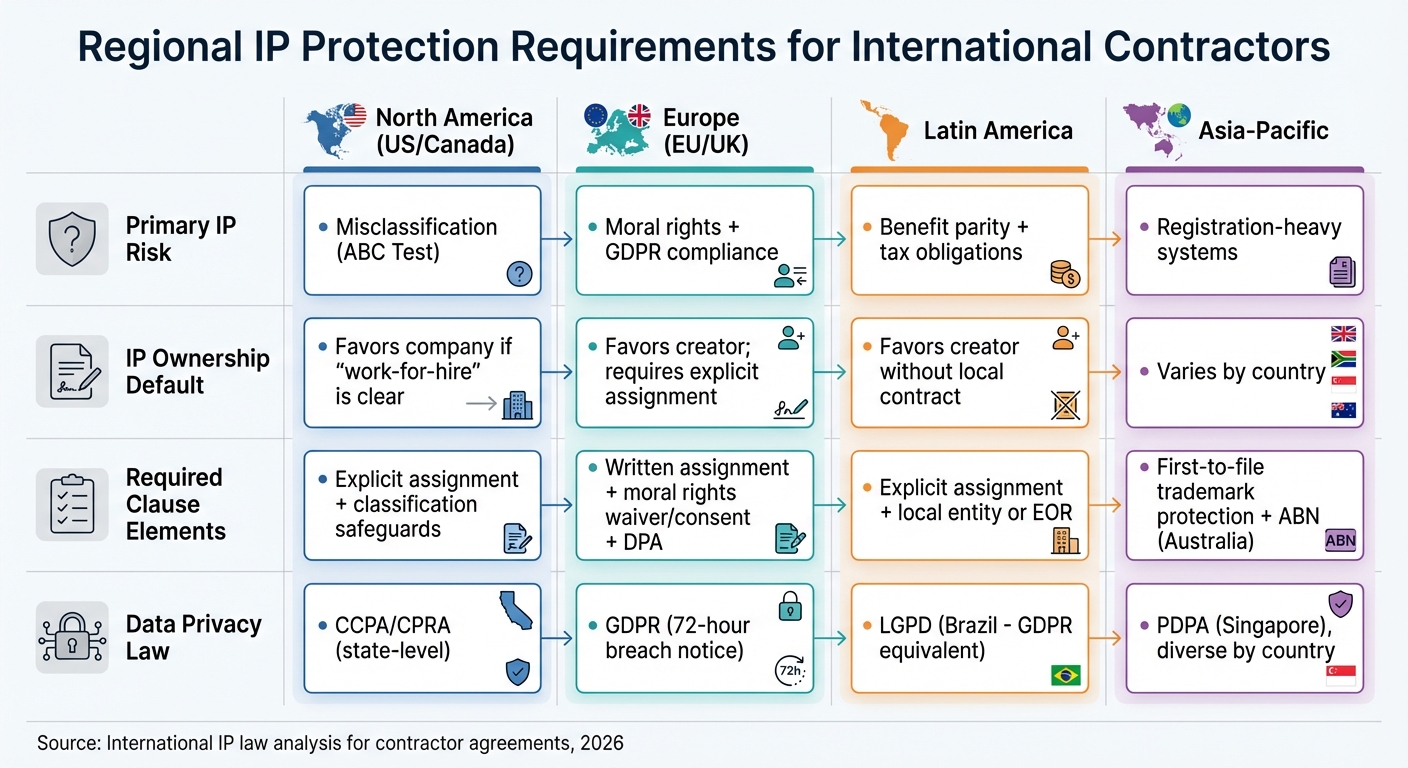
IP Protection Requirements by Region: Ownership Defaults, Required Clauses, and Data Privacy Laws
Regional Differences in IP Law
To protect your intellectual property (IP) effectively, tailoring your clauses to fit local laws is crucial. A common mistake is assuming that the IP rules of your home country apply universally. Your contract must align with the legal framework of your contractor's location [1]. Otherwise, you risk enforcement issues, as IP ownership rules differ significantly across regions.
In common law countries like the United States, United Kingdom, and Australia, IP created within the scope of work often transfers to the hiring company - provided there's an employment relationship or a written agreement in place. However, in civil law countries like Germany, France, and the Netherlands, explicit written invention assignment clauses are required by law [5]. For example, in the Netherlands, contractors can register trademarks under their own name if they create them during a project, potentially surprising foreign companies [7].
Europe also introduces the concept of moral rights, which protect a creator's right to attribution and the integrity of their work. In France and Germany, these rights cannot be waived through a contract. Instead, agreements should include clauses like "modification consent" or "attribution agreements" to navigate these rights without breaching local laws [5]. Similarly, Nordic countries enforce strong moral rights, ensuring creators retain attribution even after transferring economic ownership [5].
"In some countries, IP rights default to the creator over the commissioner. So, if your company works with an international contractor, the IP for their work may default to the contractor (without a watertight contract)." – Remote.com [7]
Latin America presents its own challenges. For instance, in Brazil and Mexico, contractors may qualify for the same benefits as full-time employees under local labor laws, which can alter IP ownership rules entirely [1]. Brazil's LGPD, which mirrors GDPR, further complicates matters by requiring specific data processing agreements within IP clauses [3].
Common Drafting Mistakes and How to Fix Them
Using generic domestic templates can jeopardize your IP rights by ignoring critical local requirements, such as currency conversion terms, regional IP defaults, and tax obligations [3]. For instance, 73% of cross-border payment disputes arise from unclear currency terms, with issues like failing to specify the exact currency or exchange rate timing being major contributors [3].
The U.S.-centric "work-for-hire" concept doesn’t translate globally. Instead, use explicit language such as "assignment of all rights, title, and interest" [3][5]. If you’re working with an Employer of Record (EOR), implement a two-step IP transfer: first, from the contractor to the EOR's local entity under local laws, and then from the EOR to your company. This ensures a clear chain of title that holds up in court [2].
In some countries, physical signatures or registration with local authorities are required to finalize IP transfers [4]. Additionally, confidentiality clauses should specify a duration of three to five years after termination [3].
Worker misclassification can also void IP assignments. If a contractor is deemed an employee under local laws based on control factors, your IP clause might be invalid. Starting in 2026, many countries are tightening rules around worker classification, often reclassifying gig workers as employees to ensure tax and benefit compliance [3]. In the U.S., California’s ABC test presumes workers are employees unless they demonstrate a high level of autonomy. In Germany, the Termination Protection Act requires exploring all alternatives before termination, which can imply an employment relationship [1].
How to address these issues:
- Choose governing laws with strong IP frameworks, such as Delaware or the UK, but include a "local law compliance" carve-out to avoid conflicts with mandatory local labor protections [4][5].
- Use dual-language agreements in non-English speaking regions, specifying that the local-language version will govern in case of disputes [5].
- Register trademarks and patents early in the contractor’s jurisdiction, as many regions operate on a "first-to-file" basis [5].
Jurisdiction Comparison Table
Here’s a quick reference guide to regional IP risks and requirements:
| Region | Primary IP Risk | IP Ownership Default | Required Clause Elements | Data Privacy Law |
|---|---|---|---|---|
| North America (US/Canada) | Misclassification (ABC Test) | Favors company if "work-for-hire" is clear | Explicit assignment + classification safeguards | CCPA/CPRA (state-level) |
| Europe (EU/UK) | Moral rights + GDPR compliance | Favors creator; requires explicit assignment | Written assignment + moral rights waiver/consent + DPA | GDPR (72-hour breach notice) |
| Latin America | Benefit parity + tax obligations | Favors creator without local contract | Explicit assignment + local entity or EOR | LGPD (Brazil - GDPR equivalent) |
| Asia-Pacific | Registration-heavy systems | Varies by country | First-to-file trademark protection + ABN (Australia) | PDPA (Singapore), diverse by country |
How to Choose the Right IP Clauses for Your Business
Choosing the right IP protection clauses isn’t about picking the most complicated legal language you can find. It’s about aligning your contract terms with your business’s actual needs - your budget, risk tolerance, and ability to enforce the agreements you create.
Budget and Total Hiring Costs
Your budget plays a big role in determining how much protection you can afford. For example, Employer of Record (EOR) services - costing $400–$600 per month per contractor - handle the two-step IP transfer process. This ensures a clear chain of title, which is vital during audits or acquisitions[5]. On the other hand, startups with limited resources might rely on standard templates, but this comes with risks. Around 10–30% of such companies face misclassification issues that could void IP assignments[5].
Additionally, payment terms matter. With 34% of international contractors reporting payment delays[3], it’s wise to include currency and exchange rate terms in your contracts (e.g., "USD at time of invoice"). Digital payment platforms like Wise charge 1.5–2%, which is lower than the 4–5% fees from traditional banks[3].
Once you’ve factored in costs, the next step is to consider legal compliance.
Legal Risk and Compliance Requirements
If your business operates in high-stakes industries like SaaS, fintech, or manufacturing, jurisdiction-specific clauses are critical. For instance, handling EU customer data through contractors requires Data Processing Agreements (DPAs) to comply with GDPR. Without these, violations could cost up to 4% of your annual revenue[3].
Looking ahead, global regulations around contractor versus employee classification are tightening, with major changes expected by 2026[3]. If contractors are reclassified as employees, local labor laws might invalidate work-for-hire clauses. To avoid this, include behavioral and financial control clauses that clearly establish the contractor’s independent status. Alternatively, using an EOR model can help solidify employment terms and prevent IP ownership disputes during audits.
Finally, it’s essential to consider your team’s ability to enforce these clauses.
Team Size and Management Capacity
Your team’s size and expertise will determine how much complexity you can manage. Small teams with limited legal resources should stick to standardized work-for-hire clauses and rely on an EOR to handle local law variations[4][9]. Mid-sized teams might opt for hybrid agreements, where the company owns deliverables but contractors retain limited rights, like using work in their portfolios[3]. Larger companies with in-house legal teams can take a more detailed approach, including jurisdiction-specific assignments and indemnity clauses to safeguard IP during liquidity events[2].
However, even the best-written clauses need operational support. If your team can’t track digital acknowledgments, confirm contractor identities quickly, or enforce security measures like multi-factor authentication, your IP may still be at risk[5]. Strong legal agreements should be paired with technical safeguards like VPNs and restricted access to prove you’ve taken reasonable steps to protect trade secrets.
2026 Cost Breakdown for Hiring International Contractors
Hiring international contractors involves more than just their hourly rates. You’ll also need to account for legal requirements, payment processing, compliance tools, and intellectual property (IP) protection measures.
Cost Comparison by Region
Hourly rates for contractors vary widely depending on the region. In the United States and Canada, senior software engineers typically charge between $80 and $150 per hour, while mid-level developers range from $50 to $80 per hour. In Latin America, senior developers cost $30 to $60 per hour, and mid-level professionals range from $20 to $40 per hour. Eastern Europe falls somewhere in between, with senior developers charging $40 to $80 per hour and mid-level professionals costing $25 to $50 per hour.
However, hourly rates are just part of the story. For instance:
- In Canada, contractors earning over CAD $30,000 annually must charge GST/HST on their invoices.
- EU-based contractors often add VAT, which can range from 15% to 27% on top of their fees[3].
- Payment platforms like Wise charge processing fees of 1.5% to 2%, while traditional bank transfers can cost between 4% and 5%[3].
- If you use an Employer of Record (EOR) service, expect to pay an additional $400 to $600 per month per contractor. This service provides stronger IP protection and reduces the risk of misclassification[5]. Over a year, this adds up to $4,800–$7,200 per contractor.
What Affects Contractor Pricing
Several factors influence contractor pricing, starting with the complexity of the role. For example, a junior marketing coordinator in Latin America might charge $25 to $35 per hour, but a senior backend engineer handling sensitive financial data could cost $60 to $100 per hour. Additionally, roles involving sensitive information - like fintech or SaaS work - may require extra security measures, such as zero-trust architecture and continuous monitoring tools, which can add $50 to $200 per user per month[5].
Urgency also plays a role. While contractor agreements allow for quick onboarding, they often lack strong IP protection. EOR setups, which take about 24 hours to establish, offer better IP assignment. On the other hand, creating your own legal entity can take 2 to 4 months but provides the most control[5].
Specific legal requirements can also increase costs. For example, in Germany, non-compete clauses for senior roles require financial compensation during the restriction period, adding another expense to consider[5].
Clear project scopes can help manage costs. Vague or poorly defined deliverables often lead to scope creep and disputes, which 34% of international contractors report as a common issue[3]. Defining deliverables in detail - such as “10 blog posts, each 1,500 words, SEO-optimized” - can minimize revisions and ensure accurate pricing.
Budget Planning for Remote Hiring
To effectively budget for international contractors, focus on three main areas: contractor compensation, legal and compliance costs, and recruitment support. Here’s an example:
- A mid-level contractor in Latin America earning $35 per hour and working 40 hours per week will cost approximately $6,067 per month in compensation.
- Add $400 to $600 per month for EOR services if you need strong IP protection.
- Factor in $50 to $100 per month for security tools like multi-factor authentication (MFA) and VPNs[5].
Opting not to use an EOR can lead to unexpected expenses, such as IP audits or misclassification penalties[5].
For a streamlined approach, consider services like RemotelyTalents.com. Their Partner Plan costs $1,000 per month with a 12-month commitment, offering pre-vetted talent from Europe, Latin America, and North America. This plan eliminates the need for multiple vendors and reduces the time-to-hire to 4–6 weeks.
For startups needing more flexibility, the On-Demand Plan costs $1,450 per month per open role. It includes a 90-day replacement guarantee and requires no long-term commitment.
Ready-to-Use Tools and Templates
Understanding the risks and costs tied to weak IP clauses is only half the battle. These tools and templates are designed to help you take immediate steps to strengthen your contracts. The difference between a contract that safeguards your intellectual property and one that leaves gaps lies in the details. The checklists and decision tools below are here to help you identify and address those gaps before they turn into costly problems.
IP Clause Drafting Checklist
This checklist is an essential tool for drafting or reviewing contractor agreements, especially when working with international contractors. It targets key areas to ensure your intellectual property is thoroughly protected.
- Scope Definition: Clearly list every type of intellectual property the contractor will create - whether it's inventions, software code, designs, documentation, or trade secrets. Avoid vague terms like "all work product", especially in Civil Law countries like Germany or France, where courts require precise descriptions [4][3].
- Assignment Language: Use the phrase "hereby assigns" instead of "will assign." The former transfers ownership immediately upon creation, while the latter creates a future obligation that might never materialize [9][5].
- Timing of Transfer: Ensure the agreement specifies that the assignment is "immediate and automatic upon creation" [4].
- Moral Rights: In Common Law jurisdictions like the US, UK, and Australia, include a waiver of moral rights. For Civil Law countries such as Germany, France, and Nordic nations - where moral rights cannot be waived - add clauses for "attribution consent" and "modification consent" [5].
- Cooperation and Pre-existing IP: Include provisions for post-contract cooperation and list any pre-existing intellectual property. Allow for remote signatures to streamline digital workflows [4].
- Confidentiality and Survival: Set confidentiality periods - 2–5 years for general data and indefinite for trade secrets. Make sure these obligations continue even after the contract ends [3][5].
- Technical Controls: Require security measures like multi-factor authentication (MFA), VPN usage, and data encryption (both at rest and in transit). Courts often view these as proof that you treat your intellectual property as genuinely confidential, which can bolster trade secret claims [5].
- Governing Law and Jurisdiction: Specify which country's laws govern the agreement and where disputes will be resolved. For international agreements, arbitration is often quicker and more enforceable than litigation [4][3].
"When a contractor relationship fails an audit, the IP ownership fails too. You're not just facing tax penalties; you're facing questions about who actually owns the code your product runs on." - Teamed Editorial Team [5]
The checklist is supported by a decision tree to help you tailor clauses based on the contractor's role and jurisdiction.
Clause Selection Decision Tree
This decision tree is designed to guide you through selecting the appropriate IP clauses for different contractor scenarios. Tailored clauses can make all the difference when working with international contractors.
-
Step 1: Assess Role Sensitivity
Contractors in roles like marketing, general administration, or public-facing content typically only need standard agreements with basic IP assignment clauses. However, for roles involving software development, R&D, or fintech, stronger protections are critical [5]. -
Step 2: Determine Legal System
In Common Law countries (US, UK, Australia), IP assignment can be automatic for work within scope. In Civil Law countries (Germany, France, Spain), written clauses are mandatory, and inventor compensation may also be required [5]. -
Step 3: Evaluate Data Access
Contractors with access to sensitive data - like proprietary code, personally identifiable information (PII), or trade secrets - require robust security measures. This includes zero-trust architecture, network segmentation, hardware security keys, and continuous monitoring. Basic password protection won't suffice [5]. -
Step 4: Choose Employment Model
Standard contractor agreements offer the least protection since they rely solely on contract language. Employer of Record (EOR) services, which cost around $400–$600 per month, provide stronger protections by using local legal entities. For the highest level of protection, consider establishing your own local entity, though this can take 2–4 months [5]. -
Step 5: Add Regional Compliance
If the contractor handles data from EU residents, include GDPR clauses. For work in Brazil, add LGPD provisions. For contractors in California, ensure CPRA requirements are incorporated [3].
Misclassifying contractors is a common mistake that can void IP assignment clauses in many jurisdictions. Estimates suggest that 10% to 30% of employers misclassify workers, leading to ownership gaps that can cost $15,000–$50,000 per jurisdiction to resolve [5].
Why Specialized Recruitment Agencies Matter for IP Protection
Why General Hiring Methods Fall Short
When it comes to protecting intellectual property (IP), many companies rely on generic hiring practices that can leave critical gaps. The typical approach - post a job, sign a contract, and get started - might seem efficient, but it often overlooks key legal nuances. These gaps, especially in international contexts, tend to emerge during audits, funding rounds, or even exits. The issue? IP ownership is governed by local employment laws, not just the language of your contract or the policies of your headquarters [5].
For instance, using standard, English-only contracts in countries like France or Germany - where civil law dominates - can lead to major enforcement issues. Courts in these jurisdictions may reject agreements not provided in the local language, making it difficult to uphold IP clauses. Additionally, standard contracts often neglect moral rights, which guarantee creators the right to attribution and integrity of their work. These rights can't simply be waived with a generic clause. Fixing these oversights later isn't cheap - remediation costs can range between $15,000 and $50,000 per jurisdiction [5].
This is where specialized recruitment agencies step in, offering tailored solutions to address these risks head-on.
The Business Case for Specialized Recruitment
Specialized recruitment agencies, particularly those well-versed in international IP laws, provide a clear advantage. They don’t just fill positions - they mitigate legal risks, streamline onboarding, and ensure airtight IP ownership.
One of the key tools these agencies use is the Employer of Record (EOR) model. This approach establishes formal, locally compliant employment relationships, ensuring automatic IP assignment. The process is thorough: IP rights are first transferred from the contractor to the agency’s local entity and then passed directly to your company, creating a clear and enforceable chain of custody [2]. Some agencies go a step further by owning their local legal entities outright, removing third-party risks entirely [2].
Beyond legal security, specialized agencies simplify the hiring process. Their platforms can reduce contractor paperwork and compliance efforts by up to 90% [9]. From day one, digital onboarding workflows integrate essential documents like IP assignment agreements and non-disclosure agreements, along with verified identity checks to confirm that the individual signing the contract is the one actually performing the work. Crucially, these agencies also assume the risk of worker misclassification. If local authorities decide to reclassify a contractor, the agency - not your company - handles the liability [5].
While these services come at a higher cost, the benefits are hard to ignore. Contractor platforms might charge $40–$50 per month but offer minimal IP protection. In contrast, EOR services, priced at $400–$600 per employee per month, provide stronger legal certainty and automatic IP assignment. For roles involving sensitive work - like software development or design - this model provides the confidence investors and acquirers need in your IP ownership chain [5].
Where to Find and Hire International Contractors
Hiring Methods Compared
When hiring international contractors, it’s important to weigh your options carefully, especially when it comes to speed, cost, intellectual property (IP) protection, and compliance risks. You have four main methods to choose from: in-house recruitment, freelance platforms, traditional recruitment agencies, and specialized agencies with Employer of Record (EOR) capabilities. Each comes with its own pros and cons.
In-house recruitment gives you full control over the hiring process. However, you’ll need to navigate local labor laws, manage tax withholdings, and ensure proper worker classification on your own [10][11]. This approach also requires drafting legally compliant contracts and verifying identities - tasks that can be challenging without a dedicated legal or HR team. Misclassification risks are a real concern here, with 10–30% of employers misclassifying workers as independent contractors [5].
Freelance platforms like Upwork and Toptal offer a quick and affordable way to find talent [11]. You can post a job and start interviewing candidates almost immediately. However, these platforms often lack strong IP protections. Contractors may work for multiple clients simultaneously, creating potential confidentiality and availability issues [11][12]. Additionally, these platforms rarely provide localized contracts or compliance support, leaving you vulnerable in regions with strict labor laws.
Traditional recruitment agencies help source specialized talent and handle initial candidate screening. They typically charge a commission based on the contractor's first-year earnings [11]. While they can reduce your recruitment workload, they don’t usually address critical issues like IP compliance or worker misclassification, leaving you to handle those responsibilities.
Specialized agencies and EORs stand out for their focus on compliance and IP protection. They establish formal employment relationships under local laws, minimizing misclassification risks [5]. These agencies also handle dual-language contracts, perform automated KYC checks, and ensure that IP clauses are legally enforceable [5][10]. While more expensive - typically $400–$600 per employee per month compared to $40–$50 for basic contractor platforms - they offer peace of mind when it comes to legal and compliance challenges [5].
| Feature | In-House Recruitment | Freelance Platforms | Traditional Agencies | Specialized Agencies (EOR) |
|---|---|---|---|---|
| Speed of Hire | Slow | Very Fast | Moderate | Moderate to Fast |
| Cost | High (overhead + legal fees) | Lowest | Moderate (commission) | Moderate (monthly fee) |
| IP Protection | Manual/High Risk | Variable/Often Weak | Variable | Built-in/Legally Vetted |
| Compliance | Your responsibility | Minimal to none | Limited | Handled by agency |
| Misclassification Risk | High | High | Medium | Low |
This comparison highlights the advantages of specialized agencies, particularly when compliance and IP protection are top priorities.
Why RemotelyTalents.com is the Right Choice

RemotelyTalents.com offers a comprehensive solution for hiring remote talent across Europe, Latin America, and North America, with built-in IP compliance measures that many other hiring methods lack. Their specialized contractor agreement templates include detailed clauses on intellectual property rights, such as "Work Results" and "Property Rights", to avoid ownership disputes [8].
Their pricing is straightforward and subscription-based, with no hidden fees. The Partner Plan starts at $1,000/month (with a 12-month commitment), while the On-Demand option costs $1,450/month per open role (no commitment required). Both plans come with a 90-day replacement guarantee. For businesses managing their own recruitment, the Self-Service Plan costs $299 as a one-time fee, promoting your job to over 10,000 pre-vetted candidates. Most hiring processes are completed within 5–7 weeks.
Clients are assigned a dedicated senior-level recruiter and account manager to oversee the entire hiring process, from sourcing and screening to onboarding. Weekly progress updates are provided via Slack, ensuring clear communication throughout the process. With over a decade of experience and a database of 10,000+ screened candidates, RemotelyTalents.com has supported 250+ companies in building effective remote teams.
They also prioritize compliance, including dual-language contracts and clauses for confidentiality, data protection, and "moral rights" (critical in jurisdictions like France and Germany) [5][8]. Identity verification is integrated into the 24-hour onboarding process, ensuring a clear audit trail for IP ownership [5]. This attention to legal detail is particularly important for roles involving proprietary technology, trade secrets, or sensitive product development.
RemotelyTalents.com specializes in roles across Marketing & eCommerce, IT/Data/Engineering, Operations & VAs, and Finance & Accounting, with a focus on candidates who are fluent in English (C1+). They deliver 3–4 qualified candidates within two weeks, offering faster turnaround times than in-house recruitment while maintaining the compliance and quality standards that freelance platforms often lack.
Frequently Asked Questions
Here are answers to common concerns about protecting intellectual property (IP) when working with international contractors.
Can I use a standard "work-for-hire" clause for international contractors?
No, the "work-for-hire" doctrine only applies to U.S. employees or certain commissioned works. For international contractors, you should include an IP assignment clause that ensures ownership transfers "immediately and automatically upon creation" [4][6].
What happens if I don't have an IP assignment clause signed before the contractor starts work?
If you skip this step, the contractor legally owns the work they create, leaving you at risk of losing all rights to it [6]. Always have the agreement signed before any work begins. Retroactive assignments are tricky and often unreliable [6][5]. If you're using an Employer of Record (EOR), they typically handle onboarding to ensure all IP documents are signed upfront [5].
Do I need to provide the contract in the contractor's local language?
It depends on the jurisdiction. In civil law countries like France and Germany, dual-language contracts are recommended to ensure enforceability. In common law jurisdictions, an English-only contract is usually sufficient. When in doubt, consult local legal experts [5][1].
How do I handle "moral rights" in European contracts?
Moral rights, such as the right to be credited as the author or to object to changes, are protected in many European countries and cannot be waived through standard IP assignment clauses [5]. For example, in France and Germany, creators maintain these rights even after transferring economic ownership. To address this, include a moral rights waiver or consent clause, allowing you to make necessary modifications without requiring the contractor's approval [3][5].
What's the risk if a contractor is misclassified as an independent contractor instead of an employee?
Misclassification can invalidate your IP assignment clause. This is a common issue, affecting 10%–30% of employers, and it may result in IP rights reverting to the contractor [5].
"When a contractor relationship fails an audit, the IP ownership fails too. You're not just facing tax penalties; you're facing questions about who actually owns the code your product runs on." – Teamed Editorial Team [5]
Using an Employer of Record (EOR) can help establish a compliant employment relationship and avoid these risks [5].
Should I include a governing law and jurisdiction clause?
Absolutely. A governing law and jurisdiction clause establishes the legal framework and location for dispute resolution. Choose a jurisdiction with strong IP assignment rules, and consider arbitration for quicker, more cost-effective resolutions [4][3].
How often should I audit my IP documentation?
Review your IP documentation at least once a year and before any funding rounds or acquisitions. Ensure all contractors have signed up-to-date invention assignment agreements [5]. Combine these audits with technical security checks, like reviewing access controls, multi-factor authentication, and repository segmentation, to demonstrate you've taken reasonable steps to protect trade secrets [5].
Next Steps: Protect Your IP Today
Now that you've got a clear understanding of IP clauses, it's time to take action. Securing your intellectual property (IP) isn’t just a legal formality - it’s a critical step toward protecting your company’s future.
Immediate Actions for Founders and Ops Teams
- Audit existing contractor agreements within 48 hours. Check that all agreements include an IP assignment clause transferring ownership immediately upon creation [4]. If you find gaps, fix them ASAP - retroactive assignments are often unreliable [5].
- Require IP assignment agreements before work begins. Ensure every contractor signs a thorough, jurisdiction-compliant IP assignment agreement before starting any project [5]. This simple step can prevent ownership disputes and protect your IP during audits or acquisitions.
- Work with experts in cross-border IP protection. Services like RemotelyTalents.com specialize in navigating the complexities of global IP laws. They provide senior-level recruiters who ensure all IP documentation is handled correctly before contractors begin work. Their expertise spans Europe, Latin America, and North America, covering nuances like moral rights waivers in France and dual-language contracts in Germany. Plans start at $1,000/month, with a 90-day replacement guarantee, and most hires are completed in 5–7 weeks with all legal paperwork finalized.
Once these immediate steps are handled, shift your focus to creating a long-term IP strategy.
Long-Term Benefits of Proper IP Protection
Strong IP clauses do more than avoid legal headaches - they can significantly impact your company’s valuation. During funding rounds or acquisitions, investors and buyers will scrutinize your IP documentation. Missing or weak contractor agreements can derail deals or lower valuations [2]. Companies that prioritize clean IP records from the start save themselves from costly last-minute fixes and demonstrate operational competence.
A solid IP foundation also makes global scaling much easier. You can confidently hire top talent worldwide, knowing your company owns the work they produce. Combine this with annual documentation audits and technical safeguards like multi-factor authentication (MFA) and encrypted VPNs to show you’ve taken "reasonable measures" to protect trade secrets [5]. This preparation can be a lifesaver if disputes arise down the road.
Related Blog Posts
Read also



Ready to hire without salary-based agency fees?
Book a free 30-minute consultation. We’ll review your role, timeline, and hiring goals, then show you how our fixed-fee remote search works.