Tax and Misclassification Risk Guide for Remote Hiring Managers


Avoid costly legal and financial mistakes when hiring remote workers. Misclassifying employees as contractors can lead to fines, back taxes, and even jail time in some regions. By 2026, global tax authorities are cracking down harder than ever, leveraging data-sharing systems to enforce compliance.
Here’s what you need to know:
- Misclassification Risks: Penalties include fines up to $500,000 (Germany), $100 million settlements (U.S.), or 30% withholding tax (IRS).
- Permanent Establishment (PE): Hiring abroad can create unexpected tax liabilities if workers sign contracts or act as local representatives.
- Employee vs. Contractor: Misclassification depends on control, payment terms, and role integration - not just contract wording.
- Compliance Tools: Use risk scoring systems, decision trees, and regular audits to avoid penalties.
- Hiring Models: Contractors are ideal for short-term, flexible roles; employees suit long-term or core business functions. Employer of Record (EOR) services can ease compliance for international hires.
Take action today: Review contracts, implement risk assessments, and consider EOR services to ensure compliance and protect your business.
Understanding Misclassification and Tax Compliance Risks
Employee vs. Contractor Misclassification
Misclassification happens when a worker is classified as an independent contractor but functions as an employee. This isn’t about what the contract says - it’s about the actual working relationship [1]. If you control how, when, and where someone works, provide their tools, or integrate them into your core business, regulators will likely view them as an employee, regardless of the label.
The financial fallout can be steep. In the U.S., the Department of Labor can fine up to $2,074 per misclassified worker, plus back taxes for Social Security and Medicare. Elsewhere, penalties are just as harsh: up to €500,000 in Germany, €45,000 per worker in France, and AUD 93,900 per violation in Australia [8]. Beyond fines, companies face retroactive payroll taxes, unpaid benefits, statutory interest, operational delays from audits, potential criminal charges for tax evasion, and long-term reputational damage that could hurt hiring efforts [1][2].
"Avoiding employee misclassification is more about action than intent. Treat a worker like an employee, and eventually, regulators will see that worker as an employee - even if you never intended to create that relationship."
- Pedro Barros, Vice President of Finance, Remote [1]
A notable case: In February 2021, the UK Supreme Court ruled in Uber BV v Aslam that Uber drivers were "workers", not independent contractors, entitling them to minimum wage and holiday pay [1]. Similarly, Nike faced over $530 million in potential tax fines for misclassifying temporary office workers [7].
Regulators look at three main factors: behavioral control (who dictates the work schedule and methods), financial control (payment terms and exclusivity), and the nature of the relationship (its permanence and integration into the business) [1]. If a contractor works fixed hours, uses company equipment, receives regular payments, and doesn’t work for other clients, the risk of misclassification increases. To mitigate this, collect evidence of the contractor’s independence, such as their business registration, website, and proof of multiple clients [2]. For U.S. companies hiring internationally, obtaining Form W-8BEN during onboarding can help avoid the IRS’s default 30% withholding tax [3].
Since misclassification ties directly to legal and financial risks, it’s also critical to understand how hiring workers abroad can lead to tax liabilities.
Permanent Establishment Risks in Cross-Border Hiring
Hiring remote workers internationally can unintentionally create a taxable presence, known as permanent establishment (PE). This can result in backdated corporate taxes, forced local registrations, and unexpected compliance obligations [9]. PE risk arises when a remote worker signs contracts on your behalf, operates under your direct control, or exclusively represents your company in their country [10].
"Your business could become taxable in another country if contractors sign contracts for you, work under your direct control, or exclusively represent your company there. This is known as permanent establishment risk."
Essentially, if your business activities in a foreign country cross a certain threshold, you may become liable for local corporate taxes and regulations [10]. For instance, many companies stick to a 30-day limit within a rolling 12-month period for remote work in countries where they lack an entity. Similarly, working less than 50% of total time in a year in a foreign location often avoids PE, though thresholds vary by country [13].
To reduce PE risks, implement clear remote work policies that limit activities and explicitly state in contracts that contractors cannot legally bind your company [10]. For critical roles, consider using an Employer of Record (EOR) or Agent of Record (AOR) to shift legal liability [2]. Regular audits can also help identify when contractor relationships begin resembling employment [3].
30-Day Remediation Action Plan
Addressing classification and tax risks requires swift action. Here’s a 30-day plan to ensure compliance:
Days 1–7:
- Review all contractor agreements and remote work setups.
- Use a risk-scoring system based on behavioral control, financial control, and relationship specifics [2][13].
- Flag high-risk cases where contractors function like employees.
Days 8–14:
- Conduct the ABC Test for these roles: assume employment unless workers are free from control, operate outside core business functions, and maintain independence [12].
- Use Economic Reality tests to evaluate financial dependence and estimate liabilities like back taxes, unpaid benefits, and penalties [1][4][11].
Days 15–21:
- Consult legal experts to calculate and arrange back payments, ensuring compliance with local laws [1].
- Assess your total financial exposure, remembering that misclassification cases can be reviewed for up to three years - or six years if there’s significant underreporting [11].
Days 22–30:
- Identify workers who need to transition to formal employment.
- For international contractors, use an EOR to handle local compliance without setting up a foreign entity [1].
- Convert high-risk contractors to EOR status or full-time employment, updating records accordingly [2].
- Document your classification rationale for every worker to prepare for future audits [2].
"Reclassifying misclassified workers after the fact isn't just a legal fix; it can slow down hiring, trigger back payments, and complicate investor relations."
- Peter Carter, Multiplier [11]
This plan minimizes risks and shows regulators you’re taking compliance seriously. Acting quickly and keeping thorough documentation are critical - delays could lead to higher penalties and scrutiny.
sbb-itb-88a7fe6
WARNING Contractor Misclassification Could Cost You 40% in Penalties
Decision Framework: Employee vs Contractor
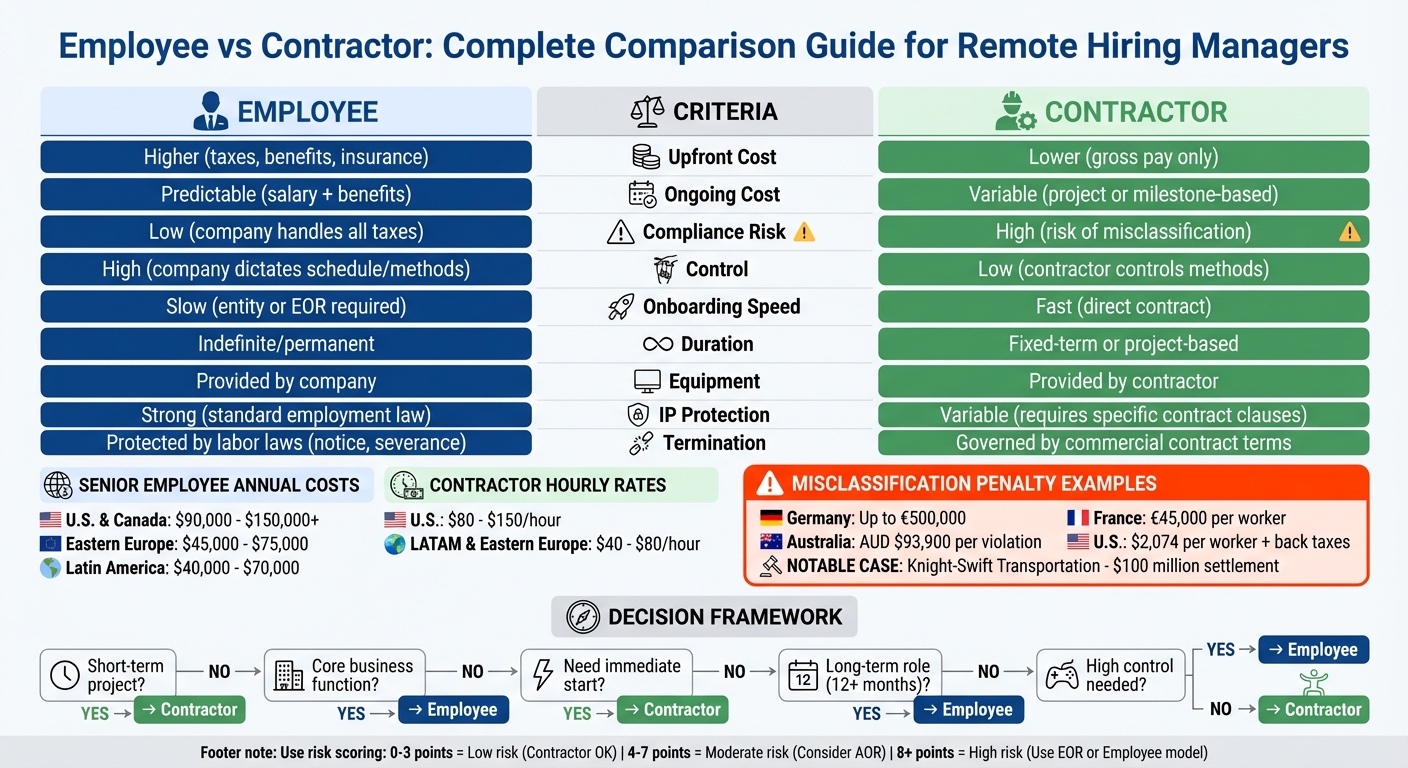
Employee vs Contractor Comparison: Costs, Risks, and Compliance Factors for Remote Hiring
This framework helps weigh factors like budget, speed, control, and compliance when deciding between hiring an employee or a contractor. Making the wrong choice can lead to costly penalties, delays, or mismatched roles. Below, we break down key considerations to guide your decision-making process.
Budget and Total Cost of Hire
Contractors often appear more affordable upfront since you only pay their gross fees - no benefits, payroll taxes, or insurance are required. However, misclassification risks can lead to hefty penalties. For instance, in Australia, violations can result in backdated payroll taxes, unpaid benefits, and fines that sometimes exceed $54,000 per infraction [5].
Employees, on the other hand, come with higher upfront costs. These include taxes, benefits, and equipment, but they also bring legal certainty and full operational control. For long-term or essential roles, the employee model minimizes compliance risks and prevents contractor arrangements from unintentionally evolving into employment-like relationships over time [3].
"Hiring contractors provides multiple benefits - the flexibility to hire beyond borders, customize employment terms without long-term commitments, and leverage cost savings to strategically drive diverse product innovation."
For international employees, you'll need either a local entity or an Employer of Record (EOR), which adds time and expense. In contrast, contractors can be onboarded quickly with a simple service agreement, making them ideal for short-term or specialized roles. However, if the position involves consistent monthly payments, deep integration into your operations, or an indefinite timeline, the contractor model may become a compliance risk.
Time-to-Hire and Onboarding Complexity
Cost is just one part of the equation - speed and onboarding complexity also matter. Contractors are faster to bring on board. With a straightforward service agreement, they can often start within days, especially if they already have a registered business and tax setup. This makes contractors a great fit for urgent or seasonal projects, as well as for testing out a new role before committing to full-time employment.
Hiring employees takes longer. If you're expanding into a new country, you'll need to set up a local entity or work with an EOR, which can take several weeks or months. You'll also need to navigate local labor laws, draft compliant contracts, and establish payroll systems. While this process is slower, it’s worthwhile for roles that require ongoing collaboration, are central to your business, or demand close integration with your team.
For contractors, you'll need to collect tax forms like the W-8BEN (for U.S. companies hiring internationally) to avoid the IRS's default 30% withholding rate [3]. For employees, these tax processes are handled automatically through payroll, though the initial setup takes more time.
The table below highlights the key differences between hiring an employee and a contractor:
Employee vs Contractor Comparison Table
| Criteria | Employee | Contractor |
|---|---|---|
| Upfront Cost | Higher (taxes, benefits, insurance) | Lower (gross pay only) |
| Ongoing Cost | Predictable (salary + benefits) | Variable (project or milestone-based) |
| Compliance Risk | Low (company handles all taxes) | High (risk of misclassification) |
| Control | High (company dictates schedule/methods) | Low (contractor controls methods) |
| Onboarding Speed | Slow (entity or EOR required) | Fast (direct contract) |
| Duration | Indefinite/permanent | Fixed-term or project-based |
| Equipment | Provided by company | Provided by contractor |
| IP Protection | Strong (standard employment law) | Variable (requires specific contract clauses) |
| Termination | Protected by labor laws (notice, severance) | Governed by commercial contract terms |
This table can help you align your hiring strategy with your business needs. Contractors are a great choice for short-term, specialized projects requiring speed and flexibility. For core roles that demand long-term collaboration and control, employees are a safer, more compliant option - even if the upfront costs are higher.
Hiring Strategies by Company Size
Building on the decision framework above, here’s how you can align remote hiring practices with your company’s size and risk tolerance.
Startups: Balancing Speed and Compliance
Startups often need to move quickly, especially when hiring internationally. Bringing on contractors from countries like Poland or Argentina in just a few days can help you tap into specialized talent while keeping overhead low. Plus, asynchronous work across time zones can keep your projects running around the clock [5].
But there’s a catch - moving too fast can lead to compliance risks. If you start dictating a contractor’s work hours, provide company equipment, or demand exclusivity, you could unintentionally cross the line into an employer-employee relationship, which comes with legal and financial penalties.
Tips for startups:
- Use milestone or project-based billing to avoid creating a relationship that resembles a salary arrangement [2].
- Collect the necessary tax forms, like the W-8BEN, during onboarding to steer clear of IRS withholding issues [3].
SMBs: A Hybrid Approach
Small to medium businesses often benefit from a mix of contractors and full-time employees. Contractors can handle short-term or seasonal needs - think marketing campaigns or specific development projects - while employees focus on core, long-term business functions that require deeper collaboration [1].
However, SMBs face challenges when contractor roles evolve. For instance, a contractor initially hired for a project might start attending team meetings regularly or receive company equipment. These changes can blur the lines and may lead regulators to view the arrangement as employment. In fact, countries like Spain, Italy, and the Netherlands are increasingly presuming long-term contractors to be employees as of 2026 [2].
Tips for SMBs:
- Perform quarterly classification audits using tools like the ABC Test or Economic Realities Test [4].
- If a contractor’s role becomes central to your business or includes managerial duties, transition them to an employee to avoid misclassification [2].
- Pay close attention to regional differences, like provincial or worker status variations in Canada or the UK [5].
Mid-Market: Prioritizing Compliance
As companies grow and operate in multiple countries, compliance becomes a top priority. The risks associated with misclassifying workers - and the financial fallout - are much larger at this scale. For example, Nike faced over $530 million in potential tax fines due to misclassified temporary workers [7], and Knight-Swift Transportation paid $100 million to settle claims involving 20,000 drivers misclassified as independent contractors [1].
At this stage, the focus shifts from speed to legal certainty. For roles that are long-term or critical to your business, mid-market companies should consider using Employer of Record (EOR) or Agent of Record (AOR) services. These models handle payroll, benefits, and taxes, eliminating the need to set up a local entity - a process that could take months and cost tens of thousands of dollars [1].
Tips for mid-market companies:
- Transition contractors to full-time employees if their role lasts over 12 months or becomes integral to your business operations [2].
- Choose EORs with established local entities to ensure accountability and transparent pricing [1].
- For high-risk regions, start with the employee model from day one to minimize exposure [2].
These tailored strategies help lay the groundwork for understanding remote hiring costs and compliance tools, which will be explored in the next sections.
Remote Hiring Costs in 2026
Getting a clear picture of hiring costs is essential to avoid misclassification risks and ensure compliance. Costs can differ significantly depending on the region and whether you’re hiring employees or contractors.
Cost Benchmarks by Region
For senior employees, total annual compensation - which includes benefits like health insurance, pensions, and paid time off - varies widely:
- U.S. and Canada: $90,000 to $150,000+
- Eastern Europe (e.g., Poland, Romania, Bulgaria): $45,000 to $75,000
- Latin America (e.g., Argentina, Colombia, Mexico): $40,000 to $70,000
When it comes to contractors, the costs are invoiced as gross amounts without deductions for taxes, benefits, or equipment. For example:
- U.S. contractors: $80 to $150 per hour
- LATAM and Eastern Europe contractors: $40 to $80 per hour, depending on the complexity of the role and market demand[1][10].
Now, let’s dive into the key factors that shape these costs and how they can influence your hiring strategy.
Factors That Affect Hiring Costs
Several elements play a role in determining your overall hiring expenses in 2026. These include seniority, urgency, role complexity, and worker classification.
- Seniority: Senior roles demand higher compensation, often including added benefits like equity, bonuses, or statutory extras. For instance, in Germany, senior employees may expect a 13th or even 14th-month salary as part of their compensation package[9].
- Urgency: Tight deadlines often lead companies to rely on services like an Employer of Record (EOR) or Agent of Record (AOR). These providers handle payroll, taxes, and benefits in foreign countries, reducing compliance risks but adding service fees[2].
- Role Complexity: The more integral a role is to your business and the more supervision it requires, the higher the likelihood that regulatory authorities will classify it as an employee role. This leads to mandatory protections like overtime pay, minimum wage enforcement, and termination costs[1][2].
- Worker Classification: This is the most significant factor. Employees require payroll taxes, social contributions, and benefits, while contractors are paid gross amounts without those obligations. Misclassification can lead to hefty fines, retroactive taxes, and back-pay obligations, with some penalties exceeding $100 million.
"Treat a worker like an employee, and eventually, regulators will see that worker as an employee - even if you never intended to create that relationship." - Pedro Barros, Remote[1]
Regional Cost Comparison Table
Here’s a breakdown of costs by region, along with key factors that influence them:
| Region | Employee Annual Cost | Contractor (Hourly Rate) | Key Cost Factors |
|---|---|---|---|
| U.S. / Canada | $90,000 – $150,000+ | $80 – $150/hour | High statutory costs, competitive salaries, employer-paid health insurance |
| Eastern Europe | $45,000 – $75,000 | $40 – $80/hour | Lower living costs, mandatory pension contributions, transport vouchers (Poland)[9] |
| Latin America | $40,000 – $70,000 | $40 – $80/hour | Cost-effective; includes 13th-month salary (Brazil) and regional adjustments[9][10] |
It’s also worth noting that termination costs for employees vary greatly depending on the region. For example, while the U.S. allows "at-will" employment for easier terminations, many other countries require notice periods and severance pay. These obligations don’t apply to contractors, making them a more flexible option in some cases[14][9]. However, misclassification risks remain a critical concern, as penalties can include retroactive taxes, fines, and back-pay for benefits, with some jurisdictions even holding company directors accountable[2].
Practical Tools for Hiring Managers
Building on the insights about costs and compliance, here are some practical tools to help hiring managers make informed worker classification decisions.
Global Workforce Risk Checklist
A global workforce risk checklist is a structured way to assess the legal and tax status of international workers before hiring them. Think of it as your compliance safety net, showing tax authorities that you've made a "good-faith" effort in classifying workers correctly if questions arise [2].
Here’s how it works:
| Risk Factor | High Risk (3 Points) | Moderate Risk (1 Point) | Low Risk (0 Points) |
|---|---|---|---|
| Work Schedule | Fixed hours set by company | Shared flexibility | Contractor sets own hours |
| Payment Type | Fixed monthly "salary" | Mixed/Retainer | Project or milestone-based |
| Tools/Systems | Company-provided laptop/email | Shared access | Contractor-owned tools |
| Duration | Indefinite/Open-ended | Long-term with renewals | Fixed-term/Defined scope |
Using a scoring system helps make decisions clear-cut. A total score of 0–3 points usually indicates low risk, meaning a direct contractor agreement is likely fine. Scores of 8 or more? That’s high risk - you might need to explore options like an Agent of Record (AOR) or Employer of Record (EOR) [2].
"Contractor misclassification risk is accelerating globally in 2026, driven by tighter enforcement, expanded data sharing between tax authorities, and the normalization of cross-border remote work." - Joseph Elegbua, Transformify [2]
Key actions to reduce risks:
- Collect tax forms upfront. For U.S. companies hiring internationally, ensure you collect Form W-8BEN (for individuals) or W-8BEN-E (for entities) during onboarding. Waiting until year-end can lead to a default 30% withholding tax [3].
- Avoid salary-like payments. Stick to project-based or milestone payments rather than fixed monthly or bi-weekly schedules. This reinforces the worker’s financial independence and reduces misclassification risks [2].
- Limit integration into your company. Avoid including contractors in internal organizational charts, company events, or performance improvement plans (PIPs). These actions can blur the line between contractor and employee [2][6].
- Require contractor-owned tools. Let contractors use their own equipment. Providing company laptops or software licenses often signals employment status in many regions [6][3].
Once you’ve scored the risks, the next step is to use a decision tree to finalize the hiring model.
Worker Classification Decision Tree
This decision tree translates your checklist score into a clear classification model. It’s an audit-ready framework tailored to local labor and tax laws [2].
2026 Risk Scoring Framework
| Risk Level | Score | Recommended Action |
|---|---|---|
| Low Risk | 0–3 points | Proceed with Direct Contractor Agreement |
| Moderate Risk | 4–7 points | Review structure; consider Agent of Record (AOR) |
| High Risk | 8+ points | Use Employer of Record (EOR) or full employment model |
This framework also considers country-specific compliance tests. For instance, the U.S. applies the IRS Common Law Test, the UK uses IR35/CEST, and Germany emphasizes economic dependence. Each country has its own rules and enforcement priorities [2][3].
Why this matters:
In February 2021, the UK Supreme Court ruled that Uber drivers must be classified as "workers" instead of independent contractors, granting them rights like minimum wage and paid holidays after a five-year legal battle [6]. Similarly, Swift Transportation faced over $100 million in damages after misclassifying 20,000 workers as independent contractors in a decade-long court case [6].
Steps to stay compliant:
- Document your rationale. Keep detailed records of your classification decisions and proof of the contractor’s independent business activities (e.g., business registration, website, or evidence of other clients) [2][3].
- Review regularly. Contractor roles can shift over time. Perform reviews every 6–12 months to ensure their status hasn’t evolved into something more employee-like [3].
- Use localized tools. Tools like the UK’s CEST or Australia’s ATO tool can help you align with local regulations [2][3].
Here’s a quick look at regional risk levels:
| Country / Region | Risk Level | Primary Compliance Test |
|---|---|---|
| United States | High | IRS Common Law Test |
| United Kingdom | High | IR35 / CEST |
| Germany | Very High | Economic dependence |
| France | Very High | Legal subordination |
| Brazil | High | Personal service & continuity |
| India | Medium-High | Control and integration |
Worker classification isn’t a one-time task. As your business grows and roles evolve, you’ll need to revisit these classifications to stay aligned with regulations. By 2026, tax authorities will increasingly collaborate across borders to track unpaid payroll taxes and social contributions [2].
"Worker classification isn't determined by what you call someone in a contract. It's determined by how they actually perform the work, particularly in the eyes of that country's authorities." - Rebecca Hosley, Content Specialist, RemoFirst [9]
Bottom line: Use the checklist to assess risk, rely on the decision tree for guidance, and ensure your documentation is thorough and up-to-date. Regular reviews will help you adapt to changes and avoid compliance issues as roles evolve.
Why Specialized Recruitment Matters in 2026
Why Generalist Hiring Fails
In 2026, the complexities of cross-border remote work have rendered generalist hiring approaches ineffective. A one-size-fits-all contract simply can't keep up with the intricate regulatory demands of international employment. Tax authorities now collaborate globally to track unpaid payroll taxes and scrutinize not just the terms of a contract, but how work is actually performed [2].
For example, employment laws differ dramatically between regions. In the U.S., California enforces the ABC test for worker classification, while the UK applies IR35 regulations, and Germany uses an "Economic Dependence" standard [2][7]. These differences mean that what’s acceptable in one country might be illegal in another. Companies that fail to address these nuances risk steep fines, back taxes, and legal battles. High-profile cases like Nike’s $530 million tax exposure and Uber’s $8.4 million settlement highlight the financial stakes [7].
Additionally, generalist hiring often overlooks risks tied to corporate tax liabilities. When contractors perform core business functions or have the authority to sign contracts, they can inadvertently expose companies to additional taxes. This is especially problematic in jurisdictions where long-term contractor relationships are increasingly viewed as employment by regulators [2].
How Specialization Improves ROI and Retention
Specialized recruitment agencies, such as RemotelyTalents.com, tackle these challenges head-on by integrating compliance into the hiring process from the start. They craft contracts tailored to local labor laws, ensuring alignment with country-specific requirements like mandatory benefits - examples include 13th-month pay, transport vouchers, and meal allowances [9][10]. These measures not only reduce compliance risks but also boost employee retention and enhance overall ROI.
"Hiring contractors provides multiple benefits - the flexibility to hire beyond borders, customize employment terms without long-term commitments, and leverage cost savings to strategically drive diverse product innovation." - Meghan Watchorn, Head of Growth, VanHack [5]
Specialized agencies streamline costs by consolidating insurance, tax, and payroll processes into a single, audit-ready system [10]. For instance, RemotelyTalents.com offers a flat monthly fee starting at $1,000, which includes a 90-day replacement guarantee, senior-level recruiters, and Slack-based communication with weekly progress updates. Most placements are completed within 5–7 weeks, drawing from a pool of over 10,000 pre-vetted candidates across Europe, Latin America, and North America.
The benefits are clear. Specialized recruitment eliminates hidden expenses like failed international payments - averaging $12 per transaction - and late payments, which affect 44% of European workers [7][10]. As the gig economy now represents up to 12% of the global workforce, penalties for worker misclassification are escalating. Specialized agencies not only help companies avoid fines but also provide a scalable, audit-ready hiring framework [2].
This emphasis on specialized recruitment naturally leads into assessing the best hiring strategies using a detailed checklist and decision tree.
Where to Hire: Comparing Recruitment Options
Finding the right recruitment approach is key to managing remote hiring risks while keeping costs, speed, and compliance in check.
Recruitment Options Comparison
When building remote teams, hiring managers generally consider four main options: in-house recruiting, freelance platforms, referrals, and specialized agencies. Each comes with its own balance of costs, speed, and compliance risks.
In-house recruiting gives you the most control but demands significant internal resources. You'll need dedicated legal, HR, and finance teams to handle international contracts, which makes this option feasible only if you're hiring in one or two countries with an established presence. However, directly managing contracts can lead to costly mistakes - between 10% and 30% of employers misclassify workers, risking fines up to $54,000 per violation in Australia, €45,000 per worker in France, and as much as €500,000 in Germany [15][8].
Freelance platforms provide quick access to specialized talent and allow flexible scaling. But compliance is entirely your responsibility. Failed international payments cost an average of $12 per transaction [7], and without automated tax form collection (like W-8BEN for non-U.S. residents), the IRS may impose a default 30% withholding requirement [3]. While these platforms are great for short-term, task-based projects, they pose significant risks for longer-term or core roles.
Referrals leverage local networks, offering trust and familiarity. International contractors often recommend skilled professionals who can help with market expansion [5]. While referrals are reliable for finding niche talent, they don’t solve the legal and tax compliance issues that come with cross-border hiring. You’ll still need localized contracts, intellectual property protections, and proper documentation to stay audit-ready.
Specialized agencies operating as Contractor of Record (CoR) or Agent of Record (AOR) shift the legal burden away from your company. They handle onboarding, localized contracts, multi-currency payments, and automated tax form collection across regions like Europe, Latin America, and North America [3][8][15]. Companies with strong onboarding processes see 82% higher new hire retention and a 70% boost in productivity [15]. For example, in 2025, Lean Technologies used RemotePass to onboard employees and contractors across the European Union. Wendy Sfeir, Head of People and Talent, described the experience as seamless, allowing the company to grow without navigating the complexities of individual EU labor laws [7].
| Recruitment Option | Cost | Speed | Compliance Support | Best For |
|---|---|---|---|---|
| In-House | High (Overhead) | Slow | Manual/Internal | 1-2 countries with local entities |
| Freelance Platforms | Low (Initial) | Very High | Low/None | Short-term, non-core tasks |
| Referrals | Low | Medium | None | Trusted niche roles |
| Specialized Agency (CoR/AOR) | Balanced/Transparent | High | High (Automated) | Compliant global scaling in Europe, LATAM, NA |
Curious about how RemotelyTalents.com fits into this landscape? Let’s break it down.
Why RemotelyTalents.com

After reviewing the options, it’s clear why RemotelyTalents.com stands out as a solution for global remote hiring.
RemotelyTalents.com is a specialized recruitment agency with expertise in Europe, Latin America, and North America. It addresses the compliance challenges that in-house teams and freelance platforms often struggle with, offering three standout features: flat, transparent pricing, localized contract expertise, and automated compliance tools.
Transparent, flat-fee pricing removes hidden costs and currency conversion hassles. RemotelyTalents.com offers subscription-based recruitment plans starting at $1,000 per month. The On-Demand plan costs $1,450 per month per open role (cancel anytime), while the Partner plan is $1,000 per month with a 12-month commitment. Both plans come with a 90-day replacement guarantee, senior-level recruiters, and Slack-based weekly updates. Placements are typically completed within 5–7 weeks, drawing from a pool of over 10,000 pre-vetted candidates.
"Many U.S. clauses in commercial contracts are either invalid or carry a completely different meaning under European law." - Stephan Grynwajc, International Lawyer [15]
RemotelyTalents.com's senior recruiters ensure contracts comply with local labor laws and include strong intellectual property protections. The platform also automates tax form collection (like W-8BEN/W-9) during onboarding, reducing audit risks and avoiding the IRS's 30% withholding requirement [3].
For hiring managers navigating complex international regulations, RemotelyTalents.com simplifies the process by consolidating insurance, tax, and payroll management into one system. With over a decade of experience and more than 250 satisfied clients, the platform specializes in roles across Marketing & eCommerce, IT/Data/Engineering, Operations & VAs, and Finance & Accounting. This focused approach helps companies build efficient, compliant teams without the legal headaches.
Conclusion
Key Takeaways
Managing remote hiring misclassification risk requires more than carefully worded contracts - it’s about how you manage the working relationship. Studies show that 10% to 30% of employers misclassify workers [15], and regulators focus on factors like behavioral control, financial control, and the clarity of the relationship - not the employer's intent [1][14]. By 2026, increased data sharing between tax authorities will make cross-border hiring even more vulnerable to audits [2].
The financial stakes are high. For example, Swift Transportation faced a $100 million payout to 20,000 misclassified workers after nearly a decade of legal proceedings [1]. In Germany, fines can reach up to €500,000 per case [8], and in the U.S., intentional violations can result in 100% back tax liabilities [8]. To protect your business, maintaining detailed, country-specific documentation is critical when facing audits [2].
Choosing the right engagement model is essential for reducing tax and misclassification risks. Direct hire is suited for short-term, low-risk projects. For long-term, core roles, an Employer of Record (EOR) ensures compliance. Meanwhile, Contractor of Record (CoR) or Agent of Record (AOR) models are ideal for managing freelancers, transferring the legal responsibility away from your company [8][15].
Next Steps: Free Risk Audit
Given these risks, it’s crucial to evaluate your processes now. If you're hiring remote talent in Europe, Latin America, or North America, consider scheduling a free remote hiring risk audit with RemotelyTalents.com. This audit helps identify contractor misclassification issues, uncovers regional tax exposure, and ensures your documentation is prepared for regulatory reviews.
RemotelyTalents.com provides flat-fee recruitment starting at $1,000/month, with most hires completed in 5–7 weeks. They offer a 90-day replacement guarantee and access to over 10,000 pre-vetted candidates across fields like Marketing, IT, Engineering, Operations, and Finance. Their senior recruiters handle localized contracts and automate tax form collection (e.g., W-8BEN, W-9). Take action now to safeguard compliance and protect your business.
Related Blog Posts
Read also



Ready to hire without salary-based agency fees?
Book a free 30-minute consultation. We’ll review your role, timeline, and hiring goals, then show you how our fixed-fee remote search works.