Remote Hiring Timeline by Role: Marketing, Finance, Sales, and Operations (2026)


Remote hiring takes longer than you think. In 2026, the average time to fill a role has increased to 41 days, up from 33 days in 2021. For Marketing, Finance, Sales, and Operations, hiring timelines vary widely based on role complexity, skill requirements, and internal processes. Here's what you need to know:
- Marketing: 4–6 weeks. Faster due to a large talent pool and high remote compatibility, but slowed by portfolio reviews.
- Finance: 6–9 weeks. Longest due to technical assessments, certifications, and compliance checks.
- Sales: 5–8 weeks. Medium timeline with delays from quota verification and role-play scenarios.
- Operations: 5–7 weeks. High remote compatibility but slowed by systems and process assessments.
Key delays come from unclear job descriptions, lengthy interviews, and slow feedback loops. To speed up hiring, focus on clear role definitions, fast decision-making, and consider using recruiting agencies that cut sourcing time by up to 50%.
Quick Comparison
| Role | Avg. Timeline | Main Challenges |
|---|---|---|
| Marketing | 4–6 weeks | Portfolio reviews, creative assessments |
| Finance | 6–9 weeks | Certifications, compliance checks |
| Sales | 5–8 weeks | Quota verification, role-play scenarios |
| Operations | 5–7 weeks | Systems and process mapping assessments |
Efficient hiring saves time, reduces costs, and avoids overburdening teams. If you're struggling with delays, consider specialized agencies to fill roles faster and more effectively.

Remote Hiring Timeline Comparison by Role 2026: Marketing, Finance, Sales, Operations
Hiring Timelines by Role: Marketing, Finance, Sales, and Operations
This section breaks down the typical hiring timelines for remote roles in Marketing, Finance, Sales, and Operations, offering benchmarks and insights into what drives or delays the process.
Marketing Roles: 4–6 Weeks
Marketing positions generally have the shortest hiring timelines, thanks to a large applicant pool and the widespread adoption of remote or hybrid work setups - about 70% of roles fall into these categories[6]. This makes it easier to fill pipelines and move quickly to interviews.
However, the process slows during the assessment phase. Reviewing portfolios, creative work, and campaign metrics takes time. For instance, a content marketing manager candidate might need to submit writing samples, SEO strategies, and traffic growth data. These steps help ensure remote candidates have the necessary creative and analytical skills.
Finance Roles: 6–9 Weeks
Finance roles take the longest to fill, typically requiring 6–9 weeks. The extended timeline stems from rigorous technical assessments, such as Excel modeling and financial forecasting, along with compliance knowledge checks (e.g., HIPAA, SOX, GDPR). Certification verification further adds to the process[6].
Only 45% of finance roles offer remote options, which narrows the candidate pool compared to marketing[6]. Additional delays often come from background check services and references, especially for roles involving sensitive data or strict regulatory demands.
Sales Roles: 5–8 Weeks
Sales positions fall in the middle range, with hiring timelines of 5–8 weeks. While not as lengthy as finance, the process involves validating performance claims, such as quota achievements and CRM data. Role-play scenarios are often used to evaluate how candidates handle objections or challenging customer interactions[6].
For remote sales roles, written communication assessments are common. These ensure candidates can effectively work in asynchronous environments where emails and messages replace face-to-face interactions. Verifying quota performance across regions and sales techniques adds complexity, requiring tailored approaches.
Operations Roles: 5–7 Weeks
Operations roles are typically filled within 5–7 weeks, aided by strong remote compatibility and an ample pool of process-oriented candidates[6]. Tasks like managing workflows and coordinating support translate well to distributed teams, broadening the talent pool.
Delays usually occur during systems assessments. Candidates are tested on their experience with key tools and their ability to map processes across teams. Demonstrating remote collaboration skills often requires additional interview rounds[6].
Timeline Comparison Table
| Role Family | Avg. Timeline | Primary Speed Drivers | Main Delay Factors |
|---|---|---|---|
| Marketing | 4–6 Weeks | High applicant volume; 70% remote/hybrid availability | Portfolio reviews; creative ROI case studies |
| Operations | 5–7 Weeks | High remote compatibility; process-driven tasks | Systems assessment; process mapping |
| Sales | 5–8 Weeks | Clearly defined performance metrics | Quota verification; role-play scenarios |
| Finance | 6–9 Weeks | Specialized technical requirements | Compliance checks; certification verification |
sbb-itb-88a7fe6
What Affects Remote Hiring Speed
Knowing what slows down remote hiring can help you plan better and keep things moving efficiently. Three main factors influence how quickly you can fill a role: the complexity of the job, where you look for candidates, and how smoothly your internal processes run.
Role Complexity and Skill Requirements
The more specialized the role, the longer it usually takes to hire. For example, Finance and Operations positions often require certifications and technical assessments, such as CPA or CMA credentials, Excel modeling, or SOX compliance checks. These steps can stretch the hiring timeline to 6–9 weeks [4].
Sales roles bring their own challenges. The pressure to avoid hiring the wrong person - like someone who interviews well but lacks the right skills - can make the process slower. Industry data shows that sales roles are among the hardest to fill because hiring mistakes can lead to lost revenue and unhappy customers [2].
On the other hand, Marketing roles are generally quicker to fill. They often emphasize consistent output over specialized qualifications. This has led to a rise in positions like "Marketing VAs" and content coordinators, roles designed for fast execution [3][4].
Next, let’s look at how geography impacts hiring timelines.
Regional Talent Supply
The region where you source candidates can significantly influence hiring speed. For North American companies, Latin America is a popular choice for roles in Marketing, Sales, and Operations. The time zone alignment and a growing pool of English-speaking professionals make communication smoother and reduce delays caused by asynchronous workflows [3][4].
"The companies that see remote hiring as a strategic advantage, not a temporary fix are the ones building stronger, more resilient teams for the future." - Claudia Real, CEO, There is Talent [3]
Cost differences also matter. For instance, in 2026, average monthly costs in Latin America were estimated at $1,739, compared to $2,974 in the United States [7]. This cost advantage allows companies to tap into larger talent pools without waiting endlessly for the perfect candidate.
Other regions also have their strengths. South Africa has become a go-to for customer support and coordination-heavy roles, while Southeast Asia excels in high-volume, back-office functions. For technical roles like DevOps or QA, Asia offers deep talent pools and efficient hiring processes. Meanwhile, North America and Western Europe are increasingly focused on senior leadership and highly specialized roles, which can lead to longer hiring cycles and higher costs if used for execution-heavy positions [3][7].
While external factors like geography play a role, internal inefficiencies can cause even bigger delays.
Internal Process Delays
Internal bottlenecks are often the biggest reason for slow hiring. Common issues include unclear job requirements, lengthy approval chains, and too many interview rounds. For example, if compensation structures or time zone requirements aren’t clearly defined upfront, you could waste weeks reviewing unqualified candidates [2].
Publishing On-Target Earnings (OTE) upfront for sales roles can reduce hiring timelines by 20–40% [2]. Scheduling challenges across time zones are another major hurdle. Using automated scheduling tools that handle time zone conversions and let candidates book directly can save valuable time [5].
The interview process itself can also drag things out. Best practices recommend limiting interviews to 3–4 rounds [2], but companies often add unnecessary steps due to committee delays or waiting for more candidates. This slows everything down.
"Global hiring works when you build systems around execution. Without structure, you don't scale, you just multiply chaos." - Paul Urwin, CFO, There is Talent [4]
Timely feedback is essential. If your team takes more than 48 hours to provide post-interview feedback, you risk losing top candidates to competitors who move faster [2]. One way to keep things moving is to stack screening calls and debriefs on the same day. Since knowledge workers spend about 19% of their time searching for information across internal tools [4], streamlining decision-making is critical.
Efficient companies also block out fixed interview times on hiring managers’ calendars and empower them to make offers without unnecessary approval delays. Standardized scorecards that include remote-specific skills like clear communication and self-direction can further speed up decision-making [4].
Cost Impact of Longer Hiring Timelines
Every day a position remains unfilled leads to lost revenue, delayed projects, and added pressure on existing teams. These effects, outlined earlier, highlight why understanding the financial toll of vacancies is crucial. This knowledge can guide decisions about when to bring in external recruiting support.
Vacancy Cost Calculation
To estimate the daily cost of a vacancy, divide the role's annual contribution by 365 and multiply by the number of days the position remains open. For instance, if a sales role carries a $500,000 annual quota, the daily cost of leaving it vacant is about $1,370. Technical roles can amplify these costs through delayed product launches or increased customer churn.
"What if every day without that senior backend engineer is costing you three feature releases, two frustrated customers, and one burned-out engineering manager who's threatening to quit?" - Mariana Medeiros, Marketing Lead at Remote Crew [1]
Vacancies also burden existing teams, forcing them to take on extra responsibilities. This can lead to reduced morale and burnout, which, in turn, may cause further resignations - extending the hiring cycle even further [1].
Once you understand these hidden costs, it's easier to weigh them against the expenses of managing recruitment internally versus using an external agency.
In-House vs. Agency Recruiting Costs
Recognizing the financial impact of vacancies underscores the importance of efficient hiring. While managing recruitment internally might seem cheaper, the associated costs can add up quickly. Companies often spend $6,500 to $8,000 annually on recruiting tools alone. Add to that the 20–30 hours hiring managers spend per mid-level role, which typically involves around 15 interviews [1][5].
Specialized recruitment agencies can streamline this process. They present pre-vetted candidates - often within 48 hours - and complete most hires within 5–7 weeks. For example, RemotelyTalents offers two plans: the On-Demand option at $1,450/month or the Partner plan at $1,000/month with a 12-month commitment. These plans include a senior recruiter, an account manager, and access to a database of over 10,000 candidates across Europe, Latin America, and North America. They also offer a 90-day replacement guarantee to reduce the risk of a mis-hire [5].
By cutting sourcing timelines by up to 50%, agencies can significantly reduce vacancy costs. For example, a sales role that takes 35–60 days to fill internally could be filled by an agency in just 7–28 days - eliminating over a month of vacancy expenses [2].
What Drives Total Recruitment Spend
Several factors can inflate recruitment costs, many of which are tied to longer hiring timelines. For instance, adding extra interview rounds requires more coordination, potentially adding 3–5 days per round. This also increases the chance of losing top candidates. Similarly, delayed feedback - taking more than 48 hours to respond after an interview - can lead to candidate drop-offs, forcing teams to restart the sourcing process and adding 2–4 weeks to the timeline [1].
Notice periods also play a role. While U.S.-based contractors can often start within days, employees in Europe typically require 1–2 months, and Brazilian hires may need up to 3 months to transition [1]. These delays extend the "time-to-start", further driving up vacancy costs.
Rushing to fill a role quickly can backfire.
"A mediocre engineer costs you money. A mediocre salesperson costs you opportunity" - Salesfolks [2]
The consequences of a poor senior hire - such as lost deals, strained client relationships, and team disruption - often outweigh the benefits of a quick hire. Agencies that use structured assessments and thorough vetting processes can cut mis-hires by up to 40% [5]. While this may extend the hiring process slightly, it’s a worthwhile trade-off for securing the right talent.
Planning Tools and Resources
Once you've identified the delays and costs tied to hiring, the next step is to craft a practical strategy for filling remote roles. Understanding the costs of delays is one thing, but creating an effective hiring plan is where the real challenge lies. Teams often underestimate the time required and overlook the coordination needed to move candidates through multiple stages. This can lead to missed deadlines, frustrated team members, and roles staying vacant for months.
The two frameworks below can help you set realistic timelines and prioritize which roles to fill first. They're tailored for remote hiring in Marketing, Finance, Sales, and Operations - fields where time zones, asynchronous workflows, and structured assessments add layers of complexity.
Hiring Timeline Checklist
This checklist outlines each stage of the remote hiring process with realistic time estimates based on 2026 industry data. The key is to map out your timeline before posting the job, not after candidates start losing interest.
- Kickoff & Role Definition (1–4 days): Finalize the job description, compensation details (including on-target earnings for sales roles), required time zone overlap, and industry background. Companies that clearly outline remote work expectations in job postings attract 33% higher-quality candidates [5].
- Sourcing & Outreach (5–21 days): Post on remote-focused job boards and use LinkedIn filters to find diverse candidates. Being transparent about compensation - like publishing OTE - can reduce the hiring timeline by 20–40% [2]. Competitive, upfront pay details speed up the process.
- Screening Interviews (5–10 days): Conduct screening calls in a concentrated period (3–5 days) to maintain momentum. Focus on communication skills and prior remote work experience.
- Deep-Dive Interviews & Assessments (5–14 days): Use structured interview questions with clear rubrics. For remote roles, include a paid trial project (4–8 hours) to test asynchronous collaboration and self-management. These structured assessments can reduce mis-hires by up to 40% [5].
- Reference Checks & Offer (2–7 days): Always check references for remote hires to confirm reliability and adaptability. Aim to extend offers within 24–48 hours after the final interview to avoid losing top candidates to competitors.
- Pre-Start & Onboarding (7–30 days): Allow time for background checks, shipping equipment (2–3 days before the start date), and creating a 30-60-90 day onboarding plan. Companies with strong remote onboarding programs see 58% higher retention rates after three years [5].
Here’s how ideal timelines compare to realistic timelines for each stage:
| Stage | Ideal Timeline (Days) | Realistic Timeline (Days) |
|---|---|---|
| Kickoff & Role Definition | 1 | 1–4 |
| Sourcing & Outreach | 2–5 | 5–21 |
| Screening Interviews | 3–4 | 5–10 |
| Deep-Dive & Role Plays | 3–4 | 5–14 |
| References & Offer | 2–3 | 2–7 |
| Pre-Start / Notice Period | 7–14 | 7–30 |
| Total | 18–30 Days | 35–60+ Days |
For roles like senior Sales or Finance positions, use the realistic timelines as your baseline since notice periods and reference checks often take longer. Once your timeline is set, the next step is determining which roles to prioritize using the Hiring Priority Matrix.
Hiring Priority Matrix
This framework helps allocate recruiting resources effectively across departments. Not all roles are equally urgent, and a hiring priority matrix can help you categorize positions based on their impact on execution, speed, and revenue [4]. It’s especially useful when hiring for multiple departments and balancing limited resources.
- Critical Priority: Roles with direct revenue impact or those that prevent major bottlenecks, like Sales (AE/SDR) or Operations Managers. Empty sales roles, for example, can result in lost revenue due to poor follow-up [4].
- High Priority: Positions that maintain customer retention and stability, such as Customer Support or Billing Assistants. These roles ensure the business runs smoothly and maintains trust [4].
- Medium Priority: Positions that support long-term growth, like Marketing Assistants or Content Coordinators. While important, these roles don’t have an immediate effect on revenue.
- Low Priority: General support or non-urgent roles, such as Administrative Assistants or Social Media VAs. These can wait until higher-priority positions are filled.
Before recruiting, use the matrix to evaluate all open roles. Identify which ones can be filled remotely and rank them by urgency [3]. This prevents spreading your recruiting team too thin and ensures focus on roles that drive the business forward.
"Global hiring works when you build systems around execution. Without structure, you don't scale, you just multiply chaos." - Paul Urwin, CFO, There is Talent [4]
The matrix also highlights the opportunity cost of leaving sales roles unfilled (lost revenue and missed pipeline opportunities) versus the operational cost of vacant engineering or admin roles [2]. Knowing which vacancies have the greatest impact allows you to allocate your budget and recruiter time where they matter most.
Why Specialized Recruiting Agencies Reduce Time-to-Hire
How Specialist Recruiters Accelerate Hiring
Specialized recruiting agencies can significantly cut down hiring timelines by addressing common in-house bottlenecks. These agencies often maintain pre-vetted talent pools sorted by role and region, allowing them to skip the lengthy sourcing phase and start presenting qualified candidates within days. For sales roles in particular, these agencies reduce the typical hiring time from an industry average of 35–60 days to just 7–28 days by launching outbound sourcing efforts immediately instead of waiting for inbound applications to trickle in [3][2].
Their use of structured evaluation frameworks is another time-saver. By employing fixed rubrics and role-specific assessments - like sales simulations for SDRs or asynchronous communication tests for remote roles - they streamline decision-making and reduce the risk of mis-hires by up to 40%. This approach is particularly effective for remote positions, where traditional interviews may fail to assess a candidate’s ability to work independently [2][5].
Regional expertise also plays a key role in speeding up the process. Agencies specializing in nearshore talent, especially recruitment firms in Latin America, ensure time zone alignment and smooth cultural integration. This expertise reduces delays in scheduling and onboarding, which are common pain points in in-house hiring. By managing the logistics of coordinating across time zones and following up with candidates, these agencies can reduce the interview burden for hiring managers by 20–40% [3][4][2].
| Role Type | Industry Average Time-to-Hire | Specialist Agency Time-to-Hire |
|---|---|---|
| SDR / BDR | 21–35 days | 7–14 days |
| SMB / Mid-Market AE | 28–45 days | 14–21 days |
| Enterprise AE | 45–70 days | 30–40 days |
| Sales Manager | 45–70 days | 28–40 days |
RemotelyTalents, for example, leverages these strategies to deliver faster and more efficient hiring outcomes for remote roles. You can schedule a free consultation to discuss your specific hiring needs.
Why RemotelyTalents Works for Remote Hiring
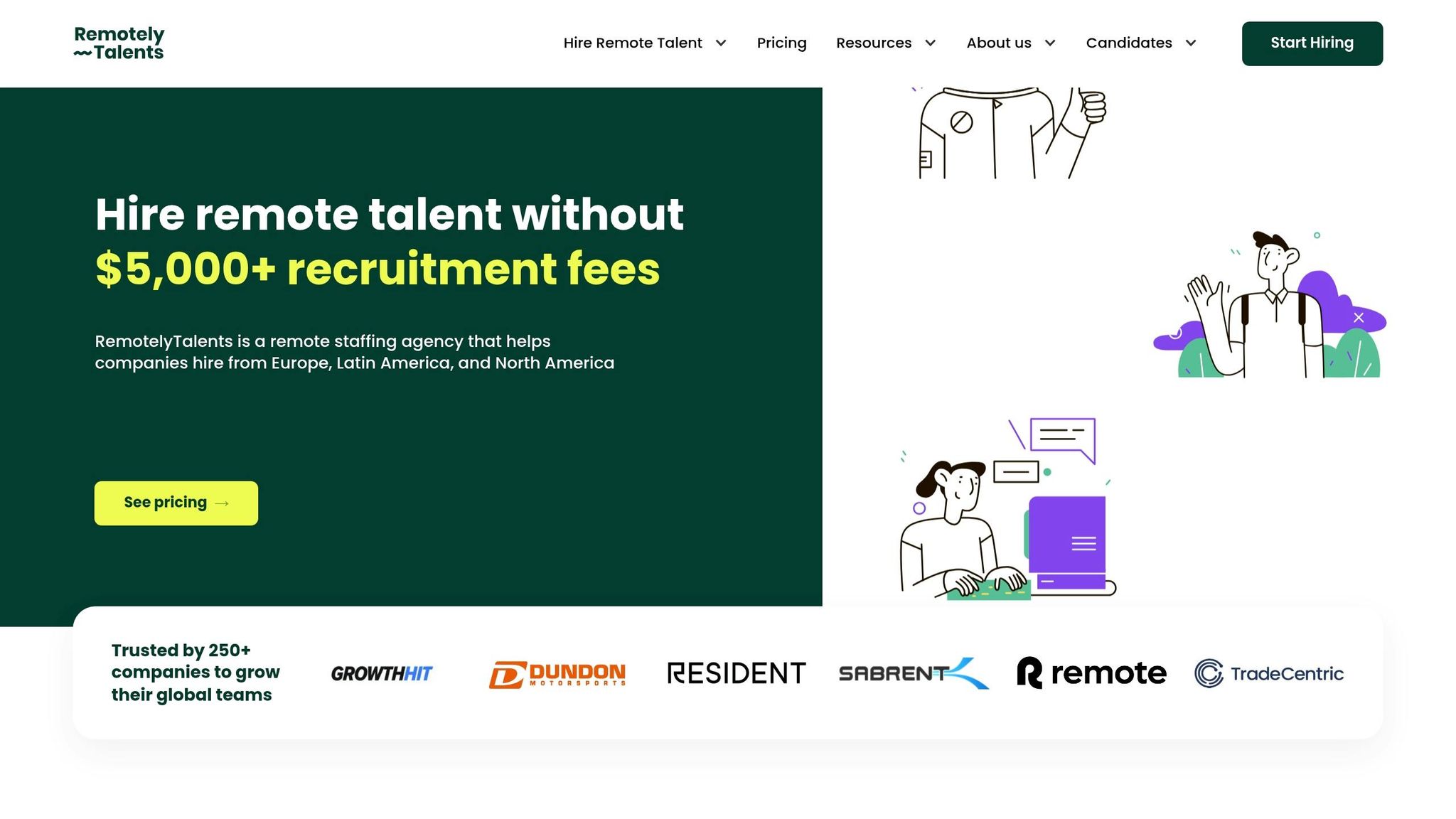
RemotelyTalents offers a subscription-based service starting at $1,000 per month (Partner Plan with a 12-month commitment) or $1,450 per month (On-Demand Plan with no long-term contract). Both plans include a 90-day replacement guarantee, senior-level recruiters, and account management via Slack with weekly updates. Most roles are filled within 5–7 weeks.
The agency boasts a database of over 10,000 pre-screened candidates specializing in areas like Marketing & eCommerce, IT/Data/Engineering, Operations & VAs, and Finance & Accounting. With recruiters based in Europe and Latin America, RemotelyTalents ensures time zone compatibility for U.S.-based businesses. Their decade of experience and a client roster of more than 250 companies demonstrate their ability to deliver results that many in-house teams struggle to achieve when hiring across multiple departments.
"The companies that see remote hiring as a strategic advantage, not a temporary fix are the ones building stronger, more resilient teams for the future." - Claudia Real, CEO, There is Talent [3]
This tailored approach highlights the value of specialized agencies in reducing hiring timelines while ensuring quality placements for remote teams.
Conclusion
Here’s a quick recap of what we’ve covered about remote hiring timelines and processes.
Main Takeaways
Remote hiring in 2026 can be predictable - as long as you plan around the complexity of the role and the speed of your internal processes. For example, Marketing roles typically close in 4–6 weeks, Finance in 6–9 weeks, Sales in 5–8 weeks, and Operations in 5–7 weeks. The difference between a 4-week hire and a 9-week hire often comes down to clear job definitions, fast feedback loops, and whether you’re sourcing candidates in-house or through specialized recruiters.
The biggest delays? They’re usually caused by internal bottlenecks, not a lack of talent. Things like unclear job descriptions, slow interview scheduling, and lengthy reference checks can drag out the process. Using structured scorecards instead of relying on "gut instincts" helps you make faster decisions and reduces the risk of losing top candidates to other offers.
Specialized recruiting agencies can cut sourcing time by up to 50% thanks to their pre-vetted talent pools and ability to handle the coordination work that often slows down in-house teams [2]. For businesses hiring across departments or expanding into regions like Latin America, this kind of support can lead to faster hires, lower costs from vacancies, and better candidate matches. Companies with distributed teams also scale up to three times faster than those relying solely on local hiring [3].
What to Do Next
If hiring remote talent in Marketing, Finance, Sales, or Operations is on your agenda, start by auditing your current process. Identify where delays happen or where candidates drop out and set clear role requirements and KPIs. Implement same-day or 48-hour feedback rules to keep things moving.
Consider a hiring timeline audit with RemotelyTalents to save time and effort. Their subscription-based recruiting starts at $1,000/month and offers a 90-day replacement guarantee. With most roles filled in 5–7 weeks, access to a database of 10,000+ candidates, and senior recruiters specializing in remote hiring across Europe, Latin America, and North America, they can help you turn hiring from a hurdle into a competitive edge. Whether you’re filling a single position or building a full remote team, having the right support can make all the difference.
Related Blog Posts
Read also



Ready to hire without salary-based agency fees?
Book a free 30-minute consultation. We’ll review your role, timeline, and hiring goals, then show you how our fixed-fee remote search works.